Linear optocoupler with analog compensation for isolation amplifier Market Insights
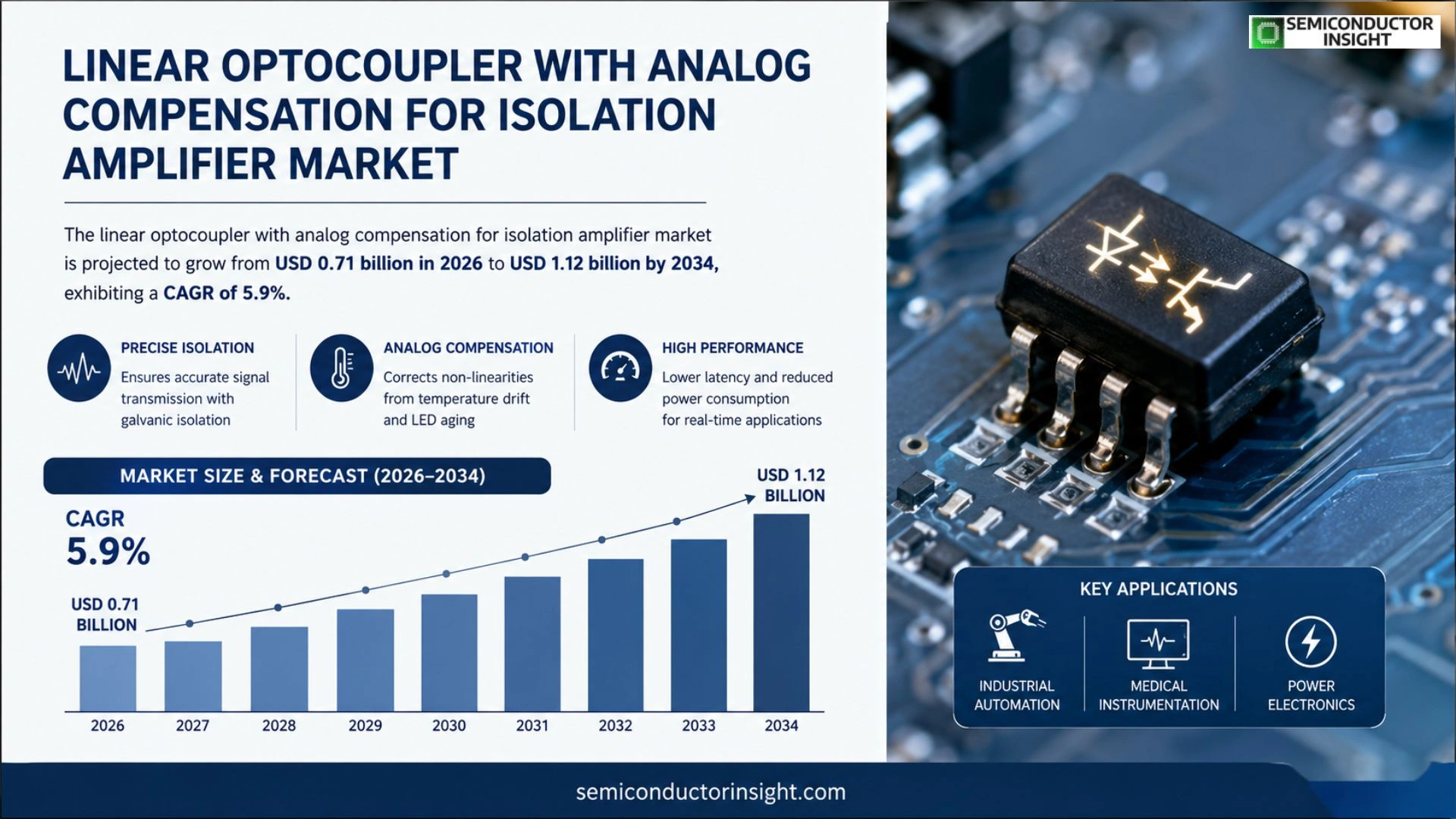
Global Linear optocoupler with analog compensation for isolation amplifier market size was valued at USD 0.68 billion in 2025. The market is projected to grow from USD 0.71 billion in 2026 to USD 1.12 billion by 2034, exhibiting a CAGR of 5.9% during the forecast period.
Linear optocouplers equipped with analog compensation provide precise galvanic isolation while preserving signal fidelity for high‑performance isolation amplifiers used in industrial automation, medical instrumentation, and power electronics. These devices combine a light‑emitting diode and a photodetector within a single package, employing analog feedback networks that correct non‑linearities caused by temperature drift or LED aging. Because they eliminate the need for digital conversion, they deliver lower latency and reduced power consumption compared with traditional digital isolators, making them attractive for applications demanding real‑time control and accurate measurement.
MARKET DRIVERS
Rising Demand for High‑Precision Isolation
Linear optocoupler with analog compensation for isolation amplifier Market is being propelled by the need for accurate signal transmission in safety‑critical environments such as automotive electric power steering and renewable energy converters. Manufacturers are prioritizing devices that deliver low offset voltage and minimal temperature drift, which directly supports system reliability.
Growth of Industrial IoT and Smart Factories
Industrial IoT deployments require robust galvanic isolation to protect low‑level sensor data from high‑voltage noise. Linear optocouplers with analog compensation provide the linearity needed for precise control loops, driving adoption across robotics, machine tools, and process automation.
➤ “Analog‑compensated linear optocouplers enable sub‑millivolt accuracy, making them the preferred choice for next‑generation motor‑drive and power‑converter designs.”
Regulatory trends emphasizing electromagnetic compatibility (EMC) and functional safety are further encouraging designers to select these components, ensuring compliance while maintaining performance margins.
MARKET CHALLENGES
Complexity of Integration and Calibration
Integrating linear optocouplers with analog compensation requires careful PCB layout and precise calibration routines. Small design teams often face steep learning curves, which can delay product development cycles and inflate engineering costs.
Other Challenges
Cost Sensitivity
Despite performance benefits, the higher unit price compared with traditional digital optocouplers can limit market penetration, especially in cost‑driven consumer electronics segments.
MARKET RESTRAINTS
Limited Supplier Base
Linear optocoupler with analog compensation for isolation amplifier Market is constrained by a relatively small number of qualified manufacturers, resulting in longer lead times and reduced bargaining power for end‑users. This concentration can also slow the introduction of incremental innovations.
MARKET OPPORTUNITIES
Emerging Applications in Renewable Energy
Renewable energy systems, particularly grid‑connected inverters and battery‑management modules, demand precise isolation to maintain power quality and safety. Linear optocouplers with analog compensation are uniquely positioned to meet these requirements, presenting a significant growth avenue for the market.
Linear optocoupler with analog compensation for isolation amplifier Market Trends
Increasing Demand for Precision Isolation in Industrial Automation
The market is experiencing a clear shift toward higher‑performance isolation solutions that maintain signal integrity while simplifying system architecture. Linear optocoupler with analog compensation for isolation amplifier Market participants are capitalizing on the need for precise galvanic isolation in harsh industrial environments, where temperature fluctuations and electromagnetic interference can degrade measurement accuracy. By integrating analog feedback networks, these devices correct non‑linearities caused by LED aging, delivering stable gain and low drift across a wide temperature range. This capability aligns with the trend of deploying smart sensors and edge‑computing nodes that require real‑time data without the latency penalties associated with digital isolators.
Other Trends
Rise of Low‑Latency Applications in Medical Devices
Medical instrumentation increasingly relies on fast, reliable signal transmission for patient monitoring and diagnostic imaging. Analog‑compensated optocouplers provide sub‑microsecond propagation delay, which is critical for closed‑loop control in infusion pumps and high‑resolution electrocardiogram systems. The reduced power consumption further supports battery‑operated portable devices, extending operational life while meeting stringent regulatory standards for safety and electromagnetic compatibility.
Adoption of Energy‑Efficient Designs in Power Electronics
Power electronics manufacturers are turning to analog compensation to meet efficiency targets in converters and motor drives. The elimination of digital processing stages lowers overall system power draw, helping manufacturers achieve higher overall efficiency ratings for renewable‑energy inverters and automotive power‑train modules. Additionally, the inherent low‑noise characteristic of analog‑compensated optocouplers supports precise current sensing, which is essential for fault detection and protective shutdown mechanisms in high‑voltage applications.
COMPETITIVE LANDSCAPE
Key Industry Players
Linear Optocoupler with Analog Compensation for Isolation Amplifier – Competitive Overview
The market is currently dominated by a few large semiconductor firms that have integrated analog‑compensated linear optocoupler technology into their isolation‑amplifier portfolios. Texas Instruments commands a sizable share by leveraging its extensive analog design expertise and broad manufacturing footprint, enabling cost‑effective solutions for industrial automation. Analog Devices follows closely, differentiating itself through high‑precision analog feedback architectures that address temperature drift and LED aging, positioning its offerings for medical instrumentation and power‑electronics applications. Both companies benefit from deep R&D pipelines and global distribution networks, which shape a market structure characterized by a clear leader–follower dynamic and high entry barriers for newcomers.
Beyond the Tier‑1 leaders, a range of niche and specialized players contribute significant innovation and address specific market segments. Broadcom and Vishay bring mature photodetector technologies that enhance signal fidelity, while ON Semiconductor and Infineon focus on ruggedized devices for harsh automotive environments. STMicroelectronics, NXP Semiconductors, and Renesas target low‑power, high‑density applications in consumer electronics. Additional contributors include Toshiba, Murata Manufacturing, Rohm Semiconductor, Microchip Technology, and Maxim Integrated, each offering unique analog‑compensation topologies or customized form factors that expand the competitive landscape and provide customers with diversified sourcing options.
List of Key Linear Optocoupler with Analog Compensation for Isolation Amplifier Companies Profiled
- Texas Instruments
- Analog Devices
- Broadcom
- Vishay Intertechnology
- ON Semiconductor
- Infineon Technologies
- STMicroelectronics
- NXP Semiconductors
- Renesas Electronics
- Toshiba Electronic Devices
- Murata Manufacturing
- Rohm Semiconductor
- Microchip Technology
- Maxim Integrated
Segment Analysis:
| Segment Category | Sub-Segments | Key Insights |
| By Type |
|
Current‑Mode Optocouplers
|
| By Application |
|
Industrial Automation
|
| By End User |
|
OEMs of Isolation Amplifiers
|
| By Functional Benefit |
|
Low Latency
|
| By Regulatory Requirement |
|
Safety Standards
|
Regional Analysis: Linear optocoupler with analog compensation for isolation amplifier Market
Automotive manufacturers in the United States and Canada are integrating linear optocouplers with analog compensation into electric vehicle power‑electronics, emphasizing high bandwidth and low offset voltage. This trend is mirrored in industrial controls where precision feedback loops demand superior isolation performance.
Stringent UL and IEC standards governing isolation voltage and electromagnetic compatibility drive the adoption of certified linear optocouplers. Compliance requirements encourage manufacturers to favor devices with proven analog compensation architectures.
Major semiconductor firms such as Texas Instruments, Analog Devices and ON Semiconductor dominate the North American supply base, offering product families tailored for high‑precision signal conditioning and isolation.
The region’s diversified supply chain, supported by domestic wafer fabs and robust logistics networks, mitigates disruptions and ensures consistent availability of linear optocoupler components.
Europe
European markets exhibit a keen focus on energy‑efficient solutions, prompting a gradual shift toward linear optocouplers with analog compensation in renewable energy converters and railway signaling. Industry consortia emphasize sustainability, driving design choices that minimize power loss while maintaining high isolation. Collaborative research programs across Germany, France and the Nordic countries foster incremental improvements in temperature stability and signal fidelity. Although adoption rates lag behind North America, the region’s strict EMC directives and growing smart‑grid deployments create a fertile environment for expanded market penetration.
Asia‑Pacific
Asia‑Pacific economies, led by China, Japan, and South Korea, are rapidly scaling production of advanced electronic systems, providing a substantial growth platform for Linear optocoupler with analog compensation for isolation amplifier Market. Consumer electronics and telecom infrastructure in the region demand compact, high‑performance isolation components, spurring local manufacturers to integrate these devices into power‑management ICs. Government incentives for semiconductor self‑reliance further accelerate R&D investment, while emerging standards in automotive electronics reinforce the need for reliable analog compensation techniques.
South America
In South America, market momentum is anchored primarily in Brazil’s expanding industrial automation sector. Local OEMs are modernizing legacy control systems, seeking linear optocouplers that offer precise analog compensation to improve process reliability. While the overall market size remains modest, increasing trade agreements and foreign direct investment are introducing higher‑grade semiconductor offerings, gradually elevating awareness of the benefits of advanced isolation solutions.
Middle East & Africa
The Middle East & Africa region presents niche opportunities driven by oil‑and‑gas instrumentation and emerging renewable projects in the Gulf states. Operators prioritize safety‑critical isolation, prompting selective adoption of linear optocouplers with analog compensation for harsh environment monitoring. In Africa, limited but growing telecommunications infrastructure encourages the use of robust isolation devices to protect sensitive signal paths, laying the groundwork for future market expansion as connectivity initiatives advance.
Report Scope
This market research report provides a comprehensive analysis of the Linear optocoupler with analog compensation for isolation amplifier Market , covering the forecast period 2026–2034. It offers detailed insights into market dynamics, technological advancements, competitive landscape, and key trends shaping the industry.
Key focus areas of the report include:
- Market Overview: The report begins with an overview outlining its current market scenario, key growth indicators, and industry transformation drivers. It discusses macroeconomic factors, demand–supply balance, regulatory landscape, and the strategic role of semiconductors in powering advancements across industries such as automotive, telecommunications, consumer electronics, and industrial automation.
- Market Size & Forecast: Historical data and future projections for revenue, unit shipments, and market value across major regions and segments.
- Segmentation Analysis: Detailed breakdown by product type, technology, application, and end-user industry to identify high-growth segments and investment opportunities.
- Regional Insights: Insights into market performance across North America, Europe, Asia-Pacific, Latin America, and the Middle East & Africa, including country-level analysis where relevant.
- Competitive Landscape: Profiles of leading market participants, including their product offerings, R&D focus, manufacturing capacity, pricing strategies, and recent developments such as mergers, acquisitions, and partnerships.
- Technology Trends & Innovation: Assessment of emerging technologies, integration of AI/IoT, semiconductor design trends, fabrication techniques, and evolving industry standards.
- Market Drivers & Restraints: Evaluation of factors driving market growth along with challenges, supply chain constraints, regulatory issues, and market-entry barriers.
- Stakeholder Insights: Insights for component suppliers, OEMs, system integrators, investors, and policymakers regarding the evolving ecosystem and strategic opportunities.
Primary and secondary research methods are employed, including interviews with industry experts, data from verified sources, and real-time market intelligence to ensure the accuracy and reliability of the insights presented.
FREQUENTLY ASKED QUESTIONS:
What is the current market size of Linear optocoupler with analog compensation for isolation amplifier Market?
-> Linear optocoupler with analog compensation for isolation amplifier market is projected to grow from USD 0.71 billion in 2026 to USD 1.12 billion by 2034.
Which key companies operate in Linear optocoupler with analog compensation for isolation amplifier Market?
-> Key players include Texas Instruments, Analog Devices, ON Semiconductor, STMicroelectronics, Broadcom, and NXP Semiconductors, among others.
What are the key growth drivers?
-> Key growth drivers include rising demand for high‑performance isolation in industrial automation, expanding medical instrumentation markets, and growth of power electronics for renewable energy systems.
Which region dominates the market?
-> Asia-Pacific is the fastest‑growing region, while North America remains a dominant market due to strong OEM presence.
What are the emerging trends?
-> Emerging trends include integration of analog‑compensated optocouplers with AI‑enabled monitoring systems and development of ultra‑low‑latency isolation solutions for real‑time control.

Get Sample Report PDF for Exclusive Insights
Report Sample Includes
- Table of Contents
- List of Tables & Figures
- Charts, Research Methodology, and more...