
Linear Absolute Encoders Market Insights
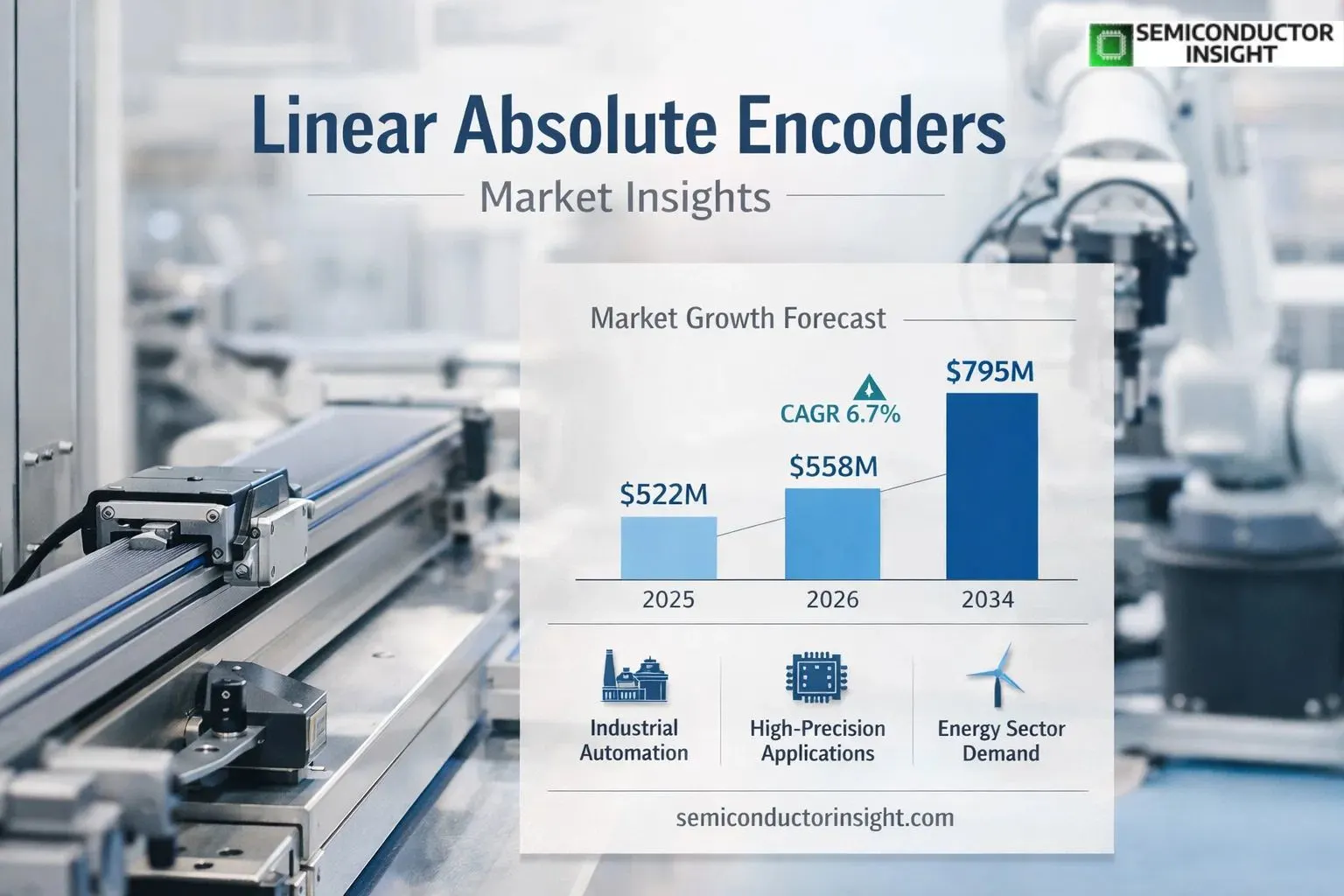
Global linear absolute encoders market size was valued at USD 522 million in 2025. The market is projected to grow from USD 558 million in 2026 to USD 795 million by 2034, exhibiting a CAGR of 6.7% during the forecast period.
Linear absolute encoders are precision position sensors designed to measure the exact location of a moving object along a linear path. Unlike incremental encoders that track relative movement, these devices provide absolute position data immediately upon power-up, eliminating the need for reference points. They achieve this through unique digital codes assigned to each position along their scale, ensuring high accuracy and reliability in industrial automation applications.
The market growth is driven by increasing demand for precision measurement in manufacturing processes and the rapid adoption of Industry 4.0 technologies. Optical linear absolute encoders currently dominate the market due to their superior resolution, while magnetic variants are gaining traction in harsh environments where contamination resistance is critical. Key players like Renishaw and HEIDENHAIN continue to innovate with compact designs and improved communication protocols to meet evolving industry requirements.
MARKET DRIVERS
Increasing Automation in Manufacturing
The Linear Absolute Encoders Market is experiencing significant growth due to rising automation across industrial sectors. These precise measurement devices are becoming essential in CNC machines, robotics, and automated production lines where position feedback is critical. Global push towards Industry 4.0 technologies is accelerating adoption, with over 65% of new manufacturing equipment now requiring high-accuracy position sensing.
Demand for High-Precision Motion Control
Linear absolute encoders provide resolution down to nanometer levels, making them indispensable in semiconductor manufacturing, medical device production, and aerospace applications. Market analysis shows the precision engineering segment accounts for approximately 28% of total Linear Absolute Encoders Market revenue, with compound annual growth projected at 7.2% through 2028.
➤ The transition from incremental to absolute position measurement is driving 40% of new encoder purchases in industrial automation applications
Energy sector applications are emerging as a significant driver, particularly in wind turbine pitch control systems and hydroelectric plant monitoring where absolute position feedback ensures operational safety.
MARKET CHALLENGES
High Initial Implementation Costs
The premium pricing of industrial-grade linear absolute encoders creates adoption barriers, particularly for small and medium enterprises. System integration expenses can exceed component costs by 300% when factoring in installation, calibration, and compatible controller requirements.
Other Challenges
Environmental Sensitivity
Temperature variations, vibration, and contamination present ongoing performance challenges, requiring additional protection measures that increase total system costs by 15-25% in harsh industrial environments.
MARKET RESTRAINTS
Competition from Alternative Technologies
Magnetic and capacitive position sensing technologies are capturing portions of the Linear Absolute Encoders Market, particularly in cost-sensitive applications where extreme precision isn’t required. These alternatives now represent an estimated 18% market share in mid-range positioning applications.
MARKET OPPORTUNITIES
Expansion in Electric Vehicle Production
The Linear Absolute Encoders Market is poised for growth through integration into EV battery manufacturing processes, where precise electrode placement and welding position control are critical. Automotive sector adoption is projected to increase by 32% as EV production scales globally.
Linear Absolute Encoders Market Trends
Growing Demand for High-Precision Industrial Automation
The Linear Absolute Encoders market is witnessing steady growth driven by increasing adoption in high-precision industrial automation applications. These devices provide accurate position feedback for advanced CNC machinery, robotics, and automated manufacturing systems, where reliability and exact positioning are critical. Manufacturers are focusing on improving resolution capabilities to meet industry requirements.
Other Trends
Optical Encoder Technology Advancements
Optical Linear Absolute Encoders continue to dominate the market due to their superior accuracy and resolution. Recent innovations in grating technology and signal processing have enhanced performance while reducing sensitivity to environmental factors. Leading manufacturers are developing new optical solutions for extreme operating conditions.
Expansion in Robotics Applications
The robotics sector is emerging as a key growth area for Linear Absolute Encoders, particularly in collaborative robots and precision automated systems. The demand stems from the need for absolute position tracking without homing routines, improving operational efficiency and safety in robotic workcells.
Regional Market Developments
Asia-Pacific is demonstrating significant growth potential in the Linear Absolute Encoders market, led by expanding manufacturing sectors in China and Southeast Asia. While North America and Europe maintain strong positions in high-end applications, emerging economies are driving volume demand for cost-effective solutions.
Industry Consolidation and Partnerships
The market landscape is evolving through strategic partnerships between encoder manufacturers and motion control system providers. Leading companies are acquiring complementary technologies to offer integrated solutions, while smaller players are focusing on niche applications requiring specialized encoder capabilities.
COMPETITIVE LANDSCAPE
Key Industry Players
Global Linear Absolute Encoders Market Dominated by Precision Engineering Leaders
The linear absolute encoders market is characterized by strong dominance from specialized measurement technology providers, with Renishaw and HEIDENHAIN GmbH leading Global market with approximately 28% combined revenue share in 2025. These market leaders have established robust R&D capabilities in high-precision optical encoders, particularly for machine tool and CNC machining applications. The competitive landscape shows concentration among European manufacturers, though Asian players like Autonics and POSIC are gaining traction through competitive pricing strategies in industrial automation segments.
Niche specialists such as RLS (a Renishaw company) and Lika Electronic focus on advanced magnetic encoder technologies, serving growing demand in robotics and automated manufacturing. Smaller innovative firms like Kappasense and Celera are making inroads with compact encoder solutions for specialized applications, intensifying competition in the under-$1000 price segment. The market also features regional leaders like Balluff in Southeast Asia and TR-Electronic in Central Europe, which maintain strong local distribution networks.
List of Key Linear Absolute Encoders Companies Profiled
- Renishaw plc
- HEIDENHAIN GmbH
- RLS d.o.o.
- Balluff Automation Malaysia Sdn Bhd
- Autonics Corporation
- Lika Electronic
- Kappasense GmbH
- TR-Electronic GmbH
- Celera Motion
- POSIC SA
- SICK AG
- Mitutoyo Corporation
- Fagor Automation
- Numerik Jena GmbH
- Micro-Epsilon
Segment Analysis:
| Segment Category | Sub-Segments | Key Insights |
| By Type |
|
Optical Linear Absolute Encoders dominate due to their superior precision capabilities.
|
| By Application |
|
Machine Tools and CNC Machining represent the largest application segment.
|
| By End User |
|
Industrial Manufacturing accounts for the majority of demand.
|
| By Technology |
|
Multi-Track Encoders are gaining significant traction in the market.
|
| By Installation |
|
Sealed Encoders represent the fastest growing segment.
|
Regional Analysis: Linear Absolute Encoders Market
Asia-Pacific
Asia-Pacific’s manufacturing sector is undergoing rapid automation, creating substantial demand for linear absolute encoders. The region’s electronics and automotive industries particularly rely on these precision components for quality control and assembly line automation. Government policies promoting Industry 4.0 adoption further accelerate market expansion across major economies.
Proximity to major encoder component suppliers gives Asian manufacturers significant cost advantages. Several global players have established production facilities in the region to leverage lower operational costs and growing local demand. This concentrated supply chain enhances product availability and supports regional market growth.
Asian manufacturers are increasingly adopting high-resolution linear absolute encoders for precision applications. The shift towards smart factories and IoT-enabled equipment drives demand for advanced encoder solutions with digital interfaces and networking capabilities compatible with modern automation systems.
While China, Japan and South Korea lead currently, Southeast Asian nations present growing opportunities. Countries like Vietnam, Thailand and Malaysia are investing heavily in manufacturing infrastructure, creating new demand centers for linear absolute encoders as they modernize production facilities.
Europe
Europe maintains a strong position in the Linear Absolute Encoders Market, characterized by advanced manufacturing sectors and stringent quality standards. Germany stands out as the regional leader, driven by its thriving machine tool industry and precision engineering requirements. The region benefits from well-established industrial automation practices and early adoption of Industry 4.0 concepts. European manufacturers emphasize high-performance encoder solutions for critical applications in semiconductor equipment, medical devices, and aerospace. The presence of numerous encoder technology innovators contributes to continuous product development. Environmental regulations and energy efficiency standards also influence encoder design preferences in this market.
North America
North America represents a technologically advanced market for linear absolute encoders, with the United States accounting for majority demand. The region’s strong aerospace, defense, and semiconductor industries require high-precision motion control solutions. Focus on reshoring manufacturing operations and upgrading existing facilities supports steady market growth. Leading encoder manufacturers maintain significant R&D operations in the region, driving innovation in encoder technologies. The growing adoption of collaborative robots and automated material handling systems in logistics and warehousing creates new application areas. Strict safety regulations and reliability requirements shape product specifications in this quality-conscious market.
Middle East & Africa
The Middle East & Africa region shows developing potential in the Linear Absolute Encoders Market, primarily concentrated in the Gulf Cooperation Council countries. Industrial diversification initiatives away from oil dependence are creating new manufacturing hubs requiring automation equipment. The region’s growing focus on infrastructure development and smart city projects presents opportunities for encoder applications. Africa’s market remains nascent but shows gradual growth as manufacturing capabilities expand in key economies like South Africa and Egypt. The market faces challenges from limited local technical expertise and preference for lower-cost alternatives in price-sensitive applications.
South America
South America represents an emerging market for linear absolute encoders, with Brazil and Argentina as the primary demand centers. The region’s automotive and food processing industries drive most of the current encoder applications. Economic fluctuations and inconsistent industrial investment create market volatility, though long-term growth prospects remain positive. Local manufacturing capabilities are limited, leading to high import dependence for advanced encoder solutions. The market shows potential as regional manufacturers gradually adopt more sophisticated automation technologies to enhance productivity and global competitiveness.
Report Scope
This market research report provides a comprehensive analysis of the Linear Absolute Encoders Market, covering the forecast period 2026–2034. It offers detailed insights into market dynamics, technological advancements, competitive landscape, and key trends shaping the industry.
Key focus areas of the report include:
- Market Overview: The report begins with an overview outlining its current market scenario, key growth indicators, and industry transformation drivers. It discusses macroeconomic factors, demand–supply balance, regulatory landscape, and the strategic role of semiconductors in powering advancements across industries such as automotive, telecommunications, consumer electronics, and industrial automation.
- Market Size & Forecast: Historical data and future projections for revenue, unit shipments, and market value across major regions and segments.
- Segmentation Analysis: Detailed breakdown by product type, technology, application, and end-user industry to identify high-growth segments and investment opportunities.
- Regional Insights: Insights into market performance across North America, Europe, Asia-Pacific, Latin America, and the Middle East & Africa, including country-level analysis where relevant.
- Competitive Landscape: Profiles of leading market participants, including their product offerings, R&D focus, manufacturing capacity, pricing strategies, and recent developments such as mergers, acquisitions, and partnerships.
- Technology Trends & Innovation: Assessment of emerging technologies, integration of AI/IoT, semiconductor design trends, fabrication techniques, and evolving industry standards.
- Market Drivers & Restraints: Evaluation of factors driving market growth along with challenges, supply chain constraints, regulatory issues, and market-entry barriers.
- Stakeholder Insights: Insights for component suppliers, OEMs, system integrators, investors, and policymakers regarding the evolving ecosystem and strategic opportunities.
Primary and secondary research methods are employed, including interviews with industry experts, data from verified sources, and real-time market intelligence to ensure the accuracy and reliability of the insights presented.
FREQUENTLY ASKED QUESTIONS:
What is the current market size of Linear Absolute Encoders Market?
-> Global Linear Absolute Encoders Market was valued at USD 522 million in 2025 and is expected to reach USD 795 million by 2034.
What is the growth rate of Linear Absolute Encoders Market?
-> The market is projected to grow at a CAGR of 6.7% during the forecast period 2026-2034.
Which key companies operate in Linear Absolute Encoders Market?
-> Key players include Renishaw, RLS, Balluff Automation Malaysia Sdn Bhd, HEIDENHAIN GmbH, Autonics, Lika Electronic, Kappasense, TR-Electronic, Celera, POSIC, among others.
What are the main product segments in this market?
-> Market is segmented into Optical Linear Absolute Encoders, Magnetic Linear Absolute Encoders, and Others by type.
Which applications dominate Linear Absolute Encoders usage?
-> Primary applications include Machine Tools and CNC Machining, Robotics and Automated Manufacturing segments.

Get Sample Report PDF for Exclusive Insights
Report Sample Includes
- Table of Contents
- List of Tables & Figures
- Charts, Research Methodology, and more...
 Download Sample Report PDF


