Light Scattering Infrared Dust Sensor Market Insights
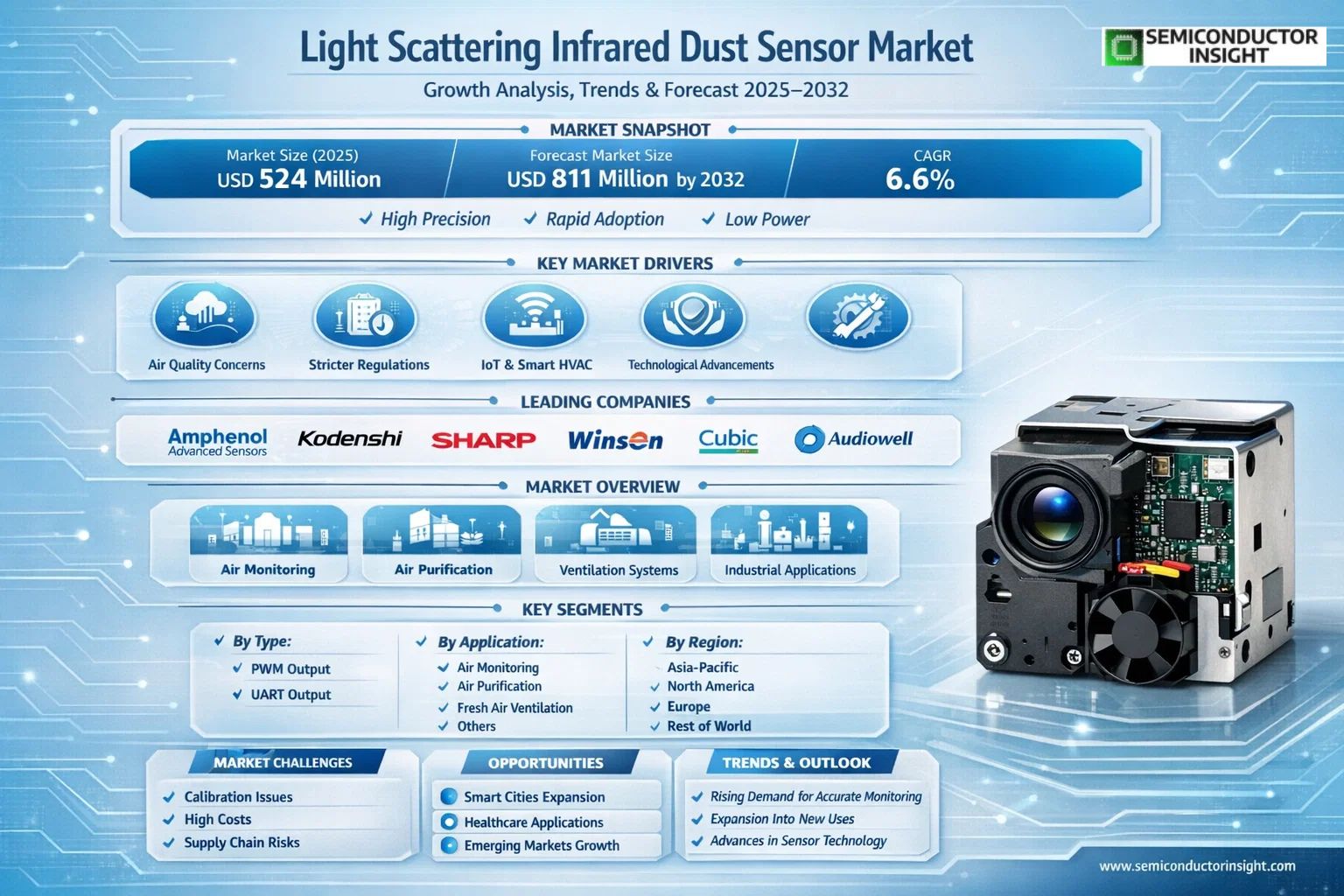
Global Light Scattering Infrared Dust Sensor market size was valued at USD 524 million in 2025. The market is projected to reach USD 811 million by 2032, exhibiting a CAGR of 6.6% during the forecast period.
Light Scattering Infrared Dust Sensors are devices based on the principle of light scattering to detect dust particle concentrations in the air. The light intensity correlates directly with the electrical signal generated through photoelectric conversion. By measuring this signal, the relative attenuation rate is calculated, enabling accurate determination of dust levels at specific sites. These sensors offer high precision and sensitivity, rapid response times, excellent stability, and low power consumption, making them ideal for applications in air purification, air monitoring, fresh air ventilation, and other scenarios requiring real-time dust concentration tracking.
The market is experiencing robust growth driven by escalating air pollution concerns worldwide, surging demand for indoor air quality solutions, and stricter environmental regulations. Furthermore, integration with IoT devices and smart HVAC systems is accelerating adoption across residential and industrial sectors. Key players are bolstering expansion through ongoing R&D investments and product innovations. For instance, leading manufacturers continue to enhance sensor accuracy for better performance in diverse environments. Amphenol Advanced Sensors, Kodenshi, Sharp Corporation, Zhengzhou Winsen Electronics Technology, Cubic Sensor and Instrument, and Audiowell represent prominent companies in the market, offering extensive portfolios tailored to varied applications.
MARKET DRIVERS
Rising Demand for Air Quality Monitoring
Light Scattering Infrared Dust Sensor Market is propelled by increasing global awareness of air pollution and its health impacts. Urbanization and industrial activities have heightened the need for precise particulate matter detection, with these sensors offering reliable measurement of PM2.5 and PM10 levels using infrared light scattering principles.
Regulatory Compliance and IoT Integration
Stricter environmental regulations, such as those from the EPA and EU standards, mandate continuous monitoring in industries like manufacturing and mining. Integration with IoT platforms enables real-time data transmission, driving adoption rates upward by approximately 12% annually in smart city projects.
➤ Advancements in sensor miniaturization enhance portability for consumer wearables and HVAC systems.
Overall, technological innovations and growing investments in environmental health infrastructure continue to fuel market expansion, positioning light scattering infrared dust sensors as essential tools for pollution control.
MARKET CHALLENGES
Technical Calibration and Accuracy Issues
In Light Scattering Infrared Dust Sensor Market, maintaining consistent accuracy across varying environmental conditions remains a key hurdle. Dust composition variations and humidity can affect light scattering patterns, requiring frequent recalibration that increases operational costs for end-users.
Other Challenges
High Development and Manufacturing Costs
Advanced infrared optics and signal processing components drive up production expenses, limiting accessibility for small-scale manufacturers and emerging markets where budget constraints prevail.Supply chain disruptions for rare earth materials used in sensors further exacerbate pricing pressures, with global shortages noted in recent years impacting delivery timelines and market penetration.
MARKET RESTRAINTS
Competition from Alternative Technologies
Light Scattering Infrared Dust Sensor Market faces restraints from competing technologies like laser-based or optical counters, which offer higher resolution at similar price points. These alternatives capture larger shares in precision applications such as cleanrooms and pharmaceuticals.Market maturity in developed regions slows growth, with penetration rates stabilizing at around 65% in North America and Europe, where legacy systems dominate industrial setups.Additionally, limited standardization in measurement protocols hinders interoperability, restraining widespread adoption in global regulatory frameworks.
MARKET OPPORTUNITIES
Expansion in Smart Cities and Healthcare
Light Scattering Infrared Dust Sensor Market holds significant potential in smart city initiatives, where air quality networks are expanding rapidly. Projections indicate a 15% CAGR through 2030 driven by urban deployments in Asia-Pacific regions.Healthcare applications, including indoor air purifiers and hospital ventilation systems, present untapped avenues as post-pandemic awareness boosts demand for real-time dust monitoring.Emerging economies offer growth prospects through government subsidies for environmental tech, alongside innovations in low-power designs for battery-operated devices.
Light Scattering Infrared Dust Sensor Market Trends
Surge in Demand Driven by Precision and Sensitivity
Light Scattering Infrared Dust Sensor Market continues to expand as industries prioritize accurate dust particle detection amid rising environmental concerns. These sensors operate on light scattering principles, where light intensity scattered by airborne particles converts into proportional electrical signals via photoelectric means, enabling precise measurement of dust concentrations through relative attenuation rates. Their high precision, sensitivity, fast response times, stability, and low power consumption position them as essential components in environments requiring reliable air quality assessment. In Light Scattering Infrared Dust Sensor Market, adoption accelerates in sectors demanding continuous monitoring, supported by advancements that enhance measurement accuracy without compromising efficiency. This trend reflects broader shifts toward proactive pollution control, with sensors integrating seamlessly into systems that deliver actionable data for compliance and health safety.
Other Trends
Expansion into Diverse Applications
Light Scattering Infrared Dust Sensor Market witnesses broadening applications across air monitoring, air purification, fresh air ventilation, and related fields where dust concentration oversight is critical. Key segments like PWM output and UART output variants cater to varied integration needs, allowing flexible deployment in stationary and portable devices alike. This diversification strengthens market resilience, as end-users leverage these sensors for optimized filtration processes and ventilation adjustments. In Light Scattering Infrared Dust Sensor Market, such versatility drives innovation, enabling tailored solutions that address specific operational challenges in residential, commercial, and industrial settings, ultimately fostering sustained demand through enhanced system performance.
Competitive Dynamics Among Leading Manufacturers
Competition in Light Scattering Infrared Dust Sensor Market intensifies as prominent players like Amphenol Advanced Sensors, Kodenshi, Sharp Corporation, Zhengzhou Winsen Electronics Technology, and Cubic Sensor and Instrument innovate to capture greater shares. These firms focus on refining product portfolios, improving output interfaces, and expanding regional footprints, particularly in high-growth areas encompassing North America, Europe, and Asia. Recent developments emphasize stability enhancements and application-specific adaptations, influencing market positioning through superior reliability. Light Scattering Infrared Dust Sensor Market benefits from this rivalry, as it spurs technological progress and cost efficiencies, while distributors and experts highlight evolving demands, drivers, and challenges that shape strategic planning for sustained competitiveness.
COMPETITIVE LANDSCAPE
Key Industry Players
Light Scattering Infrared Dust Sensor Market Leaders and Challengers
Light Scattering Infrared Dust Sensor Market exhibits a moderately concentrated structure dominated by a handful of key global players, with the top five manufacturers accounting for a substantial revenue share in 2025. Leading companies such as Amphenol Advanced Sensors, Kodenshi, and Sharp Corporation leverage their technological expertise in light scattering principles to deliver high-precision sensors characterized by fast response times, stability, and low power consumption. These leaders benefit from strong R&D capabilities and established supply chains, enabling them to capture significant market segments in air monitoring and purification applications amid growing demand driven by environmental regulations and urbanization.
Beyond the frontrunners, a robust ecosystem of niche and regional players contributes to innovation and competition, including Zhengzhou Winsen Electronics Technology, Cubic Sensor and Instrument, and Audiowell, which specialize in cost-effective solutions for PWM and UART output variants. Companies like Guangzhou Luftmy Intelligent Technology and MFrontier are expanding through targeted applications in fresh air ventilation and industrial monitoring, fostering market growth at a projected CAGR of 6.6% through 2032. This dynamic landscape encourages mergers, product diversification, and regional expansions, particularly in Asia-Pacific hubs like China, challenging incumbents while enhancing overall sensor performance standards.
List of Key Light Scattering Infrared Dust Sensor Companies Profiled
- Amphenol Advanced Sensors
- Kodenshi
- Sharp Corporation
- NIDS
- Zhengzhou Winsen Electronics Technology
- Cubic Sensor and Instrument
- Audiowell
- Guangzhou Luftmy Intelligent Technology
- MFrontier
- Henan Fosen Electronics Technology
- Shenzhen Hoto Intelligent Control Technology
- Plantower
- Nova Fitness
- Sensirion
- Optex
Segment Analysis:
| Segment Category | Sub-Segments | Key Insights |
| By Type |
|
PWM Output leads the segment due to its seamless integration capabilities and efficiency in diverse applications.
|
| By Application |
|
Air Purification emerges as the frontrunner, driven by the critical need for cleaner indoor atmospheres across various settings.
|
| By End User |
|
Industrial Facilities commands the forefront position owing to rigorous operational and compliance demands.
|
| By Installation Type |
|
Fixed Installation holds dominance for its unwavering reliability in continuous monitoring scenarios.
|
| By Deployment Environment |
|
Indoor Environments spearheads the category with tailored performance for everyday air quality control.
|
Regional Analysis: Light Scattering Infrared Dust Sensor Market
Asia-Pacific
Intense industrialization and pollution control policies drive demand for Light Scattering Infrared Dust Sensors. Urban air quality programs in megacities accelerate integration into monitoring stations and industrial automation, enhancing precision in hazardous environments.
Local innovators alongside global firms dominate, offering customized infrared scattering tech for dust detection. Strong R&D ecosystems support affordable, rugged sensors for diverse applications like agriculture and construction site safety.
Regulatory inconsistencies and counterfeit products pose hurdles, yet quality standards evolve. Harsh climatic variations demand resilient designs, prompting ongoing material enhancements for reliable performance.
Smart infrastructure projects and green manufacturing trends open avenues for advanced sensor integration. Export potential to emerging markets strengthens regional hubs as innovation leaders in dust monitoring technologies.
North America
In North America, Light Scattering Infrared Dust Sensor Market thrives on advanced technological ecosystems and rigorous workplace safety standards. The United States and Canada prioritize these sensors in oil & gas, pharmaceuticals, and cleanroom environments for accurate particulate matter tracking. Environmental Protection Agency guidelines boost deployment in ambient air quality networks, while Industry 4.0 integration favors wireless, real-time capabilities. Leading firms focus on high-sensitivity infrared models for research labs and data centers. Growing emphasis on sustainable practices in agriculture and forestry applications expands market reach. Despite high initial costs, value-added services like predictive analytics drive adoption, positioning the region as a hub for premium innovations in Light Scattering Infrared Dust Sensor Market.
Europe
Europe’s Light Scattering Infrared Dust Sensor Market benefits from the European Green Deal and stringent emission norms. Germany, France, and the UK lead with applications in automotive manufacturing, renewable energy sites, and urban pollution control. Sensors excel in detecting fine dust particles for compliance with EU directives, integrated into ventilation systems and public transport. Collaborative R&D initiatives enhance multi-parameter sensing, combining dust with gas detection. Focus on circular economy principles promotes sensor recycling and longevity. Regional strengths in precision engineering ensure high reliability, with expansion into heritage site preservation and indoor air quality monitoring solidifying Europe’s pivotal role.
South America
South America’s Light Scattering Infrared Dust Sensor Market grows amid mining booms and deforestation concerns in Brazil and Chile. Industrial sectors like steel production and agriculture adopt infrared scattering tech for occupational health and environmental compliance. Urban centers invest in air quality stations to combat biomass burning effects. Cost-sensitive innovations bridge accessibility gaps, enabling widespread use in remote operations. Partnerships with international suppliers introduce rugged designs for tropical conditions, fostering market maturation. Rising awareness of respiratory health issues accelerates demand, marking potential for significant expansion.
Middle East & Africa
The Middle East & Africa segment of Light Scattering Infrared Dust Sensor Market is propelled by desertification challenges and oilfield dust management. Saudi Arabia and South Africa integrate sensors into smart grids and construction megaprojects for proactive monitoring. Harsh environments demand dust-resistant, solar-powered variants, aligning with energy diversification goals. Public health initiatives in urban areas enhance adoption for traffic and industrial emissions. Emerging regulations and infrastructure investments create fertile ground, with regional customization driving future growth trajectories.
Report Scope
This market research report provides a comprehensive analysis of Light Scattering Infrared Dust Sensor Market, covering the forecast period 2025–2032. It offers detailed insights into market dynamics, technological advancements, competitive landscape, and key trends shaping the industry.
Key focus areas of the report include:
- Market Overview: The report begins with an overview outlining its current market scenario, key growth indicators, and industry transformation drivers. It discusses macroeconomic factors, demand–supply balance, regulatory landscape, and the strategic role of Light Scattering Infrared Dust Sensors in enabling precise dust concentration detection across industries such as air purification, air monitoring, fresh air ventilation, and environmental applications.
- Market Size & Forecast: Historical data and future projections for revenue, unit shipments, and market value across major regions and segments.
- Segmentation Analysis: Detailed breakdown by product type, technology, application, and end-user industry to identify high-growth segments and investment opportunities.
- Regional Insights: Insights into market performance across North America, Europe, Asia-Pacific, Latin America, and the Middle East & Africa, including country-level analysis where relevant.
- Competitive Landscape: Profiles of leading market participants, including their product offerings, R&D focus, manufacturing capacity, pricing strategies, and recent developments such as mergers, acquisitions, and partnerships.
- Technology Trends & Innovation: Assessment of emerging technologies, integration of AI/IoT, semiconductor design trends, fabrication techniques, and evolving industry standards.
- Market Drivers & Restraints: Evaluation of factors driving market growth along with challenges, supply chain constraints, regulatory issues, and market-entry barriers.
- Stakeholder Insights: Insights for component suppliers, OEMs, system integrators, investors, and policymakers regarding the evolving ecosystem and strategic opportunities.
Primary and secondary research methods are employed, including interviews with industry experts, data from verified sources, and real-time market intelligence to ensure the accuracy and reliability of the insights presented.
FREQUENTLY ASKED QUESTIONS:
What is the current market size of Light Scattering Infrared Dust Sensor Market?
-> Light Scattering Infrared Dust Sensor Market was valued at USD 524 million in 2025 and is expected to reach USD 811 million by 2032, at a CAGR of 6.6% during the forecast period.
Which key companies operate in Light Scattering Infrared Dust Sensor Market?
-> Key players include Amphenol Advanced Sensors, Kodenshi, Sharp Corporation, NIDS, Zhengzhou Winsen Electronics Technology, Cubic Sensor and Instrument, Audiowell, Guangzhou Luftmy Intelligent Technology, MFrontier, Henan Fosen Electronics Technology, among others.
What are the key growth drivers?
-> Key growth drivers include demand for high-precision air quality monitoring, air purification, fresh air ventilation systems, and characteristics like fast response, good stability, and low power consumption.
Which region dominates the market?
-> Asia is a key region with significant growth potential, particularly in China, while North America, including the U.S., holds substantial market share.
What are the emerging trends?
-> Emerging trends include advancements in light scattering technology for higher sensitivity and precision, integration in air monitoring and purification applications, and low-power designs for portable devices.

Get Sample Report PDF for Exclusive Insights
Report Sample Includes
- Table of Contents
- List of Tables & Figures
- Charts, Research Methodology, and more...
 Download Sample Report PDF