LIB Cathode Conductive Auxiliary Agents Market, Trends, Business Strategies 2025-2032

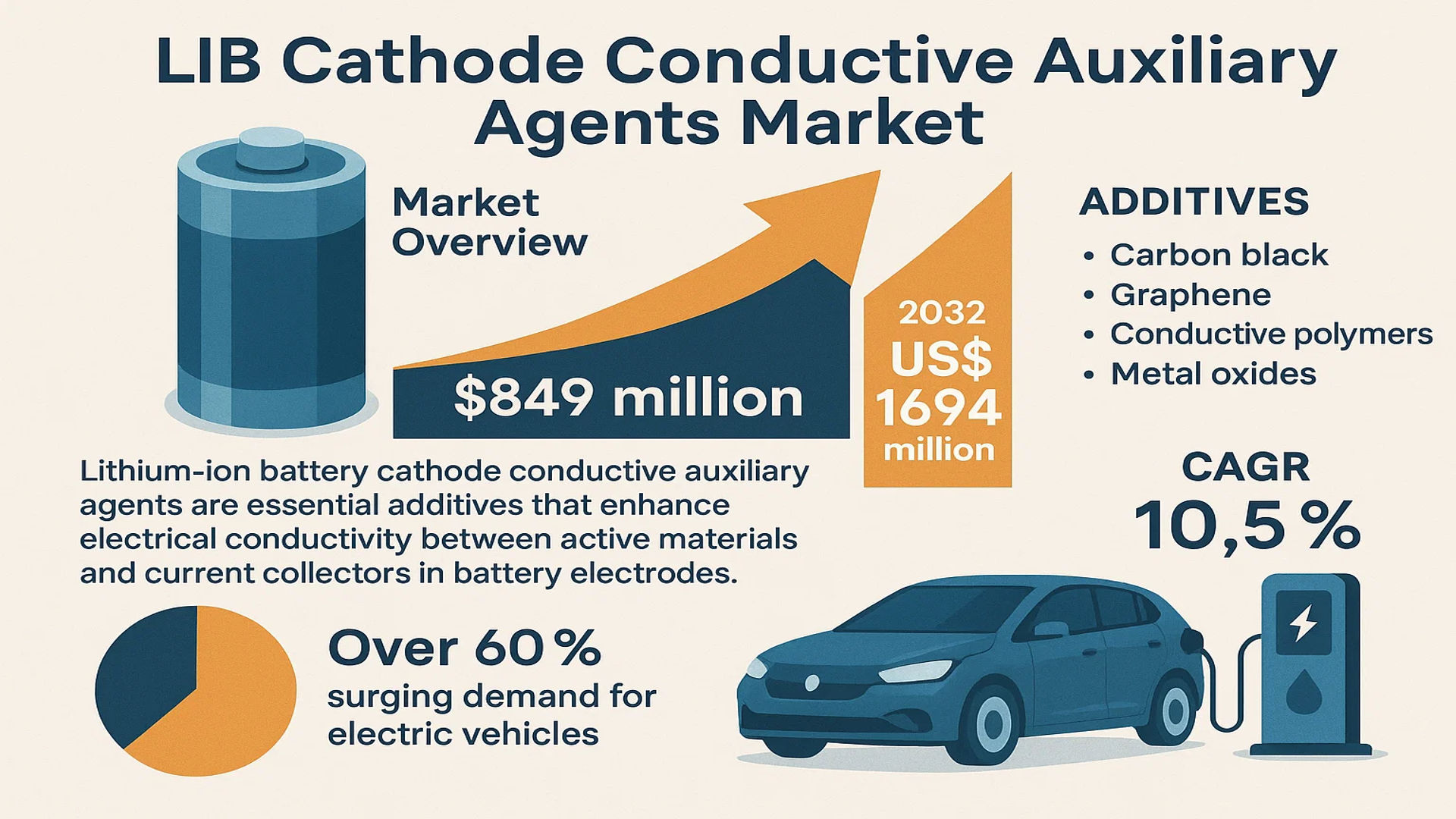
LIB Cathode Conductive Auxiliary Agents Market was valued at 849 million in 2024 and is projected to reach US$ 1694 million by 2032, at a CAGR of 10.5% during the forecast period.

PDF Icon Download Sample Report PDF
  • Quick Dispatch

    All Orders

  • Secure Payment

    100% Secure Payment

Price range: $1,500.00 through $4,250.00

Clear

MARKET INSIGHTS

The global LIB Cathode Conductive Auxiliary Agents Market was valued at 849 million in 2024 and is projected to reach US$ 1694 million by 2032, at a CAGR of 10.5% during the forecast period.

Lithium-ion battery (LIB) cathode conductive auxiliary agents are essential additives that enhance electrical conductivity between active materials and current collectors in battery electrodes. These agents form conductive networks to improve battery performance metrics such as capacity, charge/discharge rates, and cycle life. Common types include carbon-based materials (carbon black, graphene), conductive polymers, and metal oxides, with carbon black currently dominating the market due to its cost-effectiveness and performance balance.

The market growth is primarily driven by surging demand for electric vehicles, which accounted for over 60% of conductive agent consumption in 2024. Furthermore, energy storage systems and 3C electronics are accelerating adoption, with the latter seeing 18% year-over-year growth in battery demand. Technological advancements in high-nickel cathodes, which require specialized conductive agents, and increasing investments in battery R&D (global spending exceeded USD 12 billion in 2023) are creating new opportunities. Key players like Cabot Corporation and LG Chem are expanding production capacities to meet the 140% projected increase in demand by 2030.
LIB Cathode Conductive Auxiliary Agents Market

MARKET DYNAMICS

MARKET DRIVERS

Rising Demand for High-Performance Lithium-Ion Batteries in Electric Vehicles Accelerates Market Growth

The global electric vehicle (EV) market is experiencing unprecedented growth, with projected sales exceeding 30 million units annually by 2030. This surge directly fuels demand for advanced lithium-ion batteries where cathode conductive additives play a critical role in enhancing performance. These additives improve electron transfer efficiency, increasing battery capacity by up to 15% and extending cycle life by approximately 20% compared to conventional formulations. Major automotive manufacturers are increasingly collaborating with battery material suppliers, creating a robust ecosystem for conductive auxiliary agent development.

Energy Storage System Expansion Creates New Application Horizons

Grid-scale energy storage installations are projected to grow at a compound annual rate exceeding 25% through 2030, driven by renewable energy integration needs. Lithium-ion batteries dominate this segment, accounting for over 80% of new storage capacity. Cathode conductive additives enable higher charge-discharge rates critical for frequency regulation applications, with specialized formulations now achieving conductivity improvements of 30-40% in high-load conditions. Recent product launches specifically targeting energy storage applications demonstrate manufacturers’ strategic focus on this high-growth sector.

Technological Advancements in Conductive Additive Formulations Drive Performance Improvements

Material science breakthroughs are enabling next-generation conductive additives with multi-functional capabilities. Carbon nanotube-based additives now demonstrate 50% higher conductivity than conventional carbon black while requiring 30% less material volume. Hybrid additive systems combining graphene with conductive polymers are showing particular promise, achieving simultaneous improvements in mechanical stability and electrochemical performance. These innovations are critical as battery manufacturers push energy densities beyond 300 Wh/kg while maintaining safety standards.

MARKET RESTRAINTS

High Production Costs and Complex Manufacturing Processes Limit Market Penetration

Advanced conductive additives require specialized production facilities with capital expenditures often exceeding $50 million for medium-scale operations. The high-purity requirements for battery-grade materials drive production costs 40-60% above industrial-grade alternatives. This cost sensitivity is particularly acute in price-competitive markets like consumer electronics, where battery manufacturers operate on thin margins. While economies of scale are gradually reducing costs, the premium pricing remains a significant barrier for widespread adoption.

Stringent Certification Requirements Delay Time-to-Market

Battery material certification processes typically require 12-18 months for automotive-grade applications, creating significant lead times for new product commercialization. Regulatory requirements continue to evolve, with recent emphasis on sustainability credentials adding further complexity. These extended validation periods discourage smaller players from entering the market and slow the adoption of innovative formulations. The certification bottleneck is particularly problematic in Europe and North America, where standards are most rigorous.

Material Compatibility Challenges with Emerging Cathode Chemistries

The rapid development of new cathode materials such as high-nickel NCM and lithium manganese iron phosphate (LMFP) creates formulation challenges for conductive additive manufacturers. These advanced cathodes require customized additive solutions to maintain performance, with optimal dispersion characteristics varying significantly between chemistries. The industry faces a knowledge gap in understanding interface interactions, leading to trial-and-error development approaches that increase R&D expenditures.

MARKET CHALLENGES

Balancing Performance Enhancements with Sustainability Requirements

While conductive additives improve battery performance, their production often involves energy-intensive processes with significant carbon footprints. The industry faces increasing pressure to reduce greenhouse gas emissions by 30-40% across the value chain by 2030. This challenge is compounded by the use of petroleum-based precursors in many carbon additives. Developing bio-based alternatives without compromising performance characteristics remains an ongoing technical hurdle for material scientists.

Supply Chain Vulnerabilities for Critical Raw Materials

Graphite, a key raw material for many conductive additives, faces supply constraints with over 70% of global production concentrated in China. The recent export controls on graphite products have created uncertainty in the market, forcing manufacturers to diversify supply sources. Alternative materials like carbon nanotubes rely on specialized catalysts that themselves face supply chain risks. These vulnerabilities became particularly evident during recent global logistics disruptions, causing price volatility exceeding 25% for some additive types.

Intellectual Property Disputes in Advanced Material Formulations

The competitive landscape has seen a surge in patent litigation as companies protect their conductive additive innovations. Over 200 new patents were filed in this sector in 2023 alone, creating a complex web of intellectual property rights. Smaller innovators face particular challenges navigating this environment, with legal defense costs sometimes reaching 15-20% of R&D budgets. This IP thicket may inadvertently slow overall market innovation as companies become cautious about potential infringement risks.

MARKET OPPORTUNITIES

Next-Generation Solid-State Batteries Create New Material Requirements

The emerging solid-state battery market, projected to exceed $8 billion by 2030, requires fundamentally different conductive additive solutions. These systems need additives that maintain conductivity across solid-solid interfaces while withstanding higher operating temperatures. Early research indicates that specially-modified carbon allotropes show particular promise, with prototype batteries demonstrating 20% higher energy density than conventional lithium-ion systems. This represents a blue ocean opportunity for additive manufacturers to develop tailored solutions for this disruptive technology.

Regional Supply Chain Localization as Strategic Imperative

Growing emphasis on supply chain resilience is driving regional production initiatives, particularly in North America and Europe. Government incentives under programs like the U.S. Inflation Reduction Act are catalyzing over $2 billion in announced investments for local battery material production. This presents opportunities for additive manufacturers to establish partnerships with regional players, with several joint ventures already announced between Asian material suppliers and Western battery manufacturers to qualify localized supply chains.

Integration of AI in Material Discovery and Formulation Optimization

Artificial intelligence is transforming additive development cycles, reducing traditional formulation testing time from months to weeks. Machine learning models trained on electrochemical performance data are achieving 85% accuracy in predicting optimal additive combinations for specific cathode formulations. This acceleration in material discovery creates opportunities for first-mover advantage, with several companies already offering AI-optimized additive packages that promise performance improvements of 10-15% over conventional benchmarks.

LIB CATHODE CONDUCTIVE AUXILIARY AGENTS MARKET TRENDS

Rising Demand for High-Performance Lithium-Ion Batteries Drives Market Expansion

The global LIB cathode conductive auxiliary agents market is experiencing substantial growth, primarily driven by the increasing demand for high-performance lithium-ion batteries across electric vehicles (EVs), renewable energy storage, and consumer electronics. The market is projected to grow at a CAGR of 10.5%, expanding from $849 million in 2024 to $1.7 billion by 2032. Conductive additives play a pivotal role in enhancing electrode conductivity, improving battery life, charge-discharge efficiency, and thermal stability, which are critical for advanced battery applications. The surge in EV production, with a forecasted 30 million units sold annually by 2030, underscores the necessity for improved cathode materials.

Other Trends

Shift Toward Sustainable and High-Energy-Density Materials

Manufacturers are increasingly adopting carbon-based nanomaterials, such as carbon nanotubes (CNTs) and graphene, due to their superior conductivity and minimal weight addition. These materials enable higher energy density while reducing the overall battery weight—a key requirement for EVs and portable electronics. Additionally, strict environmental regulations are pushing companies to replace conventional conductive agents like acetylene black with eco-friendly alternatives, fostering innovation in this segment.

Growing Investments in Energy Storage Solutions

The rapid expansion of grid-scale energy storage systems is accelerating demand for long-lasting, high-efficiency lithium batteries, where cathode conductive additives play a crucial role. Governments worldwide are investing heavily in renewable energy integration, with global energy storage capacity expected to exceed 1,000 GWh by 2030. Leading players, including LG Chem and BTR New Material, are actively expanding production capacities to meet the increasing need for high-performance conductive agents in energy storage applications.

COMPETITIVE LANDSCAPE

Key Industry Players

Companies Focus on Innovation and Expansion to Maintain Market Position

The global LIB Cathode Conductive Auxiliary Agents market exhibits a competitive landscape with a mix of established chemical manufacturers and specialized battery materials producers. Market leaders are leveraging their technological expertise and production capacities to cater to the growing demand from lithium-ion battery manufacturers. Birla Carbon and Cabot Corporation have emerged as dominant players, collectively accounting for over 30% of the market share in 2024, primarily due to their extensive carbon black product portfolios and global distribution networks.

Asian players such as LG Chem and BTR New Material are gaining significant traction, driven by their proximity to major battery production hubs in China, South Korea, and Japan. These companies have been investing heavily in R&D to develop advanced conductive additives that enhance battery performance while reducing costs. Recent expansions in production capacity by these firms indicate their commitment to meeting the surging demand from electric vehicle manufacturers.

The market is witnessing increasing competition from emerging players specializing in next-generation conductive materials. Dynanonic and ADEKA have introduced innovative graphene-based conductive additives that offer superior performance characteristics, particularly in high-energy-density battery applications. These technological advancements are reshaping competitive dynamics as established players respond with their own product innovations.

Strategic partnerships and vertical integration have become key competitive strategies. Imerys recently entered into a joint venture with a major cathode producer to ensure stable supply chains, while Denka has vertically integrated its conductive additive production with carbon nanotube manufacturing. Such moves are expected to intensify competition while driving product standardization across the industry.

List of Key LIB Cathode Conductive Auxiliary Agents Companies Profiled

  • Birla Carbon (India)
  • Orion Engineered Carbons (Luxembourg)
  • Cabot Corporation (U.S.)
  • Imerys Graphite & Carbon (Switzerland)
  • Denka Company Limited (Japan)
  • LG Chem (South Korea)
  • Resonac Holdings Corporation (Japan)
  • BTR New Material Group (China)
  • Zeon Corporation (Japan)
  • ADEKA Corporation (Japan)
  • Dynanonic (China)

Segment Analysis:

By Type

Lithium Nickel Cobalt Manganese Oxide Leads the Market Due to High Adoption in EV Batteries

The market is segmented based on type into:

  • Lithium Carbonate
  • Lithium Nickel Cobalt Manganese Oxide
  • Lithium Iron Phosphate
  • Lithium Manganese Phosphate
  • Others

By Application

Power Battery Segment Dominates Due to Rising Electric Vehicle Demand

The market is segmented based on application into:

  • Power Battery
  • 3C Electronic Battery
  • Energy Storage Battery
  • Others

By End User

Automotive Sector Drives Market Growth with Increasing EV Production

The market is segmented based on end user into:

  • Automotive
  • Consumer Electronics
  • Energy Storage Systems
  • Industrial

Regional Analysis: LIB Cathode Conductive Auxiliary Agents Market

Asia-Pacific
The Asia-Pacific region dominates the global LIB Cathode Conductive Auxiliary Agents market, accounting for over 60% of total demand in 2024. This leadership position stems from China’s massive lithium-ion battery production capacity, which exceeds 1,200 GWh annually. The country’s “14th Five-Year Plan” actively promotes new energy vehicles and energy storage systems, creating sustained demand for high-performance conductive additives. Japan and South Korea follow closely, with major battery manufacturers like LG Chem and Panasonic driving innovation in cathode materials. Despite pricing pressures, the region benefits from established supply chains, government subsidies for electric vehicles, and rapid urbanization driving demand for consumer electronics.

North America
The North American market is experiencing accelerated growth due to strict emissions regulations and the Biden administration’s push for domestic battery manufacturing. The Inflation Reduction Act’s $369 billion clean energy investments are incentivizing localized production of battery components, including conductive additives. Canada’s rich lithium reserves and growing gigafactory projects (such as those by Tesla and Stellantis) present new opportunities for suppliers. However, the region faces challenges in competing with Asian producers on cost, with many manufacturers still dependent on imported conductive materials despite efforts to build domestic supply chains.

Europe
Europe’s market growth is propelled by the European Battery Alliance’s initiatives to establish a competitive battery value chain. Stringent EU regulations on battery sustainability (including the new Battery Passport requirements) are driving demand for advanced conductive additives that enhance energy density and lifecycle performance. Germany leads in technological development, with companies like BASF investing heavily in next-generation cathode materials. The region’s focus on circular economy principles is prompting innovation in recyclable conductive additives – though adoption remains slow due to higher costs compared to conventional options.

South America
South America represents an emerging market with Brazil and Argentina showing the most potential. Brazil’s growing electric vehicle adoption (with sales increasing 200% year-over-year in 2023) and Argentina’s lithium mining expansion create opportunities. However, market development is constrained by economic instability, limited local manufacturing capabilities, and reliance on imported battery components. The region shows promise as a future production hub due to abundant lithium resources, but currently lacks the infrastructure for large-scale conductive additive manufacturing.

Middle East & Africa
This region remains in early development stages for LIB conductive additives. While benefitting from renewable energy investments (particularly in solar-plus-storage projects), limited local battery production constrains market growth. The UAE and Saudi Arabia are making strategic investments in battery technology as part of energy diversification plans, but currently serve primarily as consumption markets for imported battery materials. The African continental free trade agreement could eventually stimulate regional value chains, though progress remains slow due to infrastructure gaps and investment challenges.

Report Scope

This market research report provides a comprehensive analysis of the global LIB Cathode Conductive Auxiliary Agents market, covering the forecast period 2024–2032. It offers detailed insights into market dynamics, technological advancements, competitive landscape, and key trends shaping the lithium-ion battery industry.

Key focus areas of the report include:

  • Market Size & Forecast: Historical data and future projections for revenue, volume shipments, and market value across major regions and application segments.
  • Segmentation Analysis: Detailed breakdown by material type (lithium carbonate, NCM, LFP, LMP), application (power batteries, 3C electronics, energy storage), and end-use industries.
  • Regional Outlook: Insights into market performance across North America, Europe, Asia-Pacific, Latin America, and Middle East & Africa, with country-level analysis of key markets.
  • Competitive Landscape: Profiles of leading conductive additive manufacturers, including their product portfolios, production capacities, technological innovations, and strategic initiatives.
  • Technology Trends: Assessment of emerging conductive additive formulations, nanotechnology applications, and performance enhancement solutions for next-gen batteries.
  • Market Drivers & Challenges: Analysis of EV adoption rates, energy storage demand, raw material availability, and regulatory impacts on conductive additive requirements.
  • Supply Chain Analysis: Examination of upstream material suppliers, manufacturing processes, and downstream battery producers in the value chain.

The research methodology combines primary interviews with industry experts and secondary data from authoritative sources to ensure data accuracy and reliability.

FREQUENTLY ASKED QUESTIONS:

What is the current market size of Global LIB Cathode Conductive Auxiliary Agents Market?

-> LIB Cathode Conductive Auxiliary Agents Market was valued at 849 million in 2024 and is projected to reach US$ 1694 million by 2032, at a CAGR of 10.5% during the forecast period..

Which key companies operate in this market?

-> Major players include Birla Carbon, Cabot Corporation, Imerys, LG Chem, Denka, and BTR New Material, who collectively held over 65% market share in 2024.

What are the primary growth drivers?

-> Key drivers include rising EV production (projected 30 million units by 2030), grid-scale energy storage deployments, and demand for high-performance 3C batteries with faster charging capabilities.

Which region leads in market share?

-> Asia-Pacific dominates with 78% market share in 2024, driven by China’s battery manufacturing ecosystem, followed by North America and Europe.

What are the emerging material trends?

-> Emerging trends include carbon nanotube adoption, graphene-based additives, and hybrid conductive systems to enhance battery energy density and cycle life.

LIB Cathode Conductive Auxiliary Agents Market, Trends, Business Strategies 2025-2032

Get Sample Report PDF for Exclusive Insights

Report Sample Includes

  • Table of Contents
  • List of Tables & Figures
  • Charts, Research Methodology, and more...
PDF Icon Download Sample Report PDF

Download Sample Report

Table of Content

1 Introduction to Research & Analysis Reports
1.1 LIB Cathode Conductive Auxiliary Agents Market Definition
1.2 Market Segments
1.2.1 Segment by Type
1.2.2 Segment by Application
1.3 Global LIB Cathode Conductive Auxiliary Agents Market Overview
1.4 Features & Benefits of This Report
1.5 Methodology & Sources of Information
1.5.1 Research Methodology
1.5.2 Research Process
1.5.3 Base Year
1.5.4 Report Assumptions & Caveats
2 Global LIB Cathode Conductive Auxiliary Agents Overall Market Size
2.1 Global LIB Cathode Conductive Auxiliary Agents Market Size: 2024 VS 2032
2.2 Global LIB Cathode Conductive Auxiliary Agents Market Size, Prospects & Forecasts: 2020-2032
2.3 Global LIB Cathode Conductive Auxiliary Agents Sales: 2020-2032
3 Company Landscape
3.1 Top LIB Cathode Conductive Auxiliary Agents Players in Global Market
3.2 Top Global LIB Cathode Conductive Auxiliary Agents Companies Ranked by Revenue
3.3 Global LIB Cathode Conductive Auxiliary Agents Revenue by Companies
3.4 Global LIB Cathode Conductive Auxiliary Agents Sales by Companies
3.5 Global LIB Cathode Conductive Auxiliary Agents Price by Manufacturer (2020-2025)
3.6 Top 3 and Top 5 LIB Cathode Conductive Auxiliary Agents Companies in Global Market, by Revenue in 2024
3.7 Global Manufacturers LIB Cathode Conductive Auxiliary Agents Product Type
3.8 Tier 1, Tier 2, and Tier 3 LIB Cathode Conductive Auxiliary Agents Players in Global Market
3.8.1 List of Global Tier 1 LIB Cathode Conductive Auxiliary Agents Companies
3.8.2 List of Global Tier 2 and Tier 3 LIB Cathode Conductive Auxiliary Agents Companies
4 Sights by Product
4.1 Overview
4.1.1 Segment by Type – Global LIB Cathode Conductive Auxiliary Agents Market Size Markets, 2024 & 2032
4.1.2 Lithium Carbonate
4.1.3 Lithium Nickel Cobalt Manganese Oxide
4.1.4 Lithium Iron Phosphate
4.1.5 Lithium Manganese Phosphate
4.1.6 Others
4.2 Segment by Type – Global LIB Cathode Conductive Auxiliary Agents Revenue & Forecasts
4.2.1 Segment by Type – Global LIB Cathode Conductive Auxiliary Agents Revenue, 2020-2025
4.2.2 Segment by Type – Global LIB Cathode Conductive Auxiliary Agents Revenue, 2026-2032
4.2.3 Segment by Type – Global LIB Cathode Conductive Auxiliary Agents Revenue Market Share, 2020-2032
4.3 Segment by Type – Global LIB Cathode Conductive Auxiliary Agents Sales & Forecasts
4.3.1 Segment by Type – Global LIB Cathode Conductive Auxiliary Agents Sales, 2020-2025
4.3.2 Segment by Type – Global LIB Cathode Conductive Auxiliary Agents Sales, 2026-2032
4.3.3 Segment by Type – Global LIB Cathode Conductive Auxiliary Agents Sales Market Share, 2020-2032
4.4 Segment by Type – Global LIB Cathode Conductive Auxiliary Agents Price (Manufacturers Selling Prices), 2020-2032
5 Sights by Application
5.1 Overview
5.1.1 Segment by Application – Global LIB Cathode Conductive Auxiliary Agents Market Size, 2024 & 2032
5.1.2 Power Battery
5.1.3 3C Electronic Battery
5.1.4 Energy Storage Battery
5.1.5 Others
5.2 Segment by Application – Global LIB Cathode Conductive Auxiliary Agents Revenue & Forecasts
5.2.1 Segment by Application – Global LIB Cathode Conductive Auxiliary Agents Revenue, 2020-2025
5.2.2 Segment by Application – Global LIB Cathode Conductive Auxiliary Agents Revenue, 2026-2032
5.2.3 Segment by Application – Global LIB Cathode Conductive Auxiliary Agents Revenue Market Share, 2020-2032
5.3 Segment by Application – Global LIB Cathode Conductive Auxiliary Agents Sales & Forecasts
5.3.1 Segment by Application – Global LIB Cathode Conductive Auxiliary Agents Sales, 2020-2025
5.3.2 Segment by Application – Global LIB Cathode Conductive Auxiliary Agents Sales, 2026-2032
5.3.3 Segment by Application – Global LIB Cathode Conductive Auxiliary Agents Sales Market Share, 2020-2032
5.4 Segment by Application – Global LIB Cathode Conductive Auxiliary Agents Price (Manufacturers Selling Prices), 2020-2032
6 Sights by Region
6.1 By Region – Global LIB Cathode Conductive Auxiliary Agents Market Size, 2024 & 2032
6.2 By Region – Global LIB Cathode Conductive Auxiliary Agents Revenue & Forecasts
6.2.1 By Region – Global LIB Cathode Conductive Auxiliary Agents Revenue, 2020-2025
6.2.2 By Region – Global LIB Cathode Conductive Auxiliary Agents Revenue, 2026-2032
6.2.3 By Region – Global LIB Cathode Conductive Auxiliary Agents Revenue Market Share, 2020-2032
6.3 By Region – Global LIB Cathode Conductive Auxiliary Agents Sales & Forecasts
6.3.1 By Region – Global LIB Cathode Conductive Auxiliary Agents Sales, 2020-2025
6.3.2 By Region – Global LIB Cathode Conductive Auxiliary Agents Sales, 2026-2032
6.3.3 By Region – Global LIB Cathode Conductive Auxiliary Agents Sales Market Share, 2020-2032
6.4 North America
6.4.1 By Country – North America LIB Cathode Conductive Auxiliary Agents Revenue, 2020-2032
6.4.2 By Country – North America LIB Cathode Conductive Auxiliary Agents Sales, 2020-2032
6.4.3 United States LIB Cathode Conductive Auxiliary Agents Market Size, 2020-2032
6.4.4 Canada LIB Cathode Conductive Auxiliary Agents Market Size, 2020-2032
6.4.5 Mexico LIB Cathode Conductive Auxiliary Agents Market Size, 2020-2032
6.5 Europe
6.5.1 By Country – Europe LIB Cathode Conductive Auxiliary Agents Revenue, 2020-2032
6.5.2 By Country – Europe LIB Cathode Conductive Auxiliary Agents Sales, 2020-2032
6.5.3 Germany LIB Cathode Conductive Auxiliary Agents Market Size, 2020-2032
6.5.4 France LIB Cathode Conductive Auxiliary Agents Market Size, 2020-2032
6.5.5 U.K. LIB Cathode Conductive Auxiliary Agents Market Size, 2020-2032
6.5.6 Italy LIB Cathode Conductive Auxiliary Agents Market Size, 2020-2032
6.5.7 Russia LIB Cathode Conductive Auxiliary Agents Market Size, 2020-2032
6.5.8 Nordic Countries LIB Cathode Conductive Auxiliary Agents Market Size, 2020-2032
6.5.9 Benelux LIB Cathode Conductive Auxiliary Agents Market Size, 2020-2032
6.6 Asia
6.6.1 By Region – Asia LIB Cathode Conductive Auxiliary Agents Revenue, 2020-2032
6.6.2 By Region – Asia LIB Cathode Conductive Auxiliary Agents Sales, 2020-2032
6.6.3 China LIB Cathode Conductive Auxiliary Agents Market Size, 2020-2032
6.6.4 Japan LIB Cathode Conductive Auxiliary Agents Market Size, 2020-2032
6.6.5 South Korea LIB Cathode Conductive Auxiliary Agents Market Size, 2020-2032
6.6.6 Southeast Asia LIB Cathode Conductive Auxiliary Agents Market Size, 2020-2032
6.6.7 India LIB Cathode Conductive Auxiliary Agents Market Size, 2020-2032
6.7 South America
6.7.1 By Country – South America LIB Cathode Conductive Auxiliary Agents Revenue, 2020-2032
6.7.2 By Country – South America LIB Cathode Conductive Auxiliary Agents Sales, 2020-2032
6.7.3 Brazil LIB Cathode Conductive Auxiliary Agents Market Size, 2020-2032
6.7.4 Argentina LIB Cathode Conductive Auxiliary Agents Market Size, 2020-2032
6.8 Middle East & Africa
6.8.1 By Country – Middle East & Africa LIB Cathode Conductive Auxiliary Agents Revenue, 2020-2032
6.8.2 By Country – Middle East & Africa LIB Cathode Conductive Auxiliary Agents Sales, 2020-2032
6.8.3 Turkey LIB Cathode Conductive Auxiliary Agents Market Size, 2020-2032
6.8.4 Israel LIB Cathode Conductive Auxiliary Agents Market Size, 2020-2032
6.8.5 Saudi Arabia LIB Cathode Conductive Auxiliary Agents Market Size, 2020-2032
6.8.6 UAE LIB Cathode Conductive Auxiliary Agents Market Size, 2020-2032
7 Manufacturers & Brands Profiles
7.1 Birla Carbon
7.1.1 Birla Carbon Company Summary
7.1.2 Birla Carbon Business Overview
7.1.3 Birla Carbon LIB Cathode Conductive Auxiliary Agents Major Product Offerings
7.1.4 Birla Carbon LIB Cathode Conductive Auxiliary Agents Sales and Revenue in Global (2020-2025)
7.1.5 Birla Carbon Key News & Latest Developments
7.2 Orion
7.2.1 Orion Company Summary
7.2.2 Orion Business Overview
7.2.3 Orion LIB Cathode Conductive Auxiliary Agents Major Product Offerings
7.2.4 Orion LIB Cathode Conductive Auxiliary Agents Sales and Revenue in Global (2020-2025)
7.2.5 Orion Key News & Latest Developments
7.3 Cabot
7.3.1 Cabot Company Summary
7.3.2 Cabot Business Overview
7.3.3 Cabot LIB Cathode Conductive Auxiliary Agents Major Product Offerings
7.3.4 Cabot LIB Cathode Conductive Auxiliary Agents Sales and Revenue in Global (2020-2025)
7.3.5 Cabot Key News & Latest Developments
7.4 Imerys
7.4.1 Imerys Company Summary
7.4.2 Imerys Business Overview
7.4.3 Imerys LIB Cathode Conductive Auxiliary Agents Major Product Offerings
7.4.4 Imerys LIB Cathode Conductive Auxiliary Agents Sales and Revenue in Global (2020-2025)
7.4.5 Imerys Key News & Latest Developments
7.5 Denka
7.5.1 Denka Company Summary
7.5.2 Denka Business Overview
7.5.3 Denka LIB Cathode Conductive Auxiliary Agents Major Product Offerings
7.5.4 Denka LIB Cathode Conductive Auxiliary Agents Sales and Revenue in Global (2020-2025)
7.5.5 Denka Key News & Latest Developments
7.6 LG Chem
7.6.1 LG Chem Company Summary
7.6.2 LG Chem Business Overview
7.6.3 LG Chem LIB Cathode Conductive Auxiliary Agents Major Product Offerings
7.6.4 LG Chem LIB Cathode Conductive Auxiliary Agents Sales and Revenue in Global (2020-2025)
7.6.5 LG Chem Key News & Latest Developments
7.7 Resonac
7.7.1 Resonac Company Summary
7.7.2 Resonac Business Overview
7.7.3 Resonac LIB Cathode Conductive Auxiliary Agents Major Product Offerings
7.7.4 Resonac LIB Cathode Conductive Auxiliary Agents Sales and Revenue in Global (2020-2025)
7.7.5 Resonac Key News & Latest Developments
7.8 BTR New Material
7.8.1 BTR New Material Company Summary
7.8.2 BTR New Material Business Overview
7.8.3 BTR New Material LIB Cathode Conductive Auxiliary Agents Major Product Offerings
7.8.4 BTR New Material LIB Cathode Conductive Auxiliary Agents Sales and Revenue in Global (2020-2025)
7.8.5 BTR New Material Key News & Latest Developments
7.9 Zeon
7.9.1 Zeon Company Summary
7.9.2 Zeon Business Overview
7.9.3 Zeon LIB Cathode Conductive Auxiliary Agents Major Product Offerings
7.9.4 Zeon LIB Cathode Conductive Auxiliary Agents Sales and Revenue in Global (2020-2025)
7.9.5 Zeon Key News & Latest Developments
7.10 ADEKA
7.10.1 ADEKA Company Summary
7.10.2 ADEKA Business Overview
7.10.3 ADEKA LIB Cathode Conductive Auxiliary Agents Major Product Offerings
7.10.4 ADEKA LIB Cathode Conductive Auxiliary Agents Sales and Revenue in Global (2020-2025)
7.10.5 ADEKA Key News & Latest Developments
7.11 Dynanonic
7.11.1 Dynanonic Company Summary
7.11.2 Dynanonic Business Overview
7.11.3 Dynanonic LIB Cathode Conductive Auxiliary Agents Major Product Offerings
7.11.4 Dynanonic LIB Cathode Conductive Auxiliary Agents Sales and Revenue in Global (2020-2025)
7.11.5 Dynanonic Key News & Latest Developments
8 Global LIB Cathode Conductive Auxiliary Agents Production Capacity, Analysis
8.1 Global LIB Cathode Conductive Auxiliary Agents Production Capacity, 2020-2032
8.2 LIB Cathode Conductive Auxiliary Agents Production Capacity of Key Manufacturers in Global Market
8.3 Global LIB Cathode Conductive Auxiliary Agents Production by Region
9 Key Market Trends, Opportunity, Drivers and Restraints
9.1 Market Opportunities & Trends
9.2 Market Drivers
9.3 Market Restraints
10 LIB Cathode Conductive Auxiliary Agents Supply Chain Analysis
10.1 LIB Cathode Conductive Auxiliary Agents Industry Value Chain
10.2 LIB Cathode Conductive Auxiliary Agents Upstream Market
10.3 LIB Cathode Conductive Auxiliary Agents Downstream and Clients
10.4 Marketing Channels Analysis
10.4.1 Marketing Channels
10.4.2 LIB Cathode Conductive Auxiliary Agents Distributors and Sales Agents in Global
11 Conclusion
12 Appendix
12.1 Note
12.2 Examples of Clients
12.3 DisclaimerList of Tables
Table 1. Key Players of LIB Cathode Conductive Auxiliary Agents in Global Market
Table 2. Top LIB Cathode Conductive Auxiliary Agents Players in Global Market, Ranking by Revenue (2024)
Table 3. Global LIB Cathode Conductive Auxiliary Agents Revenue by Companies, (US$, Mn), 2020-2025
Table 4. Global LIB Cathode Conductive Auxiliary Agents Revenue Share by Companies, 2020-2025
Table 5. Global LIB Cathode Conductive Auxiliary Agents Sales by Companies, (Tons), 2020-2025
Table 6. Global LIB Cathode Conductive Auxiliary Agents Sales Share by Companies, 2020-2025
Table 7. Key Manufacturers LIB Cathode Conductive Auxiliary Agents Price (2020-2025) & (US$/Ton)
Table 8. Global Manufacturers LIB Cathode Conductive Auxiliary Agents Product Type
Table 9. List of Global Tier 1 LIB Cathode Conductive Auxiliary Agents Companies, Revenue (US$, Mn) in 2024 and Market Share
Table 10. List of Global Tier 2 and Tier 3 LIB Cathode Conductive Auxiliary Agents Companies, Revenue (US$, Mn) in 2024 and Market Share
Table 11. Segment by Type – Global LIB Cathode Conductive Auxiliary Agents Revenue, (US$, Mn), 2024 & 2032
Table 12. Segment by Type – Global LIB Cathode Conductive Auxiliary Agents Revenue (US$, Mn), 2020-2025
Table 13. Segment by Type – Global LIB Cathode Conductive Auxiliary Agents Revenue (US$, Mn), 2026-2032
Table 14. Segment by Type – Global LIB Cathode Conductive Auxiliary Agents Sales (Tons), 2020-2025
Table 15. Segment by Type – Global LIB Cathode Conductive Auxiliary Agents Sales (Tons), 2026-2032
Table 16. Segment by Application – Global LIB Cathode Conductive Auxiliary Agents Revenue, (US$, Mn), 2024 & 2032
Table 17. Segment by Application – Global LIB Cathode Conductive Auxiliary Agents Revenue, (US$, Mn), 2020-2025
Table 18. Segment by Application – Global LIB Cathode Conductive Auxiliary Agents Revenue, (US$, Mn), 2026-2032
Table 19. Segment by Application – Global LIB Cathode Conductive Auxiliary Agents Sales, (Tons), 2020-2025
Table 20. Segment by Application – Global LIB Cathode Conductive Auxiliary Agents Sales, (Tons), 2026-2032
Table 21. By Region – Global LIB Cathode Conductive Auxiliary Agents Revenue, (US$, Mn), 2025-2032
Table 22. By Region – Global LIB Cathode Conductive Auxiliary Agents Revenue, (US$, Mn), 2020-2025
Table 23. By Region – Global LIB Cathode Conductive Auxiliary Agents Revenue, (US$, Mn), 2026-2032
Table 24. By Region – Global LIB Cathode Conductive Auxiliary Agents Sales, (Tons), 2020-2025
Table 25. By Region – Global LIB Cathode Conductive Auxiliary Agents Sales, (Tons), 2026-2032
Table 26. By Country – North America LIB Cathode Conductive Auxiliary Agents Revenue, (US$, Mn), 2020-2025
Table 27. By Country – North America LIB Cathode Conductive Auxiliary Agents Revenue, (US$, Mn), 2026-2032
Table 28. By Country – North America LIB Cathode Conductive Auxiliary Agents Sales, (Tons), 2020-2025
Table 29. By Country – North America LIB Cathode Conductive Auxiliary Agents Sales, (Tons), 2026-2032
Table 30. By Country – Europe LIB Cathode Conductive Auxiliary Agents Revenue, (US$, Mn), 2020-2025
Table 31. By Country – Europe LIB Cathode Conductive Auxiliary Agents Revenue, (US$, Mn), 2026-2032
Table 32. By Country – Europe LIB Cathode Conductive Auxiliary Agents Sales, (Tons), 2020-2025
Table 33. By Country – Europe LIB Cathode Conductive Auxiliary Agents Sales, (Tons), 2026-2032
Table 34. By Region – Asia LIB Cathode Conductive Auxiliary Agents Revenue, (US$, Mn), 2020-2025
Table 35. By Region – Asia LIB Cathode Conductive Auxiliary Agents Revenue, (US$, Mn), 2026-2032
Table 36. By Region – Asia LIB Cathode Conductive Auxiliary Agents Sales, (Tons), 2020-2025
Table 37. By Region – Asia LIB Cathode Conductive Auxiliary Agents Sales, (Tons), 2026-2032
Table 38. By Country – South America LIB Cathode Conductive Auxiliary Agents Revenue, (US$, Mn), 2020-2025
Table 39. By Country – South America LIB Cathode Conductive Auxiliary Agents Revenue, (US$, Mn), 2026-2032
Table 40. By Country – South America LIB Cathode Conductive Auxiliary Agents Sales, (Tons), 2020-2025
Table 41. By Country – South America LIB Cathode Conductive Auxiliary Agents Sales, (Tons), 2026-2032
Table 42. By Country – Middle East & Africa LIB Cathode Conductive Auxiliary Agents Revenue, (US$, Mn), 2020-2025
Table 43. By Country – Middle East & Africa LIB Cathode Conductive Auxiliary Agents Revenue, (US$, Mn), 2026-2032
Table 44. By Country – Middle East & Africa LIB Cathode Conductive Auxiliary Agents Sales, (Tons), 2020-2025
Table 45. By Country – Middle East & Africa LIB Cathode Conductive Auxiliary Agents Sales, (Tons), 2026-2032
Table 46. Birla Carbon Company Summary
Table 47. Birla Carbon LIB Cathode Conductive Auxiliary Agents Product Offerings
Table 48. Birla Carbon LIB Cathode Conductive Auxiliary Agents Sales (Tons), Revenue (US$, Mn) and Average Price (US$/Ton) & (2020-2025)
Table 49. Birla Carbon Key News & Latest Developments
Table 50. Orion Company Summary
Table 51. Orion LIB Cathode Conductive Auxiliary Agents Product Offerings
Table 52. Orion LIB Cathode Conductive Auxiliary Agents Sales (Tons), Revenue (US$, Mn) and Average Price (US$/Ton) & (2020-2025)
Table 53. Orion Key News & Latest Developments
Table 54. Cabot Company Summary
Table 55. Cabot LIB Cathode Conductive Auxiliary Agents Product Offerings
Table 56. Cabot LIB Cathode Conductive Auxiliary Agents Sales (Tons), Revenue (US$, Mn) and Average Price (US$/Ton) & (2020-2025)
Table 57. Cabot Key News & Latest Developments
Table 58. Imerys Company Summary
Table 59. Imerys LIB Cathode Conductive Auxiliary Agents Product Offerings
Table 60. Imerys LIB Cathode Conductive Auxiliary Agents Sales (Tons), Revenue (US$, Mn) and Average Price (US$/Ton) & (2020-2025)
Table 61. Imerys Key News & Latest Developments
Table 62. Denka Company Summary
Table 63. Denka LIB Cathode Conductive Auxiliary Agents Product Offerings
Table 64. Denka LIB Cathode Conductive Auxiliary Agents Sales (Tons), Revenue (US$, Mn) and Average Price (US$/Ton) & (2020-2025)
Table 65. Denka Key News & Latest Developments
Table 66. LG Chem Company Summary
Table 67. LG Chem LIB Cathode Conductive Auxiliary Agents Product Offerings
Table 68. LG Chem LIB Cathode Conductive Auxiliary Agents Sales (Tons), Revenue (US$, Mn) and Average Price (US$/Ton) & (2020-2025)
Table 69. LG Chem Key News & Latest Developments
Table 70. Resonac Company Summary
Table 71. Resonac LIB Cathode Conductive Auxiliary Agents Product Offerings
Table 72. Resonac LIB Cathode Conductive Auxiliary Agents Sales (Tons), Revenue (US$, Mn) and Average Price (US$/Ton) & (2020-2025)
Table 73. Resonac Key News & Latest Developments
Table 74. BTR New Material Company Summary
Table 75. BTR New Material LIB Cathode Conductive Auxiliary Agents Product Offerings
Table 76. BTR New Material LIB Cathode Conductive Auxiliary Agents Sales (Tons), Revenue (US$, Mn) and Average Price (US$/Ton) & (2020-2025)
Table 77. BTR New Material Key News & Latest Developments
Table 78. Zeon Company Summary
Table 79. Zeon LIB Cathode Conductive Auxiliary Agents Product Offerings
Table 80. Zeon LIB Cathode Conductive Auxiliary Agents Sales (Tons), Revenue (US$, Mn) and Average Price (US$/Ton) & (2020-2025)
Table 81. Zeon Key News & Latest Developments
Table 82. ADEKA Company Summary
Table 83. ADEKA LIB Cathode Conductive Auxiliary Agents Product Offerings
Table 84. ADEKA LIB Cathode Conductive Auxiliary Agents Sales (Tons), Revenue (US$, Mn) and Average Price (US$/Ton) & (2020-2025)
Table 85. ADEKA Key News & Latest Developments
Table 86. Dynanonic Company Summary
Table 87. Dynanonic LIB Cathode Conductive Auxiliary Agents Product Offerings
Table 88. Dynanonic LIB Cathode Conductive Auxiliary Agents Sales (Tons), Revenue (US$, Mn) and Average Price (US$/Ton) & (2020-2025)
Table 89. Dynanonic Key News & Latest Developments
Table 90. LIB Cathode Conductive Auxiliary Agents Capacity of Key Manufacturers in Global Market, 2023-2025 (Tons)
Table 91. Global LIB Cathode Conductive Auxiliary Agents Capacity Market Share of Key Manufacturers, 2023-2025
Table 92. Global LIB Cathode Conductive Auxiliary Agents Production by Region, 2020-2025 (Tons)
Table 93. Global LIB Cathode Conductive Auxiliary Agents Production by Region, 2026-2032 (Tons)
Table 94. LIB Cathode Conductive Auxiliary Agents Market Opportunities & Trends in Global Market
Table 95. LIB Cathode Conductive Auxiliary Agents Market Drivers in Global Market
Table 96. LIB Cathode Conductive Auxiliary Agents Market Restraints in Global Market
Table 97. LIB Cathode Conductive Auxiliary Agents Raw Materials
Table 98. LIB Cathode Conductive Auxiliary Agents Raw Materials Suppliers in Global Market
Table 99. Typical LIB Cathode Conductive Auxiliary Agents Downstream
Table 100. LIB Cathode Conductive Auxiliary Agents Downstream Clients in Global Market
Table 101. LIB Cathode Conductive Auxiliary Agents Distributors and Sales Agents in Global Market

List of Figures
Figure 1. LIB Cathode Conductive Auxiliary Agents Product Picture
Figure 2. LIB Cathode Conductive Auxiliary Agents Segment by Type in 2024
Figure 3. LIB Cathode Conductive Auxiliary Agents Segment by Application in 2024
Figure 4. Global LIB Cathode Conductive Auxiliary Agents Market Overview: 2024
Figure 5. Key Caveats
Figure 6. Global LIB Cathode Conductive Auxiliary Agents Market Size: 2024 VS 2032 (US$, Mn)
Figure 7. Global LIB Cathode Conductive Auxiliary Agents Revenue: 2020-2032 (US$, Mn)
Figure 8. LIB Cathode Conductive Auxiliary Agents Sales in Global Market: 2020-2032 (Tons)
Figure 9. The Top 3 and 5 Players Market Share by LIB Cathode Conductive Auxiliary Agents Revenue in 2024
Figure 10. Segment by Type – Global LIB Cathode Conductive Auxiliary Agents Revenue, (US$, Mn), 2024 & 2032
Figure 11. Segment by Type – Global LIB Cathode Conductive Auxiliary Agents Revenue Market Share, 2020-2032
Figure 12. Segment by Type – Global LIB Cathode Conductive Auxiliary Agents Sales Market Share, 2020-2032
Figure 13. Segment by Type – Global LIB Cathode Conductive Auxiliary Agents Price (US$/Ton), 2020-2032
Figure 14. Segment by Application – Global LIB Cathode Conductive Auxiliary Agents Revenue, (US$, Mn), 2024 & 2032
Figure 15. Segment by Application – Global LIB Cathode Conductive Auxiliary Agents Revenue Market Share, 2020-2032
Figure 16. Segment by Application – Global LIB Cathode Conductive Auxiliary Agents Sales Market Share, 2020-2032
Figure 17. Segment by Application -Global LIB Cathode Conductive Auxiliary Agents Price (US$/Ton), 2020-2032
Figure 18. By Region – Global LIB Cathode Conductive Auxiliary Agents Revenue, (US$, Mn), 2025 & 2032
Figure 19. By Region – Global LIB Cathode Conductive Auxiliary Agents Revenue Market Share, 2020 VS 2024 VS 2032
Figure 20. By Region – Global LIB Cathode Conductive Auxiliary Agents Revenue Market Share, 2020-2032
Figure 21. By Region – Global LIB Cathode Conductive Auxiliary Agents Sales Market Share, 2020-2032
Figure 22. By Country – North America LIB Cathode Conductive Auxiliary Agents Revenue Market Share, 2020-2032
Figure 23. By Country – North America LIB Cathode Conductive Auxiliary Agents Sales Market Share, 2020-2032
Figure 24. United States LIB Cathode Conductive Auxiliary Agents Revenue, (US$, Mn), 2020-2032
Figure 25. Canada LIB Cathode Conductive Auxiliary Agents Revenue, (US$, Mn), 2020-2032
Figure 26. Mexico LIB Cathode Conductive Auxiliary Agents Revenue, (US$, Mn), 2020-2032
Figure 27. By Country – Europe LIB Cathode Conductive Auxiliary Agents Revenue Market Share, 2020-2032
Figure 28. By Country – Europe LIB Cathode Conductive Auxiliary Agents Sales Market Share, 2020-2032
Figure 29. Germany LIB Cathode Conductive Auxiliary Agents Revenue, (US$, Mn), 2020-2032
Figure 30. France LIB Cathode Conductive Auxiliary Agents Revenue, (US$, Mn), 2020-2032
Figure 31. U.K. LIB Cathode Conductive Auxiliary Agents Revenue, (US$, Mn), 2020-2032
Figure 32. Italy LIB Cathode Conductive Auxiliary Agents Revenue, (US$, Mn), 2020-2032
Figure 33. Russia LIB Cathode Conductive Auxiliary Agents Revenue, (US$, Mn), 2020-2032
Figure 34. Nordic Countries LIB Cathode Conductive Auxiliary Agents Revenue, (US$, Mn), 2020-2032
Figure 35. Benelux LIB Cathode Conductive Auxiliary Agents Revenue, (US$, Mn), 2020-2032
Figure 36. By Region – Asia LIB Cathode Conductive Auxiliary Agents Revenue Market Share, 2020-2032
Figure 37. By Region – Asia LIB Cathode Conductive Auxiliary Agents Sales Market Share, 2020-2032
Figure 38. China LIB Cathode Conductive Auxiliary Agents Revenue, (US$, Mn), 2020-2032
Figure 39. Japan LIB Cathode Conductive Auxiliary Agents Revenue, (US$, Mn), 2020-2032
Figure 40. South Korea LIB Cathode Conductive Auxiliary Agents Revenue, (US$, Mn), 2020-2032
Figure 41. Southeast Asia LIB Cathode Conductive Auxiliary Agents Revenue, (US$, Mn), 2020-2032
Figure 42. India LIB Cathode Conductive Auxiliary Agents Revenue, (US$, Mn), 2020-2032
Figure 43. By Country – South America LIB Cathode Conductive Auxiliary Agents Revenue Market Share, 2020-2032
Figure 44. By Country – South America LIB Cathode Conductive Auxiliary Agents Sales, Market Share, 2020-2032
Figure 45. Brazil LIB Cathode Conductive Auxiliary Agents Revenue, (US$, Mn), 2020-2032
Figure 46. Argentina LIB Cathode Conductive Auxiliary Agents Revenue, (US$, Mn), 2020-2032
Figure 47. By Country – Middle East & Africa LIB Cathode Conductive Auxiliary Agents Revenue, Market Share, 2020-2032
Figure 48. By Country – Middle East & Africa LIB Cathode Conductive Auxiliary Agents Sales, Market Share, 2020-2032
Figure 49. Turkey LIB Cathode Conductive Auxiliary Agents Revenue, (US$, Mn), 2020-2032
Figure 50. Israel LIB Cathode Conductive Auxiliary Agents Revenue, (US$, Mn), 2020-2032
Figure 51. Saudi Arabia LIB Cathode Conductive Auxiliary Agents Revenue, (US$, Mn), 2020-2032
Figure 52. UAE LIB Cathode Conductive Auxiliary Agents Revenue, (US$, Mn), 2020-2032
Figure 53. Global LIB Cathode Conductive Auxiliary Agents Production Capacity (Tons), 2020-2032
Figure 54. The Percentage of Production LIB Cathode Conductive Auxiliary Agents by Region, 2024 VS 2032
Figure 55. LIB Cathode Conductive Auxiliary Agents Industry Value Chain
Figure 56. Marketing Channels