Li‑Fi Semiconductor Market Insights
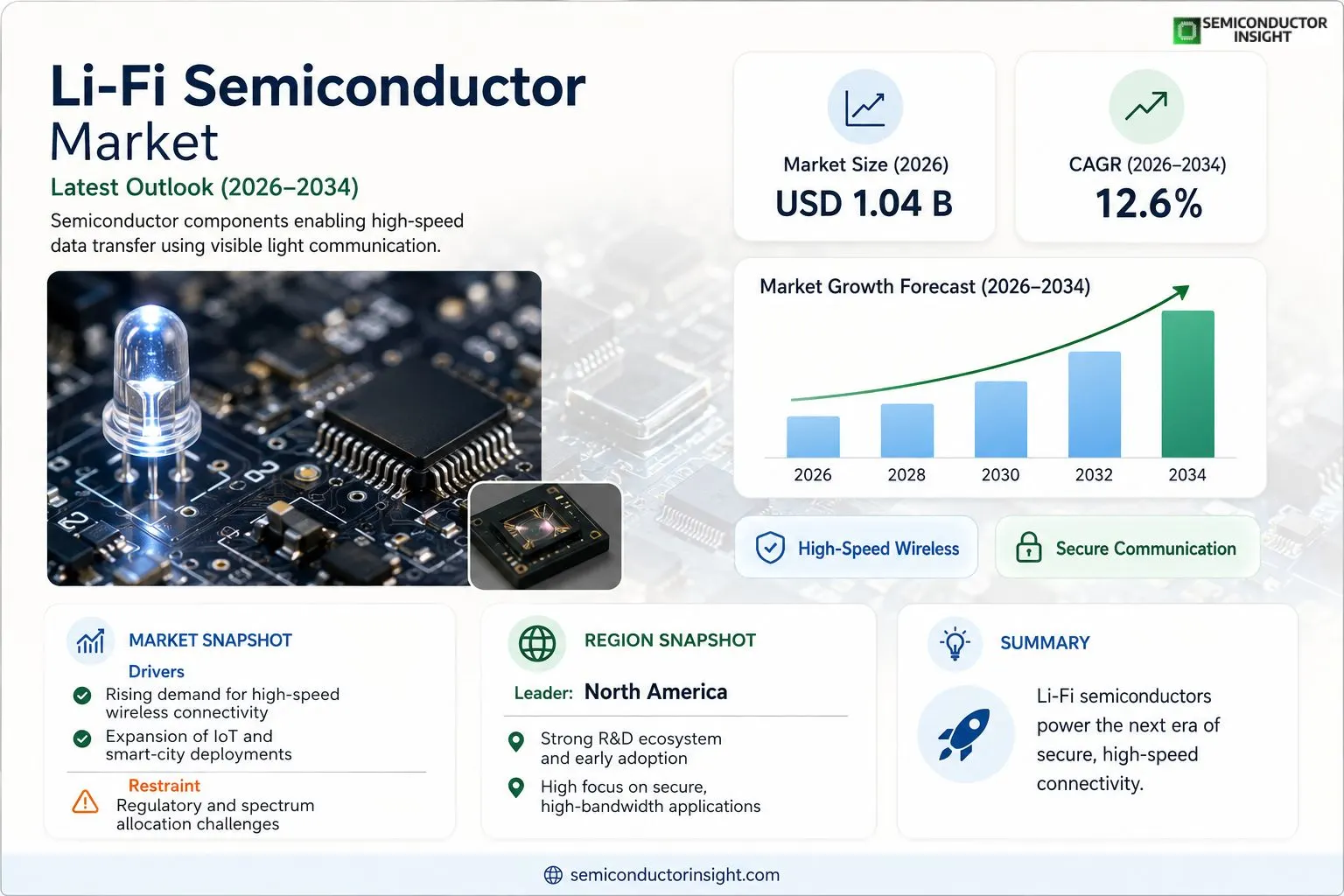
Global Li‑Fi semiconductor market is projected to grow from USD 1.04 billion in 2026 to USD 3.12 billion by 2034, exhibiting a CAGR of 12.6% during the forecast period.
Li‑Fi semiconductors are specialized optoelectronic components that convert visible light into high‑speed data signals and vice versa, enabling wireless communication through illumination sources such as LEDs or laser diodes. These devices integrate photodiodes, driver ICs, modulation circuits, and packaging technologies designed for indoor positioning, secure networking, and Internet‑of‑Things connectivity.The market is experiencing rapid expansion because enterprises seek higher bandwidth alternatives to congested radio‑frequency spectra, while recent standards such as IEEE 802.15.7c drive adoption across smart‑building projects. Furthermore, collaborations like Samsung’s partnership with pureLiFi announced in March 2024 to co‑develop next‑generation LED transceivers illustrate how leading players,pureLiFi, Signify (Philips Lighting), Oledcomm, and Acuity Brands,are accelerating product rollouts.
MARKET DRIVERS
Growing Demand for High‑Speed Wireless Connectivity
Li‑Fi Semiconductor Market is being propelled by enterprises that require multi‑gigabit data rates for real‑time analytics, video conferencing, and AR/VR experiences. 5G roll‑outs and the need for low‑latency backhaul have created a compelling case for optical wireless solutions that bypass congested radio frequencies.
Expansion of IoT and Smart‑City Deployments
Smart‑city initiatives and massive IoT networks rely on secure, interference‑free links. Li‑Fi technology, powered by advanced semiconductor components, offers encrypted data streams that support thousands of sensors per square meter, driving adoption across municipal lighting and traffic‑management systems.
➤ Industry analysts forecast a compound annual growth rate of over 30 % for Li‑Fi Semiconductor Market through 2030, underscoring its role in next‑generation connectivity.
Ultimately, the convergence of high‑bandwidth demand, edge‑computing workloads, and the push for sustainable wireless infrastructure will sustain the upward trajectory of Li‑Fi Semiconductor Market.
MARKET CHALLENGES
Technical Integration Barriers
Integrating Li‑Fi modules with existing RF‑based networking equipment requires redesign of PCB layouts and power management schemes. Manufacturers must address thermal dissipation and alignment tolerances, which can delay time‑to‑market for new semiconductor products.
Other Challenges
High Production Costs
Fabrication of visible‑light photodiodes and drivers at scale remains costly compared with mature silicon‑based RF chips, limiting price‑competitive entry for smaller vendors.
MARKET RESTRAINTS
Regulatory and Spectrum Allocation Issues
Although Li‑Fi operates in the unlicensed visible spectrum, some jurisdictions apply strict lighting standards and safety certifications that can slow product approvals. Aligning semiconductor design with varied global regulations adds complexity to market entry strategies.
MARKET OPPORTUNITIES
Emerging Applications in Healthcare and Aviation
Hospitals are adopting Li‑Fi for secure patient‑data transmission in environments where RF interference jeopardizes medical equipment. Similarly, aircraft cabins are exploring Li‑Fi for high‑speed passenger entertainment, creating a niche for rugged, low‑power semiconductor solutions.
Li-Fi Semiconductor Market Trends
Enterprise Shift Toward High‑Bandwidth Light‑Based Links
Li‑Fi Semiconductor Market is seeing a decisive shift as enterprises across finance, manufacturing, and logistics adopt light‑based data links to bypass congested RF bands. Li‑Fi semiconductor solutions leverage existing LED illumination to deliver multi‑gigabit throughput, thereby reducing latency and enhancing encryption at the physical layer. Recent pilot installations in European data centers show continuous high‑speed traffic over optical links while maintaining illumination standards, proving the technology can complement fiber backbones without major retrofits. In addition, the ability to modulate light at frequencies invisible to the human eye supports secure indoor networking, making the technology attractive for regulated sectors that prioritize data integrity.
Other Trends
Standardization and Interoperability
Adoption accelerates as industry consortia finalize IEEE 802.15.7c specifications, establishing common modulation schemes, channel‑access methods, and compliance test procedures. Vendors are aligning driver ICs, photodiodes, and packaging designs with the emerging standard, which reduces integration risk for system integrators and shortens time‑to‑market for smart‑building deployments. Collaborative testbeds across North America, Asia, and the Middle East demonstrate seamless handover between Li‑Fi and Wi‑Fi, highlighting the role of interoperable semiconductor modules. The standardized approach also encourages OEMs to embed transceiver chips directly into LED fixtures, fostering economies of scale that lower component cost and broaden the addressable market.
Integration with IoT and Smart‑Building Ecosystems
Manufacturers such as pureLiFi and Signify are embedding Li‑Fi transceivers directly into LED fixtures, enabling real‑time sensor data collection, precise indoor positioning, and secure access control without additional radio hardware. The convergence of light‑based communication with edge‑AI processing creates a unified platform for energy management, occupancy analytics, and predictive maintenance in smart‑building ecosystems. Early deployments in corporate campuses report measurable reductions in wireless interference and noticeable improvements in network reliability, affirming the strategic advantage of Li‑Fi semiconductor integration for future‑ready infrastructure. As more firms adopt hybrid architectures that combine fiber, Wi‑Fi, and light‑based links, the Li‑Fi semiconductor component stack is poised to become a foundational element of next‑generation connectivity.
COMPETITIVE LANDSCAPEKey Industry Players
Li‑Fi Semiconductor Market Competitive Overview
Li‑Fi Semiconductor Market is anchored by a few vertically integrated innovators that combine LED driver ICs, photodiodes, and modulation circuitry into single‑chip solutions. pureLiFi leads the space with its patented LED transceiver platform, benefiting from strategic alliances such as the 2024 Samsung partnership that accelerates commercialization in enterprise and smart‑building deployments. This leadership is reinforced by pureLiFi’s extensive IP portfolio and a clear focus on IEEE 802.15.7c compliance, which positions it as the de‑facto reference design for high‑speed visible‑light communications. The overall market structure is oligopolistic, with a handful of large players dominating design and a broader ecosystem of niche suppliers that specialize in component‑level innovations, packaging, or application‑specific modules.Beyond the leader, a diverse set of manufacturers contribute depth and breadth to the ecosystem. Signify (Philips Lighting) leverages its global lighting footprint to embed Li‑Fi transceivers in commercial luminaires, while Oledcomm supplies turnkey solutions for secure networking in government and defense sectors. Acuity Brands integrates Li‑Fi modules into its smart‑building portfolio, targeting secure indoor positioning. Samsung’s semiconductor arm supplies laser‑diode based emitters, and Luxshare Precision offers high‑volume packaging for cost‑sensitive IoT devices. Additional players such as Cisco, Huawei, Panasonic, Intel, and Broadcom are expanding into the visible‑light domain through either acquisition or in‑house R&D, adding competitive pressure across the value chain and fostering rapid technology diffusion.
List of Key Li‑Fi Semiconductor Companies Profiled
- pureLiFi
- Signify (Philips Lighting)
- Oledcomm
- Acuity Brands
- Samsung Electronics
- Luxshare Precision
- Cisco Systems
- Huawei Technologies
- Panasonic Corporation
- Intel Corporation
- Broadcom Inc.
- Taiyo Yuden
- Visigo Ltd.
- Luminus Devices
- Velux Lighting
Segment Analysis:
| Segment Category | Sub-Segments | Key Insights |
| By Type |
|
Photodiode Solutions – They are valued for high sensitivity and fast response, enabling reliable data capture even under low illumination. – Integration with driver ICs creates compact transceiver modules that simplify system design. – Manufacturers focus on improving packaging to enhance durability in commercial lighting fixtures. |
| By Application |
|
Indoor Positioning – Li‑Fi’s line‑of‑sight nature provides centimeter‑level accuracy, making it attractive for asset tracking in warehouses. – The technology dovetails with existing LED infrastructure, reducing deployment cost for location‑based services. – Enterprises view it as a way to enhance security by limiting signal propagation to defined spaces. |
| By End User |
|
Smart‑Building Integrators – They prioritize seamless integration of Li‑Fi with building management systems to deliver both illumination and data services. – The ability to provide secure, RF‑free communication aligns with corporate policies for electromagnetic compliance. – Collaboration with lighting OEMs accelerates rollout of bundled hardware‑software packages. |
| By Technology Trend |
|
Hybrid RF/Li‑Fi Solutions – Industry sees hybrid designs as a bridge for organizations transitioning from legacy Wi‑Fi to optical wireless. – Combining RF resilience with Li‑Fi bandwidth provides continuity in environments where line‑of‑sight cannot be guaranteed. – Partnerships such as Samsung and pureLiFi illustrate momentum toward integrated transceiver platforms. |
| By Deployment Scenario |
|
Office Environments – Companies leverage Li‑Fi to offload congested Wi‑Fi channels, especially in open‑plan workspaces with dense device counts. – The technology supports secure, line‑of‑sight communication that aligns with data‑privacy requirements. – Integration with smart‑lighting controls creates energy‑efficient networks that adapt illumination based on occupancy. |
Regional Analysis: North America
North America
The healthcare sector in North America is exploring Li-Fi for secure data transmission in sensitive environments. Its ability to operate without electromagnetic interference is particularly beneficial in hospitals and laboratories. Li-Fi can facilitate real-time monitoring of patient vitals and secure access to medical records, bolstering efficiency and data privacy.
The industrial sector is leveraging Li-Fi’s reliability and security for wireless control and monitoring of machinery. Its immunity to radio frequency interference makes it ideal for challenging industrial environments. This technology enables enhanced precision and data integrity in critical industrial processes.
Data centers and high-performance computing facilities are increasingly interested in Li-Fi to manage the burgeoning demands for data transfer. Li-Fi’s capacity for high bandwidth and secure communication makes it a viable alternative to traditional wireless technologies. This is a critical area of growth for Li-Fi semiconductors.
Li-Fi is finding applications in retail environments for in-store navigation, digital signage, and secure point-of-sale systems. Its ability to provide localized and secure wireless connectivity enhances the customer experience and streamlines operational processes.
Europe
Europe is witnessing a steady expansion of the Li-Fi semiconductor market, spurred by stringent data privacy regulations and a focus on energy efficiency. The region’s commitment to sustainable technologies aligns well with Li-Fi’s low-power characteristics. Strong research collaborations and government funding are accelerating development and deployment. Key applications include secure communication in critical infrastructure and specialized industrial settings.
Asia-Pacific
Asia-Pacific represents a high-growth potential market for Li-Fi semiconductors, driven by rapid urbanization and increasing demand for wireless connectivity. Countries like Japan and South Korea are pioneering Li-Fi adoption in areas such as public transportation and smart buildings. The region’s robust manufacturing base and proactive government policies are further propelling market expansion.
South America
South America is beginning to explore the potential of Li-Fi for niche applications like secure data transfer in financial institutions and specialized industrial facilities. While the market is still nascent, growing investments in infrastructure development are expected to create opportunities for Li-Fi adoption in the coming years.
Middle East & Africa
The Middle East & Africa region presents long-term growth prospects for the Li-Fi semiconductor market, particularly in sectors like oil and gas, healthcare, and smart city initiatives. The demand for secure and reliable wireless communication in challenging environments is driving adoption. Investment in smart infrastructure projects is expected to further accelerate market growth.
Report Scope
This market research report provides a comprehensive analysis of the Li-Fi Semiconductor Market , covering the forecast period 2026–2034. It offers detailed insights into market dynamics, technological advancements, competitive landscape, and key trends shaping the industry.
Key focus areas of the report include:
- Market Overview: The report begins with an overview outlining its current market scenario, key growth indicators, and industry transformation drivers. It discusses macroeconomic factors, demand–supply balance, regulatory landscape, and the strategic role of semiconductors in powering advancements across industries such as automotive, telecommunications, consumer electronics, and industrial automation.
- Market Size & Forecast: Historical data and future projections for revenue, unit shipments, and market value across major regions and segments.
- Segmentation Analysis: Detailed breakdown by product type, technology, application, and end-user industry to identify high-growth segments and investment opportunities.
- Regional Insights: Insights into market performance across North America, Europe, Asia-Pacific, Latin America, and the Middle East & Africa, including country-level analysis where relevant.
- Competitive Landscape: Profiles of leading market participants, including their product offerings, R&D focus, manufacturing capacity, pricing strategies, and recent developments such as mergers, acquisitions, and partnerships.
- Technology Trends & Innovation: Assessment of emerging technologies, integration of AI/IoT, semiconductor design trends, fabrication techniques, and evolving industry standards.
- Market Drivers & Restraints: Evaluation of factors driving market growth along with challenges, supply chain constraints, regulatory issues, and market-entry barriers.
- Stakeholder Insights: Insights for component suppliers, OEMs, system integrators, investors, and policymakers regarding the evolving ecosystem and strategic opportunities.
Primary and secondary research methods are employed, including interviews with industry experts, data from verified sources, and real-time market intelligence to ensure the accuracy and reliability of the insights presented.
FREQUENTLY ASKED QUESTIONS:
What is the current market size of Li-Fi Semiconductor Market?
-> Li‑Fi Semiconductor Market was valued at USD 0.92 billion in 2025 and is expected to reach USD 3.12 billion by 2034, reflecting a robust growth trajectory.
Which key companies operate in Li-Fi Semiconductor Market?
-> Key players include pureLiFi, Signify (Philips Lighting), Oledcomm, Acuity Brands, and Samsung, among others.
What are the key growth drivers?
-> Key growth drivers include the need for higher‑bandwidth alternatives to congested radio‑frequency spectra, adoption of IEEE 802.15.7c standards, and increasing smart‑building deployments.
Which region dominates the market?
-> The reference does not specify a single dominant region; market activity is observed globally.
What are the emerging trends?
-> Emerging trends include standardization efforts (IEEE 802.15.7c), integration with IoT platforms, and collaborative developments such as Samsung’s partnership with pureLiFi for next‑generation LED transceivers.

Get Sample Report PDF for Exclusive Insights
Report Sample Includes
- Table of Contents
- List of Tables & Figures
- Charts, Research Methodology, and more...
 Download Sample Report PDF