LEO Connectivity Market Insights
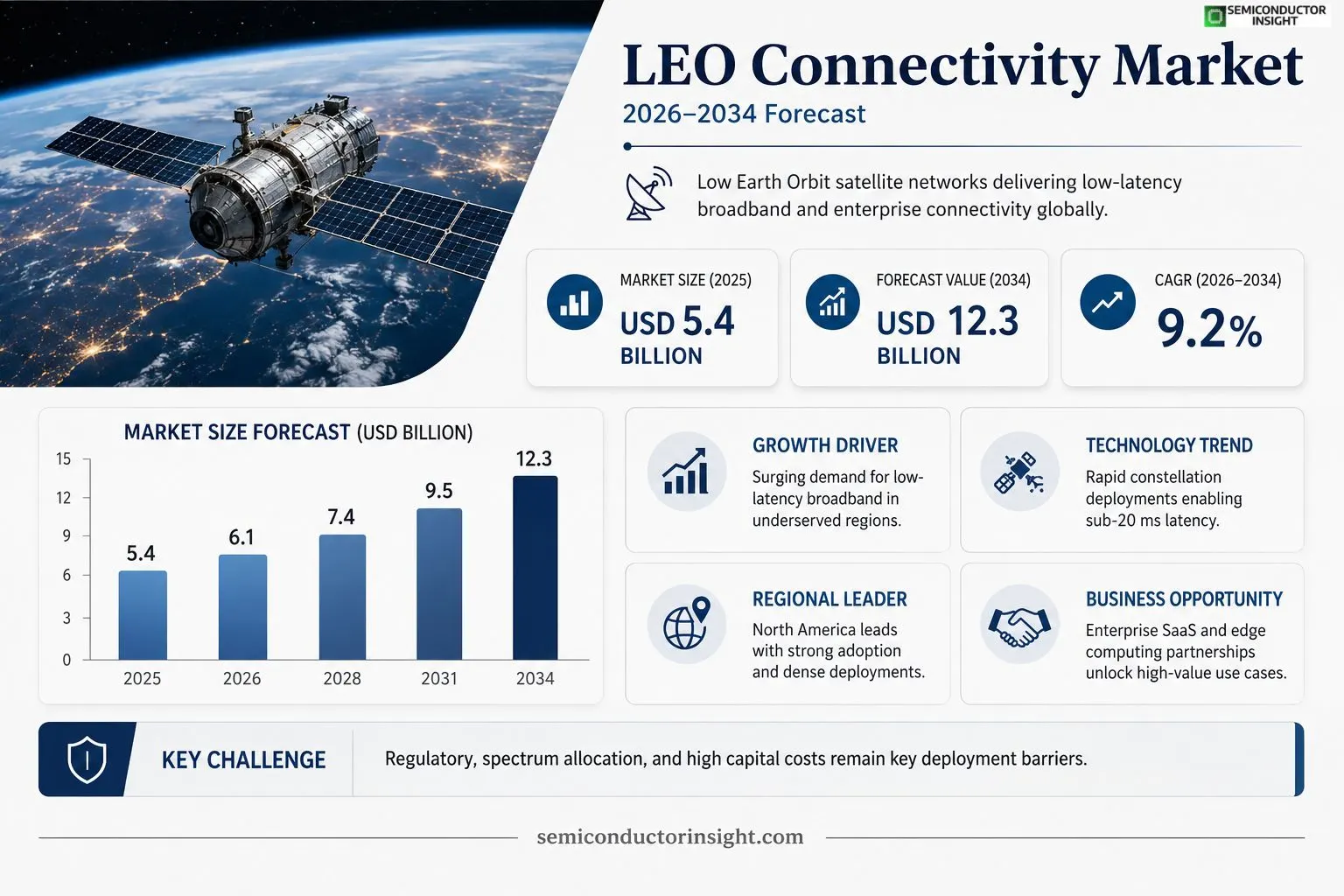
Global LEO connectivity market size was valued at USD 5.4 billion in 2025. The market is projected to grow from USD 6.1 billion in 2026 to USD 12.3 billion by 2034, exhibiting a CAGR of 9\.2 % during the forecast period.
LEO connectivity refers to broadband communication services delivered via satellites positioned in low‑earth orbit (typically 500‑2,000 km altitude). These constellations provide low‑latency (<20 ms) data links for consumer internet, enterprise backhaul, maritime and aviation connectivity, as well as massive machine‑type communications for IoT deployments.The market is experiencing rapid growth because telecom operators are seeking affordable high‑speed coverage in underserved regions while enterprises demand reliable low‑latency links for edge computing and autonomous systems.
Furthermore, substantial capital inflows,such as the USD 10 billion funding round for OneWeb in early 2024,and regulatory approvals for new spectrum bands are accelerating deployment schedules.
Key players including SpaceX (Starlink), OneWeb, Telesat Lightspeed and Amazon Project Kuiper continue expanding their constellations, driving competitive pricing and service diversification.
MARKET DRIVERS
Rising Demand for Global Broadband Coverage
LEO Connectivity Market is propelled by the urgent need to deliver high‑speed internet to underserved regions, especially in remote and maritime environments. Satellite operators are deploying constellations of low‑earth‑orbit nodes, which reduces latency to under 30 ms,making real‑time applications viable.
Growth of Data‑Intensive Applications
Emerging technologies such as autonomous drones, Internet of Things (IoT) sensors, and edge‑AI services require reliable, low‑latency backhaul. LEO Connectivity Market is benefitting from this trend, with enterprise contracts projected to increase by more than 20 % year‑over‑year.
➤ “By 2030, LEO constellations could generate over $30 billion in annual revenues, driven largely by broadband SaaS models.”
In addition, government initiatives targeting digital inclusion are allocating substantial funding, further accelerating satellite launch schedules and ground‑segment investments across LEO Connectivity Market.
MARKET CHALLENGES
Regulatory and Spectrum Allocation Issues
The rapid expansion of satellite megaconstellations faces complex international regulatory hurdles. Securing consistent spectrum rights in Ka‑band and V‑band remains a bottleneck, potentially delaying service roll‑outs in key markets.
Other Challenges
High Capital Expenditure
Deploying thousands of LEO satellites requires multibillion‑dollar investments, and financing constraints can limit the pace at which new entrants join LEO Connectivity Market. Moreover, insurance premiums for launch and in‑orbit operations have risen, adding to overall cost pressures.
MARKET RESTRAINTS
Technical Reliability Concerns
Maintaining a high‑throughput, low‑latency network across thousands of moving platforms introduces reliability challenges. Orbital debris risk, on‑orbit collisions, and the need for frequent replenishment flights can restrict long‑term scalability of LEO Connectivity Market.
MARKET OPPORTUNITIES
Enterprise SaaS and Edge Computing Partnerships
Collaborations between LEO providers and cloud service giants are unlocking new revenue streams. By integrating satellite backhaul with edge‑computing platforms, LEO Connectivity Market can deliver latency‑critical services,such as real‑time analytics for autonomous logistics,to enterprise customers worldwide.
LEO Connectivity Market Trends
Accelerated Constellation Deployments
LEO Connectivity Market is experiencing a pronounced acceleration in satellite constellation growth, as leading operators add dozens of new satellites each month to approach near‑global reach. This deployment cadence has pushed average latency below 20 ms for broadband users, effectively mimicking fiber‑grade performance for applications that demand real‑time response. Expanded coverage now includes isolated rural communities, underserved islands, and high‑altitude routes that were previously dependent on costly microwave links. By diversifying orbit slots and employing inter‑satellite laser links, providers are enhancing network resilience, reducing single‑point failures, and offering seamless handover for mobile users traversing vast territories. The cumulative effect is a more inclusive digital infrastructure that supports both consumer internet demand and critical communications for public safety agencies.
Other Trends
Regulatory and Spectrum Advances
Recent regulatory decisions have streamlined spectrum allocation for low‑earth orbit operators, with both North American and European bodies endorsing new Ka‑band and Q‑band assignments. These approvals eliminate longstanding licensing delays, allowing manufacturers to shift from test flights to commercial service launches within a shortened timeframe. Additionally, harmonized international filing procedures are reducing coordination overhead for cross‑border constellations, fostering faster integration of global coverage footprints. Governments are also issuing supportive policies that incentivize investment in ground‑segment infrastructure, such as user terminals and gateway stations, further accelerating the rollout of high‑capacity LEO services. This regulatory momentum is a key enabler for sustained network expansion and competitive pricing across the ecosystem.
Enterprise Edge and IoT Integration
Enterprises are increasingly turning to LEO services to meet the stringent latency and reliability requirements of edge computing, autonomous platforms, and massive machine‑type communications. Sectors such as maritime logistics, commercial aviation, and large‑scale IoT deployments are leveraging low‑latency links to replace legacy satellite systems, achieving more deterministic data transmission for real‑time analytics and remote operation control. The ability to provide consistent broadband across sea lanes and flight corridors is unlocking new business models, including predictive maintenance, on‑board entertainment, and real‑time cargo monitoring. As edge data centers proliferate near the network fringe, LEO Connectivity Market is positioned to become the backbone for distributed intelligence, ensuring that critical workloads remain responsive regardless of geographic constraints.
COMPETITIVE LANDSCAPEKey Industry Players
LEO Connectivity Market Competitive Landscape
LEO Connectivity Market is dominated by a handful of vertically integrated constellations that combine satellite manufacturing, launch capability, and end‑user services. SpaceX’s Starlink remains the largest operator, with over 4,500 active satellites delivering sub‑20 ms latency to more than 500 million users worldwide. OneWeb, backed by a $10 billion funding round, is rapidly expanding its 648‑satellite network to serve enterprise backhaul and maritime customers, while Telesat Lightspeed is targeting high‑value government and data‑center interconnect segments with a 298‑satellite architecture. Amazon’s Project Kuiper, slated for a 3,236‑satellite rollout, seeks to leverage Amazon Web Services to bundle cloud and connectivity, intensifying price competition and accelerating spectrum allocation approvals. This concentration of scale‑driven players creates a tiered market where premium, low‑latency services command premium pricing, and mass‑market broadband competes on cost and coverage breadth.Beyond the headline constellations, a diverse set of niche operators and technology partners is shaping specialized value propositions. AST SpaceMobile is pursuing direct‑to‑handset connectivity for mobile network operators, while Samsung Electronics is collaborating on satellite‑enabled smartphones to broaden consumer adoption. Smaller firms such as Kepler Communications and Swarm Technologies focus on IoT and machine‑type communications, offering small‑packet data plans for maritime, logistics, and remote‑sensing applications. Rocket Lab’s Photon service provides on‑demand launch and orbital hosting for bespoke LEO payloads, enabling rapid entry for emerging startups. Iridium Communications, although originally a medium‑earth orbit system, is augmenting its portfolio with hybrid LEO services to improve latency for mission‑critical voice and telemetry. This ecosystem of focused players adds depth to the competitive landscape, fostering innovation in ground‑segment integration, spectrum sharing, and value‑added services.
List of Key LEO Connectivity Companies Profiled
- SpaceX (Starlink)
- OneWeb
- Telesat Lightspeed
- Amazon Project Kuiper
- AST SpaceMobile
- Samsung Electronics (Satellite Services)
- Kepler Communications
- Swarm Technologies
- Rocket Lab (Photon Satellite Service)
- Iridium Communications (Hybrid LEO)
- Hughes Network Systems
- LeoSat (Planned Constellation)
- BlueWalker (Blue Star Satellite)
- Rokwire (formerly LeoStella)
- Prodea Systems
Segment Analysis:
| Segment Category | Sub-Segments | Key Insights |
| By Type |
|
Broadband Internet drives mass‑market adoption by extending high‑speed connectivity to remote households – it fuels new digital experiences such as online learning and tele‑health – it pressures service providers to innovate pricing and bundle options, creating a competitive ecosystem that lowers entry barriers for users. |
| By Application |
|
Edge Computing leverages the ultra‑low latency of LEO constellations to enable real‑time data processing at the network edge – it supports autonomous vehicle algorithms and remote industrial automation – it encourages a shift from centralized clouds to distributed intelligence, enhancing resilience and responsiveness across sectors. |
| By End User |
|
Enterprise & Industrial prioritizes reliable, low‑latency links for mission‑critical operations – LEO connectivity underpins secure communications for remote sites, disaster response, and critical national infrastructure – the segment drives demand for scalable service models that can be integrated with existing terrestrial networks. |
| By Service Model |
|
Subscription model is emerging as the preferred approach for steady revenue streams – it aligns with consumer expectations for predictable costs and service continuity – providers are tailoring tiered packages that balance data caps with performance guarantees, fostering deeper customer loyalty. |
| By Technology Integration |
|
Hybrid Satellite‑Terrestrial strategies combine LEO agility with existing ground infrastructure – they enhance coverage redundancy and improve service quality in dense urban zones – this integration encourages ecosystem partnerships, allowing operators to leverage diverse assets for a seamless user experience. |
Regional Analysis: North America
North America
Government support through funding and regulatory frameworks is a significant catalyst for LEO connectivity development in North America. Initiatives focused on bridging the digital divide and promoting rural broadband access are directly contributing to market growth.
Businesses across various sectors, including logistics, manufacturing, and media, are increasingly embracing LEO connectivity to enhance operational efficiency, improve data transmission, and support remote workforces.
The proliferation of IoT devices is driving demand for LEO connectivity to enable seamless data transfer from remote sensors and devices, supporting applications in agriculture, environmental monitoring, and smart cities.
Ensuring the security and resilience of LEO networks is paramount, particularly for government and critical infrastructure applications. Robust security protocols and data encryption are essential for building trust and fostering wider adoption.
Europe
Europe presents a mature telecommunications market with a strong focus on network densification and the integration of new technologies. While existing infrastructure is well-developed, LEO connectivity offers a valuable complement, particularly in challenging terrains and for specialized use cases requiring high bandwidth and low latency. The European Union’s emphasis on digital sovereignty and connectivity targets is expected to further stimulate the adoption of LEO solutions across the continent.
Asia-Pacific
The Asia-Pacific region is characterized by diverse market dynamics, ranging from rapidly urbanizing areas to remote rural communities. LEO connectivity holds significant potential in this region to address the growing demand for broadband access, particularly in areas where terrestrial infrastructure is limited or cost-prohibitive. The expanding IoT market and the increasing adoption of cloud-based services are further driving the need for reliable and affordable connectivity solutions.
South America
South America faces unique connectivity challenges due to its vast geographical expanse and uneven infrastructure development. LEO connectivity offers a compelling solution to bridge the digital divide and provide access to high-speed internet in underserved regions. The growing demand for e-commerce and digital services is fueling the need for improved connectivity, making LEO a viable option for expanding market reach.
Middle East & Africa
The Middle East and Africa represent high-growth potential markets for LEO connectivity. Several countries in this region are actively investing in digital infrastructure to support economic diversification and sustainable development. LEO solutions can play a crucial role in connecting remote communities, facilitating business operations, and enabling the deployment of innovative applications like smart agriculture and remote healthcare.
Report Scope
This market research report provides a comprehensive analysis of the LEO Connectivity Market , covering the forecast period 2026–2034. It offers detailed insights into market dynamics, technological advancements, competitive landscape, and key trends shaping the industry.
Key focus areas of the report include:
- Market Overview: The report begins with an overview outlining its current market scenario, key growth indicators, and industry transformation drivers. It discusses macroeconomic factors, demand–supply balance, regulatory landscape, and the strategic role of semiconductors in powering advancements across industries such as automotive, telecommunications, consumer electronics, and industrial automation.
- Market Size & Forecast: Historical data and future projections for revenue, unit shipments, and market value across major regions and segments.
- Segmentation Analysis: Detailed breakdown by product type, technology, application, and end-user industry to identify high-growth segments and investment opportunities.
- Regional Insights: Insights into market performance across North America, Europe, Asia-Pacific, Latin America, and the Middle East & Africa, including country-level analysis where relevant.
- Competitive Landscape: Profiles of leading market participants, including their product offerings, R&D focus, manufacturing capacity, pricing strategies, and recent developments such as mergers, acquisitions, and partnerships.
- Technology Trends & Innovation: Assessment of emerging technologies, integration of AI/IoT, semiconductor design trends, fabrication techniques, and evolving industry standards.
- Market Drivers & Restraints: Evaluation of factors driving market growth along with challenges, supply chain constraints, regulatory issues, and market-entry barriers.
- Stakeholder Insights: Insights for component suppliers, OEMs, system integrators, investors, and policymakers regarding the evolving ecosystem and strategic opportunities.
Primary and secondary research methods are employed, including interviews with industry experts, data from verified sources, and real-time market intelligence to ensure the accuracy and reliability of the insights presented.
FREQUENTLY ASKED QUESTIONS:
What is the current market size of LEO Connectivity Market?
-> LEO Connectivity Market was valued at USD 5.4 billion in 2025 and is expected to reach USD 12.3 billion by 2034, reflecting a CAGR of 9.2% over the forecast period.
Which key companies operate in LEO Connectivity Market?
-> Key players include SpaceX (Starlink), OneWeb, Telesat Lightspeed, and Amazon Project Kuiper, among others.
What are the key growth drivers?
-> Key growth drivers include telecom operators seeking affordable high‑speed coverage in underserved regions, enterprises demanding low‑latency links for edge computing and autonomous systems, substantial capital inflows such as the USD 10 billion funding round for OneWeb, and regulatory approvals for new spectrum bands.
Which region dominates the market?
-> The market is global, with strong activity in North America, Europe, and Asia‑Pacific. No single region overwhelmingly dominates, but deployment density is highest in North America and Europe.
What are the emerging trends?
-> Emerging trends include low‑latency broadband services for edge computing, integration of massive IoT connectivity, expansion of maritime and aviation satellite links, and ongoing regulatory developments facilitating new spectrum allocations.

Get Sample Report PDF for Exclusive Insights
Report Sample Includes
- Table of Contents
- List of Tables & Figures
- Charts, Research Methodology, and more...
 Download Sample Report PDF