Lens-type Under Screen Fingerprint Sensors Market Insights
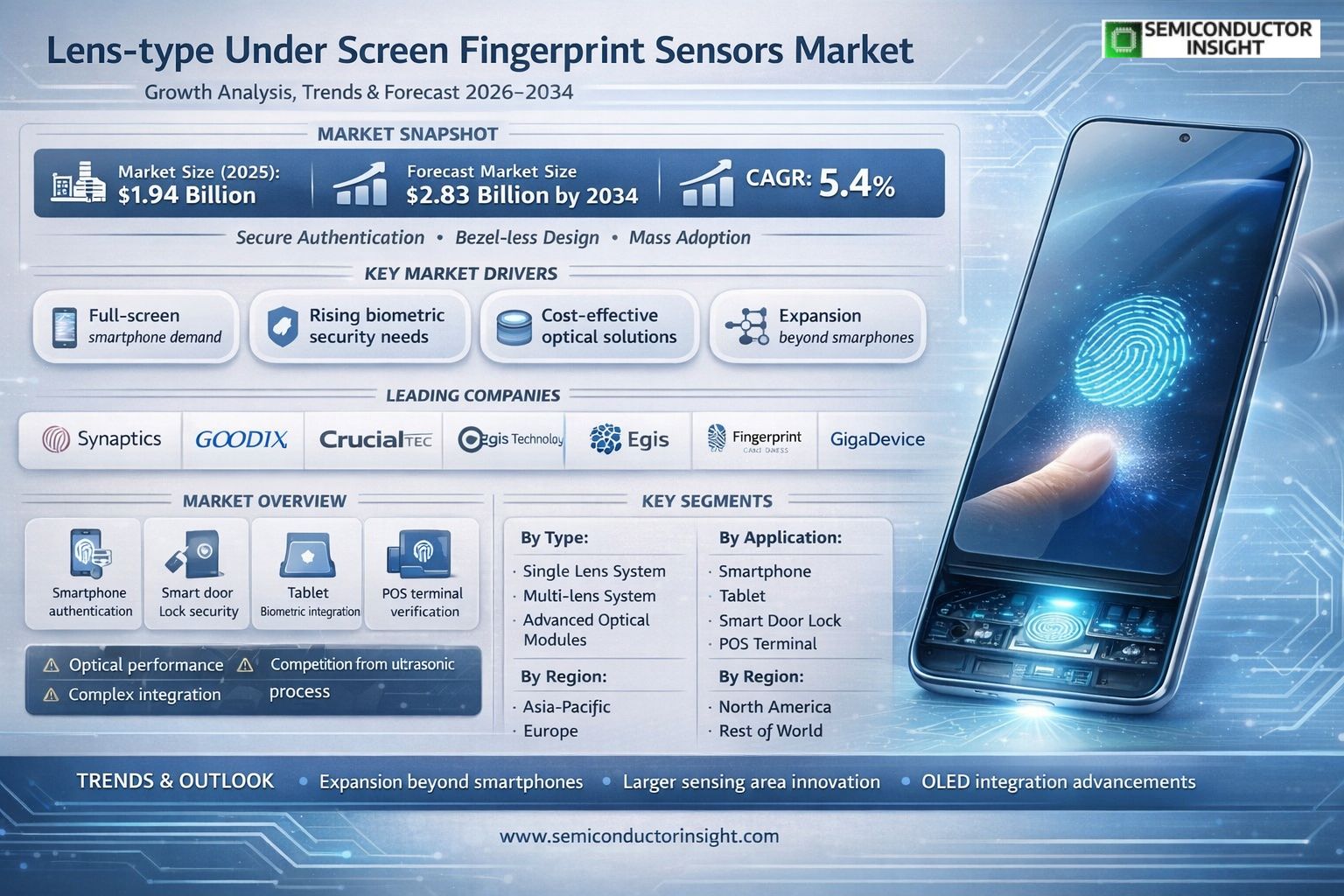
Global Lens-type Under Screen Fingerprint Sensors market size was valued at USD 1.94 billion in 2025. The market is projected to grow from USD 2.04 billion in 2026 to USD 2.83 billion by 2034, exhibiting a CAGR of 5.4% during the forecast period.
Lens-type under-screen fingerprint sensors are advanced biometric modules that achieve high-precision fingerprint image capture by integrating a micro lens and light source beneath the display panel. This technology uses a lens system to focus the optical image of the user’s finger onto a high-resolution image sensor, enabling accurate acquisition of fingerprint details even when the screen is illuminated. When a user touches the designated area, an OLED light-emitting layer illuminates the fingerprint; the lens then captures and transmits this image to a processing unit for comparison and verification.
The market is experiencing steady growth driven by several key factors, including the relentless pursuit of full-screen, bezel-less smartphone designs and increasing consumer demand for seamless, secure authentication. However, it faces challenges from competing technologies like ultrasonic sensors, which offer better performance with wet fingers. Recent developments by key players are crucial for market expansion; for instance, companies like Goodix Technology and Synaptics continue to refine their optical solutions to improve speed and accuracy while reducing module thickness. Furthermore, adoption is expanding beyond smartphones into applications such as tablets, smart door locks, and POS terminals, creating new growth avenues in the Internet of Things (IoT) ecosystem.
MARKET DRIVERS
Strong Demand for Enhanced Mobile Security and Convenience
The primary driver for the Lens-type Under Screen Fingerprint Sensors Market is the sustained consumer demand for seamless and secure device authentication. As smartphones become central to digital finance and identity, users prioritize biometric security that does not compromise screen design. Lens-type technology, which captures a high-resolution 2D fingerprint image through the display, offers a familiar and reliable user experience. This has cemented its position as a mainstream solution, especially in the mid-range smartphone segment, where it balances cost and performance effectively.
Cost-Effective Integration and Manufacturing Scalability
Compared to ultrasonic alternatives, lens-type optical sensors benefit from more mature and cost-effective manufacturing processes. Their design leverages established CMOS image sensor technology, allowing for rapid scaling and integration by display and module manufacturers. This cost advantage enables smartphone OEMs to incorporate under-display fingerprint sensing into a wider range of models, significantly expanding the total addressable market for Lens-type Under Screen Fingerprint Sensors.
➤ The evolution towards full-screen displays with minimal bezels has made under-panel biometrics not a luxury, but a necessity for modern smartphone design.
This design imperative directly fuels adoption. Furthermore, advancements in algorithms have improved recognition speed and accuracy in diverse conditions, addressing earlier limitations and boosting consumer confidence in the technology within the Lens-type Under Screen Fingerprint Sensors Market.
MARKET CHALLENGES
Technical Limitations in Performance and Reliability
A significant challenge facing the Lens-type Under Screen Fingerprint Sensors Market is the inherent limitation of optical technology. Performance can degrade under bright ambient light or with screen protectors, leading to failed authentication attempts. The sensor requires the screen to emit light, which can be a minor power drain and poses potential challenges with newer, more power-efficient display types. These factors can impact the perceived reliability compared to other biometric methods.
Other Challenges
Competition from Alternative Technologies
The market faces intense competition from ultrasonic fingerprint sensors, which offer superior performance through certain materials and in wet conditions, and from evolving facial recognition systems. This pressures lens-type sensor providers to continuously innovate on cost and performance to maintain market share.
Supply Chain and Component Complexity
Integrating the sensor module with the display assembly adds complexity to the manufacturing process. This requires close collaboration between sensor makers, display panel manufacturers, and smartphone brands, creating potential bottlenecks and quality control challenges in the supply chain.
MARKET RESTRAINTS
Market Saturation and Slowing Smartphone Innovation Cycles
A key restraint for the Lens-type Under Screen Fingerprint Sensors Market is the slowing global smartphone replacement cycle. As market growth plateaus, the volume of new devices integrating this technology faces a natural ceiling. Furthermore, the technology has become a standard feature in many segments, reducing its role as a key differentiator that can drive consumer upgrades, thereby limiting premium pricing potential and squeezing profit margins for sensor vendors.
Security Perception and Standardization Hurdles
While convenient, 2D optical sensing is often perceived as less secure than 3D ultrasonic sensing or traditional capacitive sensors, as it can potentially be fooled by high-resolution photographs. This perception, though addressed by liveness detection software, can restrain adoption in applications requiring the highest security assurance. The lack of universal performance and security standards also creates market fragmentation.
MARKET OPPORTUNITIES
Expansion into New Device Segments and Applications
The most promising opportunity for the Lens-type Under Screen Fingerprint Sensors Market lies beyond smartphones. The technology is poised for adoption in other consumer electronics, such as tablets, premium laptops, and smart home devices, where secure, convenient user authentication is increasingly valued. This expansion into new verticals represents a significant growth avenue to offset slowing smartphone sales.
Advancements in Multi-Modal Biometrics and IoT Integration
Innovation in sensor fusion presents a major opportunity. Integrating lens-type fingerprint sensing with other biometric modalities like facial recognition or behavioral analytics can create more secure and adaptive multi-factor authentication systems. Furthermore, as the Internet of Things (IoT) ecosystem grows, these sensors could provide essential secure identity verification for access control, automotive applications, and industrial IoT, diversifying the market’s revenue streams.
Lens-type Under Screen Fingerprint Sensors Market Trends
Expansion into New Device Categories
The primary application of lens-type under screen fingerprint sensors has been in the smartphone segment, where they are valued for enabling sleek, bezel-less designs while maintaining high-precision biometric security. However, the recent trend shows significant expansion into other consumer and commercial electronics. For example, adoption is increasing in tablets for an integrated user experience and in smart door locks for enhanced, keyless security systems. This diversification of the Lens-type Under Screen Fingerprint Sensors Market reduces reliance on the smartphone sector and opens new revenue streams for manufacturers.
Other Trends
Continued Technological Refinement for Larger Sensing Areas
Ongoing innovation is focused on improving the performance and size of the sensing area. Manufacturers are developing advanced lens systems and more sophisticated algorithms to enable faster and more accurate reading through thicker glass and screen protectors. The push toward larger, single-touch authentication zones under the screen is a key competitive focus, enhancing user convenience and enabling new form factors in high-end mobile devices, which remains a core driver for the Lens-type Under Screen Fingerprint Sensors Market.
Heightened Market Competition and Strategic Focus
The market is characterized by a competitive landscape where established players like Synaptics, Goodix Technology, and CrucialTec compete with emerging technology firms from Asia. This intense competition is driving strategic investments in research and development for cost reduction and performance enhancement. A trend is also observed in the forming of strategic partnerships with display and smartphone OEMs to integrate sensor technology more seamlessly, ensuring design wins in flagship device launches and securing long-term supply agreements.
COMPETITIVE LANDSCAPE
Key Industry Players
Market Dominated by Specialized Providers in Optical Sensing and Authentication
Global lens-type under-screen fingerprint sensor market is characterized by intense competition among a mix of established semiconductor firms and specialized security solution providers, with the top five players collectively accounting for a significant revenue share. Synaptics, leveraging its legacy in human interface systems, and Goodix Technology, a major force from China, are prominent leaders. Their competitive edge stems from deep integration capabilities with OLED display manufacturers and advanced algorithm development for fast, reliable authentication. The market structure is further defined by key players such as CrucialTec and Egis Technology, which focus on optimizing optical lens systems and sensor miniaturization to cater to the demanding design requirements of flagship smartphones, which remain the primary application.
Beyond the dominant leaders, a cadre of significant niche and regional players contributes to a diversified competitive field. Companies like Beijing Chipone Technology (Chipone), Fingerprint Cards, and Beijing GigaDevice (GigaDevice) are expanding their footprint by offering cost-competitive and energy-efficient solutions, targeting mid-range smartphone models and adjacent markets like smart door locks and POS terminals. The competitive dynamics are driven by continuous R&D in multi-lens systems for enhanced accuracy, patent portfolios around optical acquisition methods, and strategic partnerships with smartphone OEMs. The entrance of biometric-focused firms such as NEXT Biometrics and emerging manufacturers in Asia is intensifying price competition while pushing technological boundaries in spoof detection and all-screen sensing areas.
List of Key Lens-type Under Screen Fingerprint Sensor Companies Profiled
- Synaptics Incorporated
- CrucialTec Co., Ltd.
- Goodix Technology (Shenzhen Goodix Technology Co., Ltd.)
- Beijing Chipone Technology Co., Ltd. (Chipone)
- Beijing GigaDevice Semiconductor Inc. (GigaDevice)
- Egis Technology Inc.
- Fingerprint Cards AB
- NEXT Biometrics Group ASA
- Shenzhen Xinguodu Technology Co., Ltd.
- Suprema Inc.
- Qualcomm Incorporated (via secure processing platforms)
- Holtek Semiconductor Inc.
- IDEMIA (Part of Advent International)
- CMOS Sensor Inc. (Specialized optical sensor designers)
- OXi Technology
Segment Analysis:
| Segment Category | Sub-Segments | Key Insights |
| By Type |
|
Multi-lens System is emerging as a key focus area for premium applications, offering enhanced accuracy and reliability over traditional single-lens designs. Its superior ability to capture high-resolution fingerprint images through multiple optical paths addresses critical security and performance demands in flagship devices. This technological advancement is driving investments from leading sensor manufacturers aiming to differentiate their offerings in a competitive market, though it presents higher manufacturing complexity. The ongoing miniaturization of components and integration challenges remain pivotal areas for research and development to improve cost-effectiveness and adoption rates across broader product tiers. |
| By Application |
|
Smartphone is the dominant and primary growth driver for lens-type under-screen sensors, serving as the benchmark for seamless user authentication in modern mobile devices. The relentless pursuit of full-screen, bezel-less designs by smartphone OEMs has cemented the integration of these sensors as a standard premium feature. Beyond basic unlocking, the technology is increasingly vital for securing mobile payments and sensitive applications, creating a robust demand pipeline. Continuous innovation is focused on expanding the active sensing area, improving recognition speed in diverse conditions, and reducing power consumption to align with overall device performance and battery life goals. |
| By End User |
|
Consumer Electronics OEMs represent the core customer base, dictating product specifications and driving volume adoption. Their stringent requirements for thin form factors, high durability, and flawless performance under various screen technologies and lighting conditions shape sensor development roadmaps. Competition among OEMs to offer cutting-edge security features creates a strong pull for advanced lens-type systems. This segment’s influence extends to supply chain dynamics and cost pressure, fostering deep, collaborative partnerships between sensor manufacturers and device makers to co-develop customized solutions that integrate seamlessly into next-generation product designs. |
| By Technology Integration |
|
OLED Display-Compatible Sensors are the foremost category, leveraging the self-emissive properties of OLED panels to provide the light source necessary for the lens to capture fingerprint images. This synergy offers superior performance, thinner module profiles, and is the preferred choice for high-end devices. The maturity of this integration path has established a clear technological benchmark. However, ongoing innovation focuses on enhancing light efficiency and overcoming challenges related to screen wear patterns and longevity, ensuring consistent sensor performance throughout the device’s lifecycle and across different OLED supplier technologies. |
| By Authentication Method Synergy |
|
Multi-Factor Biometric Systems is the segment demonstrating significant strategic importance, where lens-type fingerprint sensors are integrated with facial recognition or iris scanning to create layered security architectures. This trend is pronounced in devices for enterprise and high-security applications, moving beyond convenience to ensure robust identity verification. The lens-type sensor’s role in such systems is valued for its high spoof resistance and reliable performance. This integration drives demand for sensors with enhanced software algorithms capable of secure, efficient data fusion and processing within a unified trusted execution environment. |
Regional Analysis: Global Lens-type Under Screen Fingerprint Sensors Market
Asia-Pacific
The region hosts the world’s most integrated supply chain for smartphone components. The proximity of sensor fabricators, display manufacturers, and final assembly plants facilitates rapid innovation cycles and cost-competitive mass production of Lens-type Under Screen Fingerprint Sensors, giving local OEMs a significant strategic advantage.
Leading smartphone brands based in the Asia-Pacific region are in a perpetual race to offer premium features in mid-range devices. The integration of Lens-type Under Screen Fingerprint Sensors is a key differentiator, driving relentless R&D to improve speed and accuracy, which in turn fuels continuous market expansion and technological refinement.
A tech-savvy, young demographic with high smartphone penetration rates creates immense demand. Consumers in this region prioritize modern design features like full-screen displays, directly translating to higher uptake of devices equipped with under-screen biometric solutions, sustaining the market’s growth momentum.
Fierce competition among numerous sensor suppliers and smartphone OEMs has driven down the average selling price of Lens-type sensors. This cost erosion has been instrumental in proliferating the technology from flagship models down to budget segments, dramatically expanding the accessible market size within the region.
North America
North America represents a high-value, technology-leading market for Lens-type Under Screen Fingerprint Sensors, characterized by early adoption of premium devices. While volume may be lower than Asia-Pacific, the region sets important trends in security and user experience that influence global R&D priorities. Demand is driven by a consumer base with high disposable income and a preference for flagship smartphones from leading brands that incorporate advanced biometrics. The market dynamics are shaped less by manufacturing and more by software integration, security certification standards, and the competitive strategies of major technology firms headquartered in the region, which prioritize robust and seamless authentication methods.
Europe
The European market for Lens-type Under Screen Fingerprint Sensors is mature and regulated, with strong emphasis on data privacy and security under frameworks like GDPR. This influences the adoption and implementation of biometric sensors, with manufacturers ensuring high compliance standards. Demand is steady, driven by replacement cycles for premium and mid-range smartphones. While not a major manufacturing base, Europe is a critical consumption region with discerning consumers who value both design and privacy. Market growth is supported by the strong presence of global smartphone brands and a robust telecommunications infrastructure that promotes the adoption of feature-rich devices.
South America
South America is an emerging market with growing potential for the Lens-type Under Screen Fingerprint Sensors Market. Growth is primarily driven by increasing smartphone penetration and a rising middle class seeking feature-rich devices at accessible price points. The market dynamics are influenced by the gradual trickle-down of technology, where features once reserved for flagships become available in mid-range models. Economic fluctuations can impact consumer spending, but the overall trend is towards modernization, with local and Chinese smartphone brands competing aggressively and bringing advanced features like under-screen sensors to a broader audience, fueling gradual market expansion.
Middle East & Africa
The Middle East & Africa region presents a diverse and evolving landscape for the Lens-type Under Screen Fingerprint Sensors Market. High-income Gulf countries exhibit demand patterns similar to developed markets, with a preference for luxury and latest-technology smartphones. In contrast, growth in other parts of Africa is driven by increasing mobile connectivity and the entry of affordable smartphone models. The overall market is nascent but growing, with potential spurred by urbanization and digitalization initiatives. The adoption of under-screen biometrics is currently concentrated in premium segments, but it is expected to gradually permeate as device affordability improves and consumer awareness increases.
Report Scope
This market research report provides a comprehensive analysis of the Lens-type Under Screen Fingerprint Sensors Market , covering the forecast period 2026–2034. It offers detailed insights into market dynamics, technological advancements, competitive landscape, and key trends shaping the industry.
Key focus areas of the report include:
- Market Overview: The report begins with an overview outlining its current market scenario, key growth indicators, and industry transformation drivers. It discusses macroeconomic factors, demand–supply balance, regulatory landscape, and the strategic role of semiconductors in powering advancements across industries such as automotive, telecommunications, consumer electronics, and industrial automation.
- Market Size & Forecast: Historical data and future projections for revenue, unit shipments, and market value across major regions and segments.
- Segmentation Analysis: Detailed breakdown by product type, technology, application, and end-user industry to identify high-growth segments and investment opportunities.
- Regional Insights: Insights into market performance across North America, Europe, Asia-Pacific, Latin America, and the Middle East & Africa, including country-level analysis where relevant.
- Competitive Landscape: Profiles of leading market participants, including their product offerings, R&D focus, manufacturing capacity, pricing strategies, and recent developments such as mergers, acquisitions, and partnerships.
- Technology Trends & Innovation: Assessment of emerging technologies, integration of AI/IoT, semiconductor design trends, fabrication techniques, and evolving industry standards.
- Market Drivers & Restraints: Evaluation of factors driving market growth along with challenges, supply chain constraints, regulatory issues, and market-entry barriers.
- Stakeholder Insights: Insights for component suppliers, OEMs, system integrators, investors, and policymakers regarding the evolving ecosystem and strategic opportunities.
Primary and secondary research methods are employed, including interviews with industry experts, data from verified sources, and real-time market intelligence to ensure the accuracy and reliability of the insights presented.
FREQUENTLY ASKED QUESTIONS:
What is the current market size of Lens-type Under Screen Fingerprint Sensors Market?
-> Global Lens-type Under Screen Fingerprint Sensors market was valued at USD 1945 million in 2025 and is projected to reach USD 2831 million by 2034, growing at a CAGR of 5.4% during the forecast period.
Which key companies operate in Lens-type Under Screen Fingerprint Sensors Market?
-> Key players include Synaptics, CrucialTec, Goodix Technology, Beijing Chipone Technology, Beijing GigaDevice, Egis Technology, Fingerprint Cards, and NEXT Biometrics, among others.
What are the key growth drivers?
-> Key growth drivers include increasing adoption in smartphones and tablets for biometric security, demand for sleek and secure device designs, and technological advancements enabling high-precision fingerprint capture under screens.
Which region dominates the market?
-> Asia is a significant market, with China exhibiting considerable growth, while sizeable markets are also present in North America and Europe.
What are the emerging trends?
-> Emerging trends include integration with OLED displays for improved illumination, the development of multi-lens systems for enhanced accuracy, and expansion into new applications like smart door locks and POS terminals.

Get Sample Report PDF for Exclusive Insights
Report Sample Includes
- Table of Contents
- List of Tables & Figures
- Charts, Research Methodology, and more...
 Download Sample Report PDF