Lead Type Solid Capacitor Market Insights
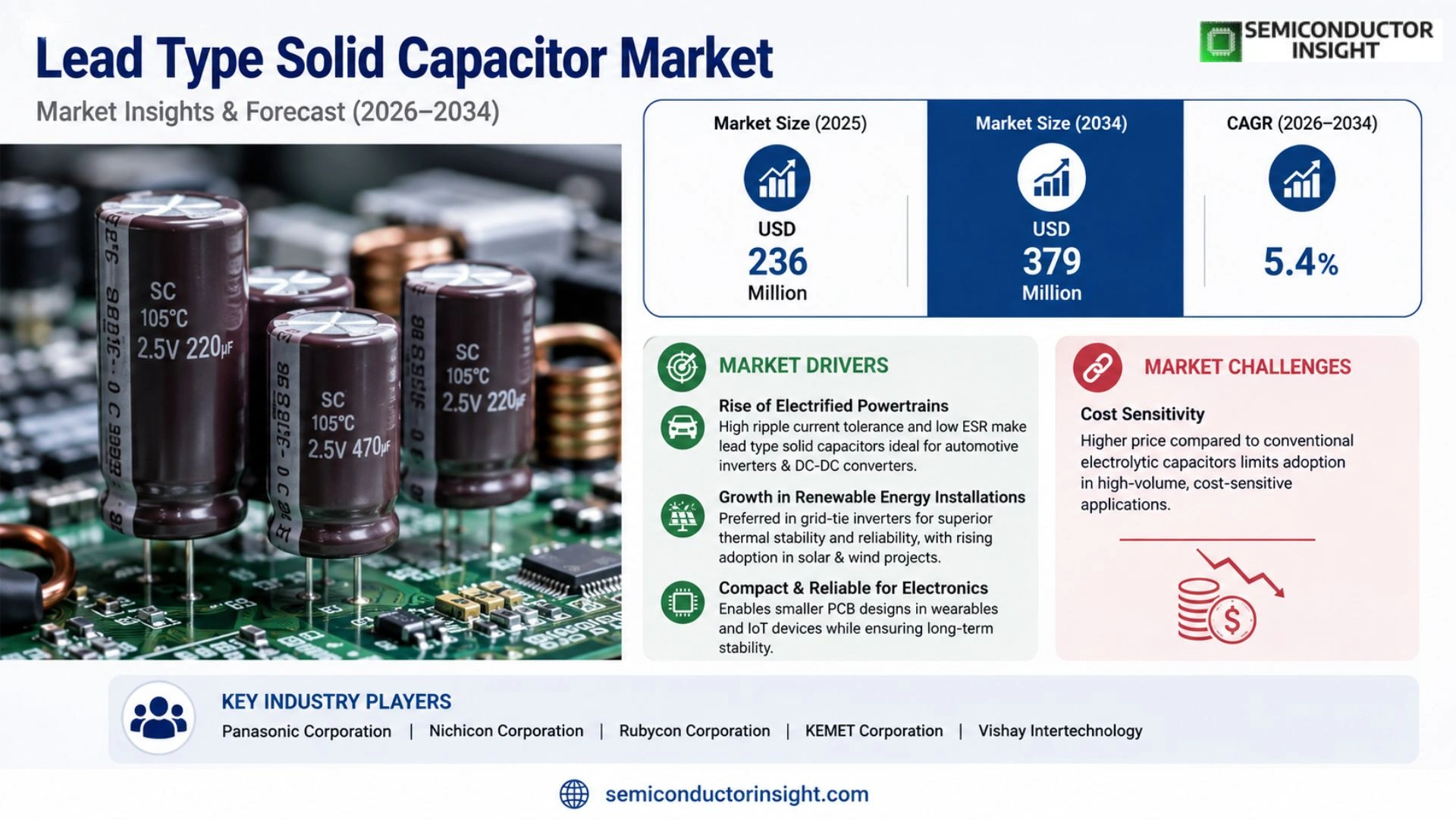
Lead Type Solid Capacitor market size was valued at USD 236 million in 2025 and is expected to reach approximately USD 379 million by 2034, implying a CAGR of about 5.4% over the forecast horizon.
A lead‑type solid capacitor incorporates a solid electrolyte,typically a conductive polymer,wound around high‑purity aluminum foil that has been electro‑chemically etched to create micron‑scale pits, thereby increasing surface area and forming a dense alumina dielectric layer. The resulting component stores electrical energy while providing filtering and coupling functions within electronic circuits.
The expansion of high‑frequency communication infrastructure, electrification of automotive systems, renewable‑energy power conversion and AI‑focused data‐center deployments are fueling demand for low‑ESR, high‑reliability capacitors; meanwhile, stricter environmental regulations are prompting manufacturers to adopt lead‑free processes and advanced polymer formulations.
MARKET DRIVERS
Rise of Electrified Powertrains
The transition toward electric drivetrains has heightened demand for components that can tolerate high ripple currents while maintaining low ESR. Lead type solid capacitors satisfy these requirements, prompting automotive OEMs to integrate them into inverter modules and DC‑DC converters. This shift is reinforced by stricter emission standards that force manufacturers to replace legacy electrolytic devices.
Growth in Renewable Energy Installations
Solar‑plus‑storage projects and wind farms increasingly rely on power‑conditioning equipment where solid‑state capacitors deliver superior thermal stability. A recent industry survey shows that installers favored lead‑type solid capacitors for grid‑tie inverters, noting a 7 % year‑over‑year rise in unit shipments for this segment. The reliability edge translates into lower warranty claims, an attractive metric for large‑scale developers.
➤ “Design engineers cite the predictable lifetime and low leakage of lead type solid capacitors as decisive factors when qualifying hardware for harsh outdoor environments.”
Beyond automotive and renewable sectors, consumer electronics manufacturers are pursuing thinner form factors for wearables and IoT devices. The compact footprint of solid‑type capacitors allows designers to shrink PCB real estate without sacrificing performance, thereby unlocking new product categories that depend on long‑term stability.
MARKET CHALLENGES
Cost Sensitivity in High‑Volume Applications
While performance benefits are clear, the premium price of lead type solid capacitors relative to conventional aluminum electrolytics poses a barrier for cost‑driven manufacturers. In mass‑produced household appliances, the incremental cost can erode margin targets, leading procurement teams to favor cheaper alternatives despite the reliability trade‑off.
Other Challenges
Supply Chain Volatility
Fluctuations in lead material availability have introduced lead times that extend beyond six months for certain capacitance values. This delay hampers just‑in‑time production models and forces some OEMs to maintain safety stocks, increasing inventory overhead.
MARKET RESTRAINTS
Stringent Environmental Regulations
Regulatory frameworks such as RoHS impose strict limits on lead content in electronic components. Although exemptions exist for certain industrial applications, manufacturers must navigate a complex compliance landscape, which can deter adoption in regions with aggressive enforcement. The added testing and certification steps inflate development costs and extend time‑to‑market.
MARKET OPPORTUNITIES
Expansion of Industrial Automation
Automation equipment for factories and logistics centers increasingly incorporates high‑performance power modules that benefit from the stable voltage‑holding characteristics of lead type solid capacitors. As global factories invest in smart production lines, suppliers that can certify low‑maintenance capacitor solutions stand to capture a growing slice of the industrial component market.
Lead Type Solid Capacitor Market Trends
Rising Demand from High‑Frequency Infrastructure
The rollout of next‑generation communication infrastructure and the electrification of transport are reshaping component requirements. Base‑station equipment for 5G networks now relies on capacitors that can sustain higher switching frequencies while keeping losses minimal. At the same time, power‑train modules in electric vehicles demand capacitors that tolerate frequent voltage transients without overheating. Both sectors converge on the need for low equivalent series resistance and stable performance across a wide temperature band, prompting designers to specify lead‑type solid capacitors more frequently than in prior generations. This shift matters because it elevates the component from a niche filter to a core element in the power‑delivery chain, thereby expanding the addressable market for manufacturers that can guarantee tight tolerance and long‑term reliability.
Other Trends
Manufacturing Process Enhancements
Recent advances in precision machining and vacuum impregnation have lowered defect rates in the anodic foil preparation stage. By employing micron‑level electrochemical etching, producers increase surface area without compromising mechanical strength, which directly translates into lower ESR values. The subsequent vacuum‑pressure filling of conductive polymer ensures uniform electrolyte distribution, reducing the likelihood of localized hot spots during high‑current operation. These process refinements not only improve product specifications but also shorten cycle time, giving plants in Europe and Japan a competitive edge over lower‑cost facilities that still rely on legacy liquid‑electrolyte techniques.
Regulatory and Environmental Shifts
Stringent RoHS‑type regulations in major markets have accelerated the transition toward lead‑free formulations and cleaner production lines. Chinese manufacturers, in particular, are investing in polymer blends that meet both performance targets and environmental standards, allowing them to capture a larger share of domestic automotive contracts that previously favored imported parts. This regulatory pressure is creating a dual incentive: companies must innovate to stay compliant, and they gain market credibility by demonstrating sustainability. The combined effect is a gradual rebalancing of supply dynamics, where firms that align product roadmaps with evolving legislation are positioned to benefit from both policy support and customer demand for greener electronics.
COMPETITIVE LANDSCAPE
Key Industry Players
Lead Type Solid Capacitor Market – Competitive Overview
The segment is dominated by a handful of multinational manufacturers whose scale and technology give them decisive leverage over pricing and supply. Vishay Intertechnology and Nichicon Corporation together account for a sizable share of global output, leveraging advanced conductive‑polymer processes and extensive distribution networks across North America, Europe and Japan. Panasonic and TDK complement this core by offering diversified product families that meet the stringent ESR and voltage specifications required by data‑center power modules and automotive power‑train control units. Their breadth of packaging options,radial and axial leads, high‑temperature grades,allows them to capture the bulk of demand from 5G base‑station manufacturers and electric‑vehicle suppliers, reinforcing a concentration pattern that leaves limited room for new entrants to gain foothold without substantial capital investment.
Beyond the tier‑one giants, a second tier of specialized firms sustains niche demand and fuels incremental innovation. Companies such as Rubycon, Murata Manufacturing, and United Chemi‑Con focus on high‑reliability variants for aerospace and military applications, where long life‑cycle support outweighs pure cost considerations. Domestic Chinese players,including AiSHI Group, Elna, and Illinois Capacitor,have accelerated product roll‑outs by exploiting recent environmental guidelines that favour lead‑free processes, thereby widening the competitive set in Asia. Smaller yet technically adept outfits like Jackcon, Hitano Enterprise, and Samwha Capacitor carve out market space by targeting emerging AI accelerator boards and renewable‑energy inverters, where bespoke voltage‑rating and form‑factor solutions are prized.
List of Key Lead Type Solid Capacitor Companies Profiled
- Vishay Intertechnology, Inc.
- Nichicon Corporation
- Panasonic Corporation
- TDK Group
- Rubycon Corporation
- Murata Manufacturing Co., Ltd.
- United Chemi‑Con, Inc.
- AiSHI Group
- Elna Co., Ltd.
- Illinois Capacitor, Inc.
- AVX Corporation
- Jackcon
- Hitano Enterprise Corp.
- Samwha Capacitor Co., Ltd.
- Lelon Electronics Corporation
Segment Analysis:
| Segment Category | Sub-Segments | Key Insights |
| By Type |
|
Radial Lead is widely preferred because its compact form factor fits densely populated circuit boards, enabling designers to achieve high packaging efficiency. Key qualitative drivers include:
|
| By Application |
|
Vehicle Electronics is emerging as the dominant application area. Designers value the capacitor’s low equivalent series resistance and high reliability under temperature extremes. Qualitative insights:
|
| By End User |
|
OEM Manufacturers drive specification trends through early‑stage design decisions. Their qualitative considerations include:
|
| By Material |
|
Aluminum Electrolytic remains the core material due to its mature manufacturing ecosystem and proven performance in high‑voltage applications. Insightful observations:
|
| By Structure |
|
Radial configuration dominates because it provides a compact footprint while maintaining excellent heat‑dispersal characteristics. Qualitative points:
|
Regional Analysis: Lead Type Solid Capacitor Market
North America
Vehicle manufacturers are integrating lead‑type solid capacitors into electrified powertrains to meet stringent thermal cycling requirements. The practice leverages the components’ long‑life expectancy, reducing warranty risk and supporting higher voltage architectures in hybrid models.
Grid‑level storage solutions rely on robust energy‑buffering devices, and lead‑type capacitors provide consistent performance in inverter modules that manage fluctuating solar and wind outputs.
Proximity to lead‑smelting facilities and mature logistics networks enables quick replenishment cycles, insulating manufacturers from the longer lead times that affect competitors in distant regions.
Alliances between capacitor producers and semiconductor firms foster co‑development of hybrid modules, blending lead‑type reliability with emerging dielectric technologies.
Europe
European stakeholders balance environmental directives with the technical merits of lead‑type solid capacitors. While the EU’s RoHS framework restricts lead usage, exemptions for critical safety components keep the market viable in aerospace and defense sectors. OEMs in Germany and France prioritize devices that can endure extreme temperature swings, especially in high‑speed rail applications. The region’s forward‑looking research institutions are experimenting with lead‑reduced alloys, suggesting a gradual shift toward lower‑lead formulations without abandoning the established performance baseline.
Asia‑Pacific
Asia‑Pacific presents a heterogeneous landscape where emerging economies adopt lead‑type capacitors for cost‑sensitive consumer electronics, whereas advanced markets such as Japan focus on high‑reliability industrial equipment. Local manufacturers benefit from abundant lead resources in China and India, creating a price advantage that fuels volume growth. At the same time, rising environmental awareness in South Korea and Singapore is prompting early investigations into alternative chemistries, hinting at a future inflection point for the region.
South America
In South America, the market is anchored by the automotive sector in Brazil and the renewable‑energy push in Chile. Lead‑type solid capacitors are valued for their durability in harsh tropical conditions, where humidity and temperature stress can shorten the life of less robust alternatives. Government incentives for clean‑energy projects are indirectly boosting demand for reliable power‑conditioning components, positioning the region for a modest but steady expansion.
Middle East & Africa
The Middle East & Africa region draws on its extensive lead mining activities, particularly in Saudi Arabia and Nigeria, to sustain a localized supply base. Oil‑field equipment manufacturers rely on the high‑temperature tolerance of lead‑type capacitors for monitoring and control systems. Meanwhile, burgeoning telecom infrastructure in Kenya and the UAE is creating niche opportunities where long‑term reliability outweighs the pursuit of the newest dielectric solutions.
Report Scope
This market research report provides a comprehensive analysis of the Lead Type Solid Capacitor Market , covering the forecast period 2026–2034. It offers detailed insights into market dynamics, technological advancements, competitive landscape, and key trends shaping the industry.
Key focus areas of the report include:
- Market Overview: The report begins with an overview outlining its current market scenario, key growth indicators, and industry transformation drivers. It discusses macroeconomic factors, demand–supply balance, regulatory landscape, and the strategic role of semiconductors in powering advancements across industries such as automotive, telecommunications, consumer electronics, and industrial automation.
- Market Size & Forecast: Historical data and future projections for revenue, unit shipments, and market value across major regions and segments.
- Segmentation Analysis: Detailed breakdown by product type, technology, application, and end-user industry to identify high-growth segments and investment opportunities.
- Regional Insights: Insights into market performance across North America, Europe, Asia-Pacific, Latin America, and the Middle East & Africa, including country-level analysis where relevant.
- Competitive Landscape: Profiles of leading market participants, including their product offerings, R&D focus, manufacturing capacity, pricing strategies, and recent developments such as mergers, acquisitions, and partnerships.
- Technology Trends & Innovation: Assessment of emerging technologies, integration of AI/IoT, semiconductor design trends, fabrication techniques, and evolving industry standards.
- Market Drivers & Restraints: Evaluation of factors driving market growth along with challenges, supply chain constraints, regulatory issues, and market-entry barriers.
- Stakeholder Insights: Insights for component suppliers, OEMs, system integrators, investors, and policymakers regarding the evolving ecosystem and strategic opportunities.
Primary and secondary research methods are employed, including interviews with industry experts, data from verified sources, and real-time market intelligence to ensure the accuracy and reliability of the insights presented.
FREQUENTLY ASKED QUESTIONS:
What is the current market size of Lead Type Solid Capacitor Market?
-> Lead Type Solid Capacitor market is expected to reach approximately USD 379 million by 2034, implying a CAGR of about 5.4% over the forecast horizon.
Which key companies operate in Lead Type Solid Capacitor Market?
-> Key players include Vishay Intertechnology, Inc., Nichicon Corporation, AISHI Group, Panasonic Corporation, TDK Group, Murata Manufacturing Co., Ltd. among others.
What are the key growth drivers?
-> Key growth drivers include deployment of 5G communication base stations, electric control systems for new‑energy vehicles, renewable‑energy power conversion devices, and AI data‑center server power supplies.
Which region dominates the market?
-> Europe holds the largest share due to high concentration of manufacturers and strong demand from automotive and industrial sectors, while North America and Japan also represent significant markets.
What are the emerging trends?
-> Emerging trends include lead‑free manufacturing processes, development of higher voltage conductive‑polymer electrolytes, reduction of ESR, miniaturization of packages, and increased focus on high‑temperature reliability for automotive electronics.

Get Sample Report PDF for Exclusive Insights
Report Sample Includes
- Table of Contents
- List of Tables & Figures
- Charts, Research Methodology, and more...
 Download Sample Report PDF