MARKET INSIGHTS
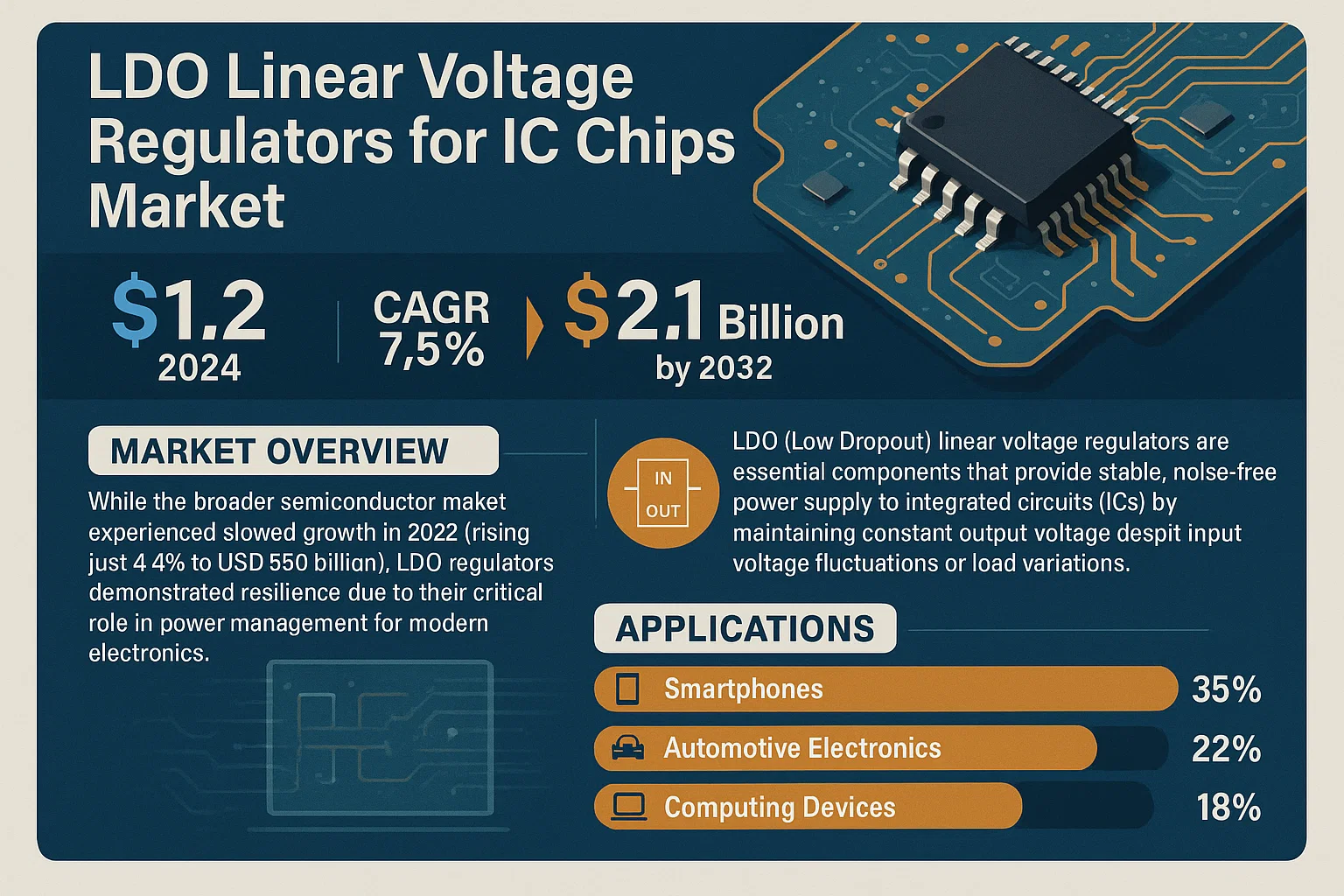
Global LDO Linear Voltage Regulators for IC Chips Market was valued at USD 1.2 billion in 2024 and is projected to reach USD 2.1 billion by 2032, exhibiting a CAGR of 7.5% during the forecast period. While the broader semiconductor market experienced slowed growth in 2022 (rising just 4.4% to USD 580 billion), LDO regulators demonstrated resilience due to their critical role in power management for modern electronics.
LDO (Low Dropout) linear voltage regulators are essential components that provide stable, noise-free power supply to integrated circuits (ICs) by maintaining constant output voltage despite input voltage fluctuations or load variations. These regulators are categorized into single-output and multi-output variants, with applications spanning smartphones (35% market share), automotive electronics (22%), and computing devices (18%) as of 2024.
The market growth is driven by increasing semiconductor content in vehicles (with analog ICs growing 20.8% in 2022) and the proliferation of IoT devices requiring efficient power management. However, supply chain disruptions in the Asia-Pacific region (which saw 2% semiconductor sales decline in 2022) present challenges. Key players like Texas Instruments (18% market share), Infineon Technologies (12%), and STMicroelectronics (9%) are investing in ultra-low-power LDO solutions to address the demand for energy-efficient electronics.
MARKET DYNAMICS
MARKET DRIVERS
Proliferation of Portable Electronics and IoT Devices to Accelerate Market Expansion
The global LDO linear voltage regulators market is experiencing robust growth driven by the exponential proliferation of portable electronics and Internet of Things (IoT) devices. These components are critical for providing stable and clean power supply to sensitive integrated circuits in battery-operated devices where power efficiency and minimal noise are paramount. The smartphone market, which exceeded 1.4 billion units shipped globally in 2023, continues to demand advanced power management solutions that extend battery life while maintaining performance. Furthermore, the IoT ecosystem is expanding rapidly with projections indicating over 29 billion connected devices by 2030, each requiring efficient voltage regulation. LDO regulators offer significant advantages in these applications due to their low quiescent current, small footprint, and excellent noise rejection capabilities, making them indispensable components in modern electronic design.
Automotive Electronics Revolution to Fuel Market Growth
The automotive industry’s rapid transition toward electrification and advanced driver-assistance systems (ADAS) is creating substantial demand for high-performance LDO linear voltage regulators. Modern vehicles incorporate hundreds of electronic control units (ECUs) that require stable voltage supplies for sensors, infotainment systems, and safety-critical components. The automotive electronics market is projected to reach approximately $400 billion by 2026, driven by increasing electronic content per vehicle which has grown from about 20% of total vehicle cost to over 35% in recent years. LDO regulators are particularly valued in automotive applications for their ability to provide clean power with low noise and high power supply rejection ratio (PSRR), essential for sensitive analog and digital circuits operating in harsh automotive environments with wide temperature variations and electrical noise.
Advancements in Semiconductor Manufacturing to Enhance Market Penetration
Technological advancements in semiconductor manufacturing processes are enabling the development of more efficient and compact LDO linear voltage regulators, further driving market adoption. The transition to smaller process nodes, including 40nm and 28nm technologies, has allowed manufacturers to integrate additional features while reducing the physical size of regulators. This miniaturization is crucial for space-constrained applications such as wearable devices and medical implants. Recent product innovations include ultra-low-dropout regulators with dropout voltages as low as 50mV at full load current, significantly improving power efficiency. Additionally, the integration of features such as power-good indicators, soft-start capabilities, and thermal protection enhances system reliability. These technological improvements are making LDO regulators more attractive compared to switching regulators in applications where noise sensitivity outweighs efficiency considerations.
MARKET CHALLENGES
Thermal Management Constraints to Challenge High-Current Applications
The market faces significant challenges related to thermal management in high-current applications. LDO linear voltage regulators dissipate excess power as heat, which becomes problematic as output current increases. This thermal limitation restricts their use in high-power applications where switching regulators are more suitable. For applications requiring currents above 500mA, the power dissipation can exceed 1W even with moderate input-output voltage differences, necessitating sophisticated heat sinking solutions that increase system cost and complexity. The challenge is particularly acute in space-constrained portable devices where adequate cooling is difficult to achieve. Manufacturers must balance performance requirements with thermal constraints, often requiring innovative packaging solutions and advanced thermal interface materials to maintain junction temperatures within safe operating limits.
Other Challenges
Efficiency Limitations in High Differential Voltage Scenarios
LDO regulators suffer from inherent efficiency limitations when handling large voltage differences between input and output. The efficiency of an LDO regulator is fundamentally limited by the ratio of output to input voltage, making them unsuitable for applications where battery voltage varies significantly during discharge. This efficiency challenge becomes particularly evident in battery-powered devices where input voltage can drop from 4.2V to 3.0V during operation, while the regulated output remains at 3.3V. In such scenarios, efficiency can drop below 80%, significantly impacting battery life compared to switching regulators that maintain high efficiency across wide input voltage ranges.
Competition from Switching Regulators
The market faces intense competition from switching voltage regulators that offer superior efficiency in high-power applications. Switching regulators typically achieve efficiencies of 85-95% compared to 40-80% for LDO regulators, making them preferred choices for applications where power consumption is critical. The performance gap continues to narrow as switching regulator technology advances, with newer devices offering improved transient response and reduced electromagnetic interference. This competitive pressure forces LDO manufacturers to focus on niche applications where their low noise, simplicity, and fast transient response provide distinct advantages.
MARKET RESTRAINTS
Supply Chain Disruptions and Component Shortages to Constrain Market Growth
The global semiconductor supply chain disruptions that began in 2020 continue to impact the LDO linear voltage regulators market. The industry experienced widespread component shortages and extended lead times, with average lead times increasing from 8-12 weeks to 20-40 weeks for many semiconductor products. These disruptions have been particularly challenging for the analog semiconductor segment, which includes voltage regulators. The situation has been exacerbated by capacity constraints at fabrication facilities, raw material shortages, and logistical challenges. While the market is gradually recovering, the memory of these disruptions has made manufacturers and customers more cautious about supply chain reliability, potentially slowing investment decisions and product development cycles.
Cost Pressure in Price-Sensitive Market Segments to Limit Adoption
Intense cost pressure in consumer electronics and other price-sensitive market segments represents a significant restraint for LDO linear voltage regulator adoption. Manufacturers in these segments often seek the lowest-cost solution that meets minimum specifications, leading to design choices that favor integrated power management units (PMUs) or simpler regulator architectures. The average selling price for standard LDO regulators in high-volume applications has declined by approximately 5-7% annually over the past five years, forcing manufacturers to continuously reduce production costs while maintaining performance. This cost pressure is particularly acute in emerging markets and entry-level devices, where component cost differences of even a few cents can determine design wins.
Design Complexity in Advanced Applications to Hinder Market Penetration
The increasing complexity of modern electronic systems presents challenges for LDO regulator implementation in advanced applications. As system-on-chip (SoC) designs become more sophisticated with multiple power domains and complex power sequencing requirements, the simple nature of LDO regulators can become a limitation. Designers must address issues such as load transient response, stability under varying conditions, and interaction with other power management components. This complexity requires more sophisticated design tools and expertise, potentially slowing adoption in applications where designers lack experience with analog power management solutions. Additionally, the trend toward higher integration often favors power management ICs that combine multiple regulators and control functions in single packages.
MARKET OPPORTUNITIES
Emerging 5G Infrastructure and Edge Computing to Create New Growth Avenues
The global deployment of 5G networks and the expansion of edge computing infrastructure present significant growth opportunities for LDO linear voltage regulators. 5G base stations and network equipment require numerous point-of-load regulators to power sensitive radio frequency components and high-speed data converters. These applications demand regulators with exceptional noise performance and stability, areas where LDO regulators excel. The 5G infrastructure market is projected to grow at a compound annual growth rate of over 40% through 2027, creating substantial demand for high-performance power management components. Similarly, edge computing nodes require efficient power delivery for processing units and memory in space-constrained environments, making LDO regulators attractive solutions despite their efficiency limitations.
Medical Electronics Expansion to Drive Demand for High-Reliability Solutions
The growing medical electronics market offers substantial opportunities for LDO linear voltage regulators, particularly in applications requiring high reliability and low noise. Medical devices such as patient monitoring equipment, diagnostic instruments, and implantable devices demand power supplies with exceptional stability and minimal electromagnetic interference. The global medical electronics market is expected to exceed $600 billion by 2027, driven by aging populations and increasing healthcare expenditure worldwide. LDO regulators are particularly well-suited for medical applications due to their simple architecture, which enhances reliability, and their excellent noise characteristics, which are critical for sensitive analog measurement circuits. The stringent regulatory requirements for medical devices also favor proven technologies like LDO regulators that have extensive reliability data and qualification history.
Renewable Energy and Industrial Automation to Provide Long-Term Growth Potential
The expansion of renewable energy systems and industrial automation represents a significant long-term opportunity for the LDO linear voltage regulator market. Solar inverters, wind turbine controllers, and battery management systems require numerous voltage regulators for control circuitry and sensor interfaces. These applications often operate in harsh environmental conditions where reliability is paramount. The industrial automation market is growing at approximately 8% annually, driven by Industry 4.0 initiatives and increasing manufacturing automation. Industrial applications frequently require regulators that can operate across wide temperature ranges and withstand electrical noise, characteristics where LDO regulators perform well. Additionally, the trend toward smarter industrial systems creates demand for additional power management components in sensors and control units.
LDO LINEAR VOLTAGE REGULATORS FOR IC CHIPS MARKET TRENDS
Increasing Demand for Power-Efficient and Miniaturized Electronics Drives Market Growth
The global LDO linear voltage regulators market is experiencing robust growth, primarily driven by the escalating demand for power-efficient and miniaturized electronic devices across multiple sectors. The market was valued at approximately $1.2 billion in 2024 and is projected to reach $1.8 billion by 2032, exhibiting a compound annual growth rate of around 5.2% during the forecast period. This expansion is largely fueled by the proliferation of smartphones, wearable technology, and Internet of Things (IoT) devices, all of which require stable, low-noise power supplies in compact form factors. LDO regulators are particularly favored in these applications because they offer simplicity, low quiescent current, and excellent noise rejection—critical attributes for battery-operated and noise-sensitive circuits. Furthermore, the automotive electronics sector represents a significant growth avenue, with modern vehicles incorporating an increasing number of electronic control units (ECUs), infotainment systems, and advanced driver-assistance systems (ADAS), all requiring reliable voltage regulation.
Other Trends
Advancements in Semiconductor Process Technologies
Continuous innovation in semiconductor manufacturing processes is enabling the development of LDO regulators with lower dropout voltages, higher power supply rejection ratios (PSRR), and reduced quiescent current. The adoption of advanced CMOS and BiCMOS processes allows for the integration of more functionalities into smaller die areas, which is essential for space-constrained applications like mobile phones and portable medical devices. These technological improvements are not only enhancing performance but also reducing the overall bill of materials (BOM) and system cost, making LDOs more attractive for high-volume consumer electronics. The trend towards higher levels of integration is also evident, with manufacturers combining LDOs with other power management ICs, such as DC-DC converters and load switches, to offer complete power management solutions on a single chip.
Rising Complexity of Electronic Systems and Supply Chain Dynamics
The increasing complexity of modern electronic systems, which often operate from multiple voltage rails, is necessitating the use of multiple LDO regulators within a single device. This is particularly true in applications like 5G infrastructure, high-performance computing, and artificial intelligence accelerators, where precise voltage regulation is paramount for signal integrity and processor stability. However, the market also faces challenges from global semiconductor supply chain fluctuations. The industry witnessed a significant disruption in 2022, with the overall semiconductor market growing only 4.4% to reach $580 billion, a sharp deceleration from the 26.2% growth seen in 2021. While the analog segment, which includes power management ICs like LDOs, showed resilience with a 20.8% growth, regional disparities were stark. The Asia Pacific region, a major hub for electronics manufacturing, saw a 2.0% decline in semiconductor sales, highlighting the vulnerability to economic pressures and shifting consumer demand. This volatility underscores the importance of robust supply chain strategies for market participants.
COMPETITIVE LANDSCAPE
Key Industry Players
Semiconductor Giants Drive Innovation in Power Management ICs
The global LDO Linear Voltage Regulators market for IC chips remains highly competitive, with established semiconductor leaders dominating the landscape. Texas Instruments (TI) maintains a strong market position, capturing nearly 18% revenue share in 2024 according to industry analyses. Their advantage stems from extensive R&D investments – allocating approximately $2 billion annually – and a broad product portfolio covering both single and multi-output LDO regulators.
While the market shows consolidation among top players, mid-sized companies are gaining traction through specialization. Analog Devices and STMicroelectronics collectively held over 22% of the market share, with their focus on high-efficiency regulators for automotive and industrial applications proving particularly successful. Both companies reported year-over-year revenue growth exceeding 15% in their power management segments.
The competitive dynamics are further influenced by regional strengths. Asian manufacturers like ROHM Semiconductor and Renesas dominate their home markets, collectively accounting for nearly 40% of Asia-Pacific sales. Their success stems from cost-optimized solutions tailored for high-volume consumer electronics production, though they face increasing pressure from Western competitors expanding in premium segments.
Recent developments highlight the intensifying competition:
- Infineon’s 2023 acquisition of a Canadian power IC startup strengthened their low-power portfolio
- NXP Semiconductors introduced a new family of automotive-grade LDOs with industry-leading noise performance
- Microchip expanded production capacity in Arizona to address U.S. supply chain priorities
List of Key LDO Linear Voltage Regulator Companies Profiled
- Texas Instruments (U.S.)
- Infineon Technologies AG (Germany)
- NXP Semiconductors (Netherlands)
- STMicroelectronics (Switzerland)
- On Semiconductor (U.S.)
- Analog Devices (U.S.)
- Renesas Electronics (Japan)
- ROHM Semiconductor (Japan)
- Microchip Technology (U.S.)
Segment Analysis:
By Type
Single-Output LDO Regulators Segment Leads Due to Widespread Integration in Low-Power Electronics
The market is segmented based on type into:
- Single-Output LDO Regulators
- Multi-Output LDO Regulators
- Subtypes: Dual-Output, Triple-Output, and others
By Application
Smartphones Segment Dominates Due to Increasing Demand for Power-Efficient Mobile Devices
The market is segmented based on application into:
- Smartphones
- Computers
- Automotive Electronics
- Appliance
- Others
By End User
Consumer Electronics Sector Accounts for Major Adoption Due to Rapid Technological Advancements
The market is segmented based on end user into:
- Consumer Electronics
- Automotive
- Industrial
- Medical
Regional Analysis: LDO Linear Voltage Regulators for IC Chips Market
Asia-Pacific
The Asia-Pacific region dominates the LDO linear voltage regulator market, accounting for over 40% of global demand due to its thriving semiconductor manufacturing ecosystem. China, Japan, South Korea, and Taiwan are key contributors, driven by strong local IC production and massive electronics manufacturing bases. While China’s semiconductor sales declined 2.0% year-on-year in 2022 due to trade restrictions and inventory corrections, the country remains the world’s largest importer of LDO regulators for smartphone and IoT applications. Meanwhile, Japan maintains its leadership in automotive-grade LDO solutions through companies like Rohm Semiconductor, supporting the electrification of vehicles. The region’s cost-competitive foundries and increasing adoption of power-efficient chips continue to make it the epicenter of LDO innovation and volume consumption.
North America
North America represents the second-largest market for LDO regulators, fueled by cutting-edge semiconductor R&D and high-performance computing requirements. The U.S. leads with companies like Texas Instruments and Analog Devices developing ultra-low-noise LDOs for aerospace, medical, and data center applications. The 17.0% year-on-year growth in Americas semiconductor sales in 2022 reflects strong demand for precision voltage regulation in 5G infrastructure and AI hardware. While automotive adoption trails Asia, North America is pioneering LDO integration in ADAS systems. The region’s focus remains on high-margin, low-quiescent-current designs with stringent qualification standards, though supply chain reshoring initiatives may boost local LDO production capacity in coming years.
Europe
Europe’s 12.6% semiconductor market growth in 2022 signals steady demand for LDO regulators, particularly from automotive and industrial sectors. German manufacturers like Infineon lead in developing AEC-Q100 qualified LDOs for electric vehicles, while STMicroelectronics drives innovation in energy-efficient multi-output regulators. The region’s strict electromagnetic compatibility (EMC) standards push LDO suppliers to enhance noise immunity characteristics. Though facing competitive pressure from Asian foundries, Europe maintains strength in specialty analog ICs, with LDOs playing a crucial role in IoT and industrial automation power management systems where reliability outweighs cost considerations.
South America
South America represents a developing LDO market, where demand primarily follows consumer electronics imports and automotive manufacturing in Brazil and Argentina. Local production remains limited, with most LDO solutions being integrated into imported chipsets or sourced from global suppliers. The lack of advanced semiconductor fabrication limits voltage regulator innovation, though increasing investments in renewable energy systems and 5G rollout could drive demand for ruggedized LDO solutions. Economic volatility and import dependencies continue to constrain market growth compared to other regions.
Middle East & Africa
This emerging market shows gradual LDO adoption primarily through telecommunications infrastructure projects and consumer electronics distribution channels. The UAE and Israel demonstrate above-average growth potential, with increasing focus on smart city deployments requiring robust power management solutions. However, the absence of local IC manufacturing means LDO consumption remains tied to finished goods imports and foreign direct investment in tech infrastructure. While current volumes are modest, strategic initiatives like Saudi Arabia’s Vision 2030 could accelerate demand for voltage regulation components in coming years.
Report Scope
This market research report provides a comprehensive analysis of the Global LDO Linear Voltage Regulators for IC Chips Market, covering the forecast period 2025–2032. It offers detailed insights into market dynamics, technological advancements, competitive landscape, and key trends shaping the industry.
Key focus areas of the report include:
- Market Size & Forecast: Historical data and future projections for revenue, unit shipments, and market value across major regions and segments. The global LDO Linear Voltage Regulators for IC Chips market was valued at USD million in 2024 and is projected to reach USD million by 2032, growing at a CAGR of % during the forecast period.
- Segmentation Analysis: Detailed breakdown by product type (Single-Output and Multi-Output LDO Regulators), application (Smartphones, Computers, Automotive Electronics, Appliances, and Others), and end-user industry to identify high-growth segments and investment opportunities.
- Regional Outlook: Insights into market performance across North America, Europe, Asia-Pacific, Latin America, and the Middle East & Africa, including country-level analysis where relevant. Asia-Pacific is expected to dominate the market due to high semiconductor manufacturing activity.
- Competitive Landscape: Profiles of leading market participants, including their product offerings, R&D focus, manufacturing capacity, pricing strategies, and recent developments such as mergers, acquisitions, and partnerships. Key players include TI, Infineon Technologies AG, NXP Semiconductors, and STMicroelectronics.
- Technology Trends & Innovation: Assessment of emerging technologies, integration of AI/IoT, semiconductor design trends, fabrication techniques, and evolving industry standards for low-dropout regulators.
- Market Drivers & Restraints: Evaluation of factors driving market growth along with challenges, supply chain constraints, regulatory issues, and market-entry barriers.
- Stakeholder Analysis: Insights for component suppliers, OEMs, system integrators, investors, and policymakers regarding the evolving ecosystem and strategic opportunities.
Primary and secondary research methods are employed, including interviews with industry experts, data from verified sources, and real-time market intelligence to ensure the accuracy and reliability of the insights presented.
FREQUENTLY ASKED QUESTIONS:
What is the current market size of Global LDO Linear Voltage Regulators for IC Chips Market?
-> LDO Linear Voltage Regulators for IC Chips Market was valued at USD 1.2 billion in 2024 and is projected to reach USD 2.1 billion by 2032, exhibiting a CAGR of 7.5% during the forecast period.
Which key companies operate in Global LDO Linear Voltage Regulators for IC Chips Market?
-> Key players include TI, Infineon Technologies AG, NXP Semiconductors, STMicroelectronics, On Semiconductor, Maxim, Microchip, Analog Devices, Renesas (Intersil), Exar, ROHM Semiconductor, FM, and Fortune.
What are the key growth drivers?
-> Key growth drivers include rising demand for power-efficient ICs, growth in consumer electronics, automotive electrification, and increasing adoption of IoT devices.
Which region dominates the market?
-> Asia-Pacific is the largest market, driven by semiconductor manufacturing hubs in China, Taiwan, South Korea, and Japan.
What are the emerging trends?
-> Emerging trends include development of ultra-low-power LDOs, integration with PMICs, and increasing demand for high-performance regulators in 5G and AI applications.

Get Sample Report PDF for Exclusive Insights
Report Sample Includes
- Table of Contents
- List of Tables & Figures
- Charts, Research Methodology, and more...
 Download Sample Report PDF