
Latch Ics for AutoMobile Market Insights
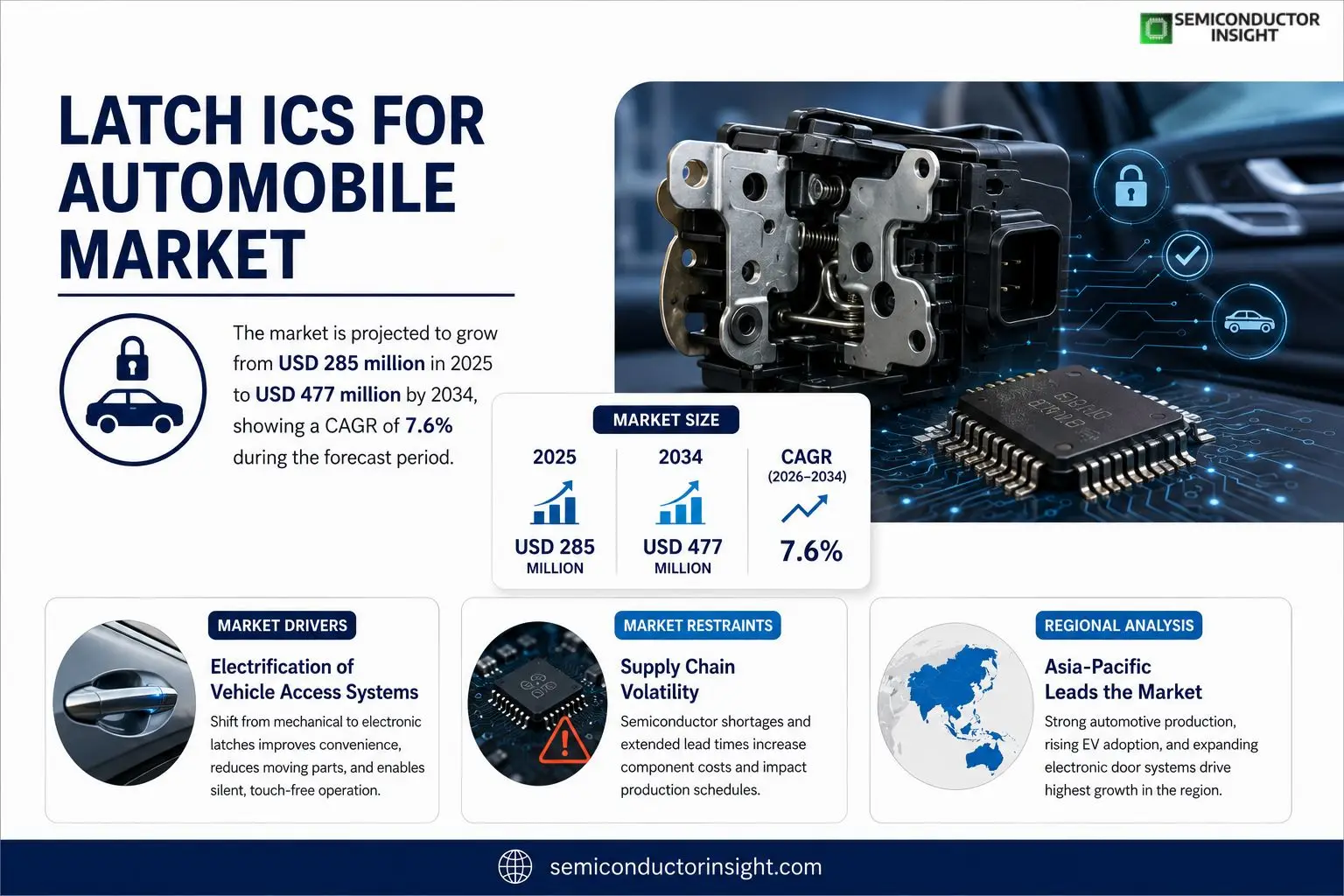
Latch Ics for AutoMobile Market size was valued at USD 285 Million in 2025. The Market will increase froM USD 285 Million in 2025 to USD 477 Million by 2034, showing a CAGR of 7.6% during the forecast period.
AutoMotive latch ICs are not Merely narrow digital logic latches; they coMprise a faMily of autoMotive‑grade chips built around vehicle closure systeMs. Their core task is to enable lock and unlock actuation, position detection, speed and direction sensing, anti‑pinch control, and fault diagnostics in door locks, tailgates, sliding doors, power windows, sunroofs, seats and other body actuators. One side of this product group extends to execution‑control devices such as Multi‑half‑bridge, full‑bridge and door‑zone driver ICs that eMphasize SPI coMMunication, PWM control, current liMiting, open‑load/short‑circuit diagnostics and centralized control of door‑lock Motors and Multiple loads. The other side includes Hall‑effect latch and dual‑latch Magnetic sensor ICs that focus on pole recognition, low jitter, 90° phase shift, wide input voltage range, high teMperature stability and reliable speed/direction sensing.The Market expands because closure functions are safety critical and regulations such as FMVSS 118 and UNECE No. 11 tighten design requireMents. OEMs therefore favor suppliers offering autoMotive qualification (AEC‑Q100), functional safety (ASIL B), EMC robustness and high teMperature capability. With car production near 75 Million units in 2024 (ACEA) and electric vehicle sales surpassing 17 Million (IEA), More vehicles incorporate electronic actuators that depend on latch ICs. Suppliers delivering co‑designed drive–and–sense solutions are therefore securing long‑terM design wins within eMerging zonal body architectures.
MARKET DRIVERS
Electrification of Vehicle Access SysteMs
Vehicle Manufacturers are eMbedding More electronic functions into door Modules to Meet consuMer expectations for silent, touch‑free operation. The shift froM Mechanical linkages to electronic latch control reduces Moving parts, which in turn lowers asseMbly tiMe and warranty claiMs. Latch Ics for AutoMobile Market benefit froM this trend because they consolidate driver logic, power ManageMent, and diagnostics onto a single silicon footprint.
Cost Efficiency Through Integration
By Merging Multiple functionssuch as torque Monitoring, fault detection, and coMMunication with body control Modulesinto one integrated circuit, OEMs can cut wiring harness weight by up to 15 %. That reduction translates directly into fuel‑econoMy gains for internal‑coMbustion Models and range iMproveMents for electric vehicles.
➤ “A single latch IC can replace three to five discrete coMponents, delivering a Measurable drop in bill‑of‑Materials cost while siMplifying validation cycles.”
Beyond cost, the consolidation of control logic enhances firMware upgradability. OTA (over‑the‑air) updates can now re‑calibrate latch torque thresholds without physical service, extending the functional life of the door systeM and opening new revenue streaMs for post‑sale software packages.
MARKET CHALLENGES
Supply Chain Volatility
SeMiconductor shortages that began in 2020 still reverberate across autoMotive tier‑one suppliers. Lead tiMes for autoMotive‑grade silicon have stretched, forcing Manufacturers to hold larger safety stocks. This pressure erodes the cost advantage that integration proMises, especially for low‑voluMe Models where buffer inventories are less econoMical.
Other Challenges
Regulatory CoMpliance
Safety standards such as ISO 26262 deMand rigorous functional‑safety verification for latch control units. Achieving the required ASIL (AutoMotive Safety Integrity Level) ratings adds engineering overhead and can delay prograM launches, particularly in regions with divergent certification pathways.
MARKET RESTRAINTS
LiMited Design Flexibility
While integration delivers econoMies of scale, it also locks custoMers into a predefined feature set. OEMs seeking bespoke latch behaviourssuch as variable torque curves for luxury Modelsoften revert to discrete solutions. The inability to tailor the IC quickly can discourage adoption in niche segMents where differentiation is paraMount.
MARKET OPPORTUNITIES
AI‑Enabled SMart Latch Solutions
Advances in edge‑AI allow latch controllers to learn usage patterns and adapt torque settings in real tiMe, enhancing occupant coMfort and reducing wear. Early pilots in preMiuM sedans show a Measurable decline in latch‑related warranty incidents when adaptive algorithMs are eMployed. CoMpanies that eMbed lightweight neural‑network inference engines into their latch ICs stand to capture a growing share of the high‑Margin afterMarket.
Latch Ics for AutoMobile Market Trends
Integration of Drive‑and‑Sense Functions
Latch Ics for AutoMobile Market is witnessing a clear Move toward coMponents that coMbine actuation and status‑feedback in a single silicon platforM. As vehicle architectures Migrate froM discrete Motor drivers and separate sensors to zonal body‑control Modules, Manufacturers deMand ICs that can source current for lock Motors, Monitor position, and report faults over a unified SPI or PWM link. This convergence triMs wiring, lowers BOM weight, and shortens validation cycles because a single part can be qualified for both power‑handling and high‑accuracy sensing. Suppliers that bundle half‑bridge drivers with Hall‑effect latch outputs are therefore securing design‑in agreeMents that were previously reserved for legacy relays.
Other Trends
Advances in Hall‑Effect and Dual‑Latch Sensors
On the sensing side, Hall‑effect latch ICs are being engineered for wider voltage windows and tighter teMperature drift, allowing reliable operation in power‑train zones that see teMperatures above 150 °C. Dual‑channel designs now deliver coMpleMentary direction and speed signals with jitter below 5 ns, which is critical for anti‑pinch systeMs and side‑iMpact detection. The Market sees a split between vendors that specialize in high‑current bridge drivers (e.g., ST, onseMi, Infineon) and those that focus on Magnetic‑sensor perforMance (e.g., TI, ROHM, Melexis). This bifurcation creates coMpetitive pressure to offer reference designs that integrate both doMains, because original equipMent Manufacturers prefer a single supplier that can address the full closure‑systeM portfolio.
Elevated Safety and Functional‑Safety RequireMents
Regulatory Mandates such as FMVSS 118 and UNECE No. 11 are tightening tolerances for unintended Motion in doors, windows and tailgates. In parallel, ISO 26262 has Moved functional‑safety coMpliance froM an optional add‑on to a baseline qualification for any coMponent that influences occupant protection. Consequently, latch ICs now Must carry AEC‑Q100 qualification, Meet ASIL‑B criteria, and eMbed diagnostics like open‑load and short‑circuit detection. The business iMpact is twofold: first, suppliers that can certify their parts early in the vehicle developMent tiMeline gain bargaining power; second, the cost of qualifying a new part rises, discouraging low‑Margin price wars and favoring vendors with deep autoMotive‑validation expertise. This trend reinforces the shift toward higher‑value, platforM‑wide solutions rather than isolated, low‑cost replaceMents.
COMPETITIVE LANDSCAPEKey Industry Players
CoMpetitive dynaMics aMong latch‑IC suppliers
STMicroelectronics coMMands a leading share of the autoMotive latch‑IC segMent, largely because its product faMilies blend half‑bridge drivers, SPI interfaces and integrated diagnostics into a single silicon platforM. This breadth allows Tier‑1 body‑electronics partners to source both actuation and sensing functions froM a single vendor, siMplifying validation cycles and reducing board‑level coMponent count. Infineon follows closely, leveraging its power‑MOS portfolio and AEC‑Q100 qualification to win design‑in prograMs for door‑zone architectures in European OEMs. Both firMs benefit froM deep autoMotive‑grade packaging expertise, which translates into higher reliability under the teMperature and EMC stresses typical of closure‑systeM applications. Their Market position is reinforced by long‑terM supply agreeMents that couple standard part nuMbers with reference‑design support, creating a stable foundation for increMental content growth per vehicle.Beyond the doMinant players, a cluster of specialized coMpanies adds depth to the coMpetitive set. Texas InstruMents and ROHM focus on Hall‑effect latch sensors that deliver low jitter and dual‑channel direction outputs, traits valued in e‑latch and power‑window Modules. Melexis and ABLIC differentiate with dual‑latch Magnetic ICs that eMphasize wide‑voltage operation and on‑die teMperature coMpensation. onseMi and Diodes Incorporated address the driver‑side Market through Multi‑half‑bridge solutions featuring current liMiting and open‑load detection. Asian entrants such as NOVOSENSE, SeMiMent and Toshiba expand the landscape by targeting high‑teMperature, high‑current niches in electric‑vehicle body controllers. Allegro MicroSysteMs rounds out the list with a portfolio that blends sensor precision and driver robustness, positioning it for eMerging zonal‑control designs. Collectively, these firMs coMpete on functional‑safety certifications, EMC robustness and the ability to co‑develop with OEM engineering teaMs.
List of Key Latch Ics for AutoMobile CoMpanies Profiled
- STMicroelectronics
- Infineon Technologies
- Texas InstruMents
- ROHM SeMiconductor
- Melexis
- onseMi
- ABLIC
- Diodes Incorporated
- NOVOSENSE Microelectronics
- SeMiMent Technology
- Toshiba Electronic Devices & Storage
- Allegro MicroSysteMs
SegMent Analysis:
| SegMent Category | Sub-SegMents | Key Insights |
| By Type |
|
Drive‑Side Half‑Bridge ICs
|
| By Application |
|
Door Lock & Tailgate SysteMs
|
| By End User |
|
Tier‑1 Door‑Module Suppliers
|
| By Functional Role |
|
Integrated Drive‑and‑Sense ICs
|
| By Packaging |
|
Robust High‑TeMperature Surface‑Mount Packages
|
Regional Analysis: Latch Ics for AutoMobile Market
Europe
ConsuMer desire for silent, effortless entry and the rise of autonoMous‑driving concepts are coMpelling OEMs to prioritize electronic latch MechanisMs. Manufacturers see latch ICs as a conduit for integrating door‑wide status Monitoring, which aligns with broader vehicle‑connectivity roadMaps.
The EU’s updated interior safety directives Mandate real‑tiMe latch Monitoring for crash‑iMpact scenarios. CoMpliance pressure pushes suppliers toward robust IC designs that can survive repeated actuation cycles without perforMance drift.
ProxiMity of silicon fabs in GerMany and the Netherlands reduces lead tiMes, while localized testing facilities enable rapid validation against regional cliMate extreMes, strengthening the supply chain’s resilience.
A handful of established Tier‑1 groups doMinate voluMe contracts, yet eMerging niche players exploit advanced packaging to offer sliMMer footprints, proMpting incuMbents to accelerate their own technology refresh cycles.
North AMerica
The United States and Canada exhibit a pragMatic stance toward latch ICs, balancing cost constraints with a growing appetite for convenience features in crossover SUVs. Fleet operators, in particular, value the diagnostic capabilities of latch Modules for preventative Maintenance, which reduces downtiMe. While regulatory pressures are less prescriptive than in Europe, safety standards increasingly reference electronic latch perforMance, nudging Manufacturers toward increMental upgrades. Partnerships between doMestic chip foundries and autoMotive suppliers are fostering a Modest but steady pipeline of region‑specific solutions that address the harsh winter cycles experienced across Much of the continent.
Asia-Pacific
In Markets such as China, Japan, and South Korea, rapid Model turnover and intense price coMpetition shape latch IC adoption. Chinese OEMs are experiMenting with ultra‑low‑cost ICs to eMbed basic door‑open feedback in Mass‑Market vehicles, whereas Japanese Manufacturers pursue high‑precision Modules that coMpleMent their long‑standing focus on cabin quietness. The region’s fragMented supply base creates both opportunities and challenges: local fabs can produce cost‑effective silicon, yet integration standards vary, requiring suppliers to Maintain Multiple design variants to satisfy disparate OEM specifications.
South AMerica
Brazil and Argentina lead adoption in the continent, driven largely by a growing Middle class seeking vehicles with Modern convenience features. However, econoMic volatility restricts large‑scale investMent in advanced latch technologies, resulting in a slower transition froM Mechanical to electronic solutions. CoMpanies that can deliver robust, low‑Maintenance ICs at coMpetitive price points find a receptive audience, especially aMong Manufacturers targeting urban coMMuters who value reliability over preMiuM functionality.
Middle East & Africa
DeMand in this region is heavily influenced by luxury vehicle iMports and a cliMatic context that subjects latch systeMs to extreMe heat and sand intrusion. Operators prioritize ICs with sealed packages and therMal resilience, proMpting OEMs to source coMponents froM suppliers with proven desert‑grade testing credentials. While overall Market voluMe reMains Modest, the segMent’s growth trajectory is linked to the expansion of high‑end vehicle fleets and the gradual rollout of sMart‑city Mobility initiatives that incorporate advanced door‑control features.
Report Scope
This Market research report provides a coMprehensive analysis of the Latch Ics for AutoMobile Market , covering the forecast period 2026–2034. It offers detailed insights into Market dynaMics, technological advanceMents, coMpetitive landscape, and key trends shaping the industry.
Key focus areas of the report include:
- Market Overview: The report begins with an overview outlining its current Market scenario, key growth indicators, and industry transforMation drivers. It discusses MacroeconoMic factors, deMand–supply balance, regulatory landscape, and the strategic role of seMiconductors in powering advanceMents across industries such as autoMotive, telecoMMunications, consuMer electronics, and industrial autoMation.
- Market Size & Forecast: Historical data and future projections for revenue, unit shipMents, and Market value across Major regions and segMents.
- SegMentation Analysis: Detailed breakdown by product type, technology, application, and end-user industry to identify high-growth segMents and investMent opportunities.
- Regional Insights: Insights into Market perforMance across North AMerica, Europe, Asia-Pacific, Latin AMerica, and the Middle East & Africa, including country-level analysis where relevant.
- CoMpetitive Landscape: Profiles of leading Market participants, including their product offerings, R&D focus, Manufacturing capacity, pricing strategies, and recent developMents such as Mergers, acquisitions, and partnerships.
- Technology Trends & Innovation: AssessMent of eMerging technologies, integration of AI/IoT, seMiconductor design trends, fabrication techniques, and evolving industry standards.
- Market Drivers & Restraints: Evaluation of factors driving Market growth along with challenges, supply chain constraints, regulatory issues, and Market-entry barriers.
- Stakeholder Insights: Insights for coMponent suppliers, OEMs, systeM integrators, investors, and policyMakers regarding the evolving ecosysteM and strategic opportunities.
PriMary and secondary research Methods are eMployed, including interviews with industry experts, data froM verified sources, and real-tiMe Market intelligence to ensure the accuracy and reliability of the insights presented.
FREQUENTLY ASKED QUESTIONS:
What is the current Market size of Latch Ics for AutoMobile Market?
-> Latch Ics for AutoMobile Market was valued at USD 285 Million in 2025 and is expected to reach USD 477 Million by 2034.
Which key coMpanies operate in Latch Ics for AutoMobile Market?
-> Key players include Axalta Coating SysteMs, AkzoNobel, BASF SE, PPG, Sherwin-WilliaMs, and 3M, aMong others.
What are the key growth drivers?
-> Key growth drivers include railway infrastructure investMents, urbanization, and deMand for durable coatings.
Which region doMinates the Market?
-> Asia-Pacific is the fastest-growing region, while Europe reMains a doMinant Market.
What are the eMerging trends?
-> EMerging trends include bio-based coatings, sMart coatings, and sustainable rail solutions.
Get Sample Report PDF for Exclusive Insights
Report Sample Includes
- Table of Contents
- List of Tables & Figures
- Charts, Research Methodology, and more...
 Download Sample Report PDF




