
Laser Screen Market Insights
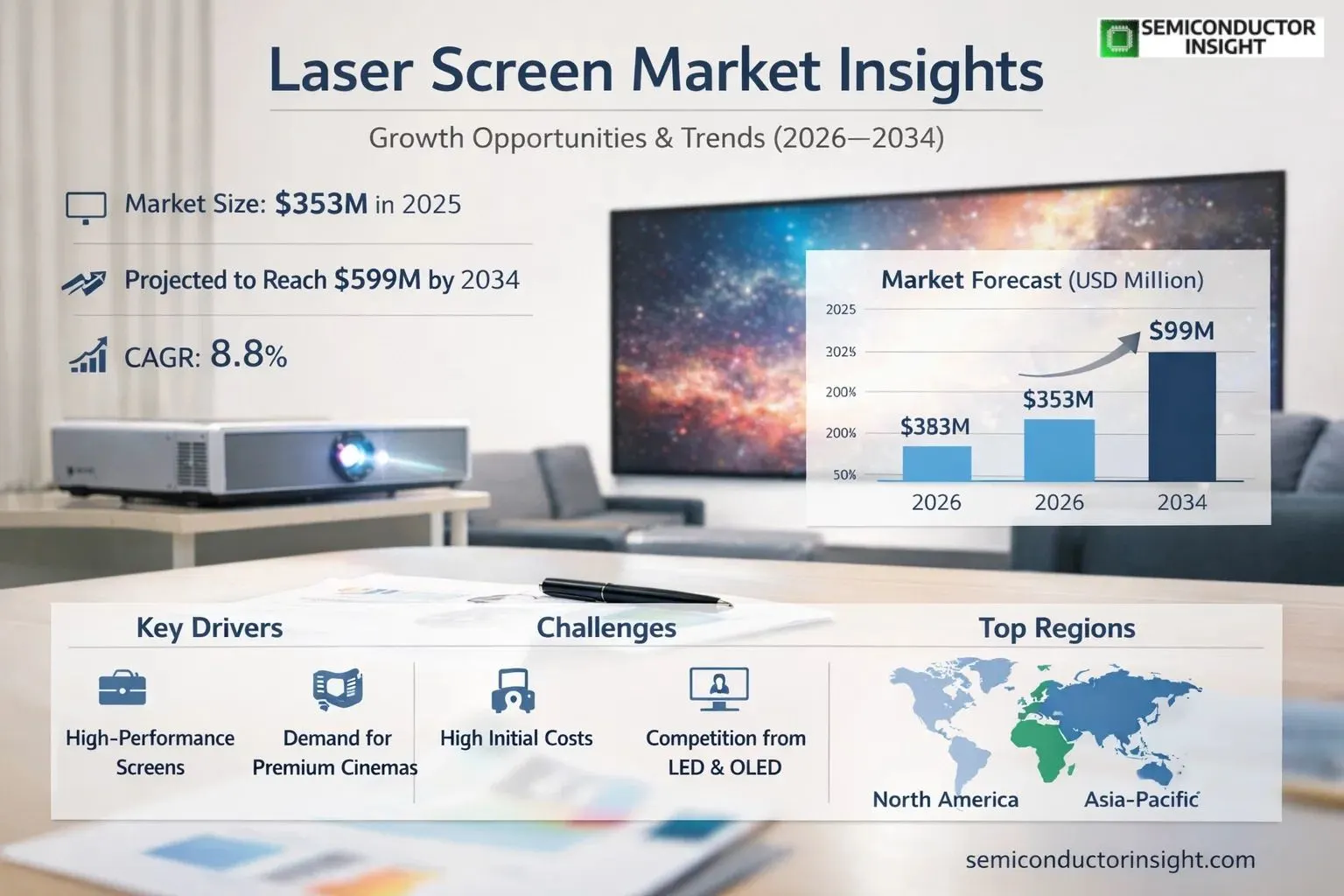
Global Laser Screen Market size was valued at USD 353 million in 2025. The market is projected to grow from USD 383 million in 2026 to USD 599 million by 2034, exhibiting a CAGR of 8.8% during the forecast period.
A laser screen is a high-performance projection surface engineered specifically for use with laser light source projectors. These screens are designed to maximize the superior brightness, contrast ratio, and color accuracy inherent in laser projection technology compared to traditional lamp-based systems. They are often optimized for high dynamic range (HDR) content and wider color gamuts, which significantly enhances the visual fidelity and immersive quality of the viewing experience in both commercial and residential settings. Key technical benefits include reduced hotspotting—a more uniform light distribution—and improved optical gain, making them ideal for demanding applications such as large-format commercial cinemas, premium home theaters, and simulation environments.
The market is experiencing robust growth driven by several converging factors, including the rapid global rollout of laser cinema projection systems and the increasing consumer demand for premium home entertainment experiences. Furthermore, technological advancements in ultra-short-throw (UST) laser projectors have created a synergistic demand for compatible ambient light rejecting (ALR) screens. Initiatives by key industry players are also accelerating adoption; for instance, leading manufacturers like Barco and Harkness Screens continuously innovate with new screen materials that enhance 3D performance and longevity. Other significant players operating in this competitive landscape include Strong/MDI Screen Systems, Severtson Screens, and Stewart Filmscreen Corporation, each offering specialized products that cater to distinct segments of the professional and consumer markets.
MARKET DRIVERS
Rising Demand in High-End Visualization and Simulation
Global Laser Screen Market is primarily propelled by the growing need for superior large-format display solutions in specialized sectors. The exceptional brightness, contrast, and color reproduction of laser screens make them indispensable for command and control centers, flight simulators, and advanced visualization rooms where image clarity is mission-critical. This shift from traditional projectors to laser-based systems is a key driver for market expansion, as organizations seek more reliable and immersive visual experiences.
Technological Advancements and Lower Total Cost of Ownership
Continuous innovation in laser phosphor and RGB laser technologies is enhancing performance while reducing costs. Compared to conventional lamp-based systems, laser screens offer a significantly longer lifespan—often exceeding 20,000 hours—which dramatically lowers maintenance and replacement expenses. This compelling total cost of ownership argument is accelerating adoption across corporate, education, and digital signage segments of Laser Screen Market.
➤ Push for brighter, always-on digital signage in retail and public spaces is creating sustained demand for the durability and visual impact of laser display solutions.
Furthermore, the integration with interactive and ultra-high-definition (4K/8K) content systems is unlocking new applications, solidifying the technology’s role in the future of professional displays.
MARKET CHALLENGES
High Initial Investment and Price Sensitivity
Despite long-term savings, the upfront capital required for high-quality laser screen systems remains a significant barrier. The cost of laser light sources and specialized optical components keeps the initial price point substantially higher than that of mainstream projector and flat-panel alternatives. This creates a challenging environment in price-sensitive markets and among small to medium-sized enterprises, potentially slowing the broader penetration of Laser Screen Market.
Other Challenges
Technical Complexity and Perceived Obsolescence Risk
The rapid pace of display technology innovation leads to concerns about quick obsolescence among buyers. Additionally, the technical complexity of installation, calibration, and integration with existing AV infrastructure requires specialized expertise, which can increase total project costs and deter some potential adopters from entering Laser Screen Market.
MARKET RESTRAINTS
Strong Competition from Established Display Technologies
The growth of Laser Screen Market is tempered by intense competition from well-established and continuously improving alternatives. Large-format LED direct-view walls offer modularity and even higher brightness, while advanced LCD and OLED panels provide excellent image quality in smaller formats. For many general-purpose applications, the cost-benefit analysis still often favors these mature technologies, limiting the addressable market for laser-based screens primarily to niche, performance-critical applications.
MARKET OPPORTUNITIES
Expansion in Emerging Applications: Immersive Entertainment and Training
A significant opportunity lies in the rapid growth of immersive experiences. Laser Screen Market is poised for expansion in sectors like planetariums, large-scale VR/AR simulation caves, and next-generation digital cinema. The technology’s ability to create seamless, curved, and exceptionally bright canvases is ideal for environments that demand total audience engagement and a profound sense of presence, areas where traditional displays fall short.
Growth in Asia-Pacific and Commercial Sectors
Geographically, the Asia-Pacific region represents a high-growth frontier due to massive investments in smart city infrastructure, corporate AV modernization, and entertainment venues. Simultaneously, the commercial sector—including high-end boardrooms, university lecture halls, and museum exhibitions—offers a vast, untapped opportunity as these entities increasingly recognize the value proposition of laser screen technology for impactful communication and storytelling.
Laser Screen Market Trends
Premium Format Cinema Expansion
A dominant trend Laser Screen Market is the continued adoption within the premium large-format cinema segment. These screens are essential for delivering the high dynamic range, improved contrast, and wide color gamut promised by laser projection systems, directly enhancing the theatrical experience. The trend is driven by the commercial rollout of new large-format branded theaters and the renovation of existing venues to IMAX and other premium standards, which mandate compatible, high-performance screens to achieve visual fidelity. This creates a focused demand for stationary, high-gain Laser Screen installations that maximize light efficiency and minimize hotspotting.
Other Trends
Manufacturer Consolidation and R&D Focus
The competitive landscape is characterized by consolidation among key manufacturers, including Harkness Screens, Barco, and Severtson Screens, who are driving innovation through research and development. Investment is focused on creating screens optimized for different ambient light conditions and specific projector technologies, expanding the product portfolio to address both commercial and high-end home theater segments. This specialization is a response to the market segmentation by Type, with manufacturers developing dedicated product lines for stationary cinema installations versus mobile or flexible solutions for other applications.
Growing Consumer Grade Demand
Beyond commercial cinemas, there is a rising trend in the adoption of Laser Screens for consumer and professional commercial applications. This includes high-end home theaters, corporate boardrooms, and simulation environments where visual quality is paramount. The market for consumer-grade laser projection systems is widening, which in turn fuels demand for complementary screens designed to meet specific needs of the family or business user, such as ease of installation, ambient light rejection, and mobile designs. This segment’s growth is diversifying the revenue streams for manufacturers.
Regional Supply Chain Development
A significant trend shaping Global Laser Screen Market is the regionalization of supply chains and manufacturing. While established players are concentrated in North America and Europe, production and sourcing activities are expanding within the Asia-Pacific region, particularly in China and Japan, to serve local demand growth and improve cost structures. This regional development trend affects market dynamics by potentially altering competitive pricing and influencing new market entrants. The focus is on building resilient regional ecosystems that can efficiently serve the projected growth in local cinema construction and commercial application deployment.
COMPETITIVE LANDSCAPE
Key Industry Players
A Consolidated Market Focused on Premium Cinema and Home Theater
Global Laser Screen Market is moderately consolidated, with a handful of established industry leaders holding significant market share, reflecting the specialized and capital-intensive nature of supplying premium projection surfaces. Harkness Screens and Barco are at the forefront, leveraging their deep expertise in cinema-grade optical surfaces and laser projection technologies. Their dominance is cemented through strategic supply agreements with major theater chains and manufacturers, focusing on high-gain, speckle-free, and HDR-optimized screens crucial for large-format cinemas and IMAX-style installations. The competitive environment is defined by continuous R&D into screen materials that enhance contrast, color gamut, and uniformity, which are critical for the superior performance promised by laser projectors.
Beyond the top-tier players, the landscape includes a diverse mix of companies targeting various market segments. Companies like Strong/MDI Screen Systems and Stewart Filmscreen hold strong positions in the premium commercial and residential integration sectors. Meanwhile, manufacturers such as Severtson Screens, Elite Screens, and Da-Lite compete effectively in the value-oriented commercial and higher-end home theater segments, often focusing on innovation in fixed-frame and mobile screen solutions. The market also features consumer electronics brands like Epson and Vankyo, which provide accessible laser-ready screen options, expanding market reach to the broader prosumer and family entertainment segments.
List of Key Laser Screen Companies Profiled
- Harkness Screens
- Barco
- Strong/MDI Screen Systems
- Severtson Screens
- Riflex Film
- Awol Vision
- Elevation Technology Partners
- Epson
- Insignia
- Vankyo
- Screen Innovations
- Elite Screens
- Legrand
- Stewart Filmscreen
- Da-Lite
- Draper
Segment Analysis:
| Segment Category | Sub-Segments | Key Insights |
| By Type |
|
Stationary Type screens represent the dominant product category, as they form the core infrastructure for high-end, permanent installations. These screens are highly favored in professional environments due to their superior stability and optimized surface characteristics for peak laser projection performance. The permanent installation in venues like cineplexes and premium theaters provides a consistent, high-quality viewing platform that maximizes the investment in advanced laser projection systems. Innovation focuses on materials that enhance brightness uniformity and color gamut for an immersive experience. |
| By Application |
|
For Commercial application is the primary revenue driver, with demand anchored in the cinema industry’s upgrade cycle to premium formats like IMAX and large-format cinemas. This segment benefits from theaters’ need to offer a distinctive, superior visual experience to compete with home entertainment systems and attract audiences. The adoption is further propelled by commercial entities in education, corporate training, and high-end simulation, where exceptional image fidelity and reliability are critical. Commercial installations prioritize screen longevity, consistent performance under heavy use, and advanced features supporting 3D and HDR content. |
| By End User |
|
Cinemas & Movie Theaters constitute the most influential end-user segment, as they are the primary adopters driving technological specifications and large-scale deployments. This group’s demand is shaped by the ongoing global trend of theater modernization to offer immersive, high-brightness experiences that traditional lamp projectors cannot achieve. The push for premium large-format screens and the integration of laser projection as a standard for new builds create a sustained, high-value market. These users are highly brand-conscious, partnering with established screen manufacturers known for reliability and technical support for complex installations. |
| By Screen Technology |
|
High-Gain Laser Screens are a critical technological segment, specifically engineered to maximize the output of laser projectors. These screens are integral to delivering the promised benefits of wider color gamuts and superior contrast, effectively translating the projector’s capabilities into a tangible viewer experience. The technology focuses on sophisticated surface coatings and microstructures that direct light efficiently to the audience, reduce hotspotting, and maintain color accuracy. This segment sees continuous material science innovation, with manufacturers competing on proprietary screen fabrics that define the ultimate quality of the projected image in demanding environments. |
| By Distribution Channel |
|
Direct Sales/OEM channels lead market access, particularly for large-scale commercial projects. This segment is characterized by strong, direct relationships between screen manufacturers like Harkness Screens or Barco and major cinema chains or project developers. These channels are essential for providing customized solutions, comprehensive technical consultancy, and post-installation service, which are non-negotiable for high-value institutional buyers. The complexity of integration with laser projection systems and architectural requirements makes the expertise and tailored support offered through direct relationships a decisive factor in purchasing decisions for the premium market tier. |
Regional Analysis: Laser Screen Market
Asia-Pacific: The Innovation and Manufacturing Hub
The region’s comprehensive supply chain for display components and lasers allows for vertically integrated production of Laser Screens. This control over manufacturing from raw materials to finished assembly ensures cost efficiency, scalability, and rapid iteration on product designs, giving local brands a significant competitive edge in global markets.
Deep integration with the world’s largest consumer electronics market accelerates Laser Screen adoption. Features are often bundled with smart projectors, gaming consoles, and home theater systems popular in the region. This ecosystem approach drives replacement cycles and educates a massive consumer base on the benefits of laser-based projection over traditional displays.
Beyond consumer use, commercial applications in digital out-of-home advertising, corporate boardrooms, and control rooms are expanding rapidly. The demand for reliable, high-brightness, and large-format Laser Screens for these professional settings is being met by regional manufacturers specializing in B2B solutions.
Substantial investment in R&D focuses on overcoming traditional limitations of projection technology. Key areas of innovation include enhancing ambient light rejection, developing ultra-short-throw capabilities for space-constrained environments, and exploring new screen materials to improve contrast and viewing angles for Laser Screen Market.
North America: The High-Value Adoption Leader
North America represents a critical high-value market characterized by early adoption of premium home cinema and professional-grade solutions. The region’s strong demand is driven by high consumer disposable income, a mature retail channel for premium AV equipment, and the presence of leading technology firms and content creators. The commercial segment, including high-end corporate installations, simulation & training, and premium entertainment venues, demonstrates a willingness to invest in top-tier Laser Screen systems for their superior image quality and longevity. Market dynamics are shaped by stringent performance expectations, brand loyalty, and a trend towards customized, integrated home theater solutions. Strategic partnerships between laser screen manufacturers and prominent projector brands are common to capture this discerning customer base.
Europe: The Quality-Conscious and Niche Market
The European Laser Screen Market is defined by a strong emphasis on quality, design aesthetics, and energy efficiency. Demand is particularly robust in Western and Northern Europe, where consumers and businesses prioritize superior performance, environmental certifications, and products that integrate seamlessly into modern architectural designs. The region shows significant traction in both the high-end residential sector and specialized commercial applications like museums, luxury retail, and design studios. European regulations promoting energy-efficient technologies indirectly benefit advanced laser projection systems over some traditional high-power displays. The market is competitive, with a mix of global brands and specialized European manufacturers competing on innovation in optical engineering and sustainable materials.
South America: The Emerging Growth Region
South America is an emerging market for Laser Screens, where growth is stimulated by gradual economic development, urbanization, and the expansion of the commercial sector. Key markets like Brazil and Argentina are seeing increased deployment in corporate and educational environments, as well as in entertainment venues such as cinemas and sports bars. While price sensitivity remains a factor, there is growing recognition of the long-term value proposition of laser-based displays, particularly their lower total cost of ownership due to reduced maintenance. The market potential is significant, with growth closely tied to broader infrastructure development and increasing digitalization across the continent’s major economies.
Middle East & Africa: The Diversified Opportunity Landscape
Laser Screen Market in the Middle East & Africa is highly diversified. The affluent Gulf Cooperation Council (GCC) states are hotspots for luxury residential and lavish commercial installations, including hotels, shopping malls, and government projects that specify high-end visual technology. In contrast, other parts of the region see growth driven by specific commercial and institutional applications, such as control rooms for utilities and mining, or digital signage in growing retail sectors. The overall market is developing, with opportunities often tied to large-scale infrastructure and tourism projects that incorporate advanced display solutions as a key component of their design and visitor experience.
Report Scope
This market research report provides a comprehensive analysis of the Laser Screen Market , covering the forecast period 2026–2034. It offers detailed insights into market dynamics, technological advancements, competitive landscape, and key trends shaping the industry.
Key focus areas of the report include:
- Market Overview: The report begins with an overview outlining its current market scenario, key growth indicators, and industry transformation drivers. It discusses macroeconomic factors, demand–supply balance, regulatory landscape, and the strategic role of semiconductors in powering advancements across industries such as automotive, telecommunications, consumer electronics, and industrial automation.
- Market Size & Forecast: Historical data and future projections for revenue, unit shipments, and market value across major regions and segments.
- Segmentation Analysis: Detailed breakdown by product type, technology, application, and end-user industry to identify high-growth segments and investment opportunities.
- Regional Insights: Insights into market performance across North America, Europe, Asia-Pacific, Latin America, and the Middle East & Africa, including country-level analysis where relevant.
- Competitive Landscape: Profiles of leading market participants, including their product offerings, R&D focus, manufacturing capacity, pricing strategies, and recent developments such as mergers, acquisitions, and partnerships.
- Technology Trends & Innovation: Assessment of emerging technologies, integration of AI/IoT, semiconductor design trends, fabrication techniques, and evolving industry standards.
- Market Drivers & Restraints: Evaluation of factors driving market growth along with challenges, supply chain constraints, regulatory issues, and market-entry barriers.
- Stakeholder Insights: Insights for component suppliers, OEMs, system integrators, investors, and policymakers regarding the evolving ecosystem and strategic opportunities.
Primary and secondary research methods are employed, including interviews with industry experts, data from verified sources, and real-time market intelligence to ensure the accuracy and reliability of the insights presented.
FREQUENTLY ASKED QUESTIONS:
What is the current market size of Laser Screen Market?
-> Laser Screen Market was valued at USD 353 million in 2025 and is projected to reach USD 599 million by 2034, growing at a CAGR of 8.8% during the forecast period.
Which key companies operate Laser Screen Market?
-> Key players include Harkness Screens, Barco, Strong/MDI Screen Systems, Severtson Screens, Riflex Film, Awol Vision, Elevation Technology Partners, Epson, Insignia, and Vankyo, among others. The top five players held a significant revenue share in Global market in 2025.
What are the key growth drivers?
-> Key growth drivers include the superior brightness, contrast, and color accuracy of laser screens, optimization for HDR and wide color gamuts, demand for enhanced viewing in large-format cinemas and premium theaters, and support for both 2D and 3D formats.
Which region dominates the market?
-> The U.S. is a key market, while China is anticipated to reach a substantial market size. The report provides detailed regional analysis for North America, Europe, Asia, South America, and the Middle East & Africa.
What are the emerging trends?
-> Emerging trends include technological advancements in screen materials to reduce hotspotting and improve light efficiency, increasing adoption in commercial applications, and the development of both stationary and mobile screen types to cater to diverse market segments.

Get Sample Report PDF for Exclusive Insights
Report Sample Includes
- Table of Contents
- List of Tables & Figures
- Charts, Research Methodology, and more...
 Download Sample Report PDF





