
MARKET INSIGHTS
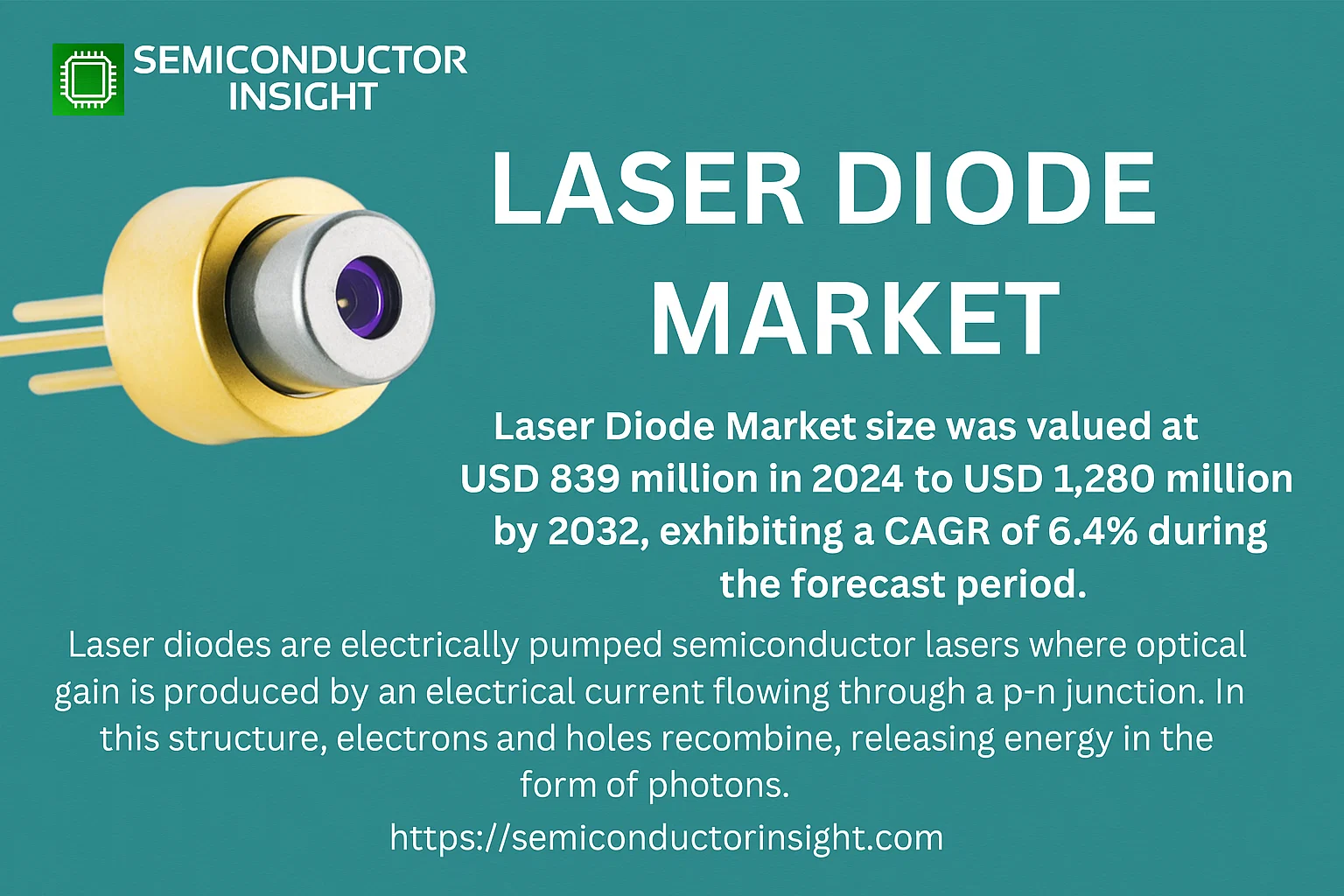
Global Laser Diode Market size was valued at USD 839 million in 2024 to USD 1,280 million by 2032, exhibiting a CAGR of 6.4% during the forecast period.
Laser diodes are electrically pumped semiconductor lasers where optical gain is produced by an electrical current flowing through a p–n junction. In this structure, electrons and holes recombine, releasing energy in the form of photons. This process can be spontaneous or stimulated, leading to optical amplification and coherent light emission within a laser resonator. These components are fundamental for converting electrical energy into high-intensity, focused light beams.
The market is experiencing steady growth due to several key drivers, including the rising demand for laser-based solutions in consumer electronics and industrial manufacturing. Furthermore, the expansion of fiber-optic communication networks and increasing adoption in medical devices for both therapeutic and diagnostic applications are contributing significantly to market expansion. The competitive landscape is also a driving force; for instance, key players like ams OSRAM and Nichia continuously innovate to produce higher-power and more efficient diodes for applications ranging from automotive LiDAR to material processing. Sony, Nichia, Sharp, Ushio, and ams OSRAM are some of the dominant players that operate in the market with extensive product portfolios.
MARKET DRIVERS
Proliferation of Fiber Optic Communication Networks
Global expansion of high-speed internet and 5G infrastructure is a primary driver for the Laser Diode Market. Laser diodes are critical components in optical transceivers used for data transmission over long distances with minimal signal loss. The demand for higher bandwidth to support cloud services, streaming, and IoT applications continues to fuel significant investments in fiber optic networks worldwide, directly increasing the consumption of high-performance laser diodes.
Growing Adoption in Industrial Manufacturing and Materials Processing
Industrial applications such as laser cutting, welding, drilling, and additive manufacturing (3D printing) are increasingly relying on high-power laser diodes. These diodes offer superior precision, efficiency, and control compared to traditional methods. The automation of manufacturing processes and the shift towards miniaturization in electronics and medical devices are propelling the demand for lasers in material processing, with the market for industrial lasers expected to see sustained growth.
Furthermore, the consumer electronics sector continues to be a strong driver. Laser diodes are essential in devices like barcode scanners, laser printers, and increasingly in consumer-grade applications such as facial recognition and LiDAR sensors in smartphones and autonomous vehicles, ensuring a steady demand stream.
MARKET CHALLENGES
High Initial Costs and Technical Complexity
The development and manufacturing of high-quality, reliable laser diodes involve sophisticated materials science and precision engineering, leading to significant research and production costs. This creates a high barrier to entry for new players and can limit adoption in price-sensitive market segments. Maintaining consistency in performance and yield rates during mass production remains a persistent challenge for manufacturers.
Other Challenges
Intense Heat Generation and Thermal Management
Laser diodes are inefficient, converting a substantial portion of electrical energy into heat. Effective thermal management is critical to prevent performance degradation and ensure long-term reliability. This requirement for advanced heat sinks and cooling systems adds to the complexity, size, and cost of the final product.
Intense Market Competition and Price Pressure
The market is characterized by the presence of several established global players and increasing competition from manufacturers, particularly in the Asia-Pacific region. This competition often leads to significant price pressure, squeezing profit margins and necessitating continuous innovation to maintain a competitive edge.
MARKET RESTRAINTS
Stringent Regulatory and Safety Standards
Laser diodes, especially those operating at higher power levels, are subject to strict international safety regulations and performance standards, such as those from the FDA and IEC. Compliance with these regulations for medical, industrial, and consumer applications requires rigorous testing and certification processes, which can delay product launches and increase development costs, acting as a restraint on market growth.
Supply Chain Vulnerabilities for Critical Raw Materials
The production of laser diodes depends on specialized semiconductor materials like gallium arsenide (GaAs) and indium phosphide (InP). The supply chain for these raw materials can be susceptible to geopolitical tensions, trade restrictions, and price volatility. Any disruption can lead to increased costs and production delays, posing a significant risk to market stability.
MARKET OPPORTUNITIES
Advancements in Automotive LiDAR and Autonomous Driving
The rapid development of Advanced Driver-Assistance Systems (ADAS) and autonomous vehicles presents a substantial opportunity. Laser diodes are the core component of LiDAR systems, which are essential for high-resolution 3D mapping and object detection. As the automotive industry moves towards higher levels of automation, the demand for reliable, cost-effective laser diodes for LiDAR is expected to surge.
Expansion in Healthcare and Biophotonics
Beyond traditional surgical applications, laser diodes are finding new opportunities in biophotonics, including flow cytometry, DNA sequencing, and non-invasive diagnostic imaging. The ongoing miniaturization of medical devices and the trend towards point-of-care diagnostics open new avenues for compact, efficient laser diode solutions, driving innovation and market expansion.
Emerging Applications in AR/VR and Display Technologies
The augmented reality (AR) and virtual reality (VR) markets are poised for significant growth. Laser diodes are key to developing ultra-compact, high-brightness projection systems for AR glasses and VR headsets. Their use in laser television and projector systems also offers opportunities for superior color gamut and energy efficiency compared to traditional display technologies.
Laser Diode Market Trends
Steady Market Expansion Driven by Diverse Applications
Global Laser Diode Market is on a robust growth trajectory, with its valuation projected to increase from USD 839 million in 2024 to USD 1,280 million by 2032, representing a compound annual growth rate of 6.4%. This consistent expansion is fueled by the widespread adoption of laser diodes across a multitude of high-growth industries. The fundamental technology, which involves the recombination of electrons and holes at a semiconductor p-n junction to produce coherent light, offers efficiency, reliability, and miniaturization advantages that are critical for modern applications.
Other Trends
Geographic Market Dominance and Shifts
North America currently leads Global market, holding over a quarter of the total market share. This dominance is attributed to strong demand from the region’s advanced industrial, medical, and telecommunications sectors. Europe and China together account for more than 35% of the market, with China’s share expected to grow significantly due to its massive manufacturing base and increasing investments in high-tech industries. The regional analysis indicates a gradual shift in production and consumption towards the Asia-Pacific region, driven by cost advantages and growing local demand.
Product Segment Leadership
The blue laser diode segment is the largest product category, commanding approximately 30% of the market. Its leadership is largely due to its critical role in high-resolution displays, optical data storage (such as Blu-ray), and specialized medical equipment. Red and infrared laser diodes also hold substantial shares, catering to applications like telecommunications, sensing, and consumer electronics. The performance characteristics of each type continue to be refined to meet the evolving demands of end-use industries.
Application-Driven Demand Growth
Industrial applications constitute the largest end-use segment for laser diodes. They are indispensable in material processing, including cutting, welding, and engraving, due to their precision and power. This is followed by optical storage and display applications, and the telecom and communication sector, where laser diodes are essential for fiber optic data transmission. The medical application segment is also a significant and rapidly growing area, with lasers being used for surgical procedures, therapeutic treatments, and diagnostic equipment. The competitive landscape is concentrated, with the top five manufacturers—including Sony, Nichia, and Sharp—collectively holding over 65% of the market, driving innovation and influencing global supply chains.
COMPETITIVE LANDSCAPE
Key Industry Players
Market Dominated by a Handful of Established Electronics Giants
Global Laser Diode Market is characterized by a high degree of concentration, with the top five manufacturers collectively holding over 65% of the market share. The competitive landscape is led by major multinational electronics corporations such as Sony, Nichia, and Sharp, which leverage their extensive research and development capabilities, established manufacturing infrastructure, and strong global supply chain networks. This dominance is particularly evident in key application segments like optical storage & display and consumer electronics. These leading players compete on the basis of technological innovation, product reliability, and price, with a strong focus on developing high-power and high-efficiency diodes for advanced applications. The market structure indicates significant barriers to entry due to the capital-intensive nature of semiconductor fabrication and the need for specialized technical expertise.
Beyond the dominant players, the market includes several significant niche and specialized manufacturers that cater to specific application segments or regions. Companies such as Hamamatsu Photonics and Toptica Eagleyard are prominent in high-performance segments like scientific research, medical applications, and defense, where precision and specific wavelength requirements are critical. Other players like ROHM, Mitsubishi Electric, and Panasonic hold strong positions in industrial applications, including materials processing and sensing. Regional players, particularly in Asia, such as Huaguang Photoelectric and Arima Lasers, also contribute to the competitive dynamics, often focusing on cost-effective solutions for local markets. The continuous evolution in telecommunications, healthcare, and manufacturing is driving competition in innovation for next-generation laser diodes.
List of Key Laser Diode Companies Profiled
- Sony
- Nichia
- Sharp
- Ushio
- ams OSRAM
- Toptica Eagleyard
- Egismos Technology
- Arima Lasers
- Panasonic
- ROHM
- Hamamatsu Photonics
- Newport Corp (MKS Instruments)
- OSI Laser Diode
- Mitsubishi Electric
- Huaguang Photoelectric
Segment Analysis:
| Segment Category | Sub-Segments | Key Insights |
| By Type |
|
Blue Laser Diode continues to be the dominant category due to its superior capabilities in high-density optical storage and advanced display technologies. Its shorter wavelength allows for greater precision and data storage density compared to other types. The segment’s leadership is further reinforced by rapidly growing adoption in consumer electronics and industrial manufacturing applications where fine detail and accuracy are paramount. Market innovation is heavily focused on enhancing the efficiency and power output of blue laser diodes. |
| By Application |
|
Industrial Applications represent the largest and most diverse segment, driven by the critical role of laser diodes in automation, material processing, and sensing. The demand is fueled by the transition towards Industry 4.0, which relies on lasers for precision cutting, welding, and additive manufacturing. This segment is characterized by a requirement for high-power, highly reliable laser diodes. The growth in industrial automation and the development of new lightweight, high-strength materials are key factors underpinning the sustained dominance of this application area. |
| By End User |
|
Manufacturing & Industrial end users are the primary drivers of market demand, leveraging laser diodes for a wide spectrum of tasks from micro-machining to large-scale cutting and marking. The high-volume consumption in this sector is linked to the continuous modernization of production lines and the need for non-contact, high-speed processing tools. This user group demands robust laser solutions that offer longevity and consistent performance under demanding operational conditions, making reliability a key purchase criterion. |
| By Wavelength |
|
Infrared Lasers are a foundational technology with dominant market penetration across telecommunications and medical applications due to their versatile interaction with various materials. Their ability to transmit efficiently through optical fibers makes them indispensable for data communication. Furthermore, their specific absorption characteristics in biological tissues enable precise surgical and therapeutic uses. The ongoing expansion of fiber optic networks and minimally invasive medical procedures continues to solidify the leadership of this wavelength category. |
| By Power Output |
|
Low Power Lasers constitute the leading segment, primarily due to their ubiquitous use in consumer electronics for reading, sensing, and communication functions, such as in barcode scanners and optical drives. Their widespread adoption is driven by cost-effectiveness, miniaturization capabilities, and low energy consumption. While high-power lasers are critical for industrial tasks, the sheer volume of devices utilizing low-power laser diodes in everyday technology ensures this segment maintains its dominant market position, with continuous demand from the electronics and sensing industries. |
Regional Analysis: Laser Diode Market
The region’s dominance is underpinned by a complete and highly efficient supply chain for semiconductor components. Concentrated production facilities for wafers, substrates, and packaging, particularly in China and Taiwan, allow for rapid scale-up and cost-optimized manufacturing of laser diodes. This integrated ecosystem supports everything from low-power diodes for consumer gadgets to high-power industrial lasers, giving local OEMs a significant advantage in both time-to-market and pricing, which is challenging for other regions to match.
The massive and growing consumer electronics industry is the primary driver of demand. Laser diodes are essential components in smartphones for facial recognition and autofocus, in data centers for optical communication, and in devices like laser printers and barcode scanners. The region’s status as the world’s factory for these goods ensures a consistent and high-volume demand base, encouraging local diode manufacturers to specialize and innovate specifically for these high-volume, cost-sensitive applications.
Government-led initiatives like “Made in China 2025” are accelerating the adoption of advanced manufacturing technologies, creating a booming market for high-power laser diodes. These diodes are critical for precision tasks such as welding, cutting, and engraving in the automotive, aerospace, and machinery sectors. The push towards smarter factories and robotics within the region ensures sustained growth for industrial-grade laser solutions, with local manufacturers developing diodes tailored to these demanding environments.
Strong investment in R&D across Japan, South Korea, and China is fostering the next generation of laser diode applications. Significant progress is being made in areas such as biomedical devices for diagnostics and therapeutics, advanced LiDAR for autonomous driving systems, and displays for augmented and virtual reality. The collaborative environment between academia, government research institutes, and industry players positions the region at the forefront of developing new market segments for laser diode technology.
North America
North America remains a critical and technologically advanced market for laser diodes, characterized by strong demand from the defense, medical, and telecommunications sectors. The region is a hub for innovation, with significant R&D activities focused on developing high-performance diodes for specialized applications. The robust healthcare industry drives demand for medical laser systems used in surgeries, dermatology, and dentistry. Furthermore, substantial investments in defense and aerospace applications, including targeting systems and communications, sustain a market for rugged and reliable laser components. The expansion of data centers and 5G infrastructure also provides a steady demand stream for communication-grade laser diodes, supported by the presence of major technology firms and telecom operators.
Europe
The European Laser Diode Market is driven by a strong industrial base, particularly in automotive manufacturing, machine tooling, and scientific research. Germany, as a manufacturing powerhouse, creates significant demand for high-power lasers used in automotive production lines for welding and cutting. The region also has a well-established medical device industry that utilizes lasers for therapeutic and diagnostic purposes. Strict regulations and a focus on high-quality, precision engineering mean that European demand often centers on reliable, high-specification diodes. Additionally, ongoing research projects funded by entities like the European Union contribute to advancements in photonics, fostering niche applications in metrology and sensing.
South America
The Laser Diode Market in South America is emerging, with growth primarily fueled by the industrial and telecommunications sectors. Brazil and Argentina are the key markets, where increasing industrialization is driving the adoption of laser-based tools for manufacturing and material processing. The expansion of mobile networks and internet infrastructure is creating opportunities for laser diodes in fiber-optic communication systems. However, market growth is often tempered by economic volatility and less mature manufacturing ecosystems compared to other regions. The medical sector also presents a growing niche, with increasing adoption of laser-based medical equipment in urban healthcare centers.
Middle East & Africa
The market in the Middle East & Africa is nascent but shows potential, driven by specific industrial and infrastructure projects. In the Middle East, the oil and gas industry utilizes laser diodes for sensing and monitoring equipment in extraction and refining processes. There is also growing investment in telecommunications infrastructure, particularly in Gulf Cooperation Council countries. In Africa, the market is very limited but evolving, with potential growth linked to gradual industrialization and the expansion of communication networks. The medical laser market is also slowly developing in major urban centers, though overall adoption rates remain low compared to other global regions.
Report Scope
This market research report provides a comprehensive analysis of the Laser Diode Market , covering the forecast period 2025–2032. It offers detailed insights into market dynamics, technological advancements, competitive landscape, and key trends shaping the industry.
Key focus areas of the report include:
- Market Overview: The report begins with an overview outlining its current market scenario, key growth indicators, and industry transformation drivers. It discusses macroeconomic factors, demand–supply balance, regulatory landscape, and the strategic role of semiconductors in powering advancements across industries such as automotive, telecommunications, consumer electronics, and industrial automation.
- Market Size & Forecast: Historical data and future projections for revenue, unit shipments, and market value across major regions and segments.
- Segmentation Analysis: Detailed breakdown by product type, technology, application, and end-user industry to identify high-growth segments and investment opportunities.
- Regional Insights: Insights into market performance across North America, Europe, Asia-Pacific, Latin America, and the Middle East & Africa, including country-level analysis where relevant.
- Competitive Landscape: Profiles of leading market participants, including their product offerings, R&D focus, manufacturing capacity, pricing strategies, and recent developments such as mergers, acquisitions, and partnerships.
- Technology Trends & Innovation: Assessment of emerging technologies, integration of AI/IoT, semiconductor design trends, fabrication techniques, and evolving industry standards.
- Market Drivers & Restraints: Evaluation of factors driving market growth along with challenges, supply chain constraints, regulatory issues, and market-entry barriers.
- Stakeholder Insights: Insights for component suppliers, OEMs, system integrators, investors, and policymakers regarding the evolving ecosystem and strategic opportunities.
Primary and secondary research methods are employed, including interviews with industry experts, data from verified sources, and real-time market intelligence to ensure the accuracy and reliability of the insights presented.
FREQUENTLY ASKED QUESTIONS:
What is the current market size of Laser Diode Market?
-> Global Laser Diode Market was valued at USD 839 million in 2024 and is projected to reach USD 1280 million by 2032, exhibiting a CAGR of 6.4% during the forecast period.
What is the definition and working principle of a Laser Diode?
-> Laser diodes are electrically pumped semiconductor lasers where gain is generated by an electrical current flowing through a p-n junction or p-i-n structure. Electrons and holes recombine in this heterostructure, releasing energy as photons, leading to optical amplification and laser oscillation with optical feedback.
Which key companies operate in the Laser Diode Market?
-> Key players include Sony, Nichia, Sharp, Ushio, and ams OSRAM, among others. Global top five manufacturers hold a share over 65%.
Which region dominates the Laser Diode Market?
-> North America is the largest market with a share over 25%, followed by Europe and China, which together have a share over 35%.
What are the leading product segments and applications in the market?
-> In terms of product, Blue Laser Diode is the largest segment with a share of about 30%. The largest application is Industrial Applications, followed by Optical Storage & Display, Telecom & Communication, and Medical Application.

Get Sample Report PDF for Exclusive Insights
Report Sample Includes
- Table of Contents
- List of Tables & Figures
- Charts, Research Methodology, and more...
 Download Sample Report PDF


