Lamp MCU Chip Market Insights
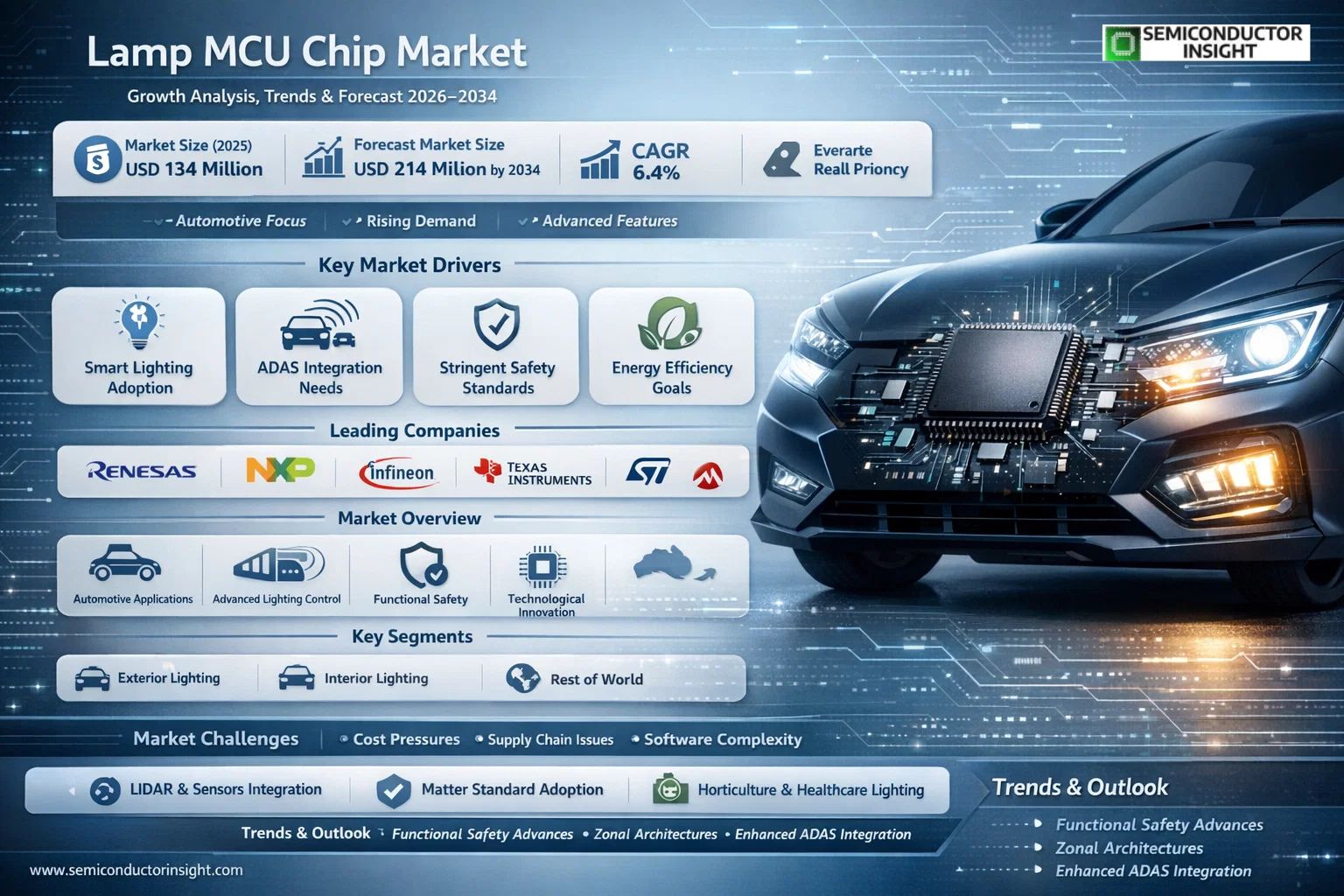
Global Lamp MCU Chip market size was valued at USD 134 million in 2025. The market is projected to grow from USD 143 million in 2026 to USD 214 million by 2034, exhibiting a CAGR of 6.4% during the forecast period.
A Lamp MCU (Microcontroller Unit) chip is a specialized semiconductor device designed for controlling lighting functions, primarily within the automotive sector. These chips manage critical operations for headlights, taillights, turn signals, and interior ambient lighting, handling tasks such as PWM dimming, fault detection diagnostics, and communication with vehicle networks. They are essential for enabling advanced features like dynamic turn signals and adaptive driving beam headlights.
The market growth is driven by the increasing electrification and sophistication of automotive lighting systems. Key factors include the mandatory adoption of advanced safety features like Daytime Running Lights (DRLs) and the integration of lighting with Advanced Driver-Assistance Systems (ADAS). Furthermore, stringent automotive safety standards such as ISO 26262 are pushing demand for more robust and functionally safe MCUs. The trend towards zonal electronic architectures also creates opportunities for dedicated lighting control units. Leading players such as Renesas Electronics, NXP Semiconductors, and Infineon Technologies dominate this space with comprehensive portfolios tailored for automotive applications.
MARKET DRIVERS
Global Adoption of Smart and Connected Lighting
The primary driver for the Lamp MCU Chip Market is the accelerating transition from conventional to smart lighting systems. IoT-enabled smart lamps require microcontrollers for wireless connectivity, sensor integration, and intelligent control, directly fueling demand for advanced Lamp MCU Chips. The expansion of smart home ecosystems and commercial building automation further stimulates this growth.
Demand for Enhanced Energy Efficiency
Stringent global energy regulations and consumer preference for sustainable products are critical drivers. Modern Lamp MCU Chips are integral to implementing advanced dimming, scheduling, and adaptive brightness features that reduce energy consumption in LED lighting systems. Their role in optimizing power management is central to the value proposition of next-generation lighting products.
➤ The shift towards Human-Centric Lighting solutions, which adjust color temperature and intensity to support well-being, is creating a specialized high-value segment for sophisticated Lamp MCU Chip architectures.
Furthermore, the push for longer product lifespans and reliability in lighting fixtures necessitates robust and durable MCUs. High-quality chips that ensure stable performance and manage thermal loads are becoming a key purchasing criterion for lighting manufacturers worldwide.
MARKET CHALLENGES
Cost-Sensitive Industry with Intense Margin Pressure
The lighting industry is historically price-competitive, creating significant pressure on Bill of Materials (BOM) costs. For many lamp manufacturers, the added expense of a feature-rich Lamp MCU Chip can be a barrier to adoption, especially in markets focused solely on basic illumination. Balancing performance with cost is a continual challenge for chip designers and suppliers.
Other Challenges
Complexity in Software and Development
The increasing need for wireless stacks, security protocols, and user interface software requires significant investment in software development tools and support, raising the total cost of ownership for lighting OEMs adopting these chips.
Supply Chain Volatility and Component Shortages
The semiconductor industry’s susceptibility to supply-demand imbalances can lead to extended lead times and price fluctuations for Lamp MCU Chips, disrupting lighting product manufacturing cycles and planning.
Fragmentation of Communication Standards
Competing wireless protocols like Zigbee, Bluetooth Mesh, Wi-Fi, and Matter create complexity. MCU suppliers must support multiple standards or risk limiting their market reach, while lighting makers face difficult choices in platform selection.
MARKET RESTRAINTS
Market Saturation in Basic Lighting Segments
A key restraint for the Lamp MCU Chip Market is the saturation and maturity of the market for simple, non-connected LED lamps. In regions where cost is the dominant factor, the replacement cycle for basic LED bulbs is slow, and the incentive to integrate an MCU is minimal. This limits the total addressable market primarily to new smart lighting installations and premium replacements.
Technical and Security Concerns
The integration of connectivity into everyday objects like lamps introduces cybersecurity and privacy risks. Concerns over data security and potential vulnerabilities can dampen consumer and corporate adoption, necessitating that Lamp MCU Chip manufacturers invest heavily in built-in hardware security features, which adds to development cost and complexity.
MARKET OPPORTUNITIES
Integration with LiDAR and Advanced Sensing
A significant opportunity lies in evolving the Lamp MCU Chip from a simple controller to the hub of an ambient intelligence sensor node. Future smart lamps with integrated occupancy, ambient light, and even air quality sensors will require more powerful, multi-core MCUs capable of local data processing, opening a high-growth segment for sophisticated chip solutions.
Growth of Standardized Ecosystems like Matter
The emergence and adoption of the Matter connectivity standard present a major opportunity. It simplifies development and ensures interoperability, which is likely to accelerate smart home adoption. Lamp MCU Chip vendors who offer certified, Matter-ready silicon solutions early will gain a substantial competitive advantage.
Expansion into Horticulture and Healthcare Lighting
Specialized lighting applications offer lucrative niche opportunities. In vertical farming, MCUs enable precise spectral control for plant growth. In healthcare, tunable lighting for patient care requires reliable, programmable chips. These segments demand specialized functionality and command higher price points, benefiting the Lamp MCU Chip Market.
Lamp MCU Chip Market Trends
Advancements in Functional Safety and Integration
The defining trend in the Lamp MCU Chip Market is the escalating demand for functional safety and higher integration. As automotive lighting evolves from simple illumination to a critical communication and safety interface, MCUs must comply with stringent standards like ISO 26262. This ensures reliable fault detection and operation, which is paramount in safety-critical applications like adaptive driving beam headlights. Concurrently, chip design focuses on integrating more peripherals,such as advanced timers, ADCs, and multiple communication interfaces,directly onto the MCU. This integration reduces system complexity, board space, and overall cost while improving reliability for both exterior and interior lighting applications.
Other Trends
Shift Towards Zonal Architectures and Advanced Communication
A significant architectural shift is underway with the adoption of zonal controllers in vehicle electronics, impacting the Lamp MCU Chip Market. Instead of a single, centralized module, lighting control is distributed across several MCUs managing specific zones. This allows for more flexible, scalable, and powerful lighting systems, enabling sophisticated animations and dynamic effects. To support this distributed data flow, there is a rapid adoption of advanced in-vehicle network protocols. CAN FD and newer Ethernet-based protocols are becoming essential, providing the necessary bandwidth for high-speed communication between lighting MCUs, sensors, and the central vehicle computer.
Rising Processing Power for ADAS and Energy Efficiency
The convergence of lighting with Advanced Driver-Assistance Systems (ADAS) is a major driver, requiring Lamp MCU chips with significantly enhanced processing capabilities. These MCUs now manage complex algorithms for dynamic light distributions, glare-free high beams, and projection-based communications. This necessitates higher clock speeds and increased embedded memory. Simultaneously, despite the rise in performance, a strong counter-trend focuses on energy efficiency. Design innovations aim to minimize active and standby power consumption, which is crucial for electric vehicles where every watt impacts range. Efficient thermal design is also a priority to ensure long-term reliability in demanding automotive environments.
COMPETITIVE LANDSCAPE
Key Industry Players
A Market Defined by Established Titans and Agile Innovators
Global Lamp MCU Chip market is characterized by a tiered competitive structure, led by entrenched automotive semiconductor giants. Companies like NXP Semiconductors, Renesas Electronics, and Infineon Technologies dominate the landscape, leveraging their deep-rooted relationships with global Tier-1 suppliers and automakers. Their leadership is built on offering highly integrated, functionally safe (ISO 26262 compliant) MCU families specifically tailored for automotive lighting, encompassing everything from basic PWM control to advanced communication via CAN FD. These leaders compete intensely on performance, reliability, and comprehensive software ecosystems. STMicroelectronics and Texas Instruments are also pivotal players, offering robust portfolios that balance processing power for complex lighting animations with energy-efficient designs, a critical factor in modern electric vehicles.
Beyond these established leaders, a dynamic layer of specialized and emerging players is gaining significant traction, particularly in the Asia-Pacific region. Companies such as Microchip Technology, GigaDevice, and Indiemicro provide cost-competitive and highly application-specific solutions for both exterior and interior lighting. Furthermore, a notable trend is the rise of domestic Chinese manufacturers like Suzhou Flagchip, Hefei Autochips, and Jiangsu Yuntu, which are capturing substantial market share by catering to the fast-growing local automotive industry. These niche players often excel at rapid innovation cycles and offer tailored support, challenging incumbents in specific vehicle segments and lighting applications, thereby making the market highly competitive.
List of Key Lamp MCU Chip Companies Profiled
- Renesas Electronics Corporation
- NXP Semiconductors N.V.
- Infineon Technologies AG
- Texas Instruments Incorporated
- STMicroelectronics N.V.
- Microchip Technology Inc.
- Indiemicro
- GigaDevice Semiconductor (Beijing) Inc.
- Suzhou Flagchip Microelectronics Co., Ltd.
- Jiangsu Yuntu Microelectronics Co., Ltd.
- Hefei Autochips Co., Ltd.
- Anhui Sinemicro Co., Ltd.
- Zhixin Semiconductor
- Shanghai Chipon Microelectronics Co., Ltd.
Segment Analysis:
| Segment Category | Sub-Segments | Key Insights |
| By Type |
|
Exterior Lighting is the predominant category, driven by the continual advancement and regulatory emphasis on vehicle safety features. Chip designs for this segment prioritize robust functional safety certification and the ability to manage complex lighting patterns for headlights and dynamic turn signals. The integration trend towards zonal architectures for scalable exterior lighting control further solidifies this segment’s leading position. |
| By Application |
|
Passenger Vehicle represents the core application segment due to very high production volumes globally and the rapid adoption of advanced lighting as a key differentiator for consumer appeal. This segment demands MCUs that support sophisticated animations, seamless integration with ADAS features, and premium interior ambient lighting, creating sustained innovation and demand. |
| By End User |
|
OEMs (Original Equipment Manufacturers) are the dominant end users, as Lamp MCUs are primarily designed into vehicles during initial production. This creates a highly integrated supply chain where MCU specifications are driven by long-term OEM development cycles and stringent quality and safety requirements, fostering deep partnerships between chipmakers and automotive manufacturers. |
| By Integration Level |
|
Highly Integrated Chips are leading due to the industry-wide push for system miniaturization, cost reduction, and enhanced reliability. These MCUs incorporate multiple peripherals like ADCs and communication controllers on a single die, which simplifies PCB design for lighting modules, reduces overall component count, and improves power efficiency, aligning perfectly with modern automotive design philosophies. |
| By Safety Certification |
|
ASIL-B Certified MCUs represent a critical and growing segment, balancing stringent safety requirements for critical exterior lighting functions with design complexity and cost. This certification level is becoming a de facto standard for new designs, as it provides a robust framework for fault detection and fail-safe operation, which is essential for ensuring vehicle safety and meeting evolving global automotive regulations. |
Regional Analysis: Lamp MCU Chip Market
Asia-Pacific
The region’s command over electronics manufacturing provides Lamp MCU chip producers with direct access to major OEMs and lighting system integrators. This proximity enables collaborative design, shorter lead times, and just-in-time inventory models that are critical for the fast-paced Lamp MCU Chip Market, ensuring components move efficiently from fab to final product.
National initiatives focused on building smart cities and upgrading public lighting with IoT connectivity are key demand drivers. Subsidies and regulations promoting LED adoption and intelligent control systems directly stimulate the Lamp MCU Chip Market, compelling local governments and contractors to source chips with advanced dimming and networking features.
The massive production of smartphones, wearables, and smart appliances across Asia-Pacific creates a spillover effect. Consumer familiarity with connected devices fuels demand for similar functionality in residential lighting, pushing manufacturers to integrate sophisticated Lamp MCU chips that enable voice control and app-based management.
Intense competition among local fabless design houses and integrated device manufacturers in the Lamp MCU Chip Market fosters rapid innovation in energy efficiency and wireless protocol integration, particularly for Bluetooth Mesh and Wi-Fi. This environment also drives continuous cost reduction, making advanced chips accessible for budget-friendly smart lamp segments.
North America
The North American market for Lamp MCU chips is characterized by its emphasis on high-value innovation, premium smart home ecosystems, and stringent quality standards. Demand is heavily influenced by leading technology companies and startups that prioritize advanced features like complex color tuning, sophisticated sensor integration, and seamless compatibility with major platforms such as Amazon Alexa, Google Home, and Apple HomeKit. The region exhibits strong demand in the commercial and industrial lighting sectors, where connected systems for energy management and data analytics are paramount. While manufacturing is less concentrated locally, North American firms maintain leadership in chip architecture design, software development, and defining the user experience standards that often shape global trends in the Lamp MCU Chip Market. The regulatory environment also encourages adoption through energy efficiency certifications.
Europe
Europe represents a mature and regulation-centric market for Lamp MCU chips, where growth is steered by the region’s ambitious environmental directives and focus on sustainable building practices. The push for nearly Zero-Energy Buildings (nZEB) and strict eco-design requirements compels the integration of intelligent, sensor-driven lighting controls, directly benefiting the Lamp MCU Chip Market. European manufacturers and chip suppliers excel in providing robust, reliable, and secure solutions that meet high data privacy and cybersecurity standards, a critical concern for commercial adopters. There is significant activity in the professional lighting sector for offices, factories, and municipalities, with an emphasis on interoperability and system-level performance rather than just component-level cost. This creates a stable, quality-oriented demand for advanced MCUs.
South America
The South American Lamp MCU Chip Market is in an emerging growth phase, primarily driven by urbanization projects and gradual infrastructure modernization. Key markets like Brazil and Argentina are seeing increased adoption in new commercial constructions and hospitality sectors, where energy cost savings are a major motivator. Market development is somewhat uneven, influenced by economic fluctuations and import dependencies for semiconductor components. However, local assembly of lighting fixtures is growing, creating a foundation for future market expansion. The focus is currently on cost-effective, entry-level smart lighting solutions with basic remote control and scheduling functions, paving the way for more sophisticated Lamp MCU chip adoption as consumer awareness and digital infrastructure improve across the region.
Middle East & Africa
This region presents a diverse landscape for the Lamp MCU Chip Market, defined by stark contrasts between advanced urban developments and broader foundational needs. In the Gulf Cooperation Council (GCC) nations, massive investments in smart city megaprojects, luxury hospitality, and iconic commercial architecture generate premium demand for cutting-edge, IoT-integrated lighting systems and their core MCU chips. Meanwhile, in other parts of Africa and the Middle East, the primary driver remains basic energy efficiency and the replacement of conventional lighting with reliable, long-life LED solutions, where MCU integration is a secondary consideration. The long-term potential is significant, anchored by urban development and a growing focus on digital infrastructure, but market maturity varies greatly by country and economic profile.
Report Scope
This market research report provides a comprehensive analysis of the Lamp MCU Chip Market , covering the forecast period 2026–2034. It offers detailed insights into market dynamics, technological advancements, competitive landscape, and key trends shaping the industry.
Key focus areas of the report include:
- Market Overview: The report begins with an overview outlining its current market scenario, key growth indicators, and industry transformation drivers. It discusses macroeconomic factors, demand–supply balance, regulatory landscape, and the strategic role of semiconductors in powering advancements across industries such as automotive, telecommunications, consumer electronics, and industrial automation.
- Market Size & Forecast: Historical data and future projections for revenue, unit shipments, and market value across major regions and segments.
- Segmentation Analysis: Detailed breakdown by product type, technology, application, and end-user industry to identify high-growth segments and investment opportunities.
- Regional Insights: Insights into market performance across North America, Europe, Asia-Pacific, Latin America, and the Middle East & Africa, including country-level analysis where relevant.
- Competitive Landscape: Profiles of leading market participants, including their product offerings, R&D focus, manufacturing capacity, pricing strategies, and recent developments such as mergers, acquisitions, and partnerships.
- Technology Trends & Innovation: Assessment of emerging technologies, integration of AI/IoT, semiconductor design trends, fabrication techniques, and evolving industry standards.
- Market Drivers & Restraints: Evaluation of factors driving market growth along with challenges, supply chain constraints, regulatory issues, and market-entry barriers.
- Stakeholder Insights: Insights for component suppliers, OEMs, system integrators, investors, and policymakers regarding the evolving ecosystem and strategic opportunities.
Primary and secondary research methods are employed, including interviews with industry experts, data from verified sources, and real-time market intelligence to ensure the accuracy and reliability of the insights presented.
FREQUENTLY ASKED QUESTIONS:
What is the current market size of Lamp MCU Chip Market?
-> Global Lamp MCU Chip Market was valued at USD 134 million in 2025 and is projected to reach USD 214 million by 2034, growing at a CAGR of 6.4% during the forecast period.
What is a Lamp MCU Chip?
-> A Lamp MCU (Microcontroller Unit) chip is a specialized microcontroller designed to control various lighting functions in vehicles, managing headlights, taillights, turn signals, and daytime running lights (DRLs). It handles tasks like PWM dimming, fault detection, system communication, and implementing complex lighting sequences and animations.
What are the key industry trends for Lamp MCU Chips?
-> Key trends include higher integration of peripherals, a strong focus on functional safety (e.g., ISO 26262), more powerful processing capabilities for complex animations and ADAS integration, adoption of advanced communication protocols like CAN FD, emphasis on energy efficiency, and a shift towards zonal architectures for flexible lighting control.
How is the Lamp MCU Chip market segmented by type?
-> The market is segmented by Type into Exterior Lighting and Interior Lighting.
Who are the key players operating in the Lamp MCU Chip Market?
-> Key players include Renesas, NXP Semiconductor, Infineon, Texas Instruments, STMicroelectronics, Microchip, Indiemicro, GigaDevice, Suzhou Flagchip, Jiangsu Yuntu, Hefei Autochips, Anhui Sinemicro, Zhixin semi, and Shanghai Chipon, among others.

Get Sample Report PDF for Exclusive Insights
Report Sample Includes
- Table of Contents
- List of Tables & Figures
- Charts, Research Methodology, and more...
 Download Sample Report PDF