Ladder Filter Market Insights
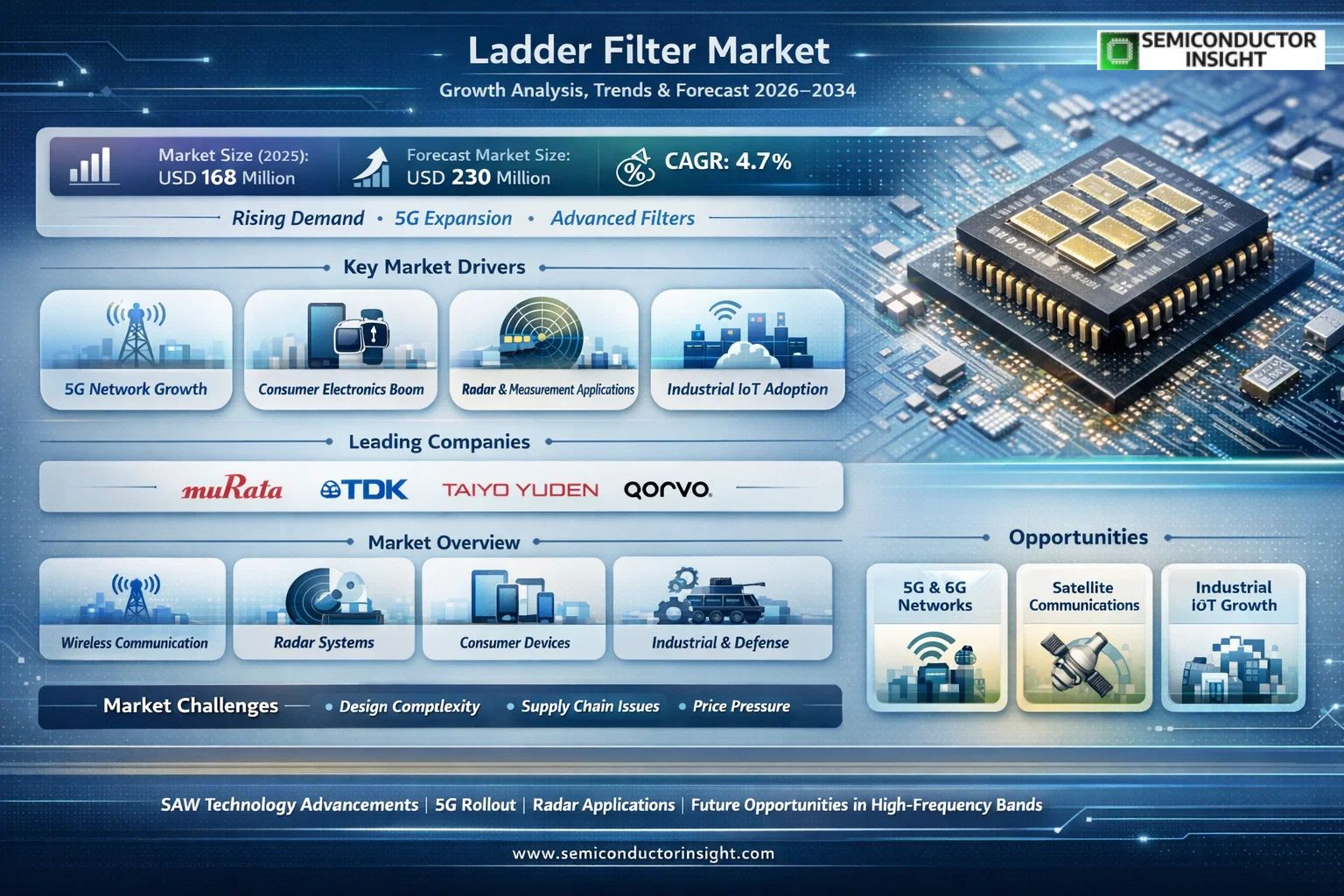
Global Ladder Filter market size was valued at USD 168 million in 2025. The market is projected to grow from USD 175.9 million in 2026 to USD 230 million by 2034, exhibiting a CAGR of 4.7% during the forecast period.
Ladder filter is a device that realizes filtering function by constructing a one-port ladder structure. This filter typically employs surface acoustic wave (SAW) resonators or other types of resonant elements, arranged and coupled in a ladder structure to achieve a specific filtering effect. The core of a ladder filter lies in its distinctive ladder architecture, which enables the filter to present unique characteristics in frequency response. The filter contains multiple resonant elements , including SAW resonators, LC resonant circuits, or other types of resonant structures , interconnected through electrical or magnetic coupling to form a complex filtering network. The working principle of a ladder filter is based on the frequency selection characteristics of resonant elements, whereby only signal components matching the resonant frequency can pass through, while signals of other frequencies are suppressed or attenuated.
The market is experiencing steady growth driven by rising demand across communication, radar, and electronic measurement applications. The expanding deployment of 5G infrastructure and increased adoption of advanced wireless communication systems are key factors propelling the demand for high-performance ladder filters globally. Leading manufacturers such as Murata Manufacturing, TDK, Taiyo Yuden, Qorvo, and Skyworks Solutions continue to shape the competitive landscape, collectively accounting for a significant share of global market revenue in 2025.
MARKET DRIVERS
Rising Demand for High-Frequency Communication Systems Fueling Ladder Filter Adoption
Global Ladder Filter Market is experiencing robust growth, driven primarily by the accelerating deployment of advanced wireless communication infrastructure worldwide. As 5G network rollouts intensify across North America, Asia-Pacific, and Europe, the need for precision frequency-selective components such as ladder filters has become increasingly critical. These components play an indispensable role in suppressing unwanted signal interference and enabling clean channel separation in densely populated RF environments. Telecom equipment manufacturers are scaling up procurement of ladder filters to meet the stringent signal integrity requirements imposed by next-generation base stations and user equipment.
Proliferation of Consumer Electronics Amplifying Market Demand
The consumer electronics segment continues to serve as a powerful engine of growth for Ladder Filter Market. Smartphones, tablets, wearables, and smart home devices increasingly incorporate SAW (Surface Acoustic Wave) and BAW (Bulk Acoustic Wave) ladder filters to manage multi-band radio frequency operations. Global smartphone shipment volume, which remains in the hundreds of millions of units annually, directly correlates with ladder filter demand. As device manufacturers pursue thinner form factors while supporting a growing number of frequency bands, miniaturized ladder filter solutions are gaining strategic importance across the electronics supply chain.
➤ The integration of ladder filters in automotive telematics and V2X (Vehicle-to-Everything) communication modules represents a rapidly expanding application frontier, as connected vehicle platforms demand reliable RF filtering across multiple frequency bands simultaneously.
Beyond telecommunications and consumer electronics, Ladder Filter Market is benefiting from growing adoption in industrial IoT (Internet of Things) deployments and defense communication systems. The demand for interference-free, reliable signal transmission in mission-critical environments is compelling system integrators to specify high-performance ladder filter components with tighter passband tolerances and lower insertion loss characteristics, further reinforcing market expansion.
MARKET CHALLENGES
Complexity of Multi-Band Filter Design Posing Technical Hurdles for Manufacturers
One of the foremost challenges confronting participants in Ladder Filter Market is the escalating design complexity associated with supporting an expanding number of frequency bands within a single compact component. As wireless standards evolve and spectrum allocations grow more fragmented, engineers face significant difficulties in maintaining sharp roll-off characteristics, low insertion loss, and high out-of-band rejection simultaneously. The development cycles for advanced ladder filter architectures have grown longer and more resource-intensive, placing considerable strain on R&D budgets, particularly for mid-sized and smaller filter manufacturers attempting to remain competitive against established players.
Other Challenges
Raw Material Supply Chain Vulnerabilities
Ladder Filter Market faces persistent supply chain pressures tied to the availability of specialized piezoelectric materials such as lithium tantalate and lithium niobate, which are essential substrates for SAW-based ladder filters. Geopolitical tensions, export controls, and concentration of key material sources in select geographic regions introduce procurement risks that can disrupt production schedules and inflate component costs for filter manufacturers globally.
Intense Price Competition and Margin Compression
Commoditization pressures within the standard ladder filter segment have led to aggressive pricing among Tier-2 and Tier-3 suppliers, particularly from manufacturers based in East Asia. This dynamic creates significant margin compression across the value chain, making it difficult for companies to sustain investment in next-generation ladder filter technology development while simultaneously meeting customer expectations for cost reduction on legacy product lines.
MARKET RESTRAINTS
High Capital Intensity of Advanced Ladder Filter Fabrication Limiting Market Entry
The fabrication of high-performance ladder filters, particularly BAW and Film Bulk Acoustic Resonator (FBAR) variants, demands sophisticated semiconductor-grade manufacturing infrastructure. The capital expenditure required to establish or upgrade production facilities to meet the precision tolerances of modern ladder filter specifications is substantial, creating significant barriers to entry for new market participants. This concentration of manufacturing capability among a small number of well-capitalized companies limits competitive diversity and can constrain overall supply responsiveness during periods of elevated demand.
Technological Substitution Risk from Emerging Filter Architectures
Ladder Filter Market faces a long-term structural restraint in the form of potential technological displacement by emerging filter technologies, including tunable RF filters and advanced dielectric resonator filters. Research initiatives at leading universities and corporate R&D laboratories are actively exploring filter architectures that could offer superior reconfigurability and broader bandwidth coverage compared to conventional ladder filter designs. While mass commercialization of these alternatives remains several years away, their continued maturation introduces an element of technological uncertainty that may temper long-term capital commitment by some industry stakeholders.
Regulatory fragmentation across regional telecommunications markets also acts as a restraint on Ladder Filter Market. Varying frequency allocation plans, electromagnetic compatibility (EMC) certification requirements, and spectrum governance frameworks across jurisdictions compel filter manufacturers to develop and certify a broader portfolio of region-specific variants. This regulatory complexity inflates compliance costs and extends product time-to-market, particularly for companies targeting simultaneous global deployment of ladder filter solutions.
MARKET OPPORTUNITIES
5G-Advanced and 6G Research Programs Creating Long-Term Ladder Filter Market Expansion Pathways
The progressive evolution of wireless standards beyond initial 5G deployments toward 5G-Advanced and early-stage 6G research presents a compelling long-term growth opportunity for Ladder Filter Market. These next-generation platforms are anticipated to operate across higher frequency bands, including portions of the millimeter-wave and sub-terahertz spectrum, where the performance requirements for RF filtering components will become even more demanding. Filter manufacturers that invest proactively in developing ladder filter solutions optimized for these emerging frequency ranges are well-positioned to capture premium design-win opportunities as standardization efforts mature.
Expansion of Satellite Communication and Non-Terrestrial Networks Unlocking New Application Segments
The rapid expansion of Low Earth Orbit (LEO) satellite constellations and the broader development of Non-Terrestrial Network (NTN) infrastructure represent a significant emerging application opportunity for Ladder Filter Market. Satellite communication terminals, both consumer-grade and enterprise-class, require highly reliable RF filtering components capable of operating across designated satellite frequency bands with minimal signal degradation. As global connectivity initiatives drive exponential growth in satellite terminal deployments, demand for specialized ladder filters engineered for space and ground segment applications is expected to increase meaningfully over the coming years.
The ongoing digital transformation of industrial operations through Industry 4.0 adoption also presents a substantial incremental opportunity for Ladder Filter Market participants. Private LTE and 5G network deployments within manufacturing facilities, logistics hubs, and energy infrastructure require robust RF filtering components to ensure reliable machine-to-machine communication in electromagnetically complex environments. As enterprises accelerate investment in smart factory and connected infrastructure initiatives, ladder filter suppliers with capabilities tailored to industrial-grade environmental and performance requirements stand to benefit from a broadening and diversifying customer base.
Ladder Filter Market Trends
Rising Demand for Surface Acoustic Wave Technology Drives Ladder Filter Market Growth
Global Ladder Filter market is witnessing sustained momentum, primarily fueled by the widespread adoption of surface acoustic wave (SAW) resonator-based designs across communication and radar applications. Ladder filters, which realize their filtering function through a one-port ladder structure, are increasingly recognized for their ability to deliver precise frequency selection with minimal signal distortion. As wireless communication infrastructure continues to expand globally, the demand for reliable and high-performance filtering solutions has placed ladder filters at the center of next-generation signal processing architectures. The communication segment remains the dominant application area, with radar and electronic measurement sectors also registering notable upticks in adoption.
Other Trends
Expansion in 5G and Wireless Communication Infrastructure
One of the most significant trends shaping Ladder Filter Market is the accelerating rollout of 5G networks across North America, Europe, and Asia-Pacific. As telecom operators densify their network infrastructure, the requirement for compact, highly selective bandpass filters has grown considerably. Ladder filters, owing to their ladder topology and efficient coupling of resonant elements, are well-suited to meet the stringent frequency management demands of modern 5G base stations and user devices. Leading manufacturers such as Murata Manufacturing, TDK, Taiyo Yuden, Qorvo, and Skyworks Solutions are actively investing in research and development to enhance filter miniaturization and improve out-of-band signal rejection performance.
Growing Integration in Radar and Electronic Measurement Systems
Beyond communication, Ladder Filter Market is experiencing growing traction within radar systems and electronic measurement equipment. Defense modernization programs across key geographies are driving procurement of advanced radar platforms that rely on high-precision filtering components. Ladder filters, with their capability to suppress unwanted frequency signals while allowing targeted frequencies to pass, are increasingly integrated into radar front-end modules. Similarly, the electronic measurement segment is adopting ladder filter solutions to ensure accuracy and signal integrity in test and measurement devices deployed in industrial and laboratory environments.
Asia-Pacific Emerging as a Key Manufacturing and Consumption Hub
Asia-Pacific, led by China, Japan, and South Korea, continues to dominate both production capacity and consumption of ladder filters. The region benefits from a deeply integrated electronics manufacturing ecosystem, with key players such as Murata Manufacturing, Taiyo Yuden, Kyocera Corporation, and TAI-SAW maintaining significant operational bases. China, in particular, is rapidly scaling domestic production capabilities to reduce reliance on imported filtering components, while simultaneously expanding its consumer electronics and telecommunications sectors that drive filter demand.
Technological Advancements and Competitive Landscape Intensify Market Dynamics
competitive landscape of Ladder Filter Market is becoming increasingly consolidated, with the top five global players commanding a substantial share of total revenue in 2025. Companies including AVX Corporation, Moog, and Qorvo are differentiating through proprietary coupling technologies and advanced resonant element configurations that push performance boundaries. Ongoing advancements in LC resonant circuit design and electrical-to-magnetic coupling methodologies are enabling manufacturers to produce ladder filters capable of operating across wider frequency ranges. These innovations, combined with growing downstream demand across communication, radar, and measurement sectors, are expected to sustain a positive growth trajectory for Global Ladder Filter market through the forecast period.
COMPETITIVE LANDSCAPE
Key Industry Players
Global Ladder Filter Market – Competitive Dynamics, Strategic Positioning, and Leading Manufacturer Profiles
Global ladder filter market, valued at approximately USD 168 million in 2025 and projected to reach USD 230 million by 2034 at a CAGR of 4.7%, is characterized by a moderately consolidated competitive landscape dominated by a handful of established electronic component manufacturers. Murata Manufacturing holds a prominent position in this space, leveraging its deep expertise in surface acoustic wave (SAW) technology and its extensive global manufacturing and distribution network. The company’s consistent investment in R&D, coupled with its ability to deliver highly miniaturized and performance-optimized ladder filters, has enabled it to capture a significant share of the market across communication, radar, and electronic measurement applications. TDK and Taiyo Yuden closely follow, both maintaining strong footholds through diversified product portfolios, robust supply chain capabilities, and long-standing relationships with OEMs in the telecommunications and consumer electronics sectors. These top players collectively accounted for a substantial portion of global ladder filter revenues in 2025, underscoring the oligopolistic tendencies within premium frequency filter segments.
Beyond the top-tier players, Ladder Filter Market features a competitive tier of specialized and regionally influential manufacturers that address niche application requirements. Qorvo and Skyworks Solutions bring strong RF engineering capabilities to the market, particularly catering to advanced communication infrastructure and defense-grade radar systems. Kyocera Corporation and AVX Corporation leverage their ceramics and passive component expertise to deliver reliable ladder filter solutions for industrial and electronic measurement environments. TAI-SAW Technology, a focused SAW component manufacturer, has carved a notable niche in Asia-Pacific markets, benefiting from proximity to major electronics manufacturing hubs. Moog Inc., while broader in its defense and aerospace orientation, contributes specialized filtering solutions for high-frequency and mission-critical applications. As demand accelerates from 5G infrastructure rollout, IoT device proliferation, and advanced radar systems, competition is expected to intensify, with players increasingly differentiating on integration capability, thermal stability, frequency precision, and miniaturization.
List of Key Ladder Filter Companies Profiled
- Murata Manufacturing
- TDK Corporation
- Taiyo Yuden
- Kyocera Corporation
- Qorvo
- Skyworks Solutions
- AVX Corporation
- Moog Inc.
- TAI-SAW Technology Co., Ltd.
- Qualcomm Technologies
- Broadcom Inc.
- EPCOS AG (a TDK Group Company)
- Abracon LLC
- API Technologies
- Golledge Electronics
Segment Analysis:
| Segment Category | Sub-Segments | Key Insights |
| By Type |
|
Surface Acoustic Wave (SAW) Ladder Filters represent the dominant type in Global ladder filter market, driven by their superior frequency selectivity and compact form factor.
|
| By Application |
|
Communication stands as the leading application segment for ladder filters, underpinned by the rapid proliferation of wireless communication infrastructure and consumer electronics worldwide.
|
| By End User |
|
Telecommunications emerges as the dominant end-user segment, reflecting the critical role of ladder filters in enabling reliable and interference-free wireless signal transmission across commercial networks.
|
| By Frequency Range |
|
Mid Frequency (1 GHz – 3 GHz) ladder filters currently account for the broadest adoption across the market, serving as the workhorse frequency range for the majority of commercial wireless applications.
|
| By Technology Platform |
|
Integrated Module-Based ladder filter platforms are rapidly establishing themselves as the preferred technology choice among original equipment manufacturers seeking to reduce board space and simplify radio frequency front-end design.
|
Regional Analysis: Ladder Filter Market
Asia-Pacific
Asia-Pacific’s aggressive 5G deployment across urban and semi-urban zones is generating strong demand for high-performance ladder filters. Telecom operators in China, South Korea, and Japan are investing heavily in next-generation network infrastructure, necessitating advanced filtering solutions that ensure signal clarity, reduced interference, and enhanced spectral efficiency in densely populated network environments.
The region hosts the world’s most prolific consumer electronics manufacturers, creating sustained demand for compact and efficient ladder filter components integrated into smartphones, wearables, and smart home devices. Rising middle-class purchasing power across Southeast Asian nations is further amplifying device penetration, which in turn supports consistent growth in ladder filter consumption across multiple product categories.
Government programs across China, India, and South Korea are channeling significant resources into domestic chip and component manufacturing. These policy-driven efforts are reducing dependency on imported filter technologies and nurturing homegrown innovation in Ladder Filter Market, creating competitive local players capable of addressing both domestic and international demand with increasing technical sophistication.
Asia-Pacific universities and private research institutions are at the forefront of acoustic wave filter innovation. Collaborative R&D between industry and academia, particularly in Japan and South Korea, is producing next-generation ladder filter architectures with superior frequency selectivity and thermal stability, ensuring the region remains a global technology leader well into the 2030s.
North America
North America represents a highly mature and technologically advanced segment of Global ladder filter market. The United States, in particular, is a key consumer and innovator in this space, with its thriving defense electronics, telecommunications, and automotive sectors generating diverse and specialized demand for ladder filter solutions. The region’s prominent defense contractors and aerospace manufacturers rely on precision filter components to ensure mission-critical signal integrity in complex operational environments. Furthermore, the rapid commercialization of 5G networks across major metropolitan areas is fueling strong aftermarket and OEM demand for advanced ladder filters. North American firms are also leading investments in private 5G networks and industrial IoT ecosystems, both of which require reliable frequency filtering. Collaborative initiatives between private enterprises and government agencies to strengthen domestic semiconductor supply chains are expected to further elevate the region’s capacity and strategic relevance in Ladder Filter Market through 2034.
Europe
Europe holds a significant and strategically important position in Global ladder filter market, characterized by its strong industrial base, rigorous regulatory standards, and leadership in automotive and industrial automation sectors. Germany, France, and the United Kingdom are among the primary contributors to regional demand, particularly as the automotive industry transitions toward connected and electrified vehicle platforms that require sophisticated onboard communication and filtering systems. European manufacturers are increasingly investing in smart manufacturing and Industry 4.0 technologies, which rely on precise radio frequency components including ladder filters. The region’s emphasis on technological sovereignty and supply chain resilience , particularly in the wake of global chip shortages , is encouraging greater local production of electronic components. Additionally, ongoing investments in pan-European 5G corridors and digital infrastructure programs are expected to sustain steady demand for ladder filter technologies across both commercial and industrial applications.
Latin America
Latin America is an emerging market in Global ladder filter landscape, with growth primarily driven by expanding telecommunications infrastructure, increasing smartphone penetration, and gradual digital transformation across key economies such as Brazil, Mexico, and Colombia. While the region currently lags behind Asia-Pacific and North America in terms of technological adoption and manufacturing depth, growing foreign direct investment in electronics assembly and rising consumer demand for connected devices are creating new opportunities for ladder filter suppliers. Government-led broadband expansion programs and spectrum auctions tied to 4G and early 5G rollouts are prompting telecom operators to upgrade their network equipment, indirectly supporting demand for filtering components. As digital literacy improves and e-commerce continues to expand, Latin America is expected to gradually increase its strategic significance within the broader ladder filter market ecosystem through the forecast period.
Middle East & Africa
The Middle East and Africa region represents a nascent but progressively important market for ladder filter technologies, underpinned by ambitious digital transformation agendas and growing investments in telecommunications infrastructure. Gulf Cooperation Council nations, particularly the United Arab Emirates and Saudi Arabia, are actively deploying 5G networks as part of their smart city and economic diversification strategies, generating emerging demand for advanced RF components including ladder filters. Africa, while still in earlier stages of connectivity development, presents long-term potential as mobile broadband adoption accelerates across sub-Saharan and North African markets. The expansion of mobile-first economies and the increasing deployment of affordable smartphones are expected to serve as indirect demand catalysts. Strategic partnerships between global technology firms and regional telecom operators are further expected to introduce high-performance ladder filter solutions into markets that have traditionally relied on legacy filtering technologies.
Report Scope
This market research report provides a comprehensive analysis of Ladder Filter Market, covering the forecast period 2026–2034. It offers detailed insights into market dynamics, technological advancements, competitive landscape, and key trends shaping the industry.
Key focus areas of the report include:
- Market Overview: The report begins with an overview outlining its current market scenario, key growth indicators, and industry transformation drivers. It discusses macroeconomic factors, demand–supply balance, regulatory landscape, and the strategic role of ladder filters in powering advancements across industries such as communication, radar systems, electronic measurement, and industrial automation.
- Market Size & Forecast: Historical data and future projections for revenue, unit shipments, and market value across major regions and segments.
- Segmentation Analysis: Detailed breakdown by product type, technology, application, and end-user industry to identify high-growth segments and investment opportunities.
- Regional Insights: Insights into market performance across North America, Europe, Asia-Pacific, Latin America, and the Middle East & Africa, including country-level analysis where relevant.
- Competitive Landscape: Profiles of leading market participants, including their product offerings, R&D focus, manufacturing capacity, pricing strategies, and recent developments such as mergers, acquisitions, and partnerships.
- Technology Trends & Innovation: Assessment of emerging technologies, integration of AI/IoT, surface acoustic wave (SAW) design trends, fabrication techniques, and evolving industry standards.
- Market Drivers & Restraints: Evaluation of factors driving market growth along with challenges, supply chain constraints, regulatory issues, and market-entry barriers.
- Stakeholder Insights: Insights for component suppliers, OEMs, system integrators, investors, and policymakers regarding the evolving ecosystem and strategic opportunities.
Primary and secondary research methods are employed, including interviews with industry experts, data from verified sources, and real-time market intelligence to ensure the accuracy and reliability of the insights presented.
FREQUENTLY ASKED QUESTIONS:
What is the current market size of Ladder Filter Market?
-> Ladder Filter Market was valued at USD 168 million in 2025 and is expected to reach USD 230 million by 2034, growing at a CAGR of 4.7% during the forecast period.
Which key companies operate in Ladder Filter Market?
-> Key players include Murata Manufacturing, TDK, Taiyo Yuden, AVX Corporation, Moog, Qorvo, TAI-SAW, Skyworks Solutions, and Kyocera Corporation, among others.
What are the key growth drivers?
-> Key growth drivers include rising demand for advanced communication systems, expansion of radar and electronic measurement applications, growing adoption of surface acoustic wave (SAW) resonator-based filters, and increasing integration of ladder filters in wireless and telecommunications infrastructure.
Which region dominates the market?
-> Asia is a dominant and fast-growing region in Ladder Filter Market, driven by major manufacturing hubs in China, Japan, and South Korea, while North America also holds a significant share supported by demand from communication and radar sectors.
What are the emerging trends?
-> Emerging trends include advancements in surface acoustic wave (SAW) filter technology, miniaturization of ladder filter components, increasing use in 5G communication systems, and growing application of ladder filters in radar and electronic measurement equipment.

Get Sample Report PDF for Exclusive Insights
Report Sample Includes
- Table of Contents
- List of Tables & Figures
- Charts, Research Methodology, and more...
 Download Sample Report PDF