Key Statistics
Key Takeaways
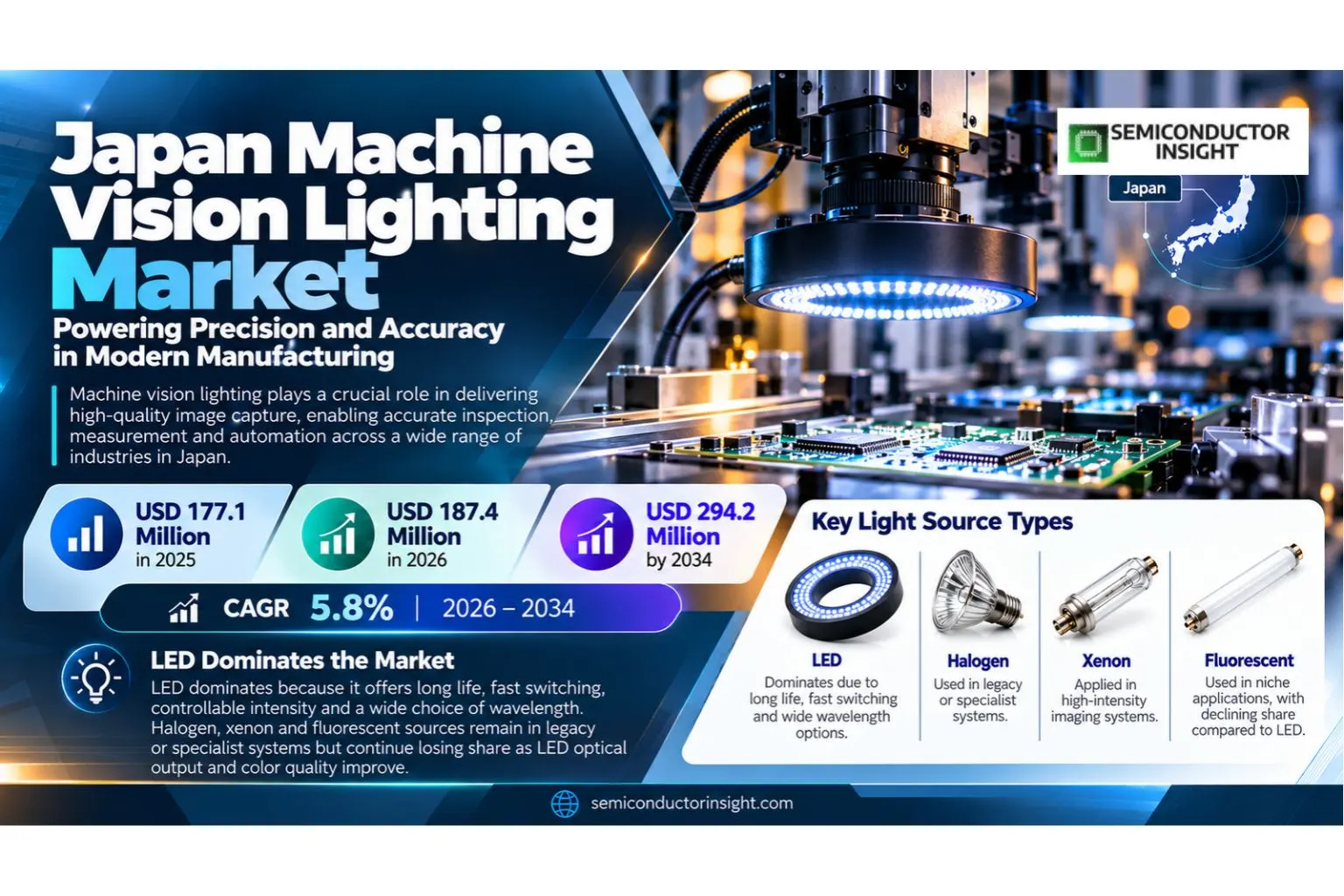
- The market is valued at USD 177.1 million in 2025 and is projected to reach USD 294.2 million by 2034, representing a 5.8% CAGR over 2026–2034.
- LED is a major product segment, while adjacent variants are expanding as performance, integration and cost requirements evolve.
- Automotive is a leading application area, supported by demand across Consumer Electronics, Food & Beverage.
- Kanto & Chubu is the largest market in 2025 based on the current concentration of demand, manufacturing capacity and ecosystem maturity.
Japan Machine Vision Lighting Market Overview
Japan Machine Vision Lighting systems provide controlled illumination that makes defects, edges, texture, color and shape visible to industrial cameras. Lighting is often the determining factor in inspection quality because even a high-resolution camera cannot reliably detect features that are hidden by glare, shadows or low contrast. Commercial adoption of Japan Machine Vision Lighting products therefore depends on system-level productivity, integration requirements, reliability expectations and the economics of replacing established alternatives in real operating environments.
Japan has a mature machine-vision ecosystem built around automotive, electronics, semiconductor and precision manufacturing. The market is shifting toward programmable LED illumination, multispectral methods, photometric stereo and structured lighting that works in close synchronization with cameras and image-processing algorithms. This increases the value of lighting as part of the vision system rather than as a passive accessory.
Segment Analysis: By Type
LED dominates because it offers long life, fast switching, controllable intensity and a wide choice of wavelength. Halogen, xenon and fluorescent sources remain in legacy or specialist systems but continue losing share as LED optical output and color quality improve. Within this segment, customers increasingly compare lifecycle support, qualification requirements, integration effort and total ownership cost rather than relying on a single specification or upfront price.
| Type | Market relevance |
|---|---|
| LED | Commercial standard for modern machine vision. |
| Halogen | Legacy high-intensity continuous source. |
| Xenon | Specialty high-brightness use. |
| Fluorescent Lighting | Declining legacy diffuse illumination. |
Segment Analysis: By Application
Automotive and consumer-electronics inspection are the strongest applications because Japan’s high-precision manufacturing requires reliable surface, assembly and dimensional inspection. Food, pharmaceuticals and logistics add growing demand for traceability and automated quality control. Within this segment, customers increasingly compare lifecycle support, qualification requirements, integration effort and total ownership cost rather than relying on a single specification or upfront price.
| Application | Market relevance |
|---|---|
| Automotive | Precision parts and assembly inspection. |
| Consumer Electronics | Semiconductor, display and electronics inspection. |
| Food & Beverage | Packaging, fill and contamination checks. |
| Pharmaceuticals | High-compliance product inspection. |
| Logistics | Barcode, parcel and dimensional inspection. |
| Others | General industrial automation. |
Segment Analysis: By Lighting Geometry
Ring and bar lights serve broad general-purpose inspection, while dome and coaxial lighting solve reflective-surface problems. Line lights are essential with line-scan cameras, and structured illumination supports shape and surface reconstruction. Within this segment, customers increasingly compare lifecycle support, qualification requirements, integration effort and total ownership cost rather than relying on a single specification or upfront price.
| Lighting Geometry | Market relevance |
|---|---|
| Ring | General close-range inspection. |
| Bar / Line | Area and line-scan illumination. |
| Dome / Diffuse | Suppresses glare on reflective surfaces. |
| Backlight | Silhouette and dimensional measurement. |
| Coaxial / Structured Light | Specular and 3D/texture inspection. |
Segment Analysis: By Wavelength
White visible illumination covers most inspections, while multispectral light improves subtle color discrimination. UV can reveal fluorescence or contamination and IR can expose features that are difficult to distinguish in visible light. Within this segment, customers increasingly compare lifecycle support, qualification requirements, integration effort and total ownership cost rather than relying on a single specification or upfront price.
| Wavelength | Market relevance |
|---|---|
| White / Visible | Broad mainstream imaging. |
| Multispectral / RGB | Color and material discrimination. |
| UV | Fluorescence and surface contamination. |
| IR | Subsurface and low-contrast inspection. |
Regional Analysis
Demand is concentrated in Kanto and Chubu because they host major automotive, electronics and industrial-automation customers, while Kansai also contributes significant machine, pharmaceutical and electronics manufacturing. Regional share also reflects supplier depth, engineering support, manufacturing concentration and the speed at which new Japan Machine Vision Lighting designs can move from evaluation into repeat deployment.
| Region | 2025 Position | Growth Outlook | Demand Profile |
|---|---|---|---|
| Kanto | Largest | Strong | Electronics, automation and research led |
| Chubu | Large | Strong | Automotive and precision manufacturing led |
| Kansai | Large specialist market | Moderate-strong | Electronics, pharmaceutical and machinery led |
| Tohoku & Hokkaido | Specialty | Moderate | Semiconductor, food and manufacturing led |
| Kyushu & Other Regions | Growing | Strong | Semiconductor and electronics led |
Detailed Regional Blocks
Why is Kanto important to this market?
Kanto leads through Tokyo, Kanagawa and surrounding manufacturing and technology centers. Electronics, logistics and research users require flexible lighting for high-mix inspection and advanced image-processing development. In Kanto, procurement decisions also depend on service coverage, qualification resources, logistics and long-term availability, so ecosystem maturity can materially influence adoption even when core technology performance is similar.
| Country / Subregion | Role | Market Context |
|---|---|---|
| Tokyo / Kanagawa | Technology and engineering hub | Vision suppliers and OEM engineering teams create high-value demand. |
| Saitama / Chiba | Manufacturing and logistics | Automated inspection supports broad lighting use. |
- KEYENCE’s CA-D series includes ring, bar, dome, multi-angle and high-function lighting synchronized with camera controllers.
- KEYENCE also offers multispectral and structured-light functions for difficult color and three-dimensional inspections.
- Advanced inspection increasingly combines optics, lighting and algorithms as a single engineered solution.
Why is Chubu important to this market?
Chubu is a major market because Aichi and surrounding prefectures contain dense automotive, machinery and component manufacturing. Stable high-speed inspection creates strong demand for line, bar and directional lighting. In Chubu, procurement decisions also depend on service coverage, qualification resources, logistics and long-term availability, so ecosystem maturity can materially influence adoption even when core technology performance is similar.
| Country / Subregion | Role | Market Context |
|---|---|---|
| Aichi | Automotive manufacturing hub | Parts and assembly inspection create large lighting demand. |
| Shizuoka | Precision manufacturing | Machine and electronics production support vision systems. |
- High-output line lighting is valuable for continuous web and line-scan inspection.
- Automotive surfaces require carefully controlled angles to reveal scratches, dents and assembly defects.
- Production lines favor LED systems with long life and repeatable intensity.
Why is Kansai important to this market?
Kansai supports machine-vision lighting through Osaka, Kyoto and Hyogo manufacturing. Semiconductor, pharmaceutical and precision-equipment users often require specialized wavelengths and diffuse lighting. In Kansai, procurement decisions also depend on service coverage, qualification resources, logistics and long-term availability, so ecosystem maturity can materially influence adoption even when core technology performance is similar.
| Country / Subregion | Role | Market Context |
|---|---|---|
| Osaka | Industrial and pharmaceutical hub | Packaging and quality-control applications support demand. |
| Kyoto | Vision-technology hub | CCS and advanced automation expertise strengthen the ecosystem. |
- CCS provides ring, bar, flat, dome, coaxial, line-sensor, UV, IR and custom machine-vision lighting products.
- The company also supports hyperspectral and photometric-stereo inspection solutions.
- Specialist lighting becomes especially valuable when surface appearance changes with angle or wavelength.
Why is Tohoku & Hokkaido important to this market?
Northern Japan has specialist demand from semiconductor fabs, food processing and precision factories. Applications often require high-reliability lighting that can run continuously in automated environments. In Tohoku & Hokkaido, procurement decisions also depend on service coverage, qualification resources, logistics and long-term availability, so ecosystem maturity can materially influence adoption even when core technology performance is similar.
| Country / Subregion | Role | Market Context |
|---|---|---|
| Tohoku | Semiconductor and precision manufacturing | Inspection systems support fabs and component plants. |
| Hokkaido | Food and logistics | Packaging and sorting create machine-vision demand. |
- Food inspection often uses backlighting and color-sensitive illumination.
- Semiconductor inspection requires stable intensity and contamination-conscious designs.
- Remote production sites value long-life LEDs that reduce maintenance.
Why is Kyushu & Other Regions important to this market?
Kyushu is gaining importance through semiconductor investment and electronics manufacturing. New production lines create opportunities for advanced inspection lighting in wafer, package and component processes. In Kyushu & Other Regions, procurement decisions also depend on service coverage, qualification resources, logistics and long-term availability, so ecosystem maturity can materially influence adoption even when core technology performance is similar.
| Country / Subregion | Role | Market Context |
|---|---|---|
| Kyushu | Semiconductor growth hub | Fab and electronics investment expands inspection demand. |
| Other regions | Distributed industrial base | Food, machinery and logistics sustain demand. |
- CCS continues expanding inspection solutions for very fine defects and difficult reflective surfaces.
- Semiconductor manufacturing adds demand for high-uniformity and wavelength-specific lighting.
- Local application engineering is valuable because optimal illumination is highly dependent on the target surface.
Competitive Landscape
CCS, KEYENCE, Moritex, Opto Engineering, Panasonic, Omron and other machine-vision suppliers compete on optical uniformity, brightness, spectral options, controller synchronization and application engineering. Japanese customers value repeatability and tailored illumination for difficult inspection surfaces.
| Company | Position | Relevant capability |
|---|---|---|
| CCS Inc. | Key participant | Japan-based specialist with broad ring, bar, line, dome, UV, IR and custom machine-vision illumination. |
| KEYENCE Corporation | Key participant | Integrated camera, controller and advanced synchronized lighting ecosystem. |
| Moritex Corporation | Key participant | Machine-vision optics and illumination supplier for precision inspection. |
| Opto Engineering Japan | Key participant | Competes through product breadth, integration capability, qualification and customer support. |
| Panasonic Industry | Key participant | Competes through product breadth, integration capability, qualification and customer support. |
| Omron Corporation | Key participant | Competes through product breadth, integration capability, qualification and customer support. |
| NIDEC COPAL | Key participant | Competes through product breadth, integration capability, qualification and customer support. |
| Effilux / STEMMER IMAGING | Key participant | Competes through product breadth, integration capability, qualification and customer support. |
Production Capacity Analysis
Machine-vision lighting capacity depends on LED packages, optical plastics or glass, aluminum heat sinks, drivers, controllers and precision assembly. The market is not capacity constrained in the way semiconductor fabs are, but high-end products require careful optical and thermal engineering. Scaling output without degrading consistency requires stable upstream materials, disciplined process control and final testing that catches drift before products reach high-value customer systems.
Japan hosts several specialist suppliers with strong domestic engineering support. Effective capacity includes application labs and loaner equipment because customers often need to test multiple lighting geometries and wavelengths before finalizing an inspection system. Second-source planning and regional technical support therefore become increasingly important as deployments expand and buyers seek supply continuity without repeating lengthy qualification work.
Market Dynamics
The market is moving from simple illumination toward computational lighting. Multi-angle, multispectral and patterned illumination can capture several images under different optical conditions and allow software to separate texture, color, shape or glare effects that a single static light cannot reveal. This is changing competitive behavior because vendors increasingly sell system-level value, workflow integration and lifecycle economics rather than an isolated component specification.
This raises the importance of synchronization between light, camera and vision controller. Lighting suppliers that provide optical hardware plus tuning knowledge can reduce inspection-development time and improve detection robustness, particularly for reflective or low-contrast surfaces. Buyers consequently evaluate total ownership cost, qualification effort and roadmap stability across the life of a program instead of focusing only on initial purchase price.
Market Drivers
| Factor | Analyst Interpretation |
|---|---|
| Factory automation | More automated inspection stations require stable purpose-built illumination. |
| Electronics miniaturization | Smaller features demand higher contrast and more controlled lighting. |
| Automotive quality control | Surface, assembly and dimensional inspection create recurring demand. |
| Advanced vision algorithms | Photometric stereo and multispectral processing increase lighting complexity. |
Market Restraints
| Factor | Analyst Interpretation |
|---|---|
| Application-specific engineering | One lighting geometry rarely works across many inspection tasks. |
| Price pressure | General-purpose LED lights face lower-cost competition. |
| Long industrial lifecycles | Installed systems may operate for many years before replacement. |
| Integration expertise | Poor optical setup can limit performance even when cameras and algorithms are advanced. |
Market Opportunities
| Factor | Analyst Interpretation |
|---|---|
| Photometric stereo lighting | Multi-directional illumination can reveal subtle surface defects. |
| Multispectral inspection | Multiple wavelengths improve color and material discrimination. |
| Semiconductor inspection | New fabs and package lines create high-value vision demand. |
| Hyperspectral illumination | Broader spectral analysis can support food, materials and contamination inspection. |
Supply Chain Analysis
The value chain combines LEDs, optics, housings, thermal design, power controllers, camera synchronization and application engineering. The strongest suppliers help users select geometry, angle, wavelength and intensity based on the physical defect being inspected. Traceability and coordination between component suppliers, integrators and end users are important because failures found late in the chain can be far more expensive than the underlying part itself.
| Supply Chain Stage | Role in the Market |
|---|---|
| LEDs and optical materials | Emitters, lenses and diffusers generate controlled illumination. |
| Lighting fixture assembly | Thermal and mechanical design creates ring, bar, dome and line products. |
| Controllers and synchronization | Strobes and intensity controls coordinate lighting with cameras. |
| Vision-system integration | Application engineers tune lighting, optics and algorithms to the inspection target. |
Recent Developments
| Date | Development | Source |
|---|---|---|
| July 2026 | CCS launched the LDF-DX two-axis phase-shift lighting series for difficult inspection of glossy and transparent surfaces using projected stripe patterns. | CCS Inc. |
| May 2026 | CCS announced expanded inspection solutions aimed at detecting extremely fine defects at nanometer-scale conditions. | CCS Inc. |
| 2026 | KEYENCE continues its CA-D machine-vision LED lighting range including ring, bar, dome, multispectral and structured-light options synchronized with vision controllers. | KEYENCE |
Report Scope & Segmentation
| Scope Item | Coverage |
|---|---|
| Base Year | 2025 |
| Estimated Year | 2026 |
| Forecast Period | 2026–2034 |
| 2025 Market Size | USD 177.1 million |
| 2026 Estimated Size | USD 187.4 million |
| 2034 Forecast Size | USD 294.2 million |
| CAGR (2026–2034) | 5.8% |
| Largest Market in 2025 | Kanto & Chubu |
| Category | Machine Vision / Industrial Lighting / Japan |
| By Type | LED, Halogen, Xenon, Fluorescent Lighting |
| By Application | Automotive, Consumer Electronics, Food & Beverage, Pharmaceuticals, Logistics, Others |
| By Lighting Geometry | Ring, Bar / Line, Dome / Diffuse, Backlight, Coaxial / Structured Light |
| By Wavelength | White / Visible, Multispectral / RGB, UV, IR |
Frequently Asked Questions
What is the 2025 market size of the Japan Machine Vision Lighting market?
The market is valued at USD 177.1 million in 2025.
What is the projected 2034 market size of the Japan Machine Vision Lighting market?
The market is projected to reach USD 294.2 million by 2034.
What is the CAGR of the Japan Machine Vision Lighting market from 2026 to 2034?
The market is expected to expand at a CAGR of 5.8% during 2026–2034.
Which region leads the Japan Machine Vision Lighting market?
Kanto & Chubu is the largest market in 2025 based on the current demand, manufacturing and deployment structure.
Which type segment is important in the Japan Machine Vision Lighting market?
LED is a major segment, while adjacent product variants are gaining share as performance and integration requirements evolve.
What is the main application for Japan Machine Vision Lighting products?
Automotive is a leading application, with additional growth coming from Consumer Electronics, Food & Beverage.
What drives growth in the Japan Machine Vision Lighting market?
More automated inspection stations require stable purpose-built illumination.
What is a key restraint for the Japan Machine Vision Lighting market?
One lighting geometry rarely works across many inspection tasks.
Which companies participate in the Japan Machine Vision Lighting market?
Key participants include CCS Inc., KEYENCE Corporation, Moritex Corporation, Opto Engineering Japan, Panasonic Industry, alongside other specialized suppliers and system companies.
What technology trend is shaping the Japan Machine Vision Lighting market?
Multi-directional illumination can reveal subtle surface defects.
Research Sources & Evidence Base
View research sources used for this overview.
- CCS Inc. — Machine Vision Lighting Products: Current ring, bar, dome, line, UV, IR and custom lighting portfolio. Source
- CCS Inc. — 2026 Product Topics: Recent lighting launches and inspection-solution developments. Source
- KEYENCE — Machine Vision Systems and Lighting: Current CA-D lighting and advanced multispectral/structured illumination features. Source

Get Sample Report PDF for Exclusive Insights
Report Sample Includes
- Table of Contents
- List of Tables & Figures
- Charts, Research Methodology, and more...
 Download Sample Report PDF