Key Statistics
Key Takeaways
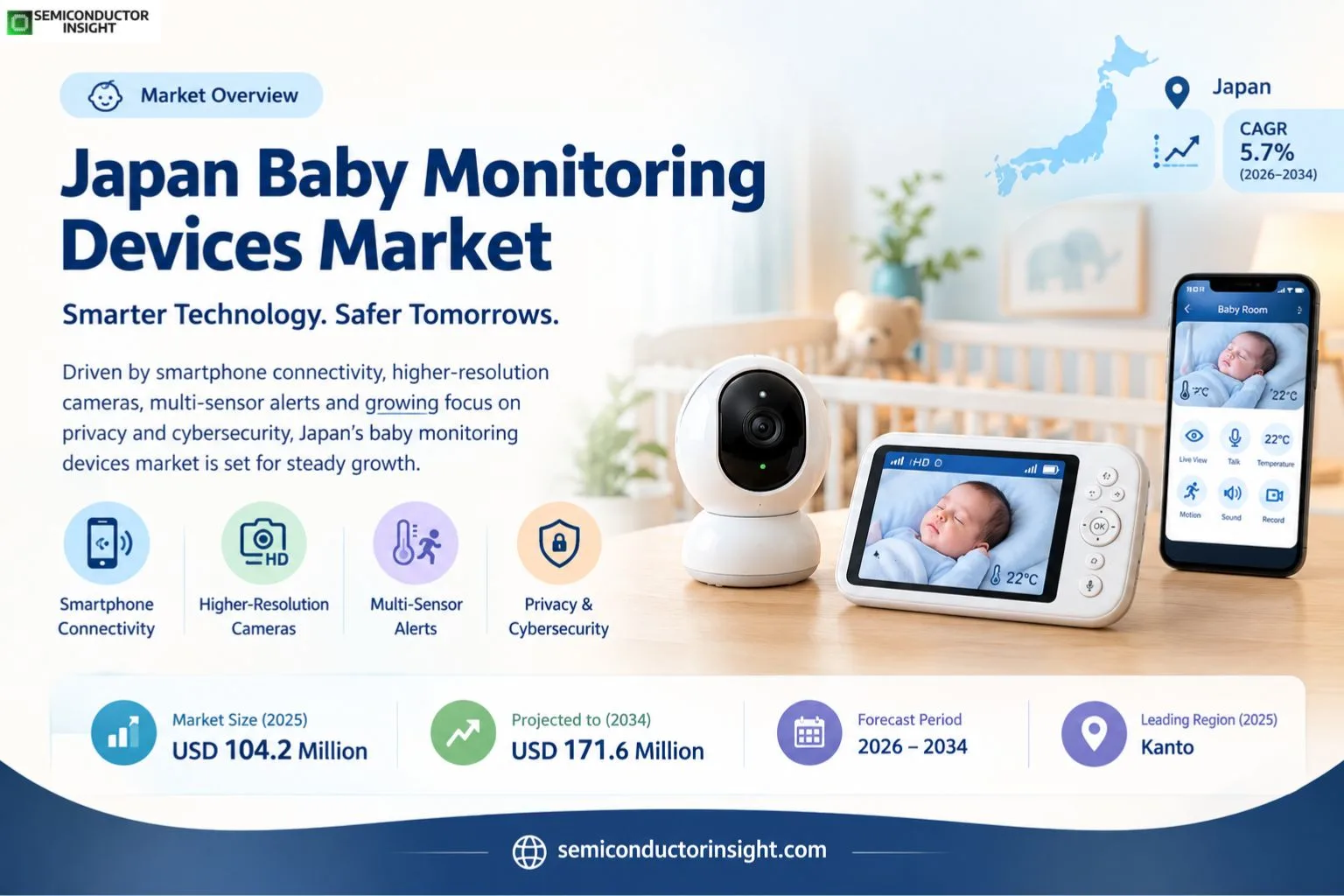
- Market size and growth: the market is valued at USD 104.2 million in 2025 and is projected to reach USD 171.6 million by 2034, representing a 5.7% CAGR across 2026–2034.
- Video Baby Monitor leads the type mix because parents increasingly value visual confirmation, night vision, motion sensing and two-way communication in a dedicated childcare device.
- Family is the leading application, supported by home monitoring is the principal use case, especially for parents balancing childcare with household tasks, remote work and sleep routines.
- Kanto is the largest geographic market, while Kanto offers the strongest incremental growth profile.
- Primary driver: parents increasingly value video, sensor alerts and remote access that reduce supervision burden while preserving confidence in infant safety
- Principal restraint: Japan’s declining number of births constrains unit growth and connected cameras face persistent privacy and cybersecurity concerns
Market Overview
The Japan baby monitoring devices market was valued at USD 104.2 million in 2025 and is projected to reach USD 171.6 million by 2034, expanding at a 5.7% CAGR during 2026–2034. Kanto leads in 2025, while the competitive landscape is being reshaped by smartphone connectivity, higher-resolution cameras, multi-sensor alerts and greater attention to privacy and cybersecurity..
Baby monitoring devices in Japan range from dedicated audio and video monitors to internet-connected cameras that send alerts and live video to smartphones. The product category increasingly combines motion, sound and temperature sensing with night vision, two-way audio and automated tracking. Panasonic’s currentcuses a dedicated J-DECT link and multiple sensors, while the KX-HBC200 extends the concept through full-HD smartphone monitoring, recording and automatic tracking.
Demand is shaped by a smaller but higher-value childcare market. Japan’s low birth rate limits unit expansion, yet parents can allocate more spending per child to products that reduce supervision burden or provide reassurance. Product usability is especially important: dedicated monitors avoid home Wi-Fi setup, while smartphone-linked cameras appeal to users who want remote access, recorded video and integration with existing connected-home routines.
Privacy and data handling increasingly affect connected-monitor positioning. The Personal Information Protection Commission treats identifiable camera imagery as personal information, reinforcing the importance of secure access, limited retention and clear user controls. This creates room for products that offer local or dedicated-network operation alongside cloud-connected features, allowing Japanese consumers to choose the balance between remote convenience and privacy.
Segment Analysis: By Type
By type, the market is segmented into Internet Baby Monitor, Video Baby Monitor, Audio Baby Monitor. Video Baby Monitor leads because its performance, integration and cost profile aligns most closely with current high-volume applications.
| Type | Function / role | Market position |
|---|---|---|
| Internet Baby Monitor | Wi-Fi or app-connected monitoring with remote viewing, alerts and recording. | Fast-growing type because smartphones make remote access and feature updates convenient. |
| Video Baby Monitor | Dedicated or connected camera-and-display system with live visual monitoring. | Leading type because visual confirmation, night vision and sensor alerts provide broad everyday value. |
| Audio Baby Monitor | Voice and sound monitoring without a video feed. | Value-oriented niche for simple monitoring, lower power and privacy-conscious households. |
Commercial implications by type
Video remains the commercial center of the category because it improves parental confidence without requiring wearables. Internet-connected models add remote access and richer software but must overcome cybersecurity concerns. Audio-only products retain a role where simplicity, cost and privacy are prioritized, particularly when parents only need notification that an infant is awake or crying.
Segment Analysis: By Application
By application, demand is segmented into Hospitals, Family, Others. Family is the largest application because it connects the underlying technology to a direct operational, safety, productivity or user-experience benefit.
| Application | Demand characteristics |
|---|---|
| Hospitals | Clinical and maternity environments use monitoring selectively where workflow, infection control and privacy requirements can be managed. |
| Family | Largest application; households use monitors during sleep, housework, remote work and multi-room childcare. |
| Others | Daycare, temporary care, hospitality and specialist support environments add smaller demand. |
By Connectivity
| Connectivity | Commercial relevance |
|---|---|
| Dedicated DECT / Proprietary RF | Direct monitor-to-camera links offer simple setup, low latency and reduced dependence on household internet. |
| Wi-Fi / Internet Connected | Smartphone access enables remote viewing, cloud features and recorded clips. |
| Hybrid Connectivity | Products combine local monitoring with optional app access, giving users resilience and remote convenience. |
By Feature Set
| Feature Set | Commercial relevance |
|---|---|
| Audio / Video Monitoring | Core monitoring remains the largest feature bundle. |
| Motion / Sound / Temperature Alerts | Sensors turn passive video into proactive notification and increase product value. |
| Recording / Auto-Tracking | Higher-end cameras add event recording, time-lapse and movement following. |
By Sales Channel
| Sales Channel | Commercial relevance |
|---|---|
| Electronics Retail | Physical retail supports product demonstration and parental trust. |
| E-commerce | Online comparison and reviews are important for feature-rich childcare electronics. |
| Baby Specialty Stores | Specialist channels connect monitors with broader newborn-product purchases. |
Regional Analysis
Kanto leads the market because the Tokyo metropolitan area is Japan’s largest population cluster, with the 2025 Census preliminary count placing Tokyo, Kanagawa, Saitama and Chiba at 36.986 million people, 30.1% of Japan’s population. Kanto has the strongest growth profile as demand expands through dense urban households, higher connected-device adoption and broad availability through electronics and e-commerce channels.
How does regional demand differ across this market?
Because this study is Japan-specific, the most useful regional lens is the country’s major population and consumer-electronics clusters. Kanto leads through the Tokyo metropolitan area, while Kansai and Chubu provide large secondary markets around Osaka and Nagoya. Kyushu and Hokkaido/Tohoku are smaller but benefit from e-commerce and nationwide product distribution. Regional purchasing differences are driven more by household density, retail access and connectivity than by fundamentally different childcare needs.
| Region | Position | Growth outlook | Demand profile | Supplier selection |
|---|---|---|---|---|
| Kanto | Largest | Strong | Dense urban households | Privacy, ease of use, connected features |
| Kansai | Second | Stable | Large metropolitan households | Value, reliability and retail support |
| Chubu | Third | Stable | Industrial and family households | Reliability and price-performance |
| Kyushu | Smaller | Moderate | Regional urban growth | Affordability and e-commerce |
| Hokkaido & Tohoku | Smaller | Selective | Dispersed households | Reliability and remote access |
Competitive Landscape
The market combines established Japanese electronics brands with imported smart-home and baby-care specialists, making trust, usability and support important competitive factors.
Panasonic has a visible domestic position through dedicated baby monitors and smartphone-connected baby cameras. Its current products illustrate two distinct value propositions: local dedicated monitoring with simple setup, and app-linked full-HD monitoring with recording and automatic tracking. This allows the brand to address privacy-conscious households as well as consumers seeking richer connected features.
Other Japanese electronics companies bring image-sensor, networking and consumer-device expertise, while international specialists compete through cloud features, wearables and AI alerts. Product differentiation depends on night imaging, sensor accuracy, app reliability, wireless range, battery life and whether the system remains useful during an internet outage.
Brand trust is unusually important because monitors operate in private spaces and may capture highly sensitive household video. Vendors that communicate security practices clearly, provide long software support and minimize setup complexity can defend premium pricing even in a market where birth volumes are structurally constrained.
| Competitive tier | Representative participants | Competitive focus |
|---|---|---|
| Domestic electronics leaders | Panasonic, Sony, Sharp, NEC | Brand trust, imaging, connectivity and domestic service |
| Monitoring / communications specialists | Uniden, OMRON | Dedicated monitoring, sensing and communications expertise |
| Broader technology vendors | Canon, Fujitsu, Hitachi, Casio | Adjacent imaging, computing and consumer-electronics capabilities |
Companies Profiled
Panasonic Corporation, Uniden Corporation, NEC Corporation, Sony Corporation, Canon Inc., Casio Computer Co., Ltd., Fujitsu Limited, OMRON Corporation, Sharp Corporation, Hitachi, Ltd.
Production Capacity Analysis
Supply depends on CMOS cameras, displays, wireless modules, microphones, speakers, temperature and motion sensors, plastic enclosures and firmware support rather than on a specialized manufacturing process unique to baby monitors.
Most device manufacturers can use established consumer-electronics supply chains, which makes physical production scalable. The harder constraint is product validation: radio performance, camera quality, night imaging, battery endurance and sensor alerts must work reliably in a domestic environment. Connected models also require app development, server infrastructure and long-term firmware maintenance after the hardware ships.
Japan’s mature retail and logistics network reduces distribution bottlenecks, but vendors still need local compliance, warranty support and Japanese-language applications. Domestic brands can leverage existing service infrastructure, while international entrants need strong channel partners to provide equivalent consumer confidence.
Market Dynamics
The market is shifting from simple one-way observation toward multi-sensor childcare systems that combine video, alerts, recording and remote access.
Dedicated monitors remain relevant because they work without complex home-network setup and can keep video local. Smartphone cameras add convenience and richer software but raise privacy, account-security and cloud-service questions. The strongest products are likely to offer both reliable local operation and optional connected services rather than forcing every household into a cloud-dependent architecture.
Market Drivers
Drivers Impact Analysis
| Driver | Impact | Commercial mechanism |
|---|---|---|
| Child-safety awareness | High | Parents use monitoring to maintain visual or audio contact while sleeping, working or completing household tasks. |
| Smartphone integration | High | App access adds remote viewing, recording and notifications without a dedicated display. |
| Multi-sensor monitoring | Medium | Motion, sound and temperature alerts add proactive value beyond a live video feed. |
| Dual-income household routines | Medium | Parents benefit from tools that reduce the need for continuous physical presence in the same room. |
Child-safety awareness
Parents use monitoring to maintain visual or audio contact while sleeping, working or completing household tasks.
Smartphone integration
App access adds remote viewing, recording and notifications without a dedicated display.
Multi-sensor monitoring
Motion, sound and temperature alerts add proactive value beyond a live video feed.
Dual-income household routines
Parents benefit from tools that reduce the need for continuous physical presence in the same room.
Market Restraints
Restraints Impact Analysis
| Restraint | Impact | Commercial mechanism |
|---|---|---|
| Declining birth volume | High | A smaller annual cohort of newborns limits the addressable unit base even when spending per child rises. |
| Privacy and cybersecurity | High | Internet-connected cameras can deter buyers if account security and data handling are unclear. |
| Premium device cost | Medium | Higher-resolution cameras and advanced software features raise the purchase price. |
| Technology overlap | Medium | General-purpose indoor security cameras can substitute for dedicated baby monitors in some households. |
Declining birth volume
A smaller annual cohort of newborns limits the addressable unit base even when spending per child rises.
Privacy and cybersecurity
Internet-connected cameras can deter buyers if account security and data handling are unclear.
Premium device cost
Higher-resolution cameras and advanced software features raise the purchase price.
Technology overlap
General-purpose indoor security cameras can substitute for dedicated baby monitors in some households.
Market Opportunities
Local-first secure monitoring
Products that keep core video and alerts inside the home while offering optional remote access can address privacy concerns.
AI-assisted event alerts
On-device sound or motion classification can reduce nuisance notifications without sending every video stream to the cloud.
Connected childcare ecosystems
Monitors can link with smart speakers, thermometers, lighting and sleep products to create broader infant-care platforms.
Premium sensor fusion
Combining video, sound, temperature and movement in one system can raise value without requiring intrusive wearables.
Supply Chain Analysis
CMOS sensors, displays, radios, microphones, speakers
Camera modules, monitors, enclosures, batteries
Apps, firmware, encryption, notifications
Electronics stores, e-commerce, warranty support
Core electronics
Imaging and wireless components determine video quality, range and power consumption. Commodity sourcing is possible, but consistency and low-light performance matter strongly in childcare use.
Device assembly
Camera mechanics, pan-tilt systems, displays and child-safe enclosures are integrated and tested for continuous household operation.
Software and security
Connected products depend on app stability, account protection, firmware updates and notification reliability. These capabilities increasingly determine brand reputation.
Retail and service
Parents often value clear setup guidance and responsive warranty support, making domestic service infrastructure a practical competitive advantage.
Recent Developments
2025 — Panasonic baby monitor and baby camera win a third consecutive Mothers Selection Award
Panasonic reported continued parent recognition for the KX-HC705 monitor and KX-HBC200 camera, highlighting demand for multi-sensor monitoring and smartphone-linked childcare devices. Source
2025 — Panasonic KX-HBC200 emphasizes full-HD smartphone monitoring and auto tracking
The current camera combines full-HD video, recording, sound and temperature sensing, smartphone alerts and automatic tracking. Source
2026 — Japan releases preliminary 2025 Census counts
The Statistics Bureau reported 123.05 million people nationally and 36.986 million in the Tokyo metropolitan area, supporting Kanto’s large consumer base. Source
Report Scope & Segmentation
<td style=”padding: 8px 10px; border: 1px solid #cdd7e5; vertical-align: t
| Attribute | Coverage |
|---|---|
| Market | Japan Baby Monitoring Devices |
| Base Year | 2025 |
| Estimated Year | 2026 |
| Forecast Period | 2026–2034 |
| 2025 Market Size | USD 104.2 million |
| 2026 Estimated Size | USD 110.2 million |
| 2034 Forecast Size | USD 171.6 million |
| CAGR | 5.7% (2026–2034) |
| By Type |

Get Sample Report PDF for Exclusive Insights
Report Sample Includes
- Table of Contents
- List of Tables & Figures
- Charts, Research Methodology, and more...
 Download Sample Report PDF