iToF Sensor Market Insights
iToF Sensor market size was valued at USD 427 million in 2025 and is expected to increase to USD 1 386 million by 2034, reflecting an implied CAGR of approximately 18.5% over the forecast horizon.
An iToF sensor is a depth‑sensing device that emits modulated near‑infrared light and derives phase‑difference information from reflected signals at each pixel, producing depth maps, distance values and three‑dimensional contour data.The shift from standalone chips toward modules, cameras and development kits lowers integration complexity for smartphone manufacturers, industrial robot builders and automotive suppliers, expanding usage across consumer electronics, robotics, logistics measurement and in‑cabin monitoring.
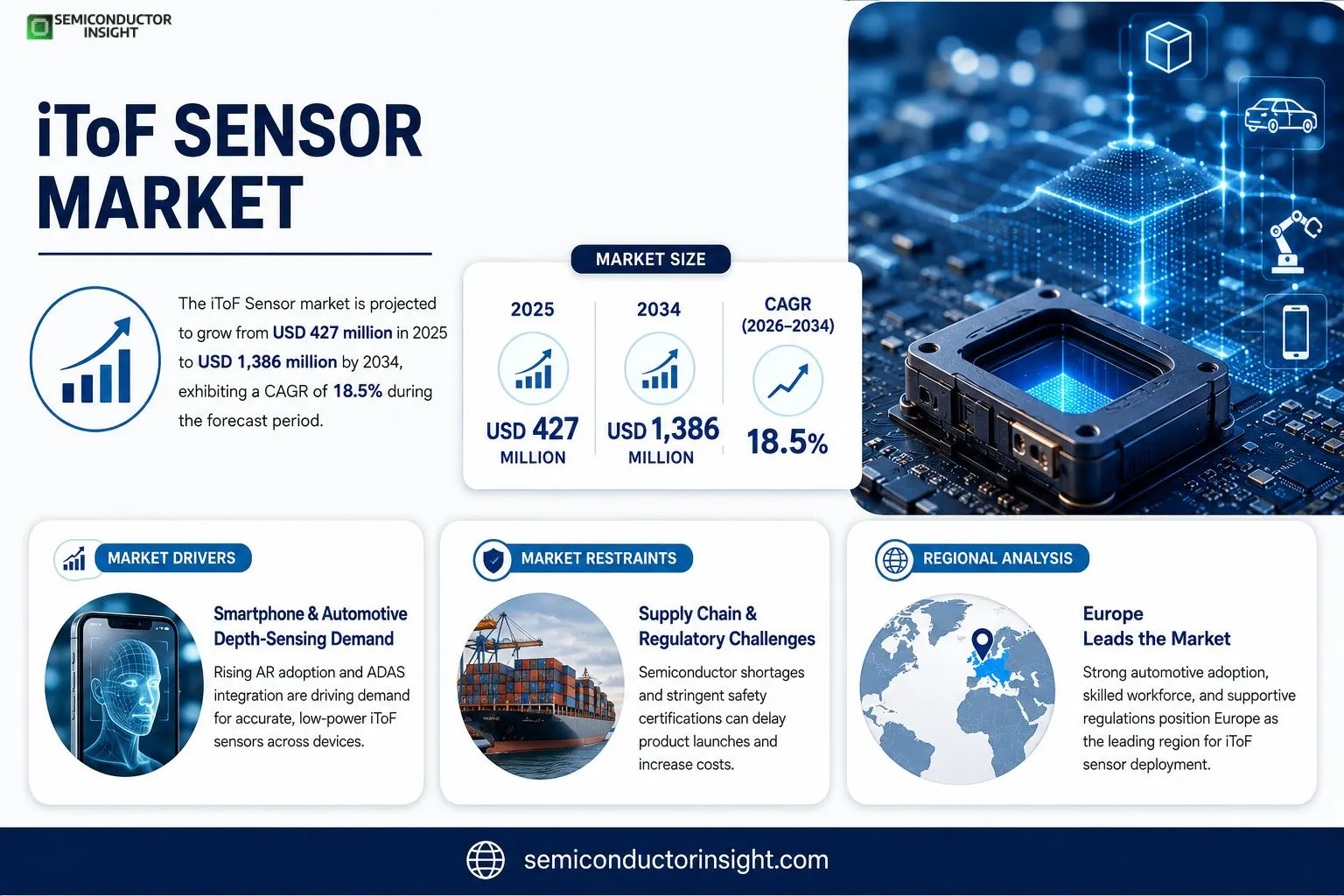
MARKET DRIVERS
Smartphone Depth‑Sensing Demand
The proliferation of augmented‑reality (AR) applications has forced leading handset manufacturers to embed precise depth‑measurement capabilities. **iToF sensors** deliver centimeter‑level accuracy while consuming less power than traditional time‑of‑flight modules, enabling seamless integration into thin‑form‑factor devices. This technical advantage translates into higher end‑user engagement and, consequently, a measurable uplift in component orders.
Automotive ADAS Integration
Advanced driver‑assistance systems (ADAS) increasingly rely on short‑range ranging for parking assistance and low‑speed collision avoidance. **iToF sensors** provide rapid response times and are tolerant to ambient light, characteristics that align with automotive safety standards. OEMs are therefore allocating larger bill‑of‑materials budgets toward these modules, which is reflected in the rising production volumes observed in recent quarters.
➤ “Manufacturers that secure early design wins for iToF‑based ADAS modules can command premium pricing for at least the next five years,”
Beyond consumer electronics and vehicles, industrial robotics vendors are standardising on iToF technology for real‑time obstacle avoidance. The shift reduces system latency and improves throughput on assembly lines, granting operators a competitive edge in high‑mix, low‑volume manufacturing environments.
MARKET CHALLENGES
Supply‑Chain Volatility
semiconductor shortages have strained the availability of high‑precision laser diodes, a core component of iToF modules. While manufacturers are expanding fab capacity, lead times remain unpredictable, forcing downstream integrators to hold safety stock at higher costs.
Other Challenges
Cost Competitiveness
Competing technologies such as structured light and stereo vision continue to erode price points. Suppliers must balance performance gains with aggressive pricing to retain market share, especially in price‑sensitive segments like mid‑range smartphones.
MARKET RESTRAINTS
Regulatory Hurdles
Regional safety certifications for automotive components can add months to a product’s time‑to‑market. The rigorous validation process for laser‑based sensors, especially in jurisdictions with stringent eye‑safety standards, slows adoption despite strong technical merit.Additionally, some end‑users remain cautious about integrating laser emitters into devices that operate close to the human body, limiting the penetration of iToF sensors in wearables and health‑monitoring equipment.
MARKET OPPORTUNITIES
Emerging 3‑D Mapping Applications
Urban planners and logistics firms are beginning to exploit high‑resolution 3‑D maps for route optimisation and infrastructure monitoring. iToF sensors, with their ability to capture dense point clouds in real time, are uniquely positioned to feed these data pipelines, opening a new revenue stream for component manufacturers.The rise of collaborative robots (cobots) in small‑to‑medium enterprises also presents a fertile market niche. By embedding compact iToF modules, cobots can achieve safe human‑machine interaction without relying on bulky external safety systems, thereby reducing total cost of ownership for adopters.
iToF Sensor Market Trends
Technology Platform Shift
The ecosystem surrounding depth-sensing devices has moved from isolated chip offerings to a coordinated platform that bundles sensors, optics, processing engines and development toolkits. Back‑side‑illuminated pixel arrays, shutters and on‑chip depth processors now arrive together with built‑in ISP blocks, enabling manufacturers to embed accurate three‑dimensional perception in a single module. This convergence shortens integration cycles for smartphone makers, robot builders and automotive suppliers, turning what once required extensive custom engineering into a plug‑and‑play capability. For iToF Sensor Market, the implication is a transition from competition centered on raw ranging distance to a race for holistic solution readiness and scenario‑specific calibration.
Other Trends
Demand Diversification Across End‑Markets
While consumer electronics and extended reality continue to value lightweight, low‑power devices, industrial automation, logistics measurement and in‑cabin automotive sensing are gaining equal prominence. Manufacturers now market modules that output volume, occupancy and pose data directly, which reduces the software burden on downstream system integrators. This broadened addressable base dilutes the impact of any single sector slowdown and creates a more resilient revenue profile for suppliers that can serve both high‑volume handheld devices and niche safety‑critical installations.
Competitive Landscape Emphasizing System Integration
Vendors that couple chip design with optical enhancementssuch as narrow‑band‑pass filters and microlens arraysand provide SDKs or reference designs are better positioned to capture the upside of the platform transition. The market now rewards firms that can guarantee ambient‑light robustness and high‑frequency modulation while also delivering turnkey camera products. Consequently, partnerships between silicon providers, optical specialists and software houses are proliferating, reshaping the traditional top‑down supply chain into a collaborative ecosystem that accelerates time‑to‑market for new applications.
COMPETITIVE LANDSCAPEKey Industry Players
iToF Sensor Market – Competitive Overview
Among the manufacturers, Sony stands out for its aggressive rollout of backside‑illuminated pixel arrays that couple a shutter with on‑chip depth processing. By integrating a built‑in ISP and offering both bare die and turnkey camera modules, Sony has built a platform that lowers the engineering effort required by smartphone OEMs and automotive cabin‑monitoring suppliers. STMicroelectronics follows closely, leveraging its extensive analog‑mixed‑signal expertise to deliver high‑modulation‑frequency chips that tolerate strong ambient light, a critical attribute for industrial robots operating on factory floors. The duopoly creates a tiered market where Tier‑1 chip providers supply reference designs that smaller system integrators subsequently adapt into niche solutions.Beyond the headline players, a cluster of specialized firms adds depth to the competitive fabric. PMD Technologies and Melexis focus on compact modules aimed at robotics and logistics, emphasizing low‑power operation and tight integration with control electronics. ESPROS and Infineon target the automotive in‑cabin segment, offering sensors with built‑in safety certifications. onsemi and Samsung supply high‑volume packaged chips that feed consumer‑electronics manufacturers seeking lightweight depth cameras for XR headsets. Meanwhile, Gpixel, Nuvoton, Orbbec, Goertek, and VisEra pursue differentiated value propositionsfrom microlens‑enhanced optical stacks to turnkey SDKscatering to developers who prioritize rapid prototyping over raw performance. This mosaic of capabilities forces incumbents to compete not only on pixel count or range but also on software support, ecosystem maturity, and the speed with which a complete depth‑sensing solution can be brought to market.
List of Key iToF Sensor Companies Profiled
- Sony Corporation
- STMicroelectronics
- PMD Technologies
- Melexis
- ESPROS
- Infineon Technologies
- onsemi
- Samsung Electronics Co., Ltd.
- Gpixel
- Nuvoton Technology Corporation
- Orbbec
- Goertek Microelectronics Co., Ltd.
- VisEra Technologies Company Limited
Segment Analysis:
| Segment Category | Sub-Segments | Key Insights |
| By Type |
|
CW‑iToF is emerging as the leading type because:
|
| By Application |
|
Industrial Automation drives the most compelling use cases because:
|
| By End User |
|
Robotics System Integrators emerge as the leading end‑user segment because:
|
| By Product Level |
|
Modules / Camera Assemblies dominate this tier because:
|
| By Delivery Format |
|
Development Kits & Reference Designs are the most influential format because:
|
Regional Analysis: iToF Sensor Market
Europe
German and French OEMs are embedding iToF units into adaptive cruise control and parking assist functions, capitalising on the sensor’s compact form factor and resilience to adverse weather. This integration reduces reliance on bulkier lidar arrays, trimming vehicle weight and cost while preserving safety margins.
UK‑based handset manufacturers are experimenting with iToF for facial unlock and augmented‑reality depth mapping, attracted by the technology’s low power draw and rapid frame rates, which dovetail with consumer expectations for seamless interaction.
Factories in the Benelux region are deploying iToF sensors on robotic pick‑and‑place lines to enhance object detection accuracy, facilitating higher throughput without sacrificing precision in fast‑moving production environments.
The European Union’s EMC and safety directives provide a harmonised testing framework, allowing suppliers to certify once and sell across multiple member states, a factor that streamlines market entry for iToF components.
North America
In the United States, iToF Sensor Market benefits from a vibrant venture‑capital scene that fuels start‑ups focused on immersive gaming and warehouse robotics. Canadian firms complement this activity with strong research partnerships that translate academic breakthroughs into commercial kits. The region’s emphasis on silicon‑photonic integration is reshaping sensor architecture, enabling higher resolution at reduced cost. While the market is fragmented, major semiconductor players are consolidating expertise, setting the stage for broader ecosystem support.
Asia‑Pacific
China’s expansive manufacturing base is converting iToF capabilities into mass‑produced consumer gadgets, particularly mid‑range smartphones where cost sensitivity is paramount. South Korea and Japan, meanwhile, are pioneering high‑precision depth sensing for autonomous drone navigation, leveraging their advanced optics heritage. The region’s rapid product cycles push suppliers to prioritise short‑lead‑time production, fostering a competitive environment that accelerates feature rollout across multiple device categories.
South America
Brazil’s emerging smart‑city initiatives are creating niche demand for iToF sensors in traffic‑management cameras and public‑transport monitoring systems. Argentine research institutes are also exploring low‑power iToF designs tailored for agricultural drones, a sector poised to benefit from precise canopy mapping. Although overall market size remains modest, these targeted applications establish footholds that could expand as regional digital‑infrastructure investments mature.
Middle East & Africa
The United Arab Emirates is channeling sovereign‑wealth funding into pilot projects that integrate iToF sensors into security‑surveillance networks and mixed‑reality training platforms for the oil‑and‑gas sector. In sub‑Saharan Africa, NGOs are testing iToF‑enabled devices for health‑screening kiosks, valuing the sensor’s ability to operate reliably in low‑light environments. These early‑stage deployments, while limited in scale, illustrate a willingness to leverage depth‑sensing technology for sector‑specific challenges.
Report Scope
This market research report provides a comprehensive analysis of the iToF Sensor Market , covering the forecast period 2026–2034. It offers detailed insights into market dynamics, technological advancements, competitive landscape, and key trends shaping the industry.
Key focus areas of the report include:
- Market Overview: The report begins with an overview outlining its current market scenario, key growth indicators, and industry transformation drivers. It discusses macroeconomic factors, demand–supply balance, regulatory landscape, and the strategic role of semiconductors in powering advancements across industries such as automotive, telecommunications, consumer electronics, and industrial automation.
- Market Size & Forecast: Historical data and future projections for revenue, unit shipments, and market value across major regions and segments.
- Segmentation Analysis: Detailed breakdown by product type, technology, application, and end-user industry to identify high-growth segments and investment opportunities.
- Regional Insights: Insights into market performance across North America, Europe, Asia-Pacific, Latin America, and the Middle East & Africa, including country-level analysis where relevant.
- Competitive Landscape: Profiles of leading market participants, including their product offerings, R&D focus, manufacturing capacity, pricing strategies, and recent developments such as mergers, acquisitions, and partnerships.
- Technology Trends & Innovation: Assessment of emerging technologies, integration of AI/IoT, semiconductor design trends, fabrication techniques, and evolving industry standards.
- Market Drivers & Restraints: Evaluation of factors driving market growth along with challenges, supply chain constraints, regulatory issues, and market-entry barriers.
- Stakeholder Insights: Insights for component suppliers, OEMs, system integrators, investors, and policymakers regarding the evolving ecosystem and strategic opportunities.
Primary and secondary research methods are employed, including interviews with industry experts, data from verified sources, and real-time market intelligence to ensure the accuracy and reliability of the insights presented.
FREQUENTLY ASKED QUESTIONS:
What is the current market size of iToF Sensor Market?
-> iToF Sensor Market was valued at USD 427 million in 2025 and is expected to reach USD 1,386 million by 2034, at a CAGR of 18.5%.
Which key companies operate in iToF Sensor Market?
-> Key players include Sony, STMicroelectronics, PMD Technologies, Melexis, ESPROS, Infineon, Silicon Integrated, OPNOUS, onsemi, Samsung Electronics, Gpixel, Nuvoton Technology, Orbbec, Goertek Microelectronics, VisEra Technologies, among others.
What are the key growth drivers?
-> Key growth drivers include advancements in backside‑illuminated pixels, shutter, high modulation frequency, on‑chip depth processing, and strong ambient‑light robustness, as well as expanding applications in industrial automation, robotics, logistics measurement, XR, and automotive in‑cabin monitoring, supported by policy catalysts such as EU safety regulations.
Which region dominates the market?
-> Asia‑Pacific dominates iToF Sensor Market, driven by strong manufacturing ecosystems in Japan, South Korea, China, and Taiwan, while also showing rapid adoption across industrial and automotive segments.
What are the emerging trends?
-> Emerging trends include the shift toward a platform‑style 3D sensing ecosystem combining sensor chips, modules, cameras, and SDKs; increased focus on high‑performance chips, low‑threshold modular delivery, and industry‑specific solutions; and greater integration of on‑chip AI processing to improve depth accuracy in complex environments.

Get Sample Report PDF for Exclusive Insights
Report Sample Includes
- Table of Contents
- List of Tables & Figures
- Charts, Research Methodology, and more...
 Download Sample Report PDF