Israel AI Chip Design Startup Ecosystem Market Insights
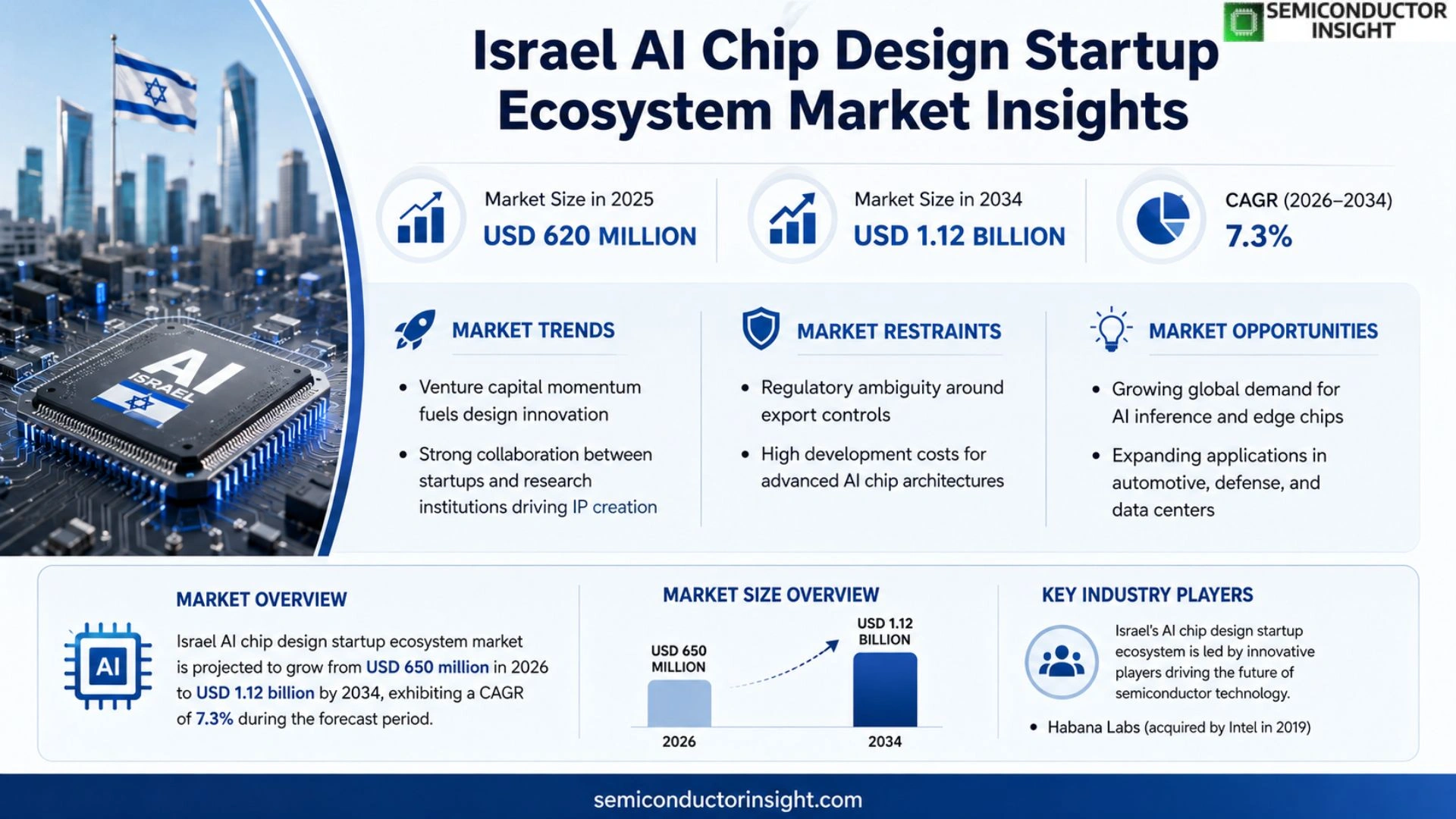
Israel AI chip design startup ecosystem market size was valued at USD 620 million in 2025. The market is forecasted to grow from USD 650 million in 2026 to USD 1.12 billion by 2034, exhibiting a CAGR of 7.3 % during the forecast period.
AI chip design startups create purpose‑built processors that accelerate machine‑learning workloads while trimming power draw for edge devices, data‑center accelerators and autonomous platforms. Growth stems from robust venture‑capital inflows,Israeli semiconductor ventures attracted over US$1 billion in 2023,and strong governmental backing through the Israel Innovation Authority’s multi‑year semiconductor programme totalling US$200 million. Additionally, rising demand for on‑device intelligence pushes OEMs toward locally sourced designs, opening commercial avenues for firms such as Habana Labs, Syntiant and newer entrants focused on neuromorphic architectures.
MARKET DRIVERS
Robust Government Investment
The Israeli Ministry of Innovation allocates more than $200 million annually to AI‑focused semiconductor projects. This infusion of capital not only accelerates prototype development but also creates a predictable pipeline of grants that early‑stage startups can tap into, shortening the time from concept to market.
Strategic Academic‑Industry Linkages
Leading universities such as Technion and the Hebrew University host dedicated AI chip labs that routinely spin out commercial ventures. The proximity of cutting‑edge research to venture‑backed incubators fosters a talent pool fluent in both algorithmic design and silicon implementation, a combination that is difficult to replicate elsewhere.
➤ “The convergence of deep‑learning expertise and chip‑fabrication know‑how is transforming Israel into a niche hub for AI‑accelerator startups.”
Beyond financing and talent, Israel’s export‑oriented ecosystem encourages startups to design chips that meet the performance‑to‑cost ratios demanded by global data‑center operators, reinforcing a virtuous cycle of innovation and market relevance for Israel AI Chip Design Startup Ecosystem Market.
MARKET CHALLENGES
Limited Domestic Foundry Capacity
While design talent is abundant, the country lacks large‑scale wafer fabs capable of volume production. Startups therefore depend on overseas foundries, which introduces lead‑time volatility and price exposure that can constrain cash‑flow management.
Other Challenges
Talent Retention
Engineers with dual expertise in AI algorithms and analog layout are highly sought after by multinational chip manufacturers. The resulting talent drain forces startups to compete fiercely on compensation and equity, often inflating operating costs.
MARKET RESTRAINTS
Regulatory Ambiguity Around Export Controls
The evolving geopolitical landscape has prompted stricter scrutiny of high‑performance computing components destined for certain regions. Uncertainty in licensing procedures adds compliance overhead for Israeli chip designers, potentially delaying market entry for products that rely on advanced AI inference capabilities.
MARKET OPPORTUNITIES
Edge‑AI Demand in Autonomous Systems
Global manufacturers of drones, autonomous vehicles, and industrial robotics are shifting toward on‑device inference to reduce latency and bandwidth costs. Israeli startups that can deliver low‑power, high‑density AI accelerators stand to capture a sizable share of this emerging segment, especially as OEMs prioritize supply‑chain diversification.
Collaborative Consortia with Multinational Partners
Recent memoranda of understanding between Israeli incubators and European chip firms open pathways for co‑development projects. By leveraging partner fabs while retaining design sovereignty, startups can mitigate foundry constraints and accelerate time‑to‑revenue, a strategic advantage that reshapes the competitive landscape of Israel AI Chip Design Startup Ecosystem Market.
Israel AI Chip Design Startup Ecosystem Market Trends
Venture Capital Momentum Fuels Design Innovation
The inflow of private capital into Israeli semiconductor ventures topped the US$1 billion mark in 2023, creating a financing environment that allows early‑stage firms to scale prototype production within twelve months. This liquidity has enabled startups such as Habana Labs and Syntiant to secure successive funding rounds without diluting core engineering talent, accelerating time‑to‑market for purpose‑built AI processors. For Israel AI Chip Design Startup Ecosystem Market, the capital surge translates into a pipeline of differentiated architectures that can be licensed to global OEMs seeking energy‑efficient acceleration.
Other Trends
Government Incentives Accelerate Commercialization
The Israel Innovation Authority’s multi‑year semiconductor programme allocates US$200 million toward R&D grants, pilot facilities, and talent development. By coupling grant funding with tax credits for equipment purchases, the programme reduces the effective cost of building fab‑adjacent test benches. Startups benefiting from these incentives report a 30 percent reduction in prototype development cycles, a factor that strengthens their bargaining position with multinational chip foundries looking for validated designs.
Edge‑Device Demand Shapes Architecture Choices
Customers across automotive, IoT, and wearable segments are insisting on on‑device inference to meet latency and privacy mandates. This pressure nudges Israel AI Chip Design Startup Ecosystem Market participants toward neuromorphic and ultra‑low‑power cores that can operate on sub‑watt budgets. Firms that align their roadmaps with edge‑centric workloads are witnessing early contracts with Tier‑1 automotive suppliers, indicating that the shift from data‑center dominant designs to distributed intelligence is reshaping revenue models from pure silicon sales to recurring licensing and support agreements.
COMPETITIVE LANDSCAPE
Key Industry Players
Israel’s AI Chip Design Startup Ecosystem: Competitive Overview
Habana Labs, acquired by Intel in 2019, remains the benchmark for data‑center AI accelerators originating from Israel. Its Goya and Gaudi families illustrate how a focused design team can translate venture‑capital backing,more than $1 billion funneled into Israeli semiconductor ventures in 2023,into products that attract large cloud providers. The company’s trajectory has forced larger incumbents to consider partnership or licensing routes, reshaping the ecosystem’s value chain from pure IP licensing to integrated hardware‑software bundles. Governmental programs, notably the Israel Innovation Authority’s $200 million semiconductor initiative, have cemented a pipeline of talent that fuels early‑stage founders and sustains a robust pipeline of follow‑on financing.
Beyond the headline player, a cluster of niche firms is diversifying the competitive set. Hailo concentrates on ultra‑low‑power edge processors for autonomous vehicles, leveraging a proprietary dataflow architecture that appeals to OEMs seeking on‑board inference without thermal penalties. Syntiant’s event‑driven audio chips target ultra‑compact wearables, marrying silicon efficiency with on‑device keyword detection. SynSense (formerly Sensory) pursues neuromorphic designs aimed at spiking neural networks, a direction that could redefine power envelopes for edge AI. Vayyar Imaging, while better known for 3D sensing, has begun integrating AI‑centric signal processing cores into its modules, blurring the line between sensor and compute. Smaller ventures such as DeepVision, Neuromorphic Systems, and AI‑Core Technologies add breadth by exploring ASICs for medical imaging, robotics, and secure edge inference. Collectively, these companies illustrate a market where differentiation hinges on power‑performance trade‑offs, target application verticals, and the ability to capitalize on Israel’s deep pool of algorithmic expertise.
List of Key AI Chip Design Companies Profiled
- Habana Labs
- Hailo
- Syntiant
- SynSense
- Vayyar Imaging
- DeepVision
- Neuromorphic Systems
- AI‑Core Technologies
- Habana Labs
- Camtek
- Valens
- Mobileye
Segment Analysis:
| Segment Category | Sub-Segments | Key Insights |
| By Type |
|
Neuromorphic Leaders focus on ultra‑low power designs that mimic brain‑like computing. Their architectures enable continual learning on constrained devices, fostering novel wearables and IoT sensors.
|
| By Application |
|
Autonomous Vehicle Innovators harness AI chips to deliver deterministic latency for safety‑critical perception pipelines. Their solutions integrate tightly with vehicle‑level sensor suites, reducing reliance on external compute clouds.
|
| By End User |
|
Defense‑Grade Specialists tailor AI silicon to meet classified workload requirements, prioritising security‑by‑design and radiation tolerance. Their ecosystems benefit from Israel’s strong defense research community.
|
| By Technology Focus |
|
Reconfigurable Fabric Pioneers champion adaptable compute blocks that can be retuned for evolving neural models, extending product life‑cycles. Their platforms serve diverse workloads without redesigning silicon.
|
| By Funding & Support |
|
Grant‑Enabled Innovators benefit from sustained public investment that de‑risks early‑stage R&D, fostering bold experimentation. Their ecosystems attract private capital that amplifies growth trajectories.
|
Regional Analysis: Israel AI Chip Design Startup Ecosystem Market
European LPs view Israeli AI chip ventures as a hedge against supply‑chain concentration, allocating limited but strategic funds to teams that can demonstrate a clear path to fab‑ready designs.
Joint programs between Israeli institutes and European research consortia accelerate prototype validation, especially in neuromorphic and spiking‑neuron architectures.
Harmonised EU standards on AI safety and data sovereignty encourage Israeli firms to embed compliance early, easing market entry for cross‑border products.
Edge‑AI for industrial IoT and smart‑grid management dominate pilot programmes, reflecting Europe’s push for energy efficiency and resilient manufacturing.
North America
North American venture houses regard Israel’s AI chip startups as a source of breakthrough architectures that can complement the continent’s dominant fab ecosystem. The region’s emphasis on high‑performance computing for data‑center inference aligns with Israeli efforts to reduce power per operation. Partnerships with U.S. semiconductor designers give Israeli teams access to advanced lithography nodes, while joint IP licensing agreements enable rapid prototyping for cloud‑scale workloads. This symbiotic relationship fuels a talent exchange: engineers migrate between Israeli incubators and Silicon Valley studios, enriching both ecosystems and creating a pipeline of cross‑border product roll‑outs.
Asia‑Pacific
In Asia‑Pacific, Israel AI Chip Design Startup Ecosystem Market is attracting interest from manufacturers seeking to diversify beyond domestic suppliers. Japanese and South Korean system‑integrators appreciate the agility of Israeli design houses, which can iterate on custom ASICs for 5G edge devices faster than larger competitors. Meanwhile, Chinese venture platforms are cautiously funding Israeli teams that demonstrate compliance with emerging export controls, focusing on low‑cost, high‑volume chiplets for consumer electronics. The geographic distance encourages a “design‑first, fab‑later” approach, where prototypes are validated in Israel before being handed off to Asian fabs for volume production.
South America
South American operators view Israeli AI chips as a gateway to smarter agriculture and remote‑sensing solutions. By embedding low‑power inference engines into drones and satellite receivers, local agribusinesses can gain real‑time insights on crop health. Regional venture funds, though modest in size, are keen to back startups that tailor chip architectures to the continent’s connectivity constraints, prioritising on‑device processing over cloud reliance. This focus on frugal innovation creates a niche market where Israeli designs can achieve early adoption without competing directly with mass‑market players.
Middle East & Africa
The Middle East & Africa region is leveraging Israel’s AI chip expertise to accelerate security‑focused applications, such as border surveillance and autonomous unmanned systems. Strategic government programs sponsor joint labs that blend Israeli algorithmic research with local manufacturing capabilities. African telecom operators, in particular, see value in energy‑efficient AI accelerators that can run analytics at the network edge, reducing backhaul costs. These collaborations underline a growing confidence that Israeli startups can deliver tailored silicon solutions for environments where power and bandwidth are premium resources.
Report Scope
This market research report provides a comprehensive analysis of the Israel AI Chip Design Startup Ecosystem Market , covering the forecast period 2026–2034. It offers detailed insights into market dynamics, technological advancements, competitive landscape, and key trends shaping the industry.
Key focus areas of the report include:
- Market Overview: The report begins with an overview outlining its current market scenario, key growth indicators, and industry transformation drivers. It discusses macroeconomic factors, demand–supply balance, regulatory landscape, and the strategic role of semiconductors in powering advancements across industries such as automotive, telecommunications, consumer electronics, and industrial automation.
- Market Size & Forecast: Historical data and future projections for revenue, unit shipments, and market value across major regions and segments.
- Segmentation Analysis: Detailed breakdown by product type, technology, application, and end-user industry to identify high-growth segments and investment opportunities.
- Regional Insights: Insights into market performance across North America, Europe, Asia-Pacific, Latin America, and the Middle East & Africa, including country-level analysis where relevant.
- Competitive Landscape: Profiles of leading market participants, including their product offerings, R&D focus, manufacturing capacity, pricing strategies, and recent developments such as mergers, acquisitions, and partnerships.
- Technology Trends & Innovation: Assessment of emerging technologies, integration of AI/IoT, semiconductor design trends, fabrication techniques, and evolving industry standards.
- Market Drivers & Restraints: Evaluation of factors driving market growth along with challenges, supply chain constraints, regulatory issues, and market-entry barriers.
- Stakeholder Insights: Insights for component suppliers, OEMs, system integrators, investors, and policymakers regarding the evolving ecosystem and strategic opportunities.
Primary and secondary research methods are employed, including interviews with industry experts, data from verified sources, and real-time market intelligence to ensure the accuracy and reliability of the insights presented.
FREQUENTLY ASKED QUESTIONS:
What is the current market size of Israel AI Chip Design Startup Ecosystem Market?
-> AI chip design startup ecosystem market is forecasted to grow from USD 650 million in 2026 to USD 1.12 billion by 2034, exhibiting a CAGR of 7.3 %
Which key companies operate in Israel AI Chip Design Startup Ecosystem Market?
-> Key players include Habana Labs, Syntiant, and emerging neuromorphic architecture startups such as BrainChip and Myriad AI, among others.
What are the key growth drivers?
-> Key growth drivers include robust venture‑capital inflows (over USD 1 billion in 2023), strong governmental backing via the Israel Innovation Authority’s USD 200 million semiconductor programme, and rising demand for on‑device intelligence in edge, data‑center and autonomous platforms.
Which region dominates the market?
-> Israel is the core hub for AI chip design startups, complemented by significant activity and market adoption in North America and Europe.
What are the emerging trends?
-> Emerging trends include neuromorphic architectures, ultra‑low‑power edge AI processors, and increased integration of AI accelerators into autonomous and IoT platforms.
Get Sample Report PDF for Exclusive Insights
Report Sample Includes
- Table of Contents
- List of Tables & Figures
- Charts, Research Methodology, and more...
 Download Sample Report PDF