Market Insights
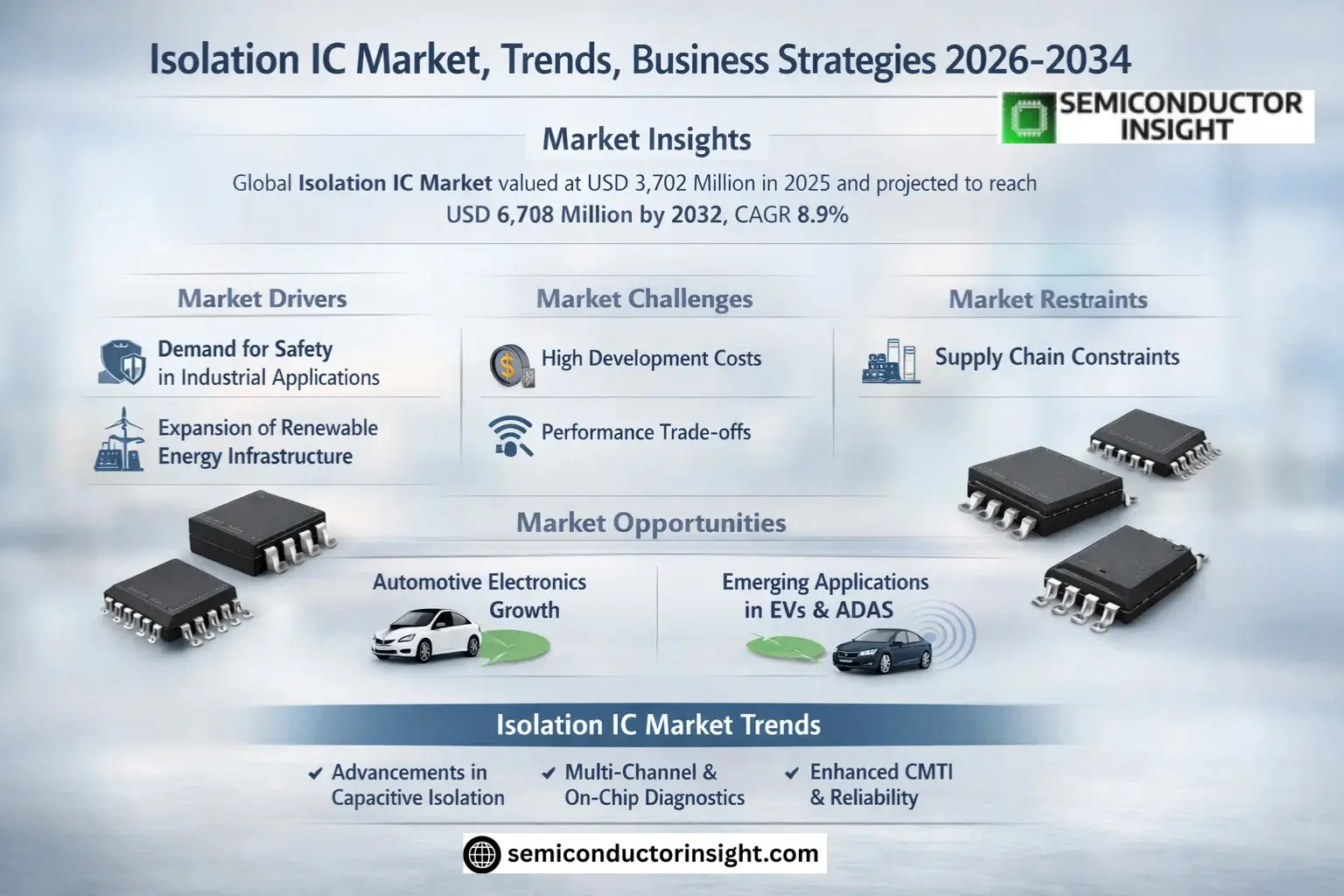
Global Isolation IC Market was valued at USD 3,702 million in 2025 and is projected to reach USD 6,718 million by 2032, exhibiting a CAGR of 8.9% during the forecast period.
Isolation IC refers to a semiconductor component designed to provide electrical isolation between input and output circuits. These chips are critical for safety compliance, noise reduction, and voltage level matching in high-voltage systems or interconnected multi-circuit applications. The technology ensures reliable signal transmission while preventing hazardous currents or ground loops.
The market growth is driven by increasing demand from industrial automation, renewable energy systems, and electric vehicles, where safety standards mandate robust isolation solutions. Capacitive coupling has emerged as the dominant technology due to its superior common-mode transient immunity (CMTI) and integration capabilities. Key players like Texas Instruments and Analog Devices are advancing miniaturization through CMOS-based designs with embedded diagnostics.
MARKET DRIVERS
Growing Demand for Safety in Industrial Applications
Isolation IC Market is experiencing significant growth due to increasing safety requirements in industrial automation and power systems. These ICs provide critical galvanic isolation, preventing hazardous voltage spikes and ensuring reliable signal transmission. *Strict regulations* in industries like manufacturing and energy are pushing adoption of high-performance isolation solutions.
Expansion of Renewable Energy Infrastructure
Global investments in solar and wind energy projects are driving demand for Isolation ICs in power conversion systems. These components play a vital role in solar inverters, battery management systems, and smart grid applications, with the market projected to grow at 8.2% CAGR through 2026.
Advancements in electric vehicle charging infrastructure are creating additional opportunities, as Isolation ICs ensure safe power delivery and communication in EV charging stations.
MARKET CHALLENGES
High Development Costs for Advanced Solutions
Designing isolation ICs that meet increasingly stringent safety standards while maintaining cost competitiveness poses significant challenges. The R&D investment for new optocoupler alternatives can exceed USD 5 million per product line, creating barriers for smaller manufacturers.
Other Challenges
Performance Trade-offs
Balancing high-speed data transmission with robust isolation properties remains technically challenging, particularly for digital isolators in 5G and IoT applications. Power consumption optimization is another critical factor affecting adoption.
MARKET RESTRAINTS
Supply Chain Constraints for Specialty Materials
Isolation IC Market faces constraints from limited availability of high-quality isolation barrier materials. Shortages of specialized silicon substrates and encapsulation materials have led to extended lead times, impacting product availability across the industry.
MARKET OPPORTUNITIES
Emerging Applications in Automotive Electronics
The automotive sector presents substantial growth potential for Isolation ICs, particularly in electric vehicle powertrains and ADAS systems. With over 25 million EVs expected on roads by 2025, demand for automotive-grade isolation solutions is forecast to triple current levels.
Isolation IC Market Trends
Technology Advancements Driving Market Growth
Isolation IC Market is witnessing significant technological improvements, particularly in capacitively coupled isolation architectures based on CMOS processes. Manufacturers are focusing on enhancing common-mode transient immunity (CMTI) and transmission consistency to meet stringent reliability requirements in industrial and automotive applications. Integration trends like multi-channel designs and on-chip diagnostics are becoming standard, helping reduce system complexity for end-users.
Other Trends
Regional Market Dominance
Asia-Pacific holds over 54% share of the global Isolation IC Market, driven by strong demand from industrial and communications sectors. North America and Europe follow with 24% and 17% market shares respectively, where automotive applications show particularly robust growth.
Competitive Landscape Evolution
The market remains fragmented with the top five vendors – ADI, Texas Instruments, Infineon, Skyworks, and Onsemi – collectively controlling 58% market share. Product differentiation through technical specifications and reliability improvements continues to be a key competitive strategy among manufacturers.
Application Sector Expansion
Industrial applications dominate Isolation IC consumption (44% market share), but automotive applications are growing rapidly (20% share) due to increasing electrification and safety requirements in vehicles. The communications and energy sectors show steady demand for isolation solutions in power management and data transmission.
Product Type Developments
Isolated drivers maintain market leadership with 48% share, though digital isolators are gaining traction due to their versatility. Manufacturers are expanding portfolios with integrated solutions combining multiple isolation functions to address complex system requirements.
COMPETITIVE LANDSCAPE
Key Industry Players
Market Dominated by Top 5 Players Holding 58% Share
Global Isolation IC Market is characterized by high fragmentation with intense competition among manufacturers. Analog Devices Inc. (ADI) leads the market with superior capacitive coupling technology and robust product portfolio across digital isolators and isolated gate drivers. Texas Instruments follows closely with innovations in multi-channel isolation solutions. The top five vendors – ADI, Texas Instruments, Infineon, Skyworks, and Onsemi collectively controlled 58% market share in 2025 through technological differentiation and strategic acquisitions.
Several regional players are gaining traction through specialized offerings. Chinese manufacturers like NOVOSENSE and 3PEAK are expanding aggressively in industrial applications with cost-competitive solutions. European semiconductor leaders such as STMicroelectronics and Infineon maintain strong positions in automotive-grade isolation ICs. Emerging players focus on niche applications including medical devices and renewable energy systems to carve out specialized market segments.
List of Key Isolation IC Companies Profiled
- Analog Devices Inc. (ADI)
- Texas Instruments
- Infineon Technologies
- Skyworks Solutions
- Onsemi
- Broadcom Inc.
- Vicor Corporation
- ROHM Semiconductor
- NVE Corporation
- STMicroelectronics
- NOVOSENSE Microelectronics
- Shanghai Chipanalog Microelectronics
- Shanghai Belling
- 3PEAK Incorporated
- Rongmei Semiconductor (Shanghai)
Segment Analysis:
| Segment Category | Sub-Segments | Key Insights |
| By Type |
|
Isolated Drivers have emerged as the dominant product category in the Isolation IC Market.
|
| By Application |
|
Industrial Applications represent the largest and fastest-growing sector for Isolation IC adoption.
|
| By End User |
|
Original Equipment Manufacturers (OEMs) constitute the primary demand source.
|
| By Isolation Technology |
|
Capacitive Coupling has become the preferred isolation architecture.
|
| By Channel Configuration |
|
Multi-channel configurations are gaining significant traction.
|
Regional Analysis: Asia-Pacific Isolation IC Market
China’s ‘Made in China 2025’ initiative accelerates industrial automation, requiring high-performance isolation ICs for motor drives and factory equipment. Smart manufacturing investments create sustained demand for reliable signal isolation solutions.
As the world’s largest electric vehicle market, China drives isolation IC demand for battery management and onboard charging systems. Domestic EV manufacturers increasingly favor integrated isolation solutions for space efficiency.
Solar and wind power installations require isolation ICs for grid-tie inverters and power conversion systems. China’s renewable energy expansion provides robust growth opportunities for isolation technology providers.
Massive 5G base station deployments create demand for isolation ICs in power supplies and communication interfaces. China’s telecom sector prefers high-speed digital isolators for signal integrity in dense installations.
Japan
Japan maintains technological leadership in high-reliability isolation ICs for automotive and industrial applications. The country’s semiconductor expertise enables premium isolation solutions for harsh environments. Japanese manufacturers focus on innovation in capacitive and magnetic isolation technologies, particularly for hybrid/electric vehicles and robotics applications. Strict industrial safety standards and aging infrastructure modernization projects sustain steady demand. Collaboration between semiconductor firms and automotive OEMs drives customized isolation IC development.
South Korea
South Korea’s strong electronics manufacturing base creates consistent isolation IC demand for consumer electronics and display applications. The market shows growing interest in integrated isolation solutions combining power delivery and signal isolation. Memory and display panel manufacturers increasingly adopt isolation ICs for equipment safety and noise immunity. Government support for semiconductor R&D benefits local isolation IC technology development, particularly for next-generation applications.
India
India’s isolation IC market grows with industrial automation adoption and renewable energy investments. Domestic manufacturing initiatives boost demand for isolation components in power electronics and industrial control systems. The telecom sector’s expansion and smart city projects create new application areas. While price sensitivity remains a challenge, growing awareness of safety standards drives premium isolation IC adoption in critical infrastructure projects.
ASEAN Countries
Southeast Asia emerges as a significant isolation IC market due to electronics manufacturing migration and infrastructure development. Malaysia and Thailand see increased demand from automotive electronics production. Vietnam’s growing industrial base requires isolation solutions for factory automation. Singapore serves as an R&D hub for isolation technologies targeting data center and marine applications in the region.
Report Scope
This market research report provides a comprehensive analysis of the Isolation IC Market, covering the forecast period 2025–2032. It offers detailed insights into market dynamics, technological advancements, competitive landscape, and key trends shaping the industry.
Key focus areas of the report include:
- Market Overview: The report begins with an overview outlining its current market scenario, key growth indicators, and industry transformation drivers. It discusses macroeconomic factors, demand–supply balance, regulatory landscape, and the strategic role of semiconductors in powering advancements across industries such as automotive, telecommunications, consumer electronics, and industrial automation.
- Market Size & Forecast: Historical data and future projections for revenue, unit shipments, and market value across major regions and segments.
- Segmentation Analysis: Detailed breakdown by product type, technology, application, and end-user industry to identify high-growth segments and investment opportunities.
- Regional Insights: Insights into market performance across North America, Europe, Asia-Pacific, Latin America, and the Middle East & Africa, including country-level analysis where relevant.
- Competitive Landscape: Profiles of leading market participants, including their product offerings, R&D focus, manufacturing capacity, pricing strategies, and recent developments such as mergers, acquisitions, and partnerships.
- Technology Trends & Innovation: Assessment of emerging technologies, integration of AI/IoT, semiconductor design trends, fabrication techniques, and evolving industry standards.
- Market Drivers & Restraints: Evaluation of factors driving market growth along with challenges, supply chain constraints, regulatory issues, and market-entry barriers.
- Stakeholder Insights: Insights for component suppliers, OEMs, system integrators, investors, and policymakers regarding the evolving ecosystem and strategic opportunities.
Primary and secondary research methods are employed, including interviews with industry experts, data from verified sources, and real-time market intelligence to ensure the accuracy and reliability of the insights presented.
FREQUENTLY ASKED QUESTIONS:
What is the current market size of Isolation IC Market?
-> Isolation IC Market was valued at USD 3,702 million in 2025 and is projected to reach USD 6,718 million by 2032, exhibiting a CAGR of 8.9% during the forecast period.
Which key companies operate in Isolation IC Market?
-> Key players include ADI, Texas Instruments, Infineon, Skyworks, Onsemi, Broadcom, ROHM, STMicroelectronics, and NOVOSENSE, among others. The top five vendors collectively held approximately 58% of the market share in 2025.
What are the key growth drivers?
-> Key growth drivers include increasing demand for high-voltage isolation in industrial applications, growing automotive electronics sector, and rising safety regulations requiring electrical isolation in various industries.
Which region dominates the market?
-> Asia-Pacific is the largest Isolation IC Market globally, with a market share of approximately 54% in 2025, followed by North America and Europe with 24% and 17% respectively.
What are the emerging trends?
-> Emerging trends include capacitively coupled isolation architectures based on CMOS processes, multi-channel high-integration solutions, and optimization of common-mode transient immunity (CMTI) for extreme environments.
Get Sample Report PDF for Exclusive Insights
Report Sample Includes
- Table of Contents
- List of Tables & Figures
- Charts, Research Methodology, and more...
 Download Sample Report PDF