iSIM Module Market Insights
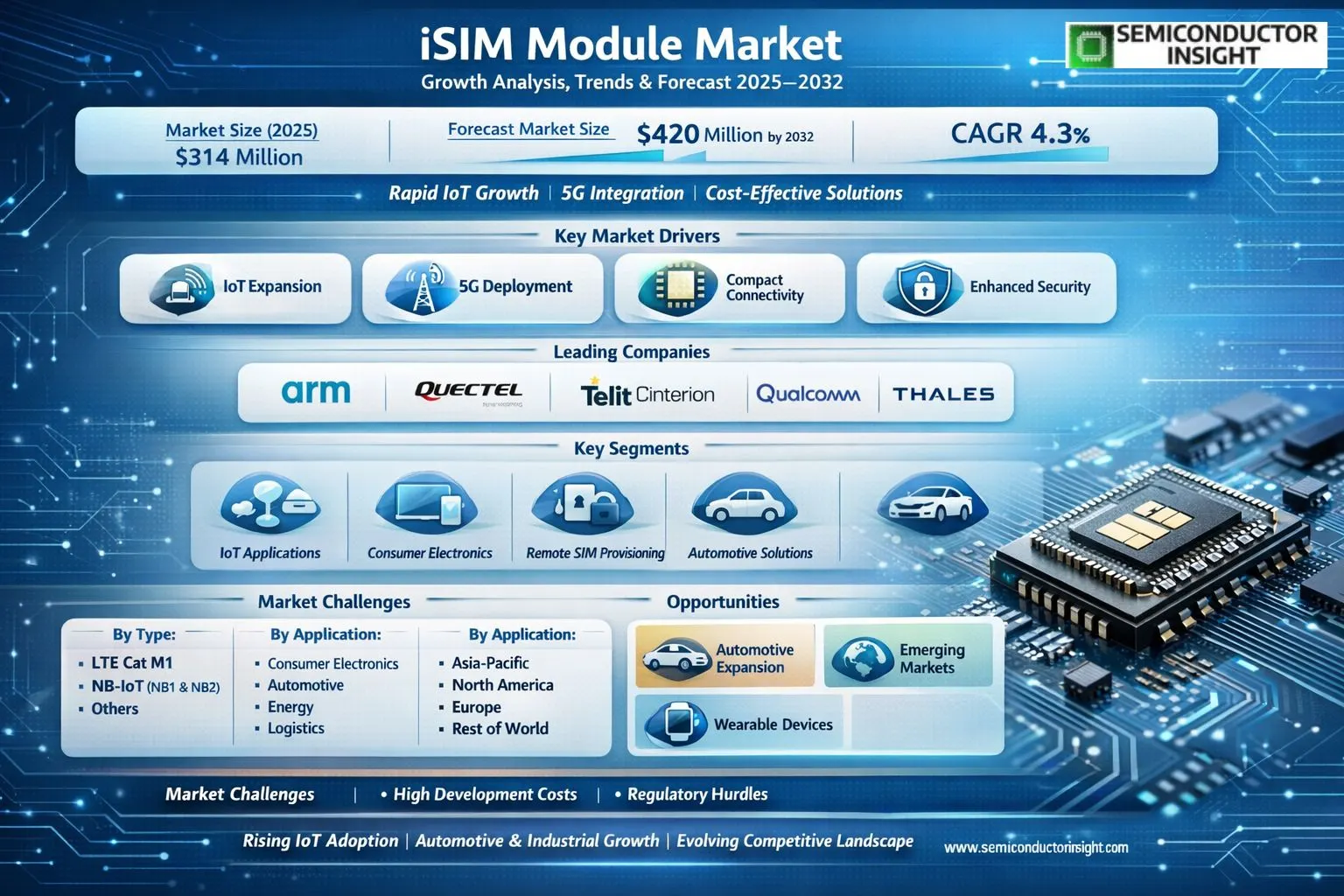
Global iSIM Module market size was valued at USD 314 million in 2025. The market is projected to reach USD 420 million by 2032, exhibiting a CAGR of 4.3% during the forecast period.
The iSIM module (Integrated SIM) is a new type of embedded user identity module that directly integrates the functions of the SIM card into the device’s system-on-chip (SoC) without using a physical SIM card or additional security chip.
The market is experiencing rapid growth due to several factors, including the explosive rise in IoT devices, demand for compact and cost-effective connectivity solutions, and advancements in 5G and LPWAN technologies. Additionally, the push for enhanced security through remote provisioning and reduced hardware complexity is fueling expansion. Initiatives by key players are expected to further drive growth. For instance, major manufacturers like ARM, Quectel, Telit-Cinterion, Qualcomm, Thales Group, Sierra Wireless, Sequans, Fibocom, U-blox, and Meig continue to innovate with integrated offerings. These companies hold significant market shares, with the top five accounting for a substantial portion of global revenue in 2025.
MARKET DRIVERS
Proliferation of IoT Devices
iSIM module market is propelled by the explosive growth in Internet of Things (IoT) deployments, with over 15 billion connected devices expected by 2025. iSIM technology, integrated directly into chipsets, eliminates the need for physical or removable SIM cards, enabling sleeker designs for wearables and sensors. This space-saving advantage aligns perfectly with the demand for compact, low-power solutions in smart homes and industrial automation.
5G Network Rollouts
Accelerating 5G adoption worldwide, with subscriber numbers surpassing 1.7 billion in 2023, boosts iSIM module market as operators prioritize seamless connectivity. iSIM supports enhanced remote provisioning, reducing operational costs for MNOs and facilitating faster network slicing for diverse applications like autonomous vehicles.
➤ iSIM module market is forecasted to achieve a CAGR of 35% through 2030, driven by IoT and 5G synergies.
Consumer electronics giants are increasingly embedding iSIM in flagship devices, fostering ecosystem maturity and driving volume sales in iSIM module market. This momentum underscores the technology’s role in enabling always-connected experiences.
MARKET CHALLENGES
Standardization Gaps
In iSIM module market, inconsistent global standards hinder widespread adoption, as GSMA specifications evolve slowly compared to eSIM maturity. Developers face interoperability issues across chipmakers like Qualcomm and MediaTek, complicating certification and delaying product launches by up to 12 months.
Other Challenges
High Development Costs
R&D investments for iSIM integration exceed $500 million annually for key players, straining smaller vendors and limiting innovation in iSIM module market. Supply chain disruptions, evident in 2022 chip shortages, further escalate costs by 20-30%.Regulatory compliance across regions adds complexity, with varying data privacy laws slowing market penetration in Europe and Asia. These factors collectively impede scalable deployment.
MARKET RESTRAINTS
Legacy Infrastructure Compatibility
iSIM module market faces restraints from entrenched 4G/LTE networks, which constitute 60% of global base stations, requiring costly upgrades for full iSIM support. Device manufacturers hesitate to transition fully, prioritizing backward compatibility that dilutes iSIM’s efficiency gains.Security concerns persist, with potential chipset vulnerabilities exposed in high-profile breaches, eroding trust among enterprises. This leads to slower enterprise adoption in critical sectors like healthcare.Patent disputes among leaders like Thales and Idemia create legal barriers, fragmenting the supply chain and restraining market consolidation in iSIM module market.
MARKET OPPORTUNITIES
Automotive Sector Expansion
iSIM module market holds immense potential in connected vehicles, where V2X communication demands robust, tamper-proof connectivity. With electric vehicle sales projected at 17 million units in 2024, iSIM enables over-the-air updates and telematics without mechanical SIM slots.Emerging markets in Asia-Pacific, boasting 5G coverage in 40% of urban areas, offer untapped growth as affordability improves. Partnerships between OEMs and MNOs can accelerate iSIM deployment.Wearables and smart city initiatives further amplify opportunities, with iSIM reducing battery drain by 15% in always-on devices, positioning iSIM module market for sustained expansion.
iSIM Module Market Trends
Rising Adoption in IoT Applications
iSIM module market is experiencing significant momentum driven by the integration of SIM functionalities directly into device system-on-chip (SoC) architectures, eliminating the need for physical SIM cards or separate security chips. This trend is particularly prominent in IoT ecosystems where compact designs and enhanced security are paramount. Manufacturers are prioritizing iSIM solutions to support seamless connectivity in resource-constrained environments, fostering efficiency in deployment and reducing hardware complexity across various connected devices.
Other Trends
Expansion in Automotive and Industrial Sectors
In the automotive sector, iSIM modules are gaining traction for enabling robust connectivity in vehicles, supporting applications from telematics to advanced driver-assistance systems. Similarly, energy and logistics industries are leveraging these modules for real-time monitoring and asset tracking, where reliable, tamper-resistant connectivity proves essential. iSIM module market benefits from this diversification, as end-users seek solutions that align with stringent reliability standards in harsh operating conditions.
Competitive Landscape Evolution
Key players such as ARM, Quectel, Telit Cinterion, Qualcomm, and Thales Group are intensifying R&D efforts to refine iSIM technologies, focusing on compatibility with diverse network types. This competition is spurring innovations that address challenges like regulatory compliance and interoperability, ultimately strengthening iSIM module market’s maturity. Surveys of industry experts highlight ongoing mergers, acquisitions, and strategic partnerships aimed at capturing larger shares in emerging applications.
Regional Dynamics and Segment Growth
Asia-Pacific regions, including China, Japan, and South Korea, are leading the charge in iSIM adoption due to robust manufacturing bases and high IoT penetration, while North America emphasizes premium applications in medical and consumer electronics. Segments like LTE Cat M1, NB-IoT (NB1 and NB2), and others are witnessing tailored developments for low-power wide-area networks. iSIM module market is thus poised for balanced expansion across 3C products, medical devices, and beyond, supported by global supply chain optimizations and policy alignments favoring embedded connectivity solutions. Industry analyses indicate sustained demand driven by these multifaceted trends, positioning stakeholders for informed strategic decisions.
COMPETITIVE LANDSCAPE
Key Industry Players
iSIM Module Market Leaders and Strategic Positioning
iSIM module market is characterized by a concentrated structure dominated by a handful of technology giants and specialized semiconductor firms. Leading players such as Qualcomm and ARM hold substantial influence due to their expertise in system-on-chip (SoC) integration, where iSIM functionality is embedded directly into device processors. In 2025, the global top five players, including these leaders alongside Thales Group and Quectel, commanded a significant revenue share, driving innovation in embedded SIM solutions for IoT and mobile applications. This oligopolistic landscape fosters rapid technological advancements, with market leaders focusing on secure, standards-compliant iSIM profiles to meet GSMA specifications, enabling seamless connectivity without physical cards.
Beyond the frontrunners, niche players like Sequans, Fibocom, and u-blox carve out positions through targeted offerings in low-power wide-area networks (LPWAN) such as LTE Cat M1 and NB-IoT, catering to applications in logistics, energy metering, and medical devices. Companies including Telit Cinterion, Sierra Wireless, and Cavli Wireless provide modular solutions emphasizing scalability and customization, addressing regional demands in automotive and consumer electronics. Emerging entrants like Meig bolster the ecosystem with cost-effective modules, intensifying competition and pressuring incumbents to innovate in security features and interoperability amid projected growth to US$420 million by 2032 at a 4.3% CAGR.
List of Key iSIM Module Companies Profiled
- ARM
- Quectel
- Telit Cinterion
- Qualcomm
- Thales Group
- Sierra Wireless
- Sequans
- Fibocom
- u-blox
- Meig
- Cavli Wireless
Segment Analysis:
| Segment Category | Sub-Segments | Key Insights |
| By Type |
|
LTE Cat M1
|
| By Application |
|
3C (Consumer Electronics)
|
| By End User |
|
Device OEMs
|
| By Provisioning Method |
|
Remote SIM Provisioning (RSP)
|
| By SoC Architecture |
|
ARM-based
|
Regional Analysis: iSIM Module Market
Asia-Pacific
Asia-Pacific excels in iSIM Module Market manufacturing due to clustered electronics hubs that streamline production. Advanced fabs produce compact modules optimized for low-power IoT endpoints, reducing costs and time-to-market for device makers.
The region’s IoT expansion fuels iSIM Module Market demand, with smart cities and industrial automation prioritizing integrated SIM for reliable connectivity. Partnerships between tech firms accelerate deployment in diverse applications.
5G rollout in Asia-Pacific enhances iSIM Module Market potential by enabling high-speed, low-latency connections in modules designed for next-gen networks, supporting massive device connectivity.
Localized supply chains in iSIM module market minimize logistics challenges, ensuring rapid iteration and customization to meet varying regional connectivity standards and device requirements.
North America
North America plays a pivotal role in iSIM module market through innovation-led strategies and early adoption in premium IoT segments. Tech giants drive research into secure, programmable iSIM solutions for enterprise applications like smart metering and telematics. The market benefits from strong R&D investments, focusing on interoperability with legacy systems while transitioning to fully integrated profiles. Regulatory support for spectrum efficiency encourages iSIM deployment in consumer wearables and automotive sectors. Collaborative ecosystems between operators and chipmakers foster customized modules that prioritize remote provisioning and lifecycle management. Despite higher development costs, the emphasis on quality and security positions this region as a trendsetter, influencing global standards in iSIM module market.
Europe
Europe’s iSIM Module Market is shaped by stringent data privacy regulations and sustainability goals, promoting eco-friendly connectivity solutions. Adoption accelerates in industrial IoT and smart grid initiatives, where iSIM modules offer reduced e-waste through hardware integration. Telecom regulations favor flexible SIM technologies, enabling operators to optimize network resources. Regional manufacturers emphasize compliance with GDPR, embedding advanced encryption in modules for secure data handling. Cross-border collaborations enhance harmonization of iSIM standards, supporting seamless roaming in connected vehicles and healthcare devices. The market dynamics reflect a balanced approach, blending innovation with ethical considerations to build consumer trust.
South America
South America witnesses emerging growth in iSIM module market, driven by expanding telecom infrastructure and digital inclusion efforts. Urbanization spurs demand for affordable IoT solutions in agriculture and logistics, where iSIM enables rugged, low-maintenance devices. Local operators partner with international suppliers to adapt modules for diverse terrains and connectivity challenges. Government incentives for 5G pilots accelerate iSIM integration in public safety networks. While infrastructure gaps persist, the region’s focus on cost-effective scalability positions it for steady advancement in iSIM module market.
Middle East & Africa
The Middle East & Africa iSIM Module Market is propelled by visionary smart city projects and resource sector digitization. Oil and gas operations adopt iSIM for remote asset tracking, valuing its durability in harsh environments. Investments in 5G corridors enhance module viability for urban connectivity hubs. Regional alliances bridge technology gaps, customizing iSIM profiles for intermittent networks. Despite varied maturity levels, strategic initiatives underscore potential for leapfrogging traditional SIM reliance in iSIM module market.
Report Scope
This market research report provides a comprehensive analysis of iSIM module market, covering the forecast period 2025–2032. It offers detailed insights into market dynamics, technological advancements, competitive landscape, and key trends shaping the industry.
Key focus areas of the report include:
- Market Overview: The report begins with an overview outlining its current market scenario, key growth indicators, and industry transformation drivers. It discusses macroeconomic factors, demand–supply balance, regulatory landscape, and the strategic role of semiconductors in powering advancements across industries such as automotive, telecommunications, consumer electronics, and industrial automation.
- Market Size & Forecast: Historical data and future projections for revenue, unit shipments, and market value across major regions and segments.
- Segmentation Analysis: Detailed breakdown by product type, technology, application, and end-user industry to identify high-growth segments and investment opportunities.
- Regional Insights: Insights into market performance across North America, Europe, Asia-Pacific, Latin America, and the Middle East & Africa, including country-level analysis where relevant.
- Competitive Landscape: Profiles of leading market participants, including their product offerings, R&D focus, manufacturing capacity, pricing strategies, and recent developments such as mergers, acquisitions, and partnerships.
- Technology Trends & Innovation: Assessment of emerging technologies, integration of AI/IoT, semiconductor design trends, fabrication techniques, and evolving industry standards.
- Market Drivers & Restraints: Evaluation of factors driving market growth along with challenges, supply chain constraints, regulatory issues, and market-entry barriers.
- Stakeholder Insights: Insights for component suppliers, OEMs, system integrators, investors, and policymakers regarding the evolving ecosystem and strategic opportunities.
Primary and secondary research methods are employed, including interviews with industry experts, data from verified sources, and real-time market intelligence to ensure the accuracy and reliability of the insights presented.
FREQUENTLY ASKED QUESTIONS:
What is the current market size of iSIM Module Market?
-> Global iSIM Module market was valued at USD 314 million in 2025 and is expected to reach USD 420 million by 2032, at a CAGR of 4.3% during the forecast period.
Which key companies operate in iSIM Module Market?
-> Key players include ARM, Quectel, Telit-Cinterion, Qualcomm, Thales Group, SierraWireless, Sequans, Fibocom, U-blox, and Meig, among others.
What are the key growth drivers?
-> Key growth drivers include rising demand for IoT connectivity, integration of SIM functions into SoCs, expansion in automotive and consumer electronics applications, and advancements in LPWAN technologies.
Which region dominates the market?
-> Asia is the fastest-growing region, driven by markets in China, Japan, and South Korea, while North America, particularly the U.S., holds significant share.
What are the emerging trends?
-> Emerging trends include shift from physical SIM to iSIM for space-saving and security, growth in LTE Cat M1 and NB-IoT segments, and increasing adoption in 3C, logistics, and medical sectors.

Get Sample Report PDF for Exclusive Insights
Report Sample Includes
- Table of Contents
- List of Tables & Figures
- Charts, Research Methodology, and more...
 Download Sample Report PDF