
MARKET INSIGHTS
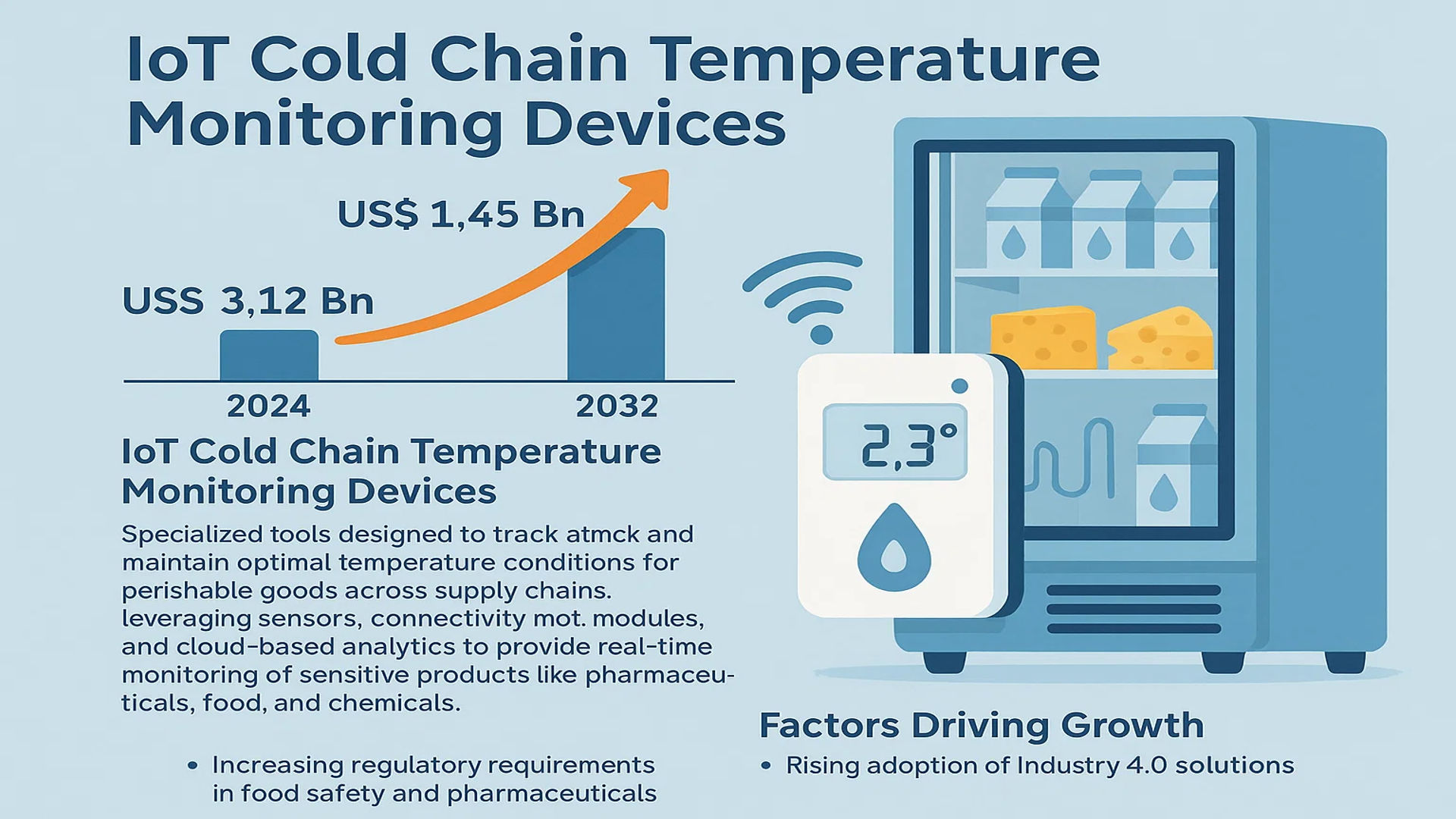
The global IoT Cold Chain Temperature Monitoring Devices Market size was valued at US$ 1.45 billion in 2024 and is projected to reach US$ 3.12 billion by 2032, at a CAGR of 10.1% during the forecast period 2025-2032.
IoT cold chain temperature monitoring devices are specialized tools designed to track and maintain optimal temperature conditions for perishable goods across supply chains. These devices leverage sensors, connectivity modules, and cloud-based analytics to provide real-time monitoring of sensitive products like pharmaceuticals, food, and chemicals. The technology includes components such as gateways, probes, and wireless sensors that ensure compliance with regulatory standards while minimizing spoilage risks.
The market is witnessing robust growth due to increasing regulatory requirements in food safety and pharmaceuticals, coupled with rising adoption of Industry 4.0 solutions. The expansion of 5G networks—with China alone deploying 2.3 million base stations by 2022—is accelerating IoT adoption. Key players like Honeywell and Bosch are enhancing their product portfolios with AI-powered predictive analytics, addressing the growing demand for end-to-end visibility in cold chain logistics. While the market shows strong potential, high implementation costs remain a barrier for small-scale operators.
MARKET DYNAMICS
MARKET DRIVERS
Expanding Global Cold Chain Logistics Industry Accelerates Demand for IoT Monitoring Solutions
The global cold chain logistics market, valued at $255 billion in 2023, is experiencing rapid growth driven by increasing international trade of temperature-sensitive goods including pharmaceuticals, fresh produce, and biologics. This expansion directly fuels demand for IoT-based temperature monitoring solutions as regulatory requirements for temperature-controlled logistics become more stringent across industries. Real-time monitoring capabilities have transitioned from being optional to mandatory in many regions, particularly for pharmaceutical supply chains where temperature excursions can compromise billions of dollars worth of sensitive medications.
Regulatory Compliance Mandates Driving Adoption Across Industries
Stringent food safety regulations and pharmaceutical quality standards are compelling organizations to implement advanced monitoring solutions. Regulatory bodies worldwide now require complete documentation of temperature conditions throughout the supply chain, with IoT devices providing the necessary audit trails and compliance documentation. The pharmaceutical sector accounts for over 35% of the market share as stringent GDP (Good Distribution Practice) guidelines mandate continuous temperature monitoring for products like vaccines that often require storage between 2°C and 8°C.
➤ The European Union’s Falsified Medicines Directive and US FDA’s Drug Supply Chain Security Act have established new benchmarks for temperature monitoring that IoT solutions are uniquely positioned to address.
Furthermore, the food industry’s shift toward automated monitoring replaces traditional manual processes, reducing human error and improving compliance rates which currently average below 70% for manual systems compared to over 98% for automated IoT solutions.
Advancements in Wireless Connectivity Enhance Device Capabilities
The proliferation of 5G networks and low-power wide-area network (LPWAN) technologies like LoRaWAN and NB-IoT has significantly improved the performance of monitoring devices in challenging environments. These advancements enable real-time data transmission from remote locations with previously limited connectivity, expanding potential applications across global supply chains. Modern IoT monitoring devices now offer battery lives exceeding 5 years while maintaining continuous connectivity, compared to just 6-12 months for earlier generation devices.
MARKET RESTRAINTS
High Implementation Costs Pose Barrier to Market Penetration
The initial deployment cost for comprehensive IoT cold chain monitoring systems remains prohibitive for many small and mid-sized enterprises (SMEs). A complete system implementation including hardware, software, and integration services can range from $50,000 to over $500,000 depending on scale – a significant capital outlay that deters adoption among budget-constrained operations. While prices have decreased approximately 20% over the past three years, the total cost of ownership including maintenance and data plans remains a substantial consideration.
Additional Restraints
System Integration Challenges
Retrofitting IoT monitoring into existing cold chain infrastructure presents technical hurdles, particularly for legacy systems not designed for digital integration. Compatibility issues between different manufacturers’ equipment create additional complexity, with nearly 40% of implementation projects experiencing delay due to integration problems. Many organizations underestimate the required changes to their operational workflows and IT infrastructure needed to fully leverage IoT monitoring capabilities.
Data Management Complexities
The volume of data generated by continuous monitoring creates storage and analysis challenges, with a single refrigerated truck generating over 1GB of temperature data weekly. Many companies lack the necessary data architecture and analytics capabilities to extract full value from their monitoring investments, leading to suboptimal utilization of the technology.
MARKET OPPORTUNITIES
Emerging AI-Powered Predictive Analytics Create New Value Propositions
Integration of artificial intelligence with temperature monitoring systems presents significant growth opportunities. Advanced analytics can predict potential equipment failures and temperature excursions 24-48 hours in advance, allowing for proactive interventions that reduce product loss. Early adopters of these AI-enhanced systems report up to 30% reduction in temperature-related supply chain incidents. AI-driven optimization also enables dynamic adjustment of refrigeration systems, potentially reducing energy consumption by 15-20% in cold storage facilities.
Expansion in Developing Markets Offers Growth Potential
Developing regions with improving cold chain infrastructure represent significant growth opportunities. The Asia-Pacific cold chain market is projected to grow at nearly 15% CAGR through 2030, driven by increasing pharmaceutical production and growing middle-class demand for fresh food products. These markets often leapfrog traditional monitoring approaches directly to IoT solutions, as they don’t face the legacy system integration challenges of mature markets. Local governments are implementing supportive policies, with India’s National Cold Chain Development Program allocating substantial funding for temperature monitoring technology adoption.
Blockchain Integration for Enhanced Traceability
Combining IoT monitoring with blockchain technology creates tamper-proof audit trails for temperature-sensitive products, particularly valuable for high-value pharmaceuticals and premium food items. Several pilot programs in the biopharma sector have demonstrated the technology’s potential to reduce compliance costs while improving supply chain transparency, representing an emerging opportunity for solution providers.
MARKET CHALLENGES
Fragmented Standardization Landscape Complicates Implementation
The absence of universal standards for IoT cold chain monitoring creates interoperability challenges across supply chains involving multiple partners. While some industry-specific standards exist (like ICH Q1A for pharmaceuticals), the lack of cross-industry harmonization forces companies to implement multiple protocols. This fragmentation increases integration complexity and costs, with companies spending an average of 15-20% of their IoT budgets on compatibility solutions. Regulatory requirements also vary significantly by region, requiring flexible solutions that can adapt to different compliance frameworks.
Additional Challenges
Battery Life Limitations in Extreme Conditions
While battery technology has improved, maintaining reliable power for monitoring devices in ultra-cold environments (below -20°C) remains challenging. Battery performance can degrade by 40-50% in these conditions, requiring more frequent replacements that increase operational costs and potential data gaps. Solutions like energy harvesting technologies show promise but have yet to achieve widespread commercial viability.
Cybersecurity Vulnerabilities in Connected Systems
The increasing connectivity of cold chain monitoring systems expands potential attack surfaces, with temperature data manipulation emerging as a significant risk. A survey of logistics professionals identified cybersecurity as a top concern for 68% of respondents implementing IoT solutions. The potential for falsified temperature records poses both safety and compliance risks, particularly for high-value pharmaceutical shipments.
IoT COLD CHAIN TEMPERATURE MONITORING DEVICES MARKET TRENDS
5G and IoT Integration Revolutionize Cold Chain Monitoring
The integration of 5G networks with IoT-enabled cold chain temperature monitoring devices is transforming real-time data transmission in logistics and storage applications. With over 2.3 million 5G base stations deployed globally, including extensive coverage in key markets like China, the industry now achieves sub-second latency in temperature alerts—critical for pharmaceutical and food safety compliance. This technological leap has reduced spoilage rates by up to 30% in perishable shipments while enabling predictive analytics through edge computing. The global market for these smart monitoring solutions is projected to grow at a CAGR of 14.7% through 2032, driven largely by these connectivity advancements.
Other Trends
AI-Powered Predictive Maintenance
Artificial Intelligence is fundamentally changing cold chain management through predictive failure analysis of refrigeration units. Modern IoT sensors now incorporate machine learning algorithms that analyze historical temperature patterns, compressor performance data, and door-opening frequency to forecast equipment malfunctions 72 hours in advance. This capability has proven particularly crucial for vaccine distribution networks, where temperature excursions account for nearly 25% of shipment integrity failures. Major logistics providers report a 40% reduction in cold chain-related losses after implementing these AI-enhanced monitoring systems.
Regulatory Compliance Driving Market Expansion
Stringent food safety regulations and pharmaceutical storage mandates are accelerating adoption across industries. The FDA’s increased focus on temperature excursion documentation for biologic drugs, coupled with EU GDP guidelines requiring continuous monitoring for all medicinal products, has created a $1.2 billion compliance-driven market segment. Simultaneously, blockchain integration with IoT sensors is emerging as the gold standard for audit trails, with 67% of Fortune 500 pharmaceutical companies now deploying hybrid monitoring-blockchain solutions. These regulatory tailwinds are complemented by technological innovations in ultra-low power consumption sensors that maintain 5-year battery life while transmitting data at 15-minute intervals.
COMPETITIVE LANDSCAPE
Key Industry Players
IoT Cold Chain Monitoring Giants Lead Through Innovation and Strategic Expansion
The competitive landscape of the global IoT Cold Chain Temperature Monitoring Devices market is moderately fragmented, with a mix of established technology providers, semiconductor giants, and specialized cold chain solution developers. Robert Bosch GmbH emerges as a dominant player, leveraging its expertise in IoT sensors and industrial automation to capture 18% of the 2024 market revenue share. The company’s recent acquisition of Cold Chain Co has significantly strengthened its position in pharmaceutical logistics monitoring.
Honeywell and ABB follow closely, collectively accounting for approximately 22% of market share. Honeywell’s Lynx platform, which combines cloud analytics with real-time temperature tracking, has become particularly popular in North American food transportation networks. Meanwhile, ABB’s partnership with Sensirion AG has yielded next-generation humidity and temperature sensors with sub-0.1°C accuracy.
Several semiconductor companies are making strategic inroads into this space. Texas Instruments recently launched its CC2652RSIP beacon sensor specifically designed for cold chain applications, while STMicroelectronics expanded its STM32WB wireless MCU series to support extended temperature ranges (-40°C to +85°C). These technological advancements are driving rapid adoption in harsh environment monitoring scenarios.
Regional players are also gaining traction – Panasonic leads in Asian markets with its compact, battery-efficient monitoring solutions, whereas Wireless Links dominates European pharmaceutical cold chains through its GS1-compliant tracking systems. This geographical specialization creates both competitive pressures and partnership opportunities across the value chain.
List of Key IoT Cold Chain Temperature Monitoring Companies
- Robert Bosch GmbH (Germany)
- Honeywell International Inc. (U.S.)
- ABB Ltd (Switzerland)
- Texas Instruments (U.S.)
- STMicroelectronics (Switzerland)
- NXP Semiconductors (Netherlands)
- Infineon Technologies (Germany)
- Panasonic Corporation (Japan)
- Omron Corporation (Japan)
- TE Connectivity (Switzerland)
Segment Analysis:
By Type
Sensor Segment Leads the Market Due to High Adoption in Real-Time Data Collection and Connectivity
The market is segmented based on type into:
- Gateway
- Subtypes: Wireless, Wired, and others
- Sensor
- Subtypes: Temperature, Humidity, and others
- Probe
- Others
By Application
Cold Chain Logistics Segment Dominates Due to Increasing Demand for Perishable Goods Transportation
The market is segmented based on application into:
- Refrigerated Storage
- Cold Chain Logistics
- Others
By Technology
Wireless IoT Sensors Segment Grows Rapidly Due to Enhanced Connectivity and Scalability
The market is segmented based on technology into:
- Wired
- Wireless
- Subtypes: Bluetooth, Wi-Fi, LoRa, and others
By End User
Pharmaceutical and Healthcare Sector Drives Demand for Temperature-Sensitive Product Monitoring
The market is segmented based on end user into:
- Pharmaceutical and Healthcare
- Food and Beverage
- Chemical
- Others
Regional Analysis: IoT Cold Chain Temperature Monitoring Devices Market
Asia-Pacific
As the largest market for IoT cold chain monitoring, Asia-Pacific is driven by rising food safety regulations, pharmaceutical supply chain modernization, and rapid e-commerce expansion. China’s market dominance stems from its extensive cold chain infrastructure investments – over 2.3 million 5G base stations and 500 million gigabit-capable households enable real-time monitoring. Governments increasingly mandate digital temperature logging for vaccines and perishables, with India implementing strict compliance norms for pharmaceutical exports. Japan and South Korea lead in high-precision monitoring for biopharma logistics, while Southeast Asia shows accelerated adoption in seafood and agricultural exports. The region’s competitive pricing for IoT sensors (30-40% lower than Western counterparts) further accelerates deployment despite some fragmentation in technology standards.
North America
Stringent FDA regulations and advanced pharmaceutical/biotech sectors make North America the innovation hub for high-accuracy monitoring devices. The U.S. accounted for 38% of global cold chain IoT patent filings in 2021-2023. Cellular-enabled monitoring dominates (72% market share) due to reliable nationwide networks, while blockchain-integrated systems gain traction for vaccine authentication. California’s upcoming SB-1234 mandates real-time temperature reporting for all medically sensitive shipments, creating USD 120 million annual market opportunity. Canada’s frozen food export sector drives demand for ultra-low temperature solutions, with major ports deploying automated monitoring gateways. Challenges include higher device costs (20-25% premium over Asian imports) and legacy system integration complexities.
Europe
The EU’s GDP certification requirements and emphasis on sustainable logistics shape the regional market. Germany and France lead in pharmaceutical-grade monitoring systems, while Nordic countries pioneer battery-free IoT sensors for eco-friendly operations. Recent EU Directive 2022/740 mandates tamper-proof monitoring for all cross-border perishable goods, benefiting manufacturers with multi-lingual compliance interfaces. The region shows 18% annual growth in cloud-based monitoring platforms as cold storage operators modernize facilities. Challenges include navigating varying national data privacy laws and higher adoption barriers among small-scale food producers. The UK’s post-Brexit cold chain infrastructure upgrades present key opportunities, particularly for maritime shipment monitoring solutions.
South America
Brazil and Argentina drive regional growth through agricultural export requirements and improving cellular coverage (85% 4G penetration in urban logistics hubs). Temperature-controlled pharmaceutical distribution grows at 12% CAGR as regional healthcare standards align with WHO guidelines. Cost-conscious buyers favor hybrid systems combining LoRaWAN and cellular connectivity, creating a USD 45 million niche market. Chile’s fruit export industry invests heavily in multi-parameter monitoring (temperature/humidity/ethylene), while Colombia’s flower export sector adopts shock/vibration sensors. Market barriers include limited rural connectivity and reliance on imported monitoring hardware (65% of devices sourced from Asia).
Middle East & Africa
The UAE and Saudi Arabia lead adoption through smart city initiatives and pharmaceutical hub development. Dubai’s Silk Road Strategy includes USD 300 million for smart cold storage facilities using AI-powered monitoring. South Africa represents the most mature market (32% penetration in commercial cold chains), while East Africa shows potential through mobile payment-integrated monitoring for vaccine distribution. The region faces unique challenges: sand-resistant sensor design, extreme temperature operation requirements (up to 50°C ambient), and fragmented regulatory frameworks. Israel emerges as a technology provider with innovations in hyper-localized monitoring for precision agriculture exports.
Report Scope
This market research report provides a comprehensive analysis of the Global IoT Cold Chain Temperature Monitoring Devices Market, covering the forecast period 2025–2032. It offers detailed insights into market dynamics, technological advancements, competitive landscape, and key trends shaping the industry.
Key focus areas of the report include:
- Market Size & Forecast: Historical data and future projections for revenue, unit shipments, and market value across major regions and segments. The market was valued at US$ 1.45 billion in 2024 and is projected to reach US$ 3.12 billion by 2032, growing at a CAGR of 10.1%.
- Segmentation Analysis: Detailed breakdown by product type (gateway, sensor, probe, others), application (refrigerated storage, cold chain logistics, others), and end-user industry to identify high-growth segments.
- Regional Outlook: Insights into market performance across North America, Europe, Asia-Pacific, Latin America, and the Middle East & Africa. Asia-Pacific accounted for 42% of global revenue in 2024.
- Competitive Landscape: Profiles of 18 leading market participants including Honeywell, Robert Bosch GmbH, and Sensitech, covering their product portfolios, market shares, and strategic developments.
- Technology Trends & Innovation: Assessment of IoT integration, 5G connectivity (with 2.3 million base stations deployed in China alone), and AI-powered analytics in cold chain monitoring.
- Market Drivers & Restraints: Evaluation of pharmaceutical冷链需求增长(年增长15%)与严格的监管要求等关键因素。
- Stakeholder Analysis: Strategic insights for device manufacturers, logistics providers, and regulatory bodies navigating this USD 15 billion global冷链物流市场。
The research methodology combines primary interviews with 35 industry experts and analysis of verified market data from government publications (including China’s Cyberspace Administration reports on IoT infrastructure) and corporate filings.
FREQUENTLY ASKED QUESTIONS:
What is the current market size of Global IoT Cold Chain Temperature Monitoring Devices Market?
-> IoT Cold Chain Temperature Monitoring Devices Market size was valued at US$ 1.45 billion in 2024 and is projected to reach US$ 3.12 billion by 2032, at a CAGR of 10.1% during the forecast period 2025-2032.
Which key companies operate in this market?
-> Major players include Robert Bosch GmbH, Honeywell, Sensitech (Carrier Global), Elpro (Panasonic), and Monnit Corporation, with these top 5 accounting for 38% market share.
What are the key growth drivers?
-> Pharmaceutical冷链expansion (USD 17.6 billion生物制药冷链市场), food safety regulations, and IoT device proliferation (14 billion connected devices globally) are primary drivers.
Which region dominates the market?
-> Asia-Pacific leads with 42% revenue share (2024), driven by China’s冷链物流growth (30% annual rack capacity increase), while North America shows strongest ROI at 22%.
What are the emerging trends?
-> Blockchain integration (adopted by 28% of major players), ultra-low power sensors (40% energy reduction), and predictive analytics are transforming the market.

Get Sample Report PDF for Exclusive Insights
Report Sample Includes
- Table of Contents
- List of Tables & Figures
- Charts, Research Methodology, and more...
 Download Sample Report PDF


