Market Insights
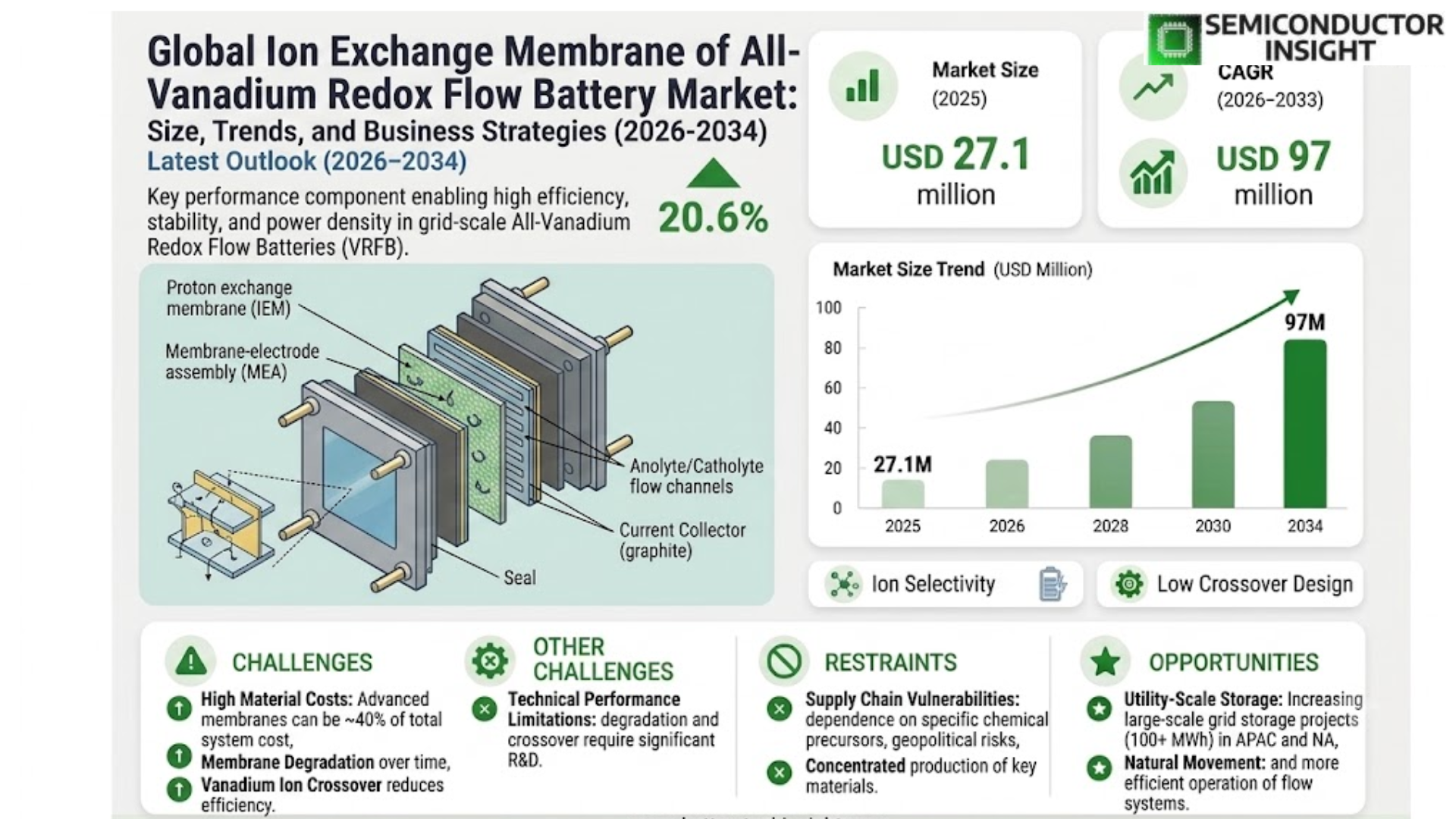
Global Ion Exchange Membrane of All-Vanadium Redox Flow Battery Market was valued at USD 27.1 million in 2025. The market is projected to grow from USD 32.5 million in 2026 to USD 97 million by 2033, exhibiting a CAGR of 20.6% during the forecast period.
Ion exchange membranes are critical components in all-vanadium redox flow batteries (VRFBs), enabling selective ion transport while preventing cross-mixing of electrolytes. These membranes separate the positive and negative chambers of VRFBs, which contain vanadium ions in different oxidation states (VO2+/VO2+ and V2+/V3+). The membrane’s proton conductivity and chemical stability directly impact battery efficiency, lifespan, and energy density.
The market growth is driven by increasing demand for large-scale energy storage solutions, particularly for renewable energy integration and grid stabilization. North America dominates with a 90% market share due to early adoption and strong R&D investments, while Asia-Pacific shows rapid growth potential. Full-fluorinated ion exchange membranes lead the product segment with a 60% share owing to superior durability. Key players like Chemours Company and FuMa-Tech are expanding production capacities to meet rising demand from utilities and industrial applications.
MARKET DRIVERS
Growing Demand for Energy Storage Solutions
The increasing adoption of renewable energy sources has propelled demand for efficient energy storage systems, with all-vanadium redox flow batteries emerging as a key solution. The ion exchange membrane segment benefits directly from this trend, as it serves as a critical component determining battery performance and longevity. Market growth is further accelerated by grid modernization initiatives worldwide.
Technological Advancements in Membrane Materials
Recent developments in perfluorinated and hydrocarbon-based ion exchange membranes have significantly improved proton conductivity and chemical stability in vanadium redox flow batteries. These innovations extend membrane lifespans while reducing crossover contamination between electrolytes, making the technology more commercially viable.
Government incentives for clean energy storage and ambitious carbon neutrality targets continue to create favorable conditions for ion exchange membrane manufacturers in this sector.
 MARKET CHALLENGES
High Material Costs Limiting Adoption
The premium cost of advanced ion exchange membranes remains a barrier to widespread adoption in the all-vanadium redox flow battery market. Nafion-based membranes, while high-performing, account for approximately 40% of total battery system costs, making alternatives financially attractive despite performance trade-offs.
Other Challenges
Technical Performance Limitations
Membrane degradation and vanadium ion crossover continue to impact battery efficiency, requiring ongoing R&D investments to address these fundamental constraints in ion exchange membrane technology.
MARKET RESTRAINTS
Supply Chain Vulnerabilities for Critical Materials
Geopolitical factors and concentrated production of key membrane materials create supply chain risks for ion exchange membrane manufacturers. The vanadium redox flow battery market faces particular sensitivity to these constraints, as membrane production requires specialized chemical precursors with limited global suppliers.
MARKET OPPORTUNITIES
Emerging Applications in Utility-Scale Storage
The increasing deployment of utility-scale energy storage projects presents significant growth potential for ion exchange membrane producers. Markets in Asia-Pacific and North America are investing heavily in 100+ MWh vanadium redox flow battery installations, each requiring thousands of square meters of high-performance membranes.
Ion Exchange Membrane of All-Vanadium Redox Flow Battery Market Trends
Rapid Market Expansion with 20.6% CAGR Projection
Global Ion Exchange Membrane for All-Vanadium Redox Flow Batteries market was valued at USD 27.1 million in 2025 and is projected to reach USD 97 million by 2033. This growth is primarily driven by increasing adoption of large-scale energy storage solutions and renewable energy integration. The proton exchange membrane plays a critical role in these systems by separating electrolytes while allowing ion transport between battery chambers.
Other Trends
Dominance of Full-Fluorine Membranes
Full-fluorinion Ion Exchange Membranes currently hold 60% market share due to their superior chemical stability and proton conductivity. These membranes are crucial for maintaining battery efficiency across charge-discharge cycles in VRB systems. Manufacturers are focusing on improving membrane durability to extend battery lifespan.
Regional Market Concentration
North America dominates with 90% market share, followed by China and Europe collectively holding about 5%. This distribution reflects regional investments in grid-scale energy storage and differing renewable energy adoption rates. New membrane development programs in Asia show potential for market diversification.
Supply Chain Consolidation
The market exhibits high concentration with the top companies controlling approximately 90% of global supply. Chemours (formerly DuPont) leads the sector, with specialized manufacturers like FuMa-Tech and Golden Energy Fuel Cell expanding their production capacities to meet growing demand for Ion Exchange Membranes in flow battery applications.
Application-Specific Growth Patterns
Large-Scale Energy Storage accounts for the majority of membrane demand (over 75%), with Industrial Grid Adjustment applications showing the strongest growth potential. As utilities increasingly deploy VRFB systems for renewable energy integration, the need for high-performance Ion Exchange Membranes will continue rising proportionally.
COMPETITIVE LANDSCAPE
Key Industry Players
Global ion exchange membrane market for VRB systems is dominated by fluoropolymer specialists
The Chemours Company (formerly DuPont) holds approximately 90% market share in the ion exchange membrane segment for vanadium redox flow batteries, with its Nafion perfluorinated membranes being the industry standard. Their technological leadership in fluoropolymer chemistry and extensive patent portfolio create high barriers to entry. The market structure remains highly concentrated due to the specialized expertise required for membrane production.
Several emerging players are developing alternative membrane technologies to compete with fluorinated options. FuMa-Tech offers cost-effective hydrocarbon-based membranes, while Golden Energy Fuel Cell focuses on composite membrane solutions. Research institutions like Dalian Institute of Chemical Physics are advancing next-generation membrane materials with improved ion selectivity and chemical stability.
List of Key Ion Exchange Membrane Companies Profiled
- Chemours Company
- FuMa-Tech GmbH
- Golden Energy Fuel Cell Co., Ltd.
- Dalian Institute of Chemical Physics
- AGC Chemicals
- Solvay SA
- W. L. Gore & Associates
- Shanghai Shangfluor New Material Technology
- Ionomr Innovations Inc.
- Fujifilm Holdings Corporation
- Toyobo Co., Ltd.
- Sumitomo Chemical Co., Ltd.
- 3M Company
- Asahi Kasei Corporation
- Toray Industries, Inc.
Segment Analysis:
| Segment Category | Sub-Segments | Key Insights |
| By Type |
|
Full-fluorinion Ion Exchange Membrane dominates due to superior chemical stability and proton conductivity in harsh acidic environments.
|
| By Application |
|
Large-Scale Energy Storage drives demand with growing renewable energy integration needs.
|
| By End User |
|
Utilities represent the core adoption channel for ion exchange membranes.
|
| By Chemical Composition |
|
Sulfonated Membranes lead with optimal performance characteristics.
|
| By Membrane Thickness |
|
Standard Thickness Membranes offer the best compromise for most applications.
|
Regional Analysis: Asia-Pacific Ion Exchange Membrane for All-Vanadium Redox Flow Battery Market
China
China’s National Energy Administration mandates encourage vanadium flow battery adoption through subsidies and renewable integration policies, creating favorable conditions for ion exchange membrane manufacturers.
Concentrated industrial clusters in Dalian and Sichuan provide complete supply chains from raw materials to finished membranes, enabling competitive production costs and rapid technology iteration cycles.
Chinese research institutions are pioneering hybrid membrane designs combining perfluorinated and hydrocarbon materials to balance cost and performance for utility-scale applications.
Strategic partnerships between membrane producers and battery system integrators are accelerating commercial deployments, particularly in renewable microgrid projects across western provinces.
Japan & South Korea
Japan and South Korea represent advanced markets for high-performance ion exchange membranes, with strong emphasis on quality and durability. Japanese manufacturers focus on premium perfluorinated membranes for long-duration storage, while Korean companies excel in cost-optimized solutions. Both countries benefit from established automotive and electronics industries that provide technical expertise in precision membrane manufacturing. Government-funded demonstration projects are driving adoption in commercial and industrial energy storage applications.
India & Southeast Asia
Emerging markets in India and Southeast Asia show growing potential for vanadium flow battery membranes as renewable energy penetration increases. India’s ambitious energy storage targets are creating new opportunities, though local membrane production remains limited. Southeast Asian nations are adopting Chinese membrane technologies through strategic partnerships, with Thailand and Malaysia developing pilot projects for grid stability applications.
Australia & New Zealand
The Oceania region demonstrates strong interest in vanadium flow batteries for remote area power systems and mining operations. Australian research institutions are collaborating with membrane manufacturers to develop customized solutions for harsh environmental conditions. New Zealand’s focus on renewable integration drives demand for membranes with high cycling stability.
Rest of Asia-Pacific
Other Asia-Pacific markets are gradually adopting vanadium flow battery technology, with early-stage deployments in Taiwan and Bangladesh. These regions typically import membranes from established producers while developing local testing and integration capabilities. Pilot projects demonstrate potential for off-grid and microgrid applications using ion exchange membrane technology.
Report Scope
This market research report provides a comprehensive analysis of the Ion Exchange Membrane of All-Vanadium Redox Flow Battery Market , covering the forecast period 2025–2033. It offers detailed insights into market dynamics, technological advancements, competitive landscape, and key trends shaping the industry.
Key focus areas of the report include:
- Market Overview: The report begins with an overview outlining its current market scenario, key growth indicators, and industry transformation drivers. It discusses macroeconomic factors, demand–supply balance, regulatory landscape, and the strategic role of ion exchange membranes in energy storage solutions across industries such as renewable energy, industrial grid management, and large-scale energy storage.
- Market Size & Forecast: Historical data and future projections for revenue, unit shipments, and market value across major regions and segments.
- Segmentation Analysis: Detailed breakdown by product type, technology, application, and end-user industry to identify high-growth segments and investment opportunities.
- Regional Insights: Insights into market performance across North America, Europe, Asia-Pacific, Latin America, and the Middle East & Africa, including country-level analysis where relevant.
- Competitive Landscape: Profiles of leading market participants, including their product offerings, R&D focus, manufacturing capacity, pricing strategies, and recent developments such as mergers, acquisitions, and partnerships.
- Technology Trends & Innovation: Assessment of emerging technologies in flow battery systems, membrane materials, and evolving industry standards.
- Market Drivers & Restraints: Evaluation of factors driving market growth along with challenges, supply chain constraints, regulatory issues, and market-entry barriers.
- Stakeholder Insights: Insights for component suppliers, OEMs, system integrators, investors, and policymakers regarding the evolving ecosystem and strategic opportunities.
Primary and secondary research methods are employed, including interviews with industry experts, data from verified sources, and real-time market intelligence to ensure the accuracy and reliability of the insights presented.
FREQUENTLY ASKED QUESTIONS:
What is the current market size of Ion Exchange Membrane of All-Vanadium Redox Flow Battery Market?
-> Ion Exchange Membrane of All-Vanadium Redox Flow Battery Market was valued at USD 27.1 million in 2025. The market is projected to grow from USD 32.5 million in 2026 to USD 97 million by 2033, exhibiting a CAGR of 20.6% during the forecast period.
Which key companies operate in Ion Exchange Membrane of All-Vanadium Redox Flow Battery Market?
-> Key players include Chemours Company, FuMa-Tech, Golden Energy Fuel Cell, and Dalian Institute of Chemical Physics, among others. The top player holds about 90% market share.
What are the key growth drivers?
-> Key growth drivers include increasing demand for large-scale energy storage solutions, growth in renewable energy adoption, and advancements in flow battery technology.
Which region dominates the market?
-> North America is the largest market with about 90% share, followed by China and Europe with a combined 5% share.
What is the largest product segment?
-> Full-fluorinion Ion Exchange Membrane dominates with about 60% market share, followed by Non-fluorinion Ion Exchange Membrane.
What are the major applications?
-> Large-Scale Energy Storage is the largest application segment, followed by Industrial Grid Adjustment and Management.

Get Sample Report PDF for Exclusive Insights
Report Sample Includes
- Table of Contents
- List of Tables & Figures
- Charts, Research Methodology, and more...
 Download Sample Report PDF