Internet Access Gateway Market, Trends, Business Strategies 2026-2034

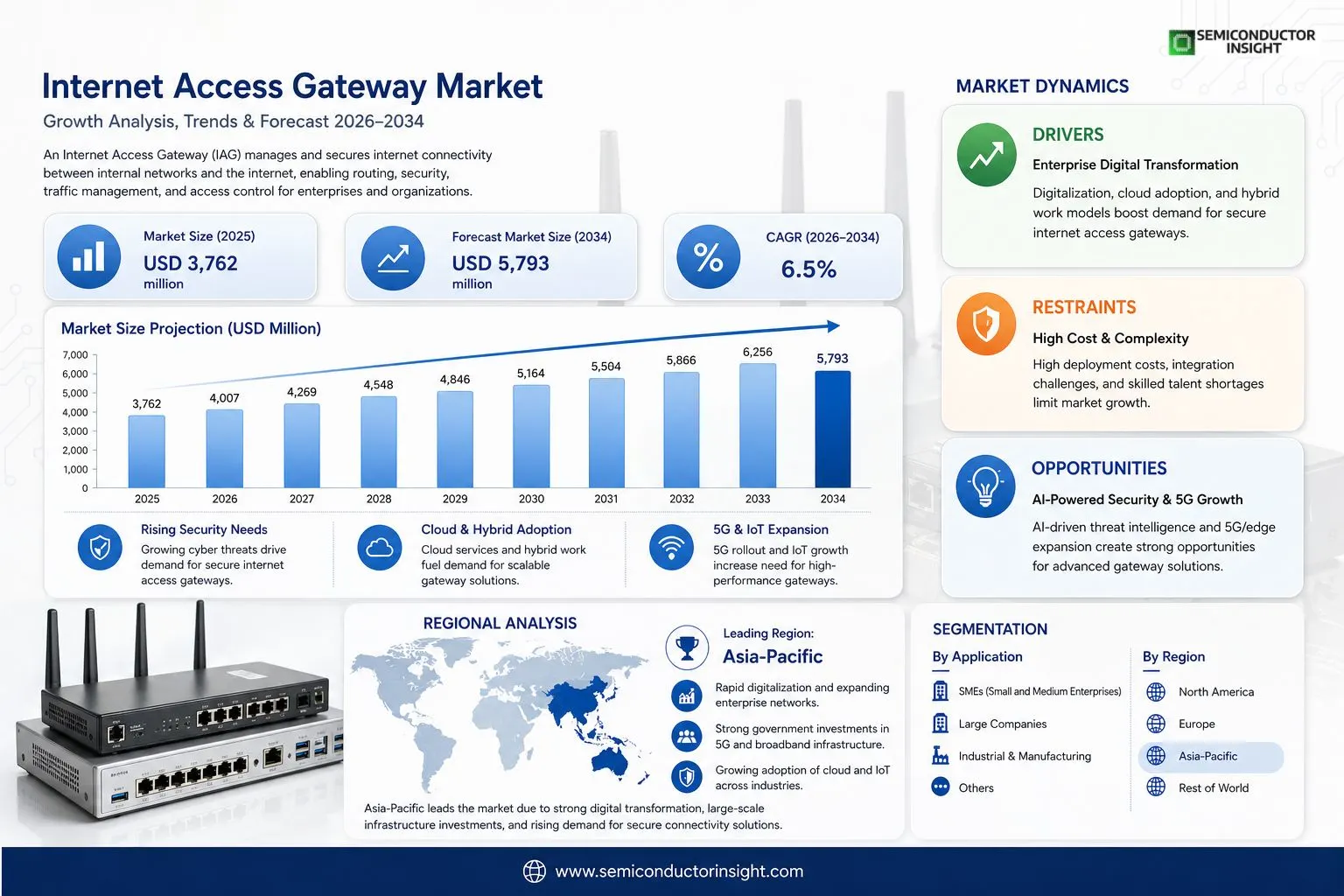
Global Internet Access Gateway Market was valued at USD 3,762 million in 2025 and is expected to reach USD 5,793 million by 2034, growing at a CAGR of 6.5% during the forecast period

PDF Icon Download Sample Report PDF
  • Quick Dispatch

    All Orders

  • Secure Payment

    100% Secure Payment

Price range: $1,500.00 through $4,250.00

Clear

Internet Access Gateway Market Insights

Global Internet Access Gateway market size was valued at USD 3,762 million in 2025. The market is projected to grow from USD 4,007 million in 2026 to USD 5,793 million by 2034, exhibiting a CAGR of 6.5% during the forecast period.

An Internet Access Gateway (IAG) is a network device or system that serves as the critical entry point for managing and controlling access to the internet. It functions as an intermediary between an internal network , such as a corporate, private, or local area network , and the broader internet, handling essential functions including routing, security enforcement, traffic management, and access control. IAGs encompass two primary product types: Cellular Access Gateways and Wireless Access Gateways, each tailored to distinct connectivity environments and enterprise requirements.

The market is experiencing consistent growth driven by the rapid expansion of enterprise digitalization, increasing adoption of cloud-based services, and the escalating need for robust network security frameworks. Furthermore, the proliferation of IoT-connected devices and Global rollout of 5G infrastructure are significantly amplifying demand for advanced gateway solutions. Key manufacturers operating in this space include Cisco, Huawei, Dell, Ubiquiti, Sangfor Technologies, Advantech, Siemens, Schneider Electric, Fujitsu, and ZTE, among others, each offering diversified portfolios catering to both SMEs and large enterprises across North America, Europe, Asia-Pacific, and emerging markets in the Middle East & Africa.
 Internet Access Gateway Market

MARKET DRIVERS

Accelerating Enterprise Digital Transformation Fueling Demand

The rapid shift toward digital-first business operations has become one of the most significant forces propelling growth in Internet Access Gateway Market. Enterprises across industries are investing heavily in modernizing their network infrastructure to support hybrid work environments, cloud-based application delivery, and real-time data processing. Internet access gateways serve as a critical control point between internal networks and the public internet, enabling organizations to manage bandwidth, enforce security policies, and maintain compliance. As businesses expand their digital footprints, the need for robust, scalable gateway solutions continues to intensify across both large enterprises and mid-sized organizations.

Surge in Cloud Adoption and Distributed Workforce Models

The widespread adoption of cloud computing platforms, including Infrastructure-as-a-Service (IaaS) and Software-as-a-Service (SaaS) models, has fundamentally altered how organizations route and manage internet traffic. Traditional perimeter-based security models are increasingly being replaced by cloud-native and hybrid gateway architectures that can handle distributed workloads efficiently. The proliferation of remote and hybrid work, accelerated by global workforce shifts in recent years, has directly increased reliance on secure internet access gateway solutions to authenticate users, filter content, and prevent data exfiltration across geographically dispersed endpoints.

The convergence of Secure Access Service Edge (SASE) frameworks with Internet Access Gateway capabilities is reshaping enterprise network security strategies, enabling unified policy enforcement across cloud and on-premise environments simultaneously.

Furthermore, the exponential growth in connected devices driven by IoT deployments in manufacturing, healthcare, and logistics sectors is creating additional demand for gateways capable of managing diverse traffic types. As organizations seek to consolidate network management functions, vendors offering unified internet access gateway platforms with integrated threat intelligence, SSL inspection, and application-level visibility are gaining a measurable competitive advantage in the marketplace.

MARKET CHALLENGES

Escalating Complexity of Cybersecurity Threats and Compliance Demands

One of the foremost challenges confronting Internet Access Gateway Market is the continuously evolving cybersecurity threat landscape. Sophisticated attack vectors, including encrypted malware, ransomware-as-a-service, and advanced persistent threats (APTs), are increasingly tunneled through standard HTTPS traffic, making detection and mitigation exceptionally difficult without deep packet inspection capabilities. Organizations must balance rigorous inspection requirements with performance demands, as SSL/TLS decryption at scale introduces latency that can negatively affect user experience and productivity. Meeting this balance requires significant investment in high-performance hardware and software architectures that many organizations , particularly in the public sector and SMB segment , find financially prohibitive.

Other Challenges

Regulatory Fragmentation Across Jurisdictions

Internet access gateway deployments must navigate an increasingly fragmented global regulatory environment. Data sovereignty laws, privacy regulations such as GDPR in Europe and PDPA in Asia, and sector-specific compliance mandates require organizations to implement jurisdiction-aware traffic policies. This regulatory complexity adds layers of configuration overhead, increases the burden on IT security teams, and can slow deployment timelines , particularly for multinational enterprises managing gateway infrastructure across multiple regions simultaneously.

Integration Complexity with Legacy Infrastructure
Many organizations continue to operate legacy network infrastructure that was not designed to interoperate with modern internet access gateway architectures. Integrating next-generation gateway solutions with older firewalls, proxy servers, and directory services creates compatibility challenges that can delay implementation and increase total cost of ownership. The shortage of skilled network security professionals further compounds this challenge, as configuring and maintaining sophisticated gateway environments requires specialized expertise that remains in limited supply across global talent markets.

MARKET RESTRAINTS

High Total Cost of Ownership Limiting Adoption Among SMBs

Despite the clear operational benefits, the high total cost of ownership associated with enterprise-grade Internet Access Gateway solutions remains a significant market restraint, particularly for small and medium-sized businesses. Licensing fees, hardware procurement or cloud subscription costs, ongoing maintenance, and the need for trained personnel collectively create a substantial financial commitment that many organizations struggle to justify within constrained IT budgets. Vendors in this space face the challenge of delivering cost-effective entry-level offerings without compromising the security capabilities that define the value proposition of advanced gateway platforms.

Vendor Lock-In Concerns Slowing Procurement Decisions

Concerns around vendor lock-in represent another notable restraint within Internet Access Gateway Market. As organizations evaluate platforms with deeply integrated policy engines, proprietary threat intelligence feeds, and vendor-specific management consoles, the prospect of long-term dependency on a single vendor creates hesitation in procurement cycles. Organizations increasingly prioritize interoperability and open standards compliance during vendor selection, which can extend evaluation timelines and complicate purchasing decisions. This dynamic is particularly pronounced in highly regulated industries such as financial services and healthcare, where switching costs and operational disruption risks are significant considerations in technology adoption strategies.

MARKET OPPORTUNITIES

AI-Powered Threat Intelligence Integration Opening New Growth Avenues

The integration of artificial intelligence and machine learning capabilities into Internet Access Gateway platforms presents a substantial growth opportunity for vendors and solution providers. AI-driven behavioral analytics can significantly enhance the ability to detect zero-day threats, identify anomalous traffic patterns, and automate policy enforcement without requiring manual intervention from security operations teams. As organizations seek to reduce mean time to detection and response across their network perimeters, gateways embedded with adaptive threat intelligence capabilities are positioned to command premium pricing and accelerate replacement cycles across the enterprise and mid-market segments.

Expanding 5G Infrastructure and Edge Computing Deployments

Global rollout of 5G networks and the rapid expansion of edge computing infrastructure are creating compelling new deployment opportunities for Internet Access Gateway solutions. As processing and data management shift closer to the network edge , in industrial facilities, smart cities, and telecommunications points of presence , the need for lightweight, high-throughput gateway solutions capable of enforcing security and access policies at distributed nodes is growing measurably. Vendors that develop purpose-built gateway architectures optimized for edge environments, with low-latency inspection and minimal computational overhead, are well-positioned to capture emerging demand across telecommunications, manufacturing, and critical infrastructure sectors globally.

Growth in Emerging Markets Driven by Digital Infrastructure Investment

Emerging economies across Asia-Pacific, Latin America, the Middle East, and Africa are experiencing accelerated investment in digital infrastructure, creating a significant and largely underpenetrated opportunity for Internet Access Gateway market participants. Government-led broadband expansion initiatives, the proliferation of internet-connected businesses, and rising cybersecurity awareness among enterprises in these regions are collectively driving first-time adoption of structured internet access management solutions. Vendors offering cloud-delivered gateway services with flexible consumption-based pricing models are particularly well-suited to capitalize on this demand, as they lower the barriers to entry for organizations in growth markets that may lack the capital infrastructure to support traditional on-premise deployments.


Internet Access Gateway Market Trends

Rising Demand for Secure and Controlled Internet Access Drives Internet Access Gateway Market Growth

Internet Access Gateway Market is witnessing significant momentum as enterprises across industries accelerate their digital transformation initiatives. Organizations increasingly rely on internet access gateways to manage, secure, and optimize connectivity between internal networks and the public internet. As the volume of web-based applications and cloud services grows, businesses are turning to advanced gateway solutions to enforce access control policies, monitor traffic, and mitigate cybersecurity threats. This shift is particularly evident among large enterprises managing complex, distributed network environments that demand robust and scalable gateway infrastructure.

Other Trends

Expansion of Cellular and Wireless Access Gateway Segments

Within Internet Access Gateway Market, the cellular access gateway and wireless access gateway segments are experiencing accelerated adoption. As mobile workforce trends expand and remote connectivity requirements increase, cellular access gateways are emerging as a preferred solution for organizations operating in areas with limited wired infrastructure. Wireless access gateways, on the other hand, are gaining traction in enterprise campuses, retail environments, and industrial facilities where flexible, high-speed connectivity is essential. These two segments collectively reflect the industry’s transition toward more agile and mobile-ready internet access solutions.

Growing Adoption Among SMEs and Large Enterprises

Internet Access Gateway Market is seeing rising uptake across both small and medium-sized enterprises (SMEs) and large corporations. SMEs are increasingly investing in cost-effective gateway solutions to safeguard their digital operations, driven by growing awareness of cyber vulnerabilities and regulatory compliance requirements. Large companies, with more complex network architectures and higher traffic volumes, are deploying enterprise-grade internet access gateways that offer advanced threat detection, deep packet inspection, and centralized management capabilities. This dual-segment growth underscores the broad applicability of internet access gateway solutions across business scales.

Competitive Landscape Shaped by Leading Technology Vendors

Internet Access Gateway Market is characterized by the active participation of globally recognized technology vendors, including Cisco, Huawei, Dell, Ubiquiti, Sangfor Technologies, Advantech, Siemens, Schneider Electric, Fujitsu, and ZTE, among others. These players are continuously innovating their product portfolios to address evolving network security challenges and changing enterprise connectivity demands. Strategic mergers, acquisitions, and product development initiatives among top market participants are intensifying competitive dynamics, compelling vendors to differentiate through enhanced performance, interoperability, and cloud integration capabilities.

Regional Market Dynamics Reflect Diverse Connectivity Needs

Geographically, Internet Access Gateway Market demonstrates varied growth patterns across North America, Europe, Asia, South America, and the Middle East and Africa. North America remains a leading region due to high enterprise digitalization rates and strong cybersecurity investment. Asia, led by China, Japan, South Korea, and India, is emerging as a high-growth region driven by rapid industrialization, expanding IT infrastructure, and increasing internet penetration. Meanwhile, Middle East and Africa markets are gradually adopting internet access gateway solutions as governments and enterprises invest in modernizing their digital infrastructure to support economic diversification goals.


COMPETITIVE LANDSCAPE

Key Industry Players

Internet Access Gateway Market , Competitive Dynamics, Leading Vendors, and Strategic Positioning

Global Internet Access Gateway (IAG) market is characterized by intense competition among a mix of established networking giants and specialized technology providers. Cisco continues to assert its dominance as the foremost player in this space, leveraging its comprehensive portfolio of enterprise-grade gateway solutions, deep-rooted channel partnerships, and sustained investment in secure access and SD-WAN capabilities. Huawei and ZTE similarly command significant market presence, particularly across Asia-Pacific and emerging economies, offering cost-competitive yet feature-rich IAG platforms tailored to both cellular and wireless access environments. Dell reinforces its competitive standing through integrated infrastructure offerings that bundle gateway functionality with broader enterprise IT ecosystems, while Siemens and Schneider Electric differentiate themselves by targeting industrial and operational technology (OT) segments, addressing the growing convergence of IT and OT networks. Together, the top five global players accounted for a substantial share of the market revenue in 2025, underscoring the oligopolistic nature of the upper tier of this industry.

Beyond the market leaders, a robust cohort of niche and regional players contributes meaningfully to the competitive fabric of Internet Access Gateway Market. Ubiquiti has carved out a loyal customer base among SMEs and value-conscious enterprises by delivering scalable wireless access gateway solutions at accessible price points. Sangfor Technologies is gaining traction in the Asia-Pacific region with its cybersecurity-integrated gateway offerings. Advantech and ADLINK Technology serve industrial IoT and edge computing segments with ruggedized, application-specific gateway hardware. Moxa is recognized for its reliable industrial networking devices, while Fujitsu brings enterprise-class reliability and managed service capabilities to the market. Obvius (Leviton) and Alotcer address specialized verticals including energy management and remote IoT connectivity respectively. ABB rounds out the competitive landscape with its focus on smart infrastructure and industrial automation-centric connectivity solutions. As Global IAG market is projected to grow from USD 3,762 million in 2025 to USD 5,793 million by 2034 at a CAGR of 6.5%, competition is expected to intensify, with vendors increasingly differentiating through security integration, cloud management, and edge intelligence capabilities.

List of Key Internet Access Gateway Companies Profiled


Segment Analysis:

Segment Category Sub-Segments Key Insights
By Type
  • Cellular Access Gateway
  • Wireless Access Gateway
Cellular Access Gateway is emerging as the dominant type in Internet Access Gateway Market, driven by the rapid global rollout of 4G LTE and 5G networks that demand robust and reliable cellular connectivity infrastructure.

  • Cellular Access Gateways are increasingly favored in remote and industrial deployments where fixed-line broadband infrastructure is unavailable or impractical, making them indispensable for field operations and distributed enterprise networks.
  • The proliferation of IoT ecosystems and machine-to-machine (M2M) communication has significantly elevated the demand for cellular gateways capable of managing high volumes of device connections with low latency and high reliability.
  • Wireless Access Gateways continue to hold strong relevance in campus, hospitality, and retail environments where dense Wi-Fi coverage and seamless user authentication are critical operational requirements.
By Application
  • SMEs (Small and Medium Enterprises)
  • Large Companies
  • Industrial & Manufacturing
  • Others
Large Companies represent the leading application segment in Internet Access Gateway Market, as enterprise-scale organizations face growing demands for centralized internet traffic management, advanced threat protection, and policy-based access control across geographically dispersed networks.

  • Large enterprises are rapidly adopting next-generation Internet Access Gateways that integrate seamlessly with cloud security frameworks such as Secure Access Service Edge (SASE) and Zero Trust Network Access (ZTNA), enabling flexible yet highly secure remote work environments.
  • SMEs are increasingly recognizing the value of cloud-managed Internet Access Gateways, which offer enterprise-grade security and traffic management capabilities without the need for extensive on-premises IT infrastructure or dedicated network specialists.
  • Industrial and manufacturing applications are gaining traction as operational technology (OT) environments undergo digital transformation, requiring gateways that can bridge legacy industrial systems with modern IP-based internet connectivity securely.
By End User
  • BFSI (Banking, Financial Services & Insurance)
  • Healthcare
  • Retail & E-Commerce
  • Government & Defense
  • Education
BFSI stands out as the dominant end-user vertical in Internet Access Gateway Market, given the sector’s stringent regulatory compliance requirements, critical need for data privacy, and high vulnerability to cyber threats that necessitate robust internet access governance.

  • Financial institutions deploy Internet Access Gateways as a frontline defense mechanism to enforce granular web filtering, prevent data exfiltration, and ensure that internet-bound traffic complies with industry mandates such as PCI-DSS and SOX.
  • Healthcare organizations are rapidly adopting Internet Access Gateways to safeguard patient data transmitted across cloud-hosted electronic health record (EHR) systems, driven by the tightening of HIPAA compliance standards and growing ransomware threats targeting medical networks.
  • Government and defense end users prioritize Internet Access Gateways with advanced content inspection and encrypted traffic analysis capabilities, ensuring that sensitive public sector communications remain protected against nation-state cyber threats and unauthorized access.
By Deployment Mode
  • On-Premises
  • Cloud-Based
  • Hybrid
Cloud-Based Deployment is rapidly becoming the preferred mode of deployment for Internet Access Gateways, as organizations seek scalable, centrally managed, and cost-effective alternatives to traditional hardware-dependent gateway architectures.

  • Cloud-based Internet Access Gateways offer organizations the flexibility to extend secure internet access to remote workers, branch offices, and mobile users without the complexity of deploying and maintaining physical appliances at each location.
  • On-premises deployment continues to be favored by organizations with stringent data sovereignty requirements or those operating in regulated industries where internet traffic must be inspected and controlled within the organization’s physical infrastructure perimeter.
  • Hybrid deployment models are gaining considerable momentum as enterprises seek to balance the control and customization benefits of on-premises gateways with the agility and scalability advantages offered by cloud-delivered gateway services.
By Component
  • Hardware
  • Software
  • Services (Managed & Professional)
Hardware remains the foundational and leading component segment within Internet Access Gateway Market, as purpose-built physical appliances continue to deliver the high throughput, deterministic performance, and ruggedized reliability demanded by enterprise and industrial deployments.

  • Purpose-built hardware gateways from key manufacturers such as Cisco, Huawei, and Advantech are engineered to handle intensive deep packet inspection, SSL/TLS decryption, and real-time threat analysis workloads that software-only solutions may struggle to process at scale without performance degradation.
  • The software segment is witnessing accelerated growth as virtualized and software-defined gateway solutions enable organizations to deploy internet access control policies dynamically across multi-cloud and hybrid IT environments, reducing capital expenditure on dedicated hardware refreshes.
  • Managed and professional services are increasingly integral to the Internet Access Gateway ecosystem, as organizations seek expert guidance for gateway configuration, policy management, threat monitoring, and ongoing optimization to maximize the security value of their deployed gateway infrastructure.


Regional Analysis: Internet Access Gateway Market

North America

North America stands as the dominant force in Global internet access gateway market, underpinned by a deeply entrenched digital infrastructure, widespread enterprise cloud adoption, and an exceptionally mature telecommunications ecosystem. The United States, in particular, serves as the nerve center of innovation, with leading technology vendors and hyperscale cloud providers continuously pushing the boundaries of gateway architecture, software-defined networking, and zero-trust security frameworks. The region’s regulatory environment, while complex, actively encourages investment in cybersecurity and network modernization, creating fertile ground for gateway solution providers to expand their portfolios. Canada reinforces the region’s leadership through aggressive broadband expansion programs and public-private partnerships aimed at closing urban-rural connectivity gaps. Enterprises across sectors including healthcare, financial services, and government are rapidly transitioning toward unified gateway platforms that consolidate network management, threat intelligence, and access control. This convergence of demand drivers, technological maturity, and favorable enterprise spending cycles positions North America as the unrivaled leader in shaping the future trajectory of Internet Access Gateway Market through 2034.
Enterprise Digital Transformation
North American enterprises are aggressively modernizing their IT infrastructure, driving sustained demand for advanced internet access gateway solutions. The proliferation of hybrid work models and multi-cloud environments has made secure, scalable gateway deployments a strategic imperative. Organizations are prioritizing platforms that offer seamless integration with existing security stacks, enabling more resilient and flexible network perimeters across distributed workforces.
Regulatory & Compliance Landscape
Stringent data privacy regulations and sector-specific compliance mandates in the United States and Canada are compelling organizations to invest in gateway technologies capable of enforcing policy-driven access controls and comprehensive traffic inspection. Frameworks such as CMMC for defense contractors and HIPAA for healthcare providers are directly influencing purchasing decisions, with compliance readiness becoming a core feature criterion for internet access gateway platforms.
Vendor Innovation & R&D Activity
The region hosts a concentration of the world’s most influential internet access gateway vendors, fostering a competitive innovation environment. Ongoing research into AI-driven threat detection, SASE architecture, and SD-WAN integration is yielding next-generation gateway solutions. Strategic acquisitions and partnerships among North American technology firms are accelerating product roadmaps and enabling vendors to deliver more comprehensive, end-to-end connectivity and security offerings to enterprise clients.
SMB Adoption & Channel Growth
Beyond large enterprises, the small and medium-sized business segment in North America is increasingly recognizing the value of managed internet access gateway services. The expansion of managed service provider channels and cloud-delivered gateway offerings has lowered the barrier to entry for SMBs, enabling them to access enterprise-grade connectivity and security capabilities without the complexity of on-premises hardware deployment or large in-house IT teams.

Europe
Europe represents a highly significant and rapidly evolving market for internet access gateway solutions, characterized by a unique interplay of stringent regulatory requirements and accelerating enterprise digitalization. The General Data Protection Regulation continues to exert considerable influence over how organizations design and deploy gateway architectures, particularly with respect to data residency, cross-border traffic management, and user privacy. Western European nations including Germany, France, and the United Kingdom are at the forefront of adopting software-defined gateway models, while Central and Eastern European markets are experiencing growing momentum driven by expanding digital economies and EU-funded connectivity initiatives. The region’s strong emphasis on sovereign cloud infrastructure and data localization is shaping gateway procurement strategies, with many organizations favoring solutions that offer granular control over traffic routing and policy enforcement. European telecom operators are also playing an increasingly active role in bundling gateway functionality within broader managed network service portfolios, offering enterprises a more integrated path to secure internet access.

Asia-Pacific
Asia-Pacific is emerging as one of the fastest-growing regions in Global internet access gateway market, propelled by explosive growth in digital connectivity, surging enterprise cloud adoption, and large-scale government-backed broadband infrastructure programs. Countries such as China, India, Japan, South Korea, and Australia are each contributing distinct demand dynamics to the regional landscape. China’s massive domestic technology ecosystem and stringent national cybersecurity regulations are driving the development of indigenously designed gateway solutions tailored to local compliance requirements. India’s rapidly expanding digital economy, fueled by a burgeoning startup ecosystem and widespread mobile internet penetration, is creating robust demand for scalable and cost-effective gateway platforms. Japan and South Korea, with their advanced industrial bases and early adoption of next-generation networking technologies, continue to invest in high-performance gateway infrastructure to support smart manufacturing and connected enterprise environments. Southeast Asia also presents compelling growth opportunities as digital transformation accelerates across financial services, retail, and public sector verticals.

South America
South America occupies a developing yet increasingly promising position within Global internet access gateway market. Brazil dominates regional demand, driven by its large enterprise base, expanding fintech sector, and ongoing efforts to modernize public sector IT infrastructure. The country’s growing awareness of cybersecurity risks, amplified by a series of high-profile data breaches, has prompted organizations to reassess their network perimeter strategies and invest in more robust gateway solutions. Other markets including Argentina, Chile, and Colombia are also witnessing gradual adoption of cloud-delivered internet access gateway platforms, particularly among mid-sized enterprises seeking to balance cost efficiency with improved security posture. However, economic volatility, currency fluctuations, and inconsistent regulatory frameworks continue to temper the pace of market expansion across parts of the region. Vendors that can offer flexible pricing models and localized support capabilities are best positioned to capture emerging opportunities as South American enterprises prioritize digital resilience.

Middle East & Africa
The Middle East and Africa region presents a nuanced and evolving landscape for Internet Access Gateway Market, with considerable variation in market maturity across sub-regions. Gulf Cooperation Council nations, particularly the United Arab Emirates and Saudi Arabia, are leading regional adoption through ambitious smart city initiatives, large-scale digital government programs, and substantial investment in cybersecurity infrastructure. These markets are increasingly deploying advanced gateway solutions as part of broader national digitalization strategies that emphasize secure and high-performance connectivity. In contrast, Sub-Saharan Africa, while earlier in its digital transformation journey, is experiencing growing momentum as mobile broadband penetration expands and enterprise connectivity needs intensify. The rollout of terrestrial fiber networks and the increasing availability of satellite-based internet services are progressively creating the foundational connectivity layer necessary to support gateway solution adoption. Public sector investment and multilateral development funding are expected to play a catalytic role in accelerating market development across underserved African markets through the forecast period.

Report Scope

This market research report provides a comprehensive analysis of Internet Access Gateway Market, covering the forecast period 2026–2034. It offers detailed insights into market dynamics, technological advancements, competitive landscape, and key trends shaping the industry.

Key focus areas of the report include:

  • Market Overview: The report begins with an overview outlining its current market scenario, key growth indicators, and industry transformation drivers. It discusses macroeconomic factors, demand–supply balance, regulatory landscape, and the strategic role of Internet Access Gateways in powering advancements across industries such as corporate networking, telecommunications, industrial automation, and cloud-based services.
  • Market Size & Forecast: Historical data and future projections for revenue, unit shipments, and market value across major regions and segments.
  • Segmentation Analysis: Detailed breakdown by product type, technology, application, and end-user industry to identify high-growth segments and investment opportunities.
  • Regional Insights: Insights into market performance across North America, Europe, Asia-Pacific, Latin America, and the Middle East & Africa, including country-level analysis where relevant.
  • Competitive Landscape: Profiles of leading market participants, including their product offerings, R&D focus, manufacturing capacity, pricing strategies, and recent developments such as mergers, acquisitions, and partnerships.
  • Technology Trends & Innovation: Assessment of emerging technologies, integration of AI/IoT, gateway design trends, security architecture evolution, and evolving industry standards.
  • Market Drivers & Restraints: Evaluation of factors driving market growth along with challenges, supply chain constraints, regulatory issues, and market-entry barriers.
  • Stakeholder Insights: Insights for component suppliers, OEMs, system integrators, investors, and policymakers regarding the evolving ecosystem and strategic opportunities.

Primary and secondary research methods are employed, including interviews with industry experts, data from verified sources, and real-time market intelligence to ensure the accuracy and reliability of the insights presented.

FREQUENTLY ASKED QUESTIONS:

What is the current market size of Internet Access Gateway Market?

-> Global Internet Access Gateway Market was valued at USD 3,762 million in 2025 and is expected to reach USD 5,793 million by 2034, growing at a CAGR of 6.5% during the forecast period.

Which key companies operate in Internet Access Gateway Market?

-> Key players include Cisco, Dell, Ubiquiti, Sangfor Technologies, Huawei, Advantech, Siemens, Schneider Electric, Fujitsu, ZTE, ABB, ADLINK Technology, Moxa, Obvius (Leviton), and Alotcer, among others.

What are the key growth drivers?

-> Key growth drivers include rising demand for secure internet access in corporate and industrial environments, rapid adoption of cloud-based applications, increasing need for traffic management and access control, and growing deployment of IoT devices requiring gateway solutions.

Which region dominates the market?

-> Asia-Pacific is among the fastest-growing regions driven by rapid digital transformation and expanding enterprise networks, while North America remains a dominant market owing to high adoption of advanced networking infrastructure.

What are the emerging trends?

-> Emerging trends include integration of AI-driven traffic management, convergence of security and gateway functions, growth of wireless and cellular access gateways, and increasing deployment across SMEs and large enterprises seeking scalable internet access solutions.


Internet Access Gateway Market, Trends, Business Strategies 2026-2034

Get Sample Report PDF for Exclusive Insights

Report Sample Includes

  • Table of Contents
  • List of Tables & Figures
  • Charts, Research Methodology, and more...

PDF Icon Download Sample Report PDF
SKU: df33837fc347
Category:
License Type

Corporate License, Excel License, PDF and Excel Databook License

Download Sample Report

Table of Content

1 Introduction to Research & Analysis Reports
1.1 Internet Access Gateway Market Definition
1.2 Market Segments
1.2.1 Segment by Type
1.2.2 Segment by Application
1.3 Global Internet Access Gateway Market Overview
1.4 Features & Benefits of This Report
1.5 Methodology & Sources of Information
1.5.1 Research Methodology
1.5.2 Research Process
1.5.3 Base Year
1.5.4 Report Assumptions & Caveats
2 Global Internet Access Gateway Overall Market Size
2.1 Global Internet Access Gateway Market Size: 2025 VS 2034
2.2 Global Internet Access Gateway Market Size, Prospects & Forecasts: 2021-2034
2.3 Global Internet Access Gateway Sales: 2021-2034
3 Company Landscape
3.1 Top Internet Access Gateway Players in Global Market
3.2 Top Global Internet Access Gateway Companies Ranked by Revenue
3.3 Global Internet Access Gateway Revenue by Companies
3.4 Global Internet Access Gateway Sales by Companies
3.5 Global Internet Access Gateway Price by Manufacturer (2021-2026)
3.6 Top 3 and Top 5 Internet Access Gateway Companies in Global Market, by Revenue in 2025
3.7 Global Manufacturers Internet Access Gateway Product Type
3.8 Tier 1, Tier 2, and Tier 3 Internet Access Gateway Players in Global Market
3.8.1 List of Global Tier 1 Internet Access Gateway Companies
3.8.2 List of Global Tier 2 and Tier 3 Internet Access Gateway Companies
4 Sights by Type
4.1 Overview
4.1.1 Segment by Type – Global Internet Access Gateway Market Size Markets, 2025 & 2034
4.1.2 Cellular Acces Gateway
4.1.3 Wireless Access Gateway
4.2 Segment by Type – Global Internet Access Gateway Revenue & Forecasts
4.2.1 Segment by Type – Global Internet Access Gateway Revenue, 2021-2026
4.2.2 Segment by Type – Global Internet Access Gateway Revenue, 2027-2034
4.2.3 Segment by Type – Global Internet Access Gateway Revenue Market Share, 2021-2034
4.3 Segment by Type – Global Internet Access Gateway Sales & Forecasts
4.3.1 Segment by Type – Global Internet Access Gateway Sales, 2021-2026
4.3.2 Segment by Type – Global Internet Access Gateway Sales, 2027-2034
4.3.3 Segment by Type – Global Internet Access Gateway Sales Market Share, 2021-2034
4.4 Segment by Type – Global Internet Access Gateway Price (Manufacturers Selling Prices), 2021-2034
5 Sights by Application
5.1 Overview
5.1.1 Segment by Application – Global Internet Access Gateway Market Size, 2025 & 2034
5.1.2 SMEs
5.1.3 Large Companies
5.2 Segment by Application – Global Internet Access Gateway Revenue & Forecasts
5.2.1 Segment by Application – Global Internet Access Gateway Revenue, 2021-2026
5.2.2 Segment by Application – Global Internet Access Gateway Revenue, 2027-2034
5.2.3 Segment by Application – Global Internet Access Gateway Revenue Market Share, 2021-2034
5.3 Segment by Application – Global Internet Access Gateway Sales & Forecasts
5.3.1 Segment by Application – Global Internet Access Gateway Sales, 2021-2026
5.3.2 Segment by Application – Global Internet Access Gateway Sales, 2027-2034
5.3.3 Segment by Application – Global Internet Access Gateway Sales Market Share, 2021-2034
5.4 Segment by Application – Global Internet Access Gateway Price (Manufacturers Selling Prices), 2021-2034
6 Sights Region
6.1 By Region – Global Internet Access Gateway Market Size, 2025 & 2034
6.2 By Region – Global Internet Access Gateway Revenue & Forecasts
6.2.1 By Region – Global Internet Access Gateway Revenue, 2021-2026
6.2.2 By Region – Global Internet Access Gateway Revenue, 2027-2034
6.2.3 By Region – Global Internet Access Gateway Revenue Market Share, 2021-2034
6.3 By Region – Global Internet Access Gateway Sales & Forecasts
6.3.1 By Region – Global Internet Access Gateway Sales, 2021-2026
6.3.2 By Region – Global Internet Access Gateway Sales, 2027-2034
6.3.3 By Region – Global Internet Access Gateway Sales Market Share, 2021-2034
6.4 North America
6.4.1 By Country – North America Internet Access Gateway Revenue, 2021-2034
6.4.2 By Country – North America Internet Access Gateway Sales, 2021-2034
6.4.3 United States Internet Access Gateway Market Size, 2021-2034
6.4.4 Canada Internet Access Gateway Market Size, 2021-2034
6.4.5 Mexico Internet Access Gateway Market Size, 2021-2034
6.5 Europe
6.5.1 By Country – Europe Internet Access Gateway Revenue, 2021-2034
6.5.2 By Country – Europe Internet Access Gateway Sales, 2021-2034
6.5.3 Germany Internet Access Gateway Market Size, 2021-2034
6.5.4 France Internet Access Gateway Market Size, 2021-2034
6.5.5 U.K. Internet Access Gateway Market Size, 2021-2034
6.5.6 Italy Internet Access Gateway Market Size, 2021-2034
6.5.7 Russia Internet Access Gateway Market Size, 2021-2034
6.5.8 Nordic Countries Internet Access Gateway Market Size, 2021-2034
6.5.9 Benelux Internet Access Gateway Market Size, 2021-2034
6.6 Asia
6.6.1 By Region – Asia Internet Access Gateway Revenue, 2021-2034
6.6.2 By Region – Asia Internet Access Gateway Sales, 2021-2034
6.6.3 China Internet Access Gateway Market Size, 2021-2034
6.6.4 Japan Internet Access Gateway Market Size, 2021-2034
6.6.5 South Korea Internet Access Gateway Market Size, 2021-2034
6.6.6 Southeast Asia Internet Access Gateway Market Size, 2021-2034
6.6.7 India Internet Access Gateway Market Size, 2021-2034
6.7 South America
6.7.1 By Country – South America Internet Access Gateway Revenue, 2021-2034
6.7.2 By Country – South America Internet Access Gateway Sales, 2021-2034
6.7.3 Brazil Internet Access Gateway Market Size, 2021-2034
6.7.4 Argentina Internet Access Gateway Market Size, 2021-2034
6.8 Middle East & Africa
6.8.1 By Country – Middle East & Africa Internet Access Gateway Revenue, 2021-2034
6.8.2 By Country – Middle East & Africa Internet Access Gateway Sales, 2021-2034
6.8.3 Turkey Internet Access Gateway Market Size, 2021-2034
6.8.4 Israel Internet Access Gateway Market Size, 2021-2034
6.8.5 Saudi Arabia Internet Access Gateway Market Size, 2021-2034
6.8.6 UAE Internet Access Gateway Market Size, 2021-2034
7 Manufacturers & Brands Profiles
7.1 Cisco
7.1.1 Cisco Company Summary
7.1.2 Cisco Business Overview
7.1.3 Cisco Internet Access Gateway Major Product Offerings
7.1.4 Cisco Internet Access Gateway Sales and Revenue in Global (2021-2026)
7.1.5 Cisco Key News & Latest Developments
7.2 Dell
7.2.1 Dell Company Summary
7.2.2 Dell Business Overview
7.2.3 Dell Internet Access Gateway Major Product Offerings
7.2.4 Dell Internet Access Gateway Sales and Revenue in Global (2021-2026)
7.2.5 Dell Key News & Latest Developments
7.3 Ubiquiti
7.3.1 Ubiquiti Company Summary
7.3.2 Ubiquiti Business Overview
7.3.3 Ubiquiti Internet Access Gateway Major Product Offerings
7.3.4 Ubiquiti Internet Access Gateway Sales and Revenue in Global (2021-2026)
7.3.5 Ubiquiti Key News & Latest Developments
7.4 Sangfor Technologies
7.4.1 Sangfor Technologies Company Summary
7.4.2 Sangfor Technologies Business Overview
7.4.3 Sangfor Technologies Internet Access Gateway Major Product Offerings
7.4.4 Sangfor Technologies Internet Access Gateway Sales and Revenue in Global (2021-2026)
7.4.5 Sangfor Technologies Key News & Latest Developments
7.5 Huawei
7.5.1 Huawei Company Summary
7.5.2 Huawei Business Overview
7.5.3 Huawei Internet Access Gateway Major Product Offerings
7.5.4 Huawei Internet Access Gateway Sales and Revenue in Global (2021-2026)
7.5.5 Huawei Key News & Latest Developments
7.6 Advantech
7.6.1 Advantech Company Summary
7.6.2 Advantech Business Overview
7.6.3 Advantech Internet Access Gateway Major Product Offerings
7.6.4 Advantech Internet Access Gateway Sales and Revenue in Global (2021-2026)
7.6.5 Advantech Key News & Latest Developments
7.7 Siemens
7.7.1 Siemens Company Summary
7.7.2 Siemens Business Overview
7.7.3 Siemens Internet Access Gateway Major Product Offerings
7.7.4 Siemens Internet Access Gateway Sales and Revenue in Global (2021-2026)
7.7.5 Siemens Key News & Latest Developments
7.8 Schneider Electric
7.8.1 Schneider Electric Company Summary
7.8.2 Schneider Electric Business Overview
7.8.3 Schneider Electric Internet Access Gateway Major Product Offerings
7.8.4 Schneider Electric Internet Access Gateway Sales and Revenue in Global (2021-2026)
7.8.5 Schneider Electric Key News & Latest Developments
7.9 Fujitsu
7.9.1 Fujitsu Company Summary
7.9.2 Fujitsu Business Overview
7.9.3 Fujitsu Internet Access Gateway Major Product Offerings
7.9.4 Fujitsu Internet Access Gateway Sales and Revenue in Global (2021-2026)
7.9.5 Fujitsu Key News & Latest Developments
7.10 ZTE
7.10.1 ZTE Company Summary
7.10.2 ZTE Business Overview
7.10.3 ZTE Internet Access Gateway Major Product Offerings
7.10.4 ZTE Internet Access Gateway Sales and Revenue in Global (2021-2026)
7.10.5 ZTE Key News & Latest Developments
7.11 ABB
7.11.1 ABB Company Summary
7.11.2 ABB Business Overview
7.11.3 ABB Internet Access Gateway Major Product Offerings
7.11.4 ABB Internet Access Gateway Sales and Revenue in Global (2021-2026)
7.11.5 ABB Key News & Latest Developments
7.12 ADLINK Technology
7.12.1 ADLINK Technology Company Summary
7.12.2 ADLINK Technology Business Overview
7.12.3 ADLINK Technology Internet Access Gateway Major Product Offerings
7.12.4 ADLINK Technology Internet Access Gateway Sales and Revenue in Global (2021-2026)
7.12.5 ADLINK Technology Key News & Latest Developments
7.13 Moxa
7.13.1 Moxa Company Summary
7.13.2 Moxa Business Overview
7.13.3 Moxa Internet Access Gateway Major Product Offerings
7.13.4 Moxa Internet Access Gateway Sales and Revenue in Global (2021-2026)
7.13.5 Moxa Key News & Latest Developments
7.14 Obvius (Leviton)
7.14.1 Obvius (Leviton) Company Summary
7.14.2 Obvius (Leviton) Business Overview
7.14.3 Obvius (Leviton) Internet Access Gateway Major Product Offerings
7.14.4 Obvius (Leviton) Internet Access Gateway Sales and Revenue in Global (2021-2026)
7.14.5 Obvius (Leviton) Key News & Latest Developments
7.15 Alotcer
7.15.1 Alotcer Company Summary
7.15.2 Alotcer Business Overview
7.15.3 Alotcer Internet Access Gateway Major Product Offerings
7.15.4 Alotcer Internet Access Gateway Sales and Revenue in Global (2021-2026)
7.15.5 Alotcer Key News & Latest Developments
8 Global Internet Access Gateway Production Capacity, Analysis
8.1 Global Internet Access Gateway Production Capacity, 2021-2034
8.2 Internet Access Gateway Production Capacity of Key Manufacturers in Global Market
8.3 Global Internet Access Gateway Production by Region
9 Key Market Trends, Opportunity, Drivers and Restraints
9.1 Market Opportunities & Trends
9.2 Market Drivers
9.3 Market Restraints
10 Internet Access Gateway Supply Chain Analysis
10.1 Internet Access Gateway Industry Value Chain
10.2 Internet Access Gateway Upstream Market
10.3 Internet Access Gateway Downstream and Clients
10.4 Marketing Channels Analysis
10.4.1 Marketing Channels
10.4.2 Internet Access Gateway Distributors and Sales Agents in Global
11 Conclusion
12 Appendix
12.1 Note
12.2 Examples of Clients
12.3 DisclaimerList of Tables
Table 1. Key Players of Internet Access Gateway in Global Market
Table 2. Top Internet Access Gateway Players in Global Market, Ranking by Revenue (2025)
Table 3. Global Internet Access Gateway Revenue by Companies, (US$, Mn), 2021-2026
Table 4. Global Internet Access Gateway Revenue Share by Companies, 2021-2026
Table 5. Global Internet Access Gateway Sales by Companies, (K Units), 2021-2026
Table 6. Global Internet Access Gateway Sales Share by Companies, 2021-2026
Table 7. Key Manufacturers Internet Access Gateway Price (2021-2026) & (US$/Unit)
Table 8. Global Manufacturers Internet Access Gateway Product Type
Table 9. List of Global Tier 1 Internet Access Gateway Companies, Revenue (US$, Mn) in 2025 and Market Share
Table 10. List of Global Tier 2 and Tier 3 Internet Access Gateway Companies, Revenue (US$, Mn) in 2025 and Market Share
Table 11. Segment by Type – Global Internet Access Gateway Revenue, (US$, Mn), 2025 & 2034
Table 12. Segment by Type – Global Internet Access Gateway Revenue (US$, Mn), 2021-2026
Table 13. Segment by Type – Global Internet Access Gateway Revenue (US$, Mn), 2027-2034
Table 14. Segment by Type – Global Internet Access Gateway Sales (K Units), 2021-2026
Table 15. Segment by Type – Global Internet Access Gateway Sales (K Units), 2027-2034
Table 16. Segment by Application – Global Internet Access Gateway Revenue, (US$, Mn), 2025 & 2034
Table 17. Segment by Application – Global Internet Access Gateway Revenue, (US$, Mn), 2021-2026
Table 18. Segment by Application – Global Internet Access Gateway Revenue, (US$, Mn), 2027-2034
Table 19. Segment by Application – Global Internet Access Gateway Sales, (K Units), 2021-2026
Table 20. Segment by Application – Global Internet Access Gateway Sales, (K Units), 2027-2034
Table 21. By Region – Global Internet Access Gateway Revenue, (US$, Mn), 2025 & 2034
Table 22. By Region – Global Internet Access Gateway Revenue, (US$, Mn), 2021-2026
Table 23. By Region – Global Internet Access Gateway Revenue, (US$, Mn), 2027-2034
Table 24. By Region – Global Internet Access Gateway Sales, (K Units), 2021-2026
Table 25. By Region – Global Internet Access Gateway Sales, (K Units), 2027-2034
Table 26. By Country – North America Internet Access Gateway Revenue, (US$, Mn), 2021-2026
Table 27. By Country – North America Internet Access Gateway Revenue, (US$, Mn), 2027-2034
Table 28. By Country – North America Internet Access Gateway Sales, (K Units), 2021-2026
Table 29. By Country – North America Internet Access Gateway Sales, (K Units), 2027-2034
Table 30. By Country – Europe Internet Access Gateway Revenue, (US$, Mn), 2021-2026
Table 31. By Country – Europe Internet Access Gateway Revenue, (US$, Mn), 2027-2034
Table 32. By Country – Europe Internet Access Gateway Sales, (K Units), 2021-2026
Table 33. By Country – Europe Internet Access Gateway Sales, (K Units), 2027-2034
Table 34. By Region – Asia Internet Access Gateway Revenue, (US$, Mn), 2021-2026
Table 35. By Region – Asia Internet Access Gateway Revenue, (US$, Mn), 2027-2034
Table 36. By Region – Asia Internet Access Gateway Sales, (K Units), 2021-2026
Table 37. By Region – Asia Internet Access Gateway Sales, (K Units), 2027-2034
Table 38. By Country – South America Internet Access Gateway Revenue, (US$, Mn), 2021-2026
Table 39. By Country – South America Internet Access Gateway Revenue, (US$, Mn), 2027-2034
Table 40. By Country – South America Internet Access Gateway Sales, (K Units), 2021-2026
Table 41. By Country – South America Internet Access Gateway Sales, (K Units), 2027-2034
Table 42. By Country – Middle East & Africa Internet Access Gateway Revenue, (US$, Mn), 2021-2026
Table 43. By Country – Middle East & Africa Internet Access Gateway Revenue, (US$, Mn), 2027-2034
Table 44. By Country – Middle East & Africa Internet Access Gateway Sales, (K Units), 2021-2026
Table 45. By Country – Middle East & Africa Internet Access Gateway Sales, (K Units), 2027-2034
Table 46. Cisco Company Summary
Table 47. Cisco Internet Access Gateway Product Offerings
Table 48. Cisco Internet Access Gateway Sales (K Units), Revenue (US$, Mn) and Average Price (US$/Unit) & (2021-2026)
Table 49. Cisco Key News & Latest Developments
Table 50. Dell Company Summary
Table 51. Dell Internet Access Gateway Product Offerings
Table 52. Dell Internet Access Gateway Sales (K Units), Revenue (US$, Mn) and Average Price (US$/Unit) & (2021-2026)
Table 53. Dell Key News & Latest Developments
Table 54. Ubiquiti Company Summary
Table 55. Ubiquiti Internet Access Gateway Product Offerings
Table 56. Ubiquiti Internet Access Gateway Sales (K Units), Revenue (US$, Mn) and Average Price (US$/Unit) & (2021-2026)
Table 57. Ubiquiti Key News & Latest Developments
Table 58. Sangfor Technologies Company Summary
Table 59. Sangfor Technologies Internet Access Gateway Product Offerings
Table 60. Sangfor Technologies Internet Access Gateway Sales (K Units), Revenue (US$, Mn) and Average Price (US$/Unit) & (2021-2026)
Table 61. Sangfor Technologies Key News & Latest Developments
Table 62. Huawei Company Summary
Table 63. Huawei Internet Access Gateway Product Offerings
Table 64. Huawei Internet Access Gateway Sales (K Units), Revenue (US$, Mn) and Average Price (US$/Unit) & (2021-2026)
Table 65. Huawei Key News & Latest Developments
Table 66. Advantech Company Summary
Table 67. Advantech Internet Access Gateway Product Offerings
Table 68. Advantech Internet Access Gateway Sales (K Units), Revenue (US$, Mn) and Average Price (US$/Unit) & (2021-2026)
Table 69. Advantech Key News & Latest Developments
Table 70. Siemens Company Summary
Table 71. Siemens Internet Access Gateway Product Offerings
Table 72. Siemens Internet Access Gateway Sales (K Units), Revenue (US$, Mn) and Average Price (US$/Unit) & (2021-2026)
Table 73. Siemens Key News & Latest Developments
Table 74. Schneider Electric Company Summary
Table 75. Schneider Electric Internet Access Gateway Product Offerings
Table 76. Schneider Electric Internet Access Gateway Sales (K Units), Revenue (US$, Mn) and Average Price (US$/Unit) & (2021-2026)
Table 77. Schneider Electric Key News & Latest Developments
Table 78. Fujitsu Company Summary
Table 79. Fujitsu Internet Access Gateway Product Offerings
Table 80. Fujitsu Internet Access Gateway Sales (K Units), Revenue (US$, Mn) and Average Price (US$/Unit) & (2021-2026)
Table 81. Fujitsu Key News & Latest Developments
Table 82. ZTE Company Summary
Table 83. ZTE Internet Access Gateway Product Offerings
Table 84. ZTE Internet Access Gateway Sales (K Units), Revenue (US$, Mn) and Average Price (US$/Unit) & (2021-2026)
Table 85. ZTE Key News & Latest Developments
Table 86. ABB Company Summary
Table 87. ABB Internet Access Gateway Product Offerings
Table 88. ABB Internet Access Gateway Sales (K Units), Revenue (US$, Mn) and Average Price (US$/Unit) & (2021-2026)
Table 89. ABB Key News & Latest Developments
Table 90. ADLINK Technology Company Summary
Table 91. ADLINK Technology Internet Access Gateway Product Offerings
Table 92. ADLINK Technology Internet Access Gateway Sales (K Units), Revenue (US$, Mn) and Average Price (US$/Unit) & (2021-2026)
Table 93. ADLINK Technology Key News & Latest Developments
Table 94. Moxa Company Summary
Table 95. Moxa Internet Access Gateway Product Offerings
Table 96. Moxa Internet Access Gateway Sales (K Units), Revenue (US$, Mn) and Average Price (US$/Unit) & (2021-2026)
Table 97. Moxa Key News & Latest Developments
Table 98. Obvius (Leviton) Company Summary
Table 99. Obvius (Leviton) Internet Access Gateway Product Offerings
Table 100. Obvius (Leviton) Internet Access Gateway Sales (K Units), Revenue (US$, Mn) and Average Price (US$/Unit) & (2021-2026)
Table 101. Obvius (Leviton) Key News & Latest Developments
Table 102. Alotcer Company Summary
Table 103. Alotcer Internet Access Gateway Product Offerings
Table 104. Alotcer Internet Access Gateway Sales (K Units), Revenue (US$, Mn) and Average Price (US$/Unit) & (2021-2026)
Table 105. Alotcer Key News & Latest Developments
Table 106. Internet Access Gateway Capacity of Key Manufacturers in Global Market, 2024-2026 (K Units)
Table 107. Global Internet Access Gateway Capacity Market Share of Key Manufacturers, 2024-2026
Table 108. Global Internet Access Gateway Production by Region, 2021-2026 (K Units)
Table 109. Global Internet Access Gateway Production by Region, 2027-2034 (K Units)
Table 110. Internet Access Gateway Market Opportunities & Trends in Global Market
Table 111. Internet Access Gateway Market Drivers in Global Market
Table 112. Internet Access Gateway Market Restraints in Global Market
Table 113. Internet Access Gateway Raw Materials
Table 114. Internet Access Gateway Raw Materials Suppliers in Global Market
Table 115. Typical Internet Access Gateway Downstream
Table 116. Internet Access Gateway Downstream Clients in Global Market
Table 117. Internet Access Gateway Distributors and Sales Agents in Global Market

List of Figures
Figure 1. Internet Access Gateway Product Picture
Figure 2. Internet Access Gateway Segment by Type in 2025
Figure 3. Internet Access Gateway Segment by Application in 2025
Figure 4. Global Internet Access Gateway Market Overview: 2025
Figure 5. Key Caveats
Figure 6. Global Internet Access Gateway Market Size: 2025 VS 2034 (US$, Mn)
Figure 7. Global Internet Access Gateway Revenue: 2021-2034 (US$, Mn)
Figure 8. Internet Access Gateway Sales in Global Market: 2021-2034 (K Units)
Figure 9. The Top 3 and 5 Players Market Share by Internet Access Gateway Revenue in 2025
Figure 10. Segment by Type – Global Internet Access Gateway Revenue, (US$, Mn), 2025 & 2034
Figure 11. Segment by Type – Global Internet Access Gateway Revenue Market Share, 2021-2034
Figure 12. Segment by Type – Global Internet Access Gateway Sales Market Share, 2021-2034
Figure 13. Segment by Type – Global Internet Access Gateway Price (US$/Unit), 2021-2034
Figure 14. Segment by Application – Global Internet Access Gateway Revenue, (US$, Mn), 2025 & 2034
Figure 15. Segment by Application – Global Internet Access Gateway Revenue Market Share, 2021-2034
Figure 16. Segment by Application – Global Internet Access Gateway Sales Market Share, 2021-2034
Figure 17. Segment by Application -Global Internet Access Gateway Price (US$/Unit), 2021-2034
Figure 18. By Region – Global Internet Access Gateway Revenue, (US$, Mn), 2025 & 2034
Figure 19. By Region – Global Internet Access Gateway Revenue Market Share, 2021 VS 2025 VS 2034
Figure 20. By Region – Global Internet Access Gateway Revenue Market Share, 2021-2034
Figure 21. By Region – Global Internet Access Gateway Sales Market Share, 2021-2034
Figure 22. By Country – North America Internet Access Gateway Revenue Market Share, 2021-2034
Figure 23. By Country – North America Internet Access Gateway Sales Market Share, 2021-2034
Figure 24. United States Internet Access Gateway Revenue, (US$, Mn), 2021-2034
Figure 25. Canada Internet Access Gateway Revenue, (US$, Mn), 2021-2034
Figure 26. Mexico Internet Access Gateway Revenue, (US$, Mn), 2021-2034
Figure 27. By Country – Europe Internet Access Gateway Revenue Market Share, 2021-2034
Figure 28. By Country – Europe Internet Access Gateway Sales Market Share, 2021-2034
Figure 29. Germany Internet Access Gateway Revenue, (US$, Mn), 2021-2034
Figure 30. France Internet Access Gateway Revenue, (US$, Mn), 2021-2034
Figure 31. U.K. Internet Access Gateway Revenue, (US$, Mn), 2021-2034
Figure 32. Italy Internet Access Gateway Revenue, (US$, Mn), 2021-2034
Figure 33. Russia Internet Access Gateway Revenue, (US$, Mn), 2021-2034
Figure 34. Nordic Countries Internet Access Gateway Revenue, (US$, Mn), 2021-2034
Figure 35. Benelux Internet Access Gateway Revenue, (US$, Mn), 2021-2034
Figure 36. By Region – Asia Internet Access Gateway Revenue Market Share, 2021-2034
Figure 37. By Region – Asia Internet Access Gateway Sales Market Share, 2021-2034
Figure 38. China Internet Access Gateway Revenue, (US$, Mn), 2021-2034
Figure 39. Japan Internet Access Gateway Revenue, (US$, Mn), 2021-2034
Figure 40. South Korea Internet Access Gateway Revenue, (US$, Mn), 2021-2034
Figure 41. Southeast Asia Internet Access Gateway Revenue, (US$, Mn), 2021-2034
Figure 42. India Internet Access Gateway Revenue, (US$, Mn), 2021-2034
Figure 43. By Country – South America Internet Access Gateway Revenue Market Share, 2021-2034
Figure 44. By Country – South America Internet Access Gateway Sales, Market Share, 2021-2034
Figure 45. Brazil Internet Access Gateway Revenue, (US$, Mn), 2021-2034
Figure 46. Argentina Internet Access Gateway Revenue, (US$, Mn), 2021-2034
Figure 47. By Country – Middle East & Africa Internet Access Gateway Revenue, Market Share, 2021-2034
Figure 48. By Country – Middle East & Africa Internet Access Gateway Sales, Market Share, 2021-2034
Figure 49. Turkey Internet Access Gateway Revenue, (US$, Mn), 2021-2034
Figure 50. Israel Internet Access Gateway Revenue, (US$, Mn), 2021-2034
Figure 51. Saudi Arabia Internet Access Gateway Revenue, (US$, Mn), 2021-2034
Figure 52. UAE Internet Access Gateway Revenue, (US$, Mn), 2021-2034
Figure 53. Global Internet Access Gateway Production Capacity (K Units), 2021-2034
Figure 54. The Percentage of Production Internet Access Gateway by Region, 2025 VS 2034
Figure 55. Internet Access Gateway Industry Value Chain
Figure 56. Marketing Channels
