Interdigital IDT Filter Market Insights
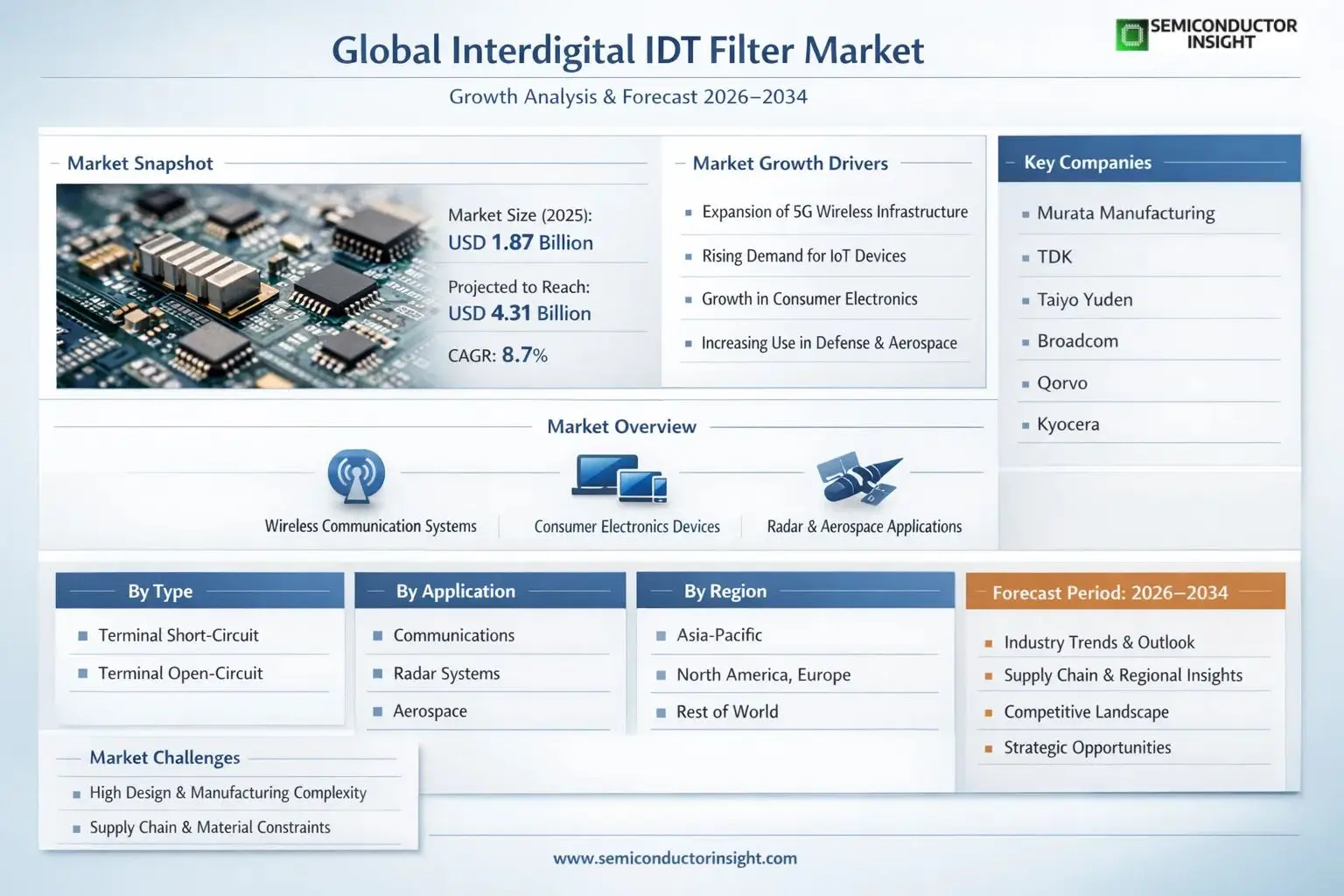
Global Interdigital IDT Filter market size was valued at USD 1.87 billion in 2025. The market is projected to grow from USD 2.04 billion in 2026 to USD 4.31 billion by 2034, exhibiting a CAGR of 8.7% during the forecast period.
Interdigital IDT filters are precision electronic components that utilize interdigital transducers (IDTs) as their core functional elements. These filters are fabricated by depositing a metallic thin film onto a piezoelectric substrate, followed by photolithographic patterning to form a series of interlocking electrode fingers. When an alternating electric field is applied across these electrodes, surface acoustic waves (SAWs) are generated via the inverse piezoelectric effect, enabling highly selective signal frequency filtering. The product types encompass Terminal Short-circuit and Terminal Open-circuit configurations, each serving distinct performance and application requirements.
The market is experiencing robust growth driven by the accelerating global rollout of 5G telecommunications infrastructure, rising complexity of RF front-end architectures, and expanding adoption of IoT-connected devices across consumer and industrial segments. Interdigital IDT filters are critically deployed in wireless communication systems including mobile handsets, base stations, radar systems, and aerospace electronics, where precise frequency selectivity is paramount. The increasing number of frequency bands demanded by next-generation communication standards continues to intensify the need for advanced filtering solutions. Leading market participants such as Murata Manufacturing, TDK, Taiyo Yuden, Broadcom, and Qorvo maintain dominant positions through continuous product innovation and strategic capacity expansions to meet rising global demand.
MARKET DRIVERS
Rising Demand for Advanced Wireless Communication Technologies
Interdigital IDT Filter market is experiencing significant growth momentum, primarily driven by the rapid global expansion of wireless communication infrastructure. As 5G networks continue their rollout across North America, Europe, and Asia-Pacific, the need for high-performance interdigital interdigital transducer (IDT) filters capable of managing complex frequency bands has intensified considerably. These filters are essential components in base stations, small cells, and user equipment, where precise signal filtering directly impacts network quality and reliability. The growing density of connected devices and the proliferation of the Internet of Things (IoT) ecosystem are compelling telecom operators and OEMs to invest in superior filtering solutions that reduce interference and signal loss.
Expansion of Consumer Electronics and Defense Applications
Beyond telecommunications, Interdigital IDT Filter market is benefiting from surging demand within the consumer electronics and defense sectors. Smartphones, tablets, wearables, and smart home devices increasingly rely on IDT-based surface acoustic wave (SAW) and bulk acoustic wave (BAW) filter technologies to manage multi-band, multi-mode RF front-end architectures. Simultaneously, defense and aerospace applications are driving demand for ruggedized, high-frequency IDT filters capable of withstanding extreme operating conditions. Military radar systems, electronic warfare platforms, and satellite communication equipment require highly specialized interdigital filter configurations, creating a stable and premium-value demand segment for market participants.
➤ The convergence of 5G infrastructure deployment and consumer electronics miniaturization trends is positioning Interdigital IDT Filter market as a critical enabler of next-generation wireless ecosystems, with filter complexity and performance requirements continuing to escalate across all application verticals.
Technological advancements in filter design and fabrication, including improvements in lithographic precision and piezoelectric material quality, have significantly expanded the operational frequency range and insertion loss performance of interdigital IDT filters. These innovations enable manufacturers to develop filters that meet the increasingly stringent requirements of modern RF systems, further stimulating market adoption. Enhanced temperature stability and reduced size profiles are also driving integration of IDT filters into compact, multi-functional RF modules, broadening their applicability across high-growth end markets.
MARKET CHALLENGES
Technical Complexity and Stringent Performance Requirements
One of the foremost challenges confronting Interdigital IDT Filter market is the escalating technical complexity involved in designing filters that can reliably operate across an expanding array of frequency bands while meeting increasingly demanding performance specifications. As wireless standards evolve and spectrum allocations become more fragmented, IDT filter designs must accommodate tighter bandwidth tolerances, lower insertion loss, and higher out-of-band rejection , often simultaneously. This places considerable pressure on R&D teams and manufacturing processes, requiring sustained investment in advanced simulation tools, materials science research, and precision fabrication capabilities. Smaller manufacturers in particular may struggle to keep pace with the rate of technical advancement demanded by leading OEM customers.
Other Challenges
Supply Chain Vulnerabilities
Interdigital IDT Filter market faces notable exposure to supply chain disruptions, particularly regarding the availability of high-purity piezoelectric substrates such as lithium niobate and lithium tantalate. Geopolitical tensions and regional production concentrations have periodically created raw material shortages, leading to delivery delays and cost pressures across the value chain. Manufacturers are increasingly compelled to diversify their supplier base and maintain higher safety stock levels, which can strain working capital and operational efficiency.
Intense Price Competition and Margin Pressure
Market participants in Interdigital IDT Filter market are navigating an environment of persistent price competition, driven by the commoditization of standard filter product lines and the negotiating leverage of large-volume electronics manufacturers. This dynamic compresses profit margins and challenges companies to continuously reduce production costs through process optimization and economies of scale while simultaneously investing in next-generation product development to maintain competitive differentiation.
MARKET RESTRAINTS
High Capital Investment Requirements and Barriers to Entry
Interdigital IDT Filter market is characterized by substantial capital intensity, as the fabrication of high-performance IDT filters demands state-of-the-art cleanroom facilities, advanced photolithography equipment, and rigorous quality control infrastructure. Establishing competitive manufacturing capacity requires significant upfront investment that creates formidable barriers to entry for new market participants. Existing players must also commit to ongoing capital expenditure to upgrade production lines in response to evolving filter design requirements and tightening performance specifications demanded by end-use industries.
Technological Substitution Risk from Emerging Filter Architectures
A meaningful restraint on Interdigital IDT Filter market’s growth trajectory is the ongoing development and adoption of alternative filtering technologies that may partially substitute for traditional interdigital IDT filter designs in certain application segments. Advanced BAW resonator technologies, thin-film bulk acoustic resonators (FBARs), and emerging RF MEMS-based filter solutions are demonstrating competitive performance characteristics at higher frequency ranges, attracting design wins in premium smartphone and millimeter-wave applications. While interdigital IDT filters retain strong advantages in specific frequency ranges and application contexts, the competitive pressure from these alternative technologies may constrain addressable market expansion in select high-growth segments over the medium term.
MARKET OPPORTUNITIES
5G and Next-Generation Network Infrastructure Deployment
The accelerating global deployment of 5G network infrastructure represents one of the most substantial near-to-medium term growth opportunities for Interdigital IDT Filter market. As mobile network operators expand 5G coverage from urban centers to suburban and rural areas, the volume of required RF filtering components is projected to grow substantially, encompassing both macro base stations and the dense small-cell networks that underpin high-capacity 5G architectures. IDT filter manufacturers with established capabilities in sub-6 GHz and mid-band frequency filtering are particularly well-positioned to capture this demand wave, as these frequency ranges remain central to broad-coverage 5G deployments globally.
Automotive Connectivity and Vehicle-to-Everything (V2X) Communication
The rapid evolution of connected and autonomous vehicle technologies is opening a compelling new application frontier for Interdigital IDT Filter market. Modern vehicles are incorporating an increasing number of wireless communication systems, including cellular-V2X, dedicated short-range communications (DSRC), satellite navigation, and advanced driver assistance system (ADAS) radar, all of which require reliable, high-performance RF filtering components. The automotive sector’s stringent reliability and longevity requirements create an opportunity for IDT filter manufacturers to develop specialized, automotive-grade product lines that command premium pricing and foster long-term customer relationships, diversifying revenue streams beyond the traditional consumer electronics and telecommunications segments.
Industrial IoT and Smart Infrastructure Expansion
The proliferation of Industrial IoT applications across manufacturing, energy, logistics, and smart city infrastructure is generating growing demand for robust wireless connectivity solutions, creating an incremental opportunity for Interdigital IDT Filter market. Industrial wireless systems operating across licensed and unlicensed spectrum bands require filtering components that deliver consistent performance in electrically noisy environments, making high-quality IDT filters an attractive solution. As digital transformation initiatives accelerate across industrial verticals globally, the cumulative volume of IoT-connected endpoints is expected to grow substantially, translating into sustained and diversified demand for interdigital IDT filter components across a broadening range of operating frequencies and environmental conditions.
Interdigital IDT Filter Market Trends
Rising Demand from 5G and Next-Generation Wireless Communication Infrastructure
Interdigital IDT Filter market is experiencing a significant upswing driven primarily by the accelerating global rollout of 5G networks. As wireless communication systems transition to higher frequency bands and more complex signal environments, the need for precise, high-performance surface acoustic wave (SAW)-based filtering solutions has become increasingly critical. Interdigital IDT filters, which leverage the piezoelectric properties of substrates to generate and filter surface acoustic waves through interdigital transducer (IDT) configurations, are uniquely positioned to address these demands. Mobile handsets, base stations, and fixed wireless access equipment all require advanced RF front-end filtering to manage signal interference across densely packed frequency spectrums. The ongoing expansion of 5G infrastructure across North America, Europe, and Asia-Pacific continues to serve as one of the most prominent demand accelerators in Interdigital IDT Filter market.
Other Trends
Integration with IoT Ecosystems
The rapid proliferation of Internet of Things (IoT) devices across industrial, consumer, and smart city applications is creating sustained demand for compact, energy-efficient RF filtering components. Interdigital IDT filters are increasingly being integrated into IoT modules due to their small form factor, low insertion loss, and reliable frequency selectivity. As billions of connected devices are projected to be deployed globally over the coming years, manufacturers of Interdigital IDT filters are scaling production and innovating in miniaturization to meet the performance requirements of low-power, always-connected IoT architectures.
Aerospace and Defense Applications Expanding Market Scope
Beyond commercial communications, Interdigital IDT Filter market is witnessing growing adoption in radar systems and aerospace applications. Defense contractors and aerospace equipment manufacturers require filters capable of operating reliably across wide temperature ranges and harsh environmental conditions. IDT-based filters, owing to their robust piezoelectric construction and precise frequency control, are finding increased use in radar signal processing and secure military communication systems. This trend is broadening the application landscape of Interdigital IDT Filter market well beyond traditional consumer electronics.
Advancements in Piezoelectric Substrate Materials
Ongoing research and development in piezoelectric substrate materials, including lithium niobate and lithium tantalate, is enabling manufacturers to produce Interdigital IDT filters with improved temperature stability and higher operating frequencies. These material advancements are allowing the filters to meet increasingly stringent performance specifications required by modern communication standards, directly supporting the market’s technological evolution.
Asia-Pacific Emerging as a Key Manufacturing and Consumption Hub
Asia-Pacific, led by China, Japan, and South Korea, continues to dominate both the production and consumption of Interdigital IDT filters. Major market participants including Murata Manufacturing, TDK, Taiyo Yuden, and Kyocera maintain significant manufacturing operations across the region, benefiting from established semiconductor supply chains and strong domestic demand from consumer electronics and telecommunications sectors. The competitive landscape remains concentrated among these established players, while emerging companies from China, such as Maxscend and Chengdu Henglitai Technology, are intensifying regional competition through capacity expansion and product innovation, further shaping the trajectory of Global Interdigital IDT Filter market.
COMPETITIVE LANDSCAPE
Key Industry Players
Interdigital IDT Filter Market , Competitive Dynamics, Strategic Positioning, and Leading Manufacturer Profiles
Global Interdigital IDT Filter market is characterized by a moderately consolidated competitive environment, with a handful of dominant players commanding significant revenue and technology share. Murata Manufacturing stands as the undisputed market leader, leveraging its deep expertise in piezoelectric materials, surface acoustic wave (SAW) technology, and large-scale manufacturing capabilities to maintain a commanding position across key geographies including Asia-Pacific, North America, and Europe. The company’s continuous investment in R&D for 5G-compatible RF front-end solutions has reinforced its competitive moat. TDK and Taiyo Yuden closely follow, each offering a robust portfolio of IDT-based filters optimized for wireless communications, IoT devices, and base station infrastructure. Broadcom and Qorvo contribute significant technological depth, particularly in high-frequency band filter solutions tailored for advanced mobile communication standards. These tier-one players collectively account for the majority of global market revenue, benefiting from established supply chain relationships, economies of scale, and extensive intellectual property portfolios covering IDT design architectures and piezoelectric substrate innovations.
Beyond the leading multinationals, Interdigital IDT Filter market also features a growing cohort of specialized and regionally significant players that are intensifying competitive pressure. Maxscend and Microgate have emerged as notable Chinese manufacturers gaining traction in domestic and export markets, supported by increasing government focus on semiconductor self-sufficiency and RF component localization. TAI-SAW Technology, a Taiwan-based specialist, has carved a strong niche in cost-competitive SAW filter solutions for consumer electronics and communications applications. Kyocera brings its advanced ceramic and piezoelectric substrate expertise to deliver high-reliability IDT filters for aerospace and industrial use cases, while CTS Corporation addresses radar systems and defense-grade communication requirements. Shoulder Electronics and Chengdu Henglitai Technology represent emerging domestic Chinese competitors focused on serving the rapidly expanding 5G infrastructure and IoT device segments, reflecting the broader industry trend of geographic diversification in IDT filter manufacturing capacity. The competitive intensity across all tiers is expected to escalate as 5G deployment accelerates global demand for high-performance, multi-band RF filtering solutions.
List of Key Interdigital IDT Filter Companies Profiled
- Murata Manufacturing
- TDK
- Taiyo Yuden
- Broadcom
- Qorvo
- Maxscend
- Microgate
- TAI-SAW Technology
- Kyocera
- CTS Corporation
- Shoulder Electronics
- Chengdu Henglitai Technology
Segment Analysis:
| Segment Category | Sub-Segments | Key Insights |
| By Type |
|
Terminal Short-circuit filters represent the dominant configuration in Interdigital IDT Filter market, favored for their superior signal suppression characteristics and robust out-of-band rejection capabilities.
|
| By Application |
|
Communications stands as the leading application segment for Interdigital IDT Filters, driven by the explosive global expansion of wireless infrastructure and the proliferation of connected consumer devices.
|
| By End User |
|
Consumer Electronics Manufacturers constitute the dominant end-user category for Interdigital IDT Filters, reflecting the massive and continuously evolving global market for smartphones, tablets, wearables, and other connected personal devices.
|
| By Piezoelectric Substrate Material |
|
Lithium Niobate (LiNbO₃) is the leading substrate material in Interdigital IDT Filter market, prized for its exceptional electromechanical coupling coefficient and broad bandwidth performance characteristics that are highly compatible with modern wideband communication standards.
|
| By Frequency Band |
|
1 GHz – 3 GHz represents the leading frequency band segment in Interdigital IDT Filter market, encompassing the majority of legacy LTE and early 5G sub-6 GHz frequency allocations that continue to form the backbone of global mobile communication networks.
|
Regional Analysis: Interdigital IDT Filter Market
Asia-Pacific
Asia-Pacific’s rapid 5G infrastructure buildout is a primary catalyst for Interdigital IDT Filter Market growth. The region’s telecommunications operators are deploying next-generation networks at an accelerated pace, driving demand for precision RF filtering components. IDT filters play a critical role in managing signal interference and ensuring spectral efficiency across dense urban network environments throughout China, Japan, South Korea, and Southeast Asia.
The region’s unmatched concentration of consumer electronics manufacturers sustains high-volume consumption of IDT filter components. Smartphones, wearables, tablets, and smart appliances manufactured across Asia-Pacific require advanced filtering solutions to meet global RF performance standards. This positions Interdigital IDT Filter market favorably within the region’s electronics value chain, ensuring consistent demand from original equipment manufacturers and contract assembly facilities.
National policies across China, South Korea, and Japan are accelerating domestic semiconductor capability, directly benefiting Interdigital IDT Filter market. Investment in advanced wafer fabrication, piezoelectric material research, and acoustic resonator design is intensifying regional innovation. These initiatives reduce import dependency and cultivate a competitive local supply chain capable of serving both regional OEMs and global export markets with high-quality IDT filtering products.
The growing adoption of connected vehicles and IoT infrastructure across Asia-Pacific is expanding the addressable market for Interdigital IDT Filter solutions. Automotive electronics require IDT filters for reliable wireless communication, radar, and keyless entry systems, while IoT devices demand compact, low-power filtering components. Regional automotive and smart device manufacturers are increasingly specifying high-performance IDT filters to meet evolving connectivity and safety standards.
North America
North America represents a strategically significant region within Interdigital IDT Filter market, underpinned by its advanced telecommunications ecosystem, robust defense electronics sector, and high concentration of technology-driven end users. The United States, in particular, leads regional demand through its ongoing 5G network densification efforts, aerospace and defense procurement programs, and thriving consumer electronics market. IDT filters are integral to military-grade communication systems, radar applications, and secure wireless platforms that are prioritized in North American defense budgets. The presence of leading fabless semiconductor companies and RF technology innovators in the region fosters continuous advancement in filter design and miniaturization. Additionally, the automotive sector’s transition toward connected and autonomous vehicles is generating new demand streams for interdigital transducer components. Research institutions and universities in the United States and Canada actively contribute to acoustic wave technology development, supporting a pipeline of next-generation IDT filter solutions tailored to emerging frequency bands and performance requirements through the forecast horizon.
Europe
Europe maintains a steady and innovation-oriented position in Interdigital IDT Filter market, characterized by its strong industrial electronics base, automotive engineering leadership, and progressive regulatory frameworks supporting advanced wireless technologies. Germany, France, and the United Kingdom are among the primary contributors to regional demand, with Germany’s automotive sector being a notable driver of IDT filter adoption in vehicle communication and sensing systems. European telecommunications operators are progressively advancing 5G deployment timelines, creating incremental demand for precision RF filtering components. The region’s commitment to Industry 4.0 transformation and smart manufacturing is also expanding the industrial IoT segment, where IDT filters serve critical roles in machine-to-machine communication infrastructure. European research consortia and public-private partnerships continue to invest in next-generation acoustic wave research, positioning the region as a contributor to global IDT filter innovation rather than solely a consumption market, thereby strengthening its long-term competitive standing in Interdigital IDT Filter market.
South America
South America occupies an emerging yet progressively relevant position in Interdigital IDT Filter market, with Brazil serving as the primary engine of regional demand. The country’s expanding telecommunications infrastructure, growing smartphone penetration, and increasing adoption of wireless connectivity solutions are gradually stimulating consumption of IDT filter components. Government-sponsored digital inclusion programs and private sector investment in broadband network expansion are laying the groundwork for broader RF component demand across the region. While South America currently accounts for a modest share of Global Interdigital IDT Filter Market, its trajectory is constructive as urban connectivity projects, industrial automation initiatives, and consumer electronics distribution networks mature. Challenges related to import dependency, currency volatility, and limited local semiconductor manufacturing capacity temper the pace of growth, though long-term prospects remain encouraging as regional digital infrastructure investment continues to intensify through the forecast period to 2034.
Middle East & Africa
The Middle East and Africa region represents a nascent but strategically noteworthy segment of Interdigital IDT Filter market, with growth momentum rooted in expanding telecommunications infrastructure, smart city development, and increasing mobile broadband adoption. Gulf Cooperation Council nations, particularly the United Arab Emirates and Saudi Arabia, are investing heavily in 5G network deployment and digital transformation initiatives that are beginning to create meaningful demand for advanced RF filtering solutions including IDT components. Africa’s rapidly expanding mobile subscriber base and leapfrog adoption of wireless technologies present a longer-term opportunity for IDT filter market penetration as network operators upgrade infrastructure to support higher data throughput. The region’s defense and government communications sectors also contribute to selective procurement of high-performance interdigital filter solutions. While infrastructural and economic challenges remain, the Middle East and Africa’s digital ambitions are expected to gradually strengthen its participation in Global Interdigital IDT Filter Market landscape through 2034.
Report Scope
This market research report provides a comprehensive analysis of Interdigital IDT Filter market, covering the forecast period 2026–2034. It offers detailed insights into market dynamics, technological advancements, competitive landscape, and key trends shaping the industry.
Key focus areas of the report include:
- Market Overview: The report begins with an overview outlining its current market scenario, key growth indicators, and industry transformation drivers. It discusses macroeconomic factors, demand–supply balance, regulatory landscape, and the strategic role of interdigital IDT filters in powering advancements across industries such as wireless communications, telecommunications, consumer electronics, and aerospace.
- Market Size & Forecast: Historical data and future projections for revenue, unit shipments, and market value across major regions and segments.
- Segmentation Analysis: Detailed breakdown by product type, technology, application, and end-user industry to identify high-growth segments and investment opportunities.
- Regional Insights: Insights into market performance across North America, Europe, Asia-Pacific, Latin America, and the Middle East & Africa, including country-level analysis where relevant.
- Competitive Landscape: Profiles of leading market participants, including their product offerings, R&D focus, manufacturing capacity, pricing strategies, and recent developments such as mergers, acquisitions, and partnerships.
- Technology Trends & Innovation: Assessment of emerging technologies, integration of AI/IoT, semiconductor design trends, fabrication techniques, and evolving industry standards.
- Market Drivers & Restraints: Evaluation of factors driving market growth along with challenges, supply chain constraints, regulatory issues, and market-entry barriers.
- Stakeholder Insights: Insights for component suppliers, OEMs, system integrators, investors, and policymakers regarding the evolving ecosystem and strategic opportunities.
Primary and secondary research methods are employed, including interviews with industry experts, data from verified sources, and real-time market intelligence to ensure the accuracy and reliability of the insights presented.
FREQUENTLY ASKED QUESTIONS:
What is the current market size of Interdigital IDT Filter Market?
-> Global Interdigital IDT Filter Market was valued at USD 1.87 billion in 2025 and is expected to reachUSD 4.31 billion by 2034, growing at a CAGR of 8.7% during the forecast period 2025–2034.
Which key companies operate in Interdigital IDT Filter Market?
-> Key players include Murata Manufacturing, TDK, Taiyo Yuden, Broadcom, Qorvo, Maxscend, Microgate, TAI-SAW, Kyocera, CTS, Shoulder Electronics, and Chengdu Henglitai Technology, among others.
What are the key growth drivers?
-> Key growth drivers include rising demand for 5G wireless communications, increasing deployment of IoT devices, growing use of interdigital IDT filters in mobile phones and base stations, and the expansion of frequency bands requiring advanced signal filtering solutions.
Which region dominates the market?
-> Asia is a leading region in Interdigital IDT Filter market, with countries such as China, Japan, and South Korea playing a significant role, while North America and Europe also represent substantial market shares driven by advanced telecommunications infrastructure.
What are the emerging trends?
-> Emerging trends include increasing adoption of surface acoustic wave (SAW) filter technology, growing integration of interdigital IDT filters in 5G RF front-end modules, rising demand from radar systems and aerospace applications, and continuous miniaturization of piezoelectric substrate components.

Get Sample Report PDF for Exclusive Insights
Report Sample Includes
- Table of Contents
- List of Tables & Figures
- Charts, Research Methodology, and more...
 Download Sample Report PDF