
Intelligent Traffic Millimeter-Wave Radar Market Insights
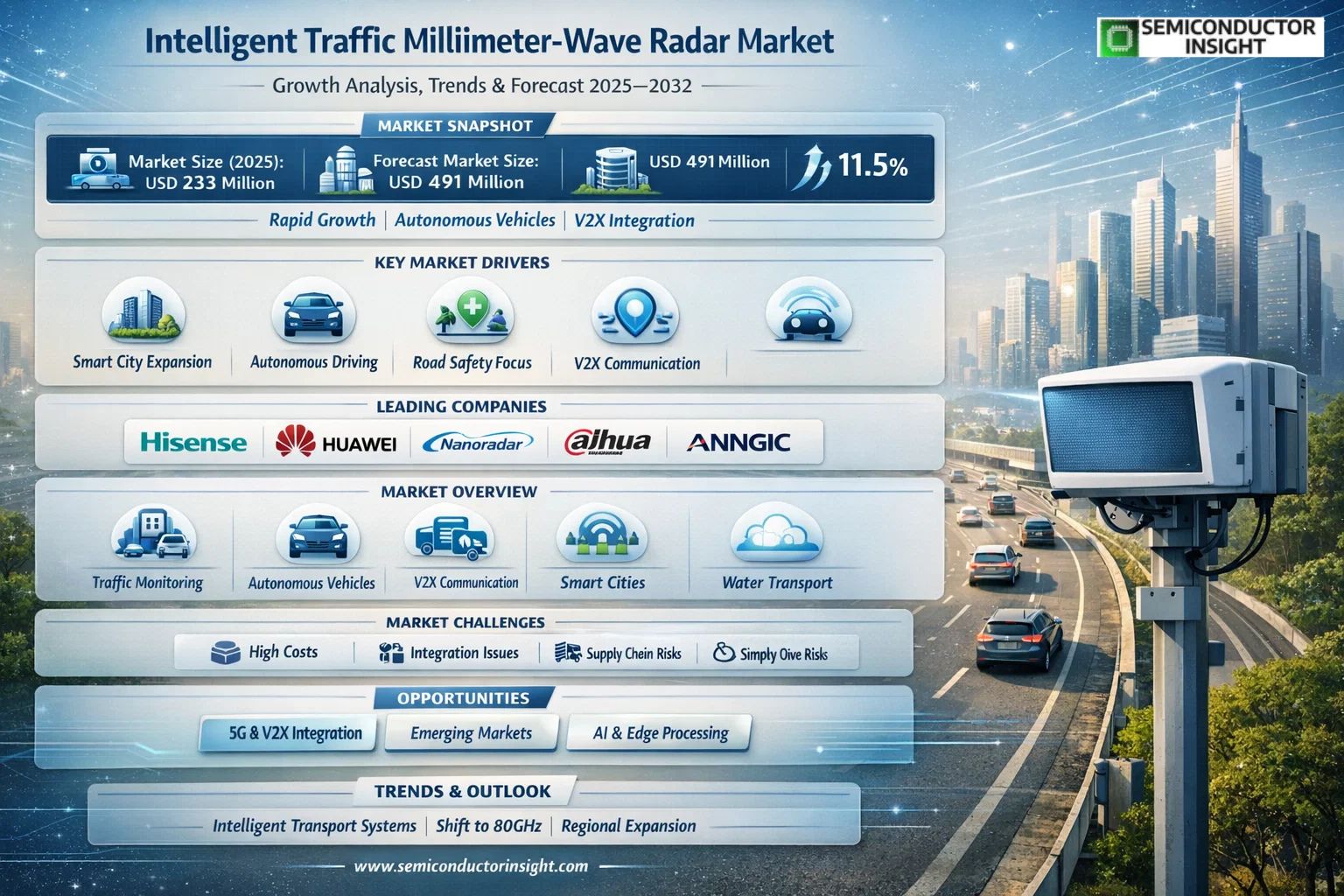
Global Intelligent Traffic Millimeter-Wave Radar market size was valued at USD 233 million in 2025. The market is projected to reach USD 491 million by 2032, exhibiting a CAGR of 11.5% during the forecast period.
Intelligent Traffic Millimeter-Wave Radar is a radar technology that operates in the millimeter-wave frequency band, widely used in intelligent transportation systems to detect and track vehicles, pedestrians, obstacles, and traffic conditions on the road. This radar works efficiently under various weather and lighting conditions, offering strong penetration and high precision in distance and speed measurements, making it widely applied in autonomous driving, vehicle-to-everything (V2X) communication, and intelligent traffic management.
The market is experiencing rapid growth due to several factors, including surging demand for smart city infrastructure, advancements in autonomous driving technologies, and increasing focus on road safety amid rising urbanization. Furthermore, integration with 5G networks and AI-driven analytics enhances real-time traffic monitoring capabilities, driving further adoption. Initiatives by key players continue to propel innovation and market expansion. Hisense Global, HUAWEI Technology, Nanoradar Science and Technology, Limradar, and Dahua Technology are some of the key players operating in the market with diverse product portfolios.
MARKET DRIVERS
Smart City Initiatives and Urbanization
The rapid expansion of smart city projects worldwide is a primary driver for Intelligent Traffic Millimeter-Wave Radar Market. With over 70% of the global population projected to live in urban areas by 2050, governments are investing heavily in traffic management systems to alleviate congestion. Millimeter-wave radars offer precise vehicle detection and speed measurement, enabling real-time data for adaptive traffic signals.
Integration with ADAS and Autonomous Vehicles
Advancements in advanced driver-assistance systems (ADAS) and the push toward Level 4 autonomy are fueling demand. These radars provide robust sensing in adverse weather, outperforming cameras and LiDAR in fog or rain, with detection ranges up to 200 meters. The market is expected to grow at a CAGR of 18% through 2030, driven by automotive OEMs adopting the technology.
➤ Regulatory mandates for traffic safety, such as Europe’s V2X standards, are accelerating deployment in highways and intersections.
Increasing road safety concerns, with over 1.3 million annual fatalities globally, underscore the need for reliable monitoring, positioning millimeter-wave solutions as essential for intelligent traffic ecosystems.
MARKET CHALLENGES
High Development and Deployment Costs
One major hurdle in Intelligent Traffic Millimeter-Wave Radar Market is the elevated cost of radar chips and system integration, often exceeding $500 per unit for high-resolution models. This limits adoption in cost-sensitive regions, where budget constraints delay large-scale infrastructure upgrades.
Other Challenges
Technical integration with existing traffic infrastructure poses difficulties, requiring extensive calibration for multi-sensor fusion. Signal interference in dense urban environments can reduce accuracy, necessitating advanced algorithms.
Supply Chain Vulnerabilities
Semiconductor shortages, exacerbated by geopolitical tensions, have increased lead times by 30%, impacting production scalability and market penetration.
MARKET RESTRAINTS
Regulatory and Standardization Barriers
Stringent regulatory approvals for radar frequency spectrum usage restrain growth in Intelligent Traffic Millimeter-Wave Radar Market. Varying standards across regions, such as FCC in the US versus ETSI in Europe, complicate global deployment and raise compliance costs by up to 20%.
Competition from alternative technologies like ultrasonic sensors and video analytics further limits market share, as they offer lower upfront costs despite inferior performance in poor visibility.
Environmental factors, including extreme temperatures affecting radar performance, add to reliability concerns, slowing adoption in harsh climates like deserts or arctic regions.
MARKET OPPORTUNITIES
5G and V2X Communication Synergies
The convergence of 5G networks and vehicle-to-everything (V2X) communication opens vast opportunities for Intelligent Traffic Millimeter-Wave Radar Market. Low-latency data sharing enhances traffic prediction models, with pilot projects in Asia showing 25% congestion reductions.Expansion into emerging markets like India and Brazil, where urban traffic is surging, promises growth. Government investments exceeding $10 billion in smart highways create demand for scalable radar solutions.Innovations in edge AI processing for radars will enable predictive analytics, positioning the market for a projected $2.5 billion valuation by 2028.
Intelligent Traffic Millimeter-Wave Radar Market Trends
Integration with Intelligent Transportation Systems
Intelligent Traffic Millimeter-Wave Radar Market is experiencing robust growth driven by its integration into intelligent transportation systems. These radars operate in the millimeter-wave frequency band, enabling precise detection and tracking of vehicles, pedestrians, obstacles, and traffic conditions. Their ability to function effectively under diverse weather and lighting scenarios, with strong penetration capabilities and high accuracy in measuring distance and speed, positions them as essential components. This trend is particularly evident in applications such as autonomous driving, vehicle-to-everything (V2X) communication, and advanced traffic management, where reliability across conditions enhances overall system performance and safety.
Other Trends
Shift Across Frequency Segments
Within Intelligent Traffic Millimeter-Wave Radar Market, a notable shift is occurring across product types, including 24GHz and 80GHz variants, alongside other frequencies. The 24GHz segment continues to dominate due to its cost-effectiveness and established deployment in various traffic monitoring scenarios, while 80GHz options gain traction for superior resolution in complex environments. This diversification allows manufacturers to address specific needs, such as short-range detection in congested areas or long-range monitoring on open roads, fostering innovation and broader market penetration.
Expansion by Application and Region
Application-wise, Intelligent Traffic Millimeter-Wave Radar Market sees accelerated expansion in urban transportation and highway systems, with emerging use in water transportation and other specialized areas. Urban deployments leverage the technology for real-time congestion management and pedestrian safety, while highways benefit from speed enforcement and incident detection. Regionally, Asia, particularly China, leads adoption, supported by strong infrastructure investments, followed by North America and Europe. Key players like HUAWEI Technology, Nanoradar Science and Technology, and Dahua Technology are intensifying R&D efforts, introducing enhancements in radar precision and integration, which propel competitive dynamics and sustain long-term market evolution.
COMPETITIVE LANDSCAPE
Key Industry Players
Leading Innovators in the Intelligent Traffic Millimeter-Wave Radar Sector
Intelligent Traffic Millimeter-Wave Radar Market features a competitive landscape dominated by established technology giants and specialized radar developers, with the global top five players collectively capturing a substantial revenue share in 2025. HUAWEI Technology stands out as a leading force, leveraging its expertise in 5G infrastructure and automotive electronics to pioneer high-resolution 24GHz and 80GHz radar systems for precise vehicle detection, pedestrian tracking, and V2X communications in urban transportation systems. Hisense Global complements this leadership with integrated solutions for intelligent traffic management, benefiting from strong supply chain capabilities amid a market valued at US$233 million in 2025 and projected to reach US$491 million by 2032 at an 11.5% CAGR. The market structure remains moderately concentrated, characterized by intense R&D investments in weather-resilient sensors that excel in adverse conditions, driving consolidation through strategic partnerships and technological differentiation.
Beyond the frontrunners, a cadre of niche players contributes to market dynamism by targeting specialized applications such as highway monitoring and obstacle avoidance. Nanoradar Science and Technology excels in compact, high-precision mmWave radars for real-time traffic analytics, while Dahua Technology integrates radar with video surveillance for comprehensive ITS deployments. Emerging innovators like Limradar, ANNGIC, and Microbrain Intelligent focus on cost-effective 80GHz solutions for water transportation and other segments, fostering competition and innovation. Hurys Intelligent Technology, AKASAKATEC, MUNIU TECHNOLOGY, LeiKe Defense Technology, and SONDIT further diversify the ecosystem with tailored offerings for regional demands, particularly in Asia-Pacific where China leads adoption. This blend of scale leaders and agile specialists ensures robust advancement in Intelligent Traffic Millimeter-Wave Radar technologies, addressing challenges like regulatory standards and supply chain volatility.
List of Key Intelligent Traffic Millimeter-Wave Radar Companies Profiled
- Hisense Global
- HUAWEI Technology
- Nanoradar Science and Technology
- Dahua Technology
- Limradar
- ANNGIC
- Microbrain Intelligent
- Hurys Intelligent Technology
- AKASAKATEC
- MUNIU TECHNOLOGY
- LeiKe Defense Technology
- SONDIT
Segment Analysis:
| Segment Category | Sub-Segments | Key Insights |
| By Type |
|
24GHz
|
| By Application |
|
Urban Transportation
|
| By End User |
|
Government Transportation Agencies
|
| By Deployment Type |
|
Roadside Fixed
|
| By Detection Range |
|
Short-range
|
Regional Analysis: Intelligent Traffic Millimeter-Wave Radar Market
Asia-Pacific
Asia-Pacific excels in smart city projects where millimeter-wave radars enable real-time traffic analytics. Deployments in bustling urban centers optimize signal timings and detect anomalies, enhancing commuter experiences. Collaborative public-private partnerships accelerate infrastructure upgrades, focusing on all-weather reliability to support 24/7 operations.
Automotive giants in the region embed Intelligent Traffic Millimeter-Wave Radar solutions in vehicles for advanced driver assistance. Emphasis on ADAS features like blind-spot monitoring drives market growth, with high production volumes ensuring cost-effective scalability and widespread consumer adoption.
Toll highways and expressways undergo retrofitting with radar technologies for precise flow management. This modernization reduces congestion hotspots, promoting sustainable transport while integrating with IoT networks for predictive maintenance and enhanced safety protocols.
Vibrant R&D hubs foster innovations in radar precision and multi-target tracking. Strategic alliances between startups and incumbents expedite commercialization, tailoring solutions to local needs and bolstering the region’s competitive edge in the global Intelligent Traffic Millimeter-Wave Radar Market.
North America
North America’s Intelligent Traffic Millimeter-Wave Radar Market thrives on technological innovation and stringent safety regulations. The U.S. leads with deployments on smart highways, where radars support automated enforcement and incident detection in varied weather. Canadian initiatives focus on winter-resilient systems for highways, integrating radars with traffic management centers for proactive congestion relief. Growing emphasis on connected vehicle pilots enhances V2I communication, improving response times to hazards. Industry leaders invest in high-resolution sensors, driving adoption in urban and suburban settings. While mature infrastructure provides a strong base, expansion into rural areas accelerates through federal grants, positioning the region as a hub for next-generation traffic solutions with a focus on data-driven optimizations.
Europe
Europe’s Intelligent Traffic Millimeter-Wave Radar Market benefits from unified EU directives on road safety and green mobility. Germany and France pioneer radar integrations in intelligent highways, emphasizing emission reductions via optimized traffic flows. The UK’s smart motorway programs utilize these radars for variable speed limits and live analytics, addressing post-Brexit infrastructure challenges. Scandinavia advances pedestrian-focused urban systems, leveraging radars for crosswalk safety. Collaborative research under Horizon programs spurs advancements in fusion technologies, blending radar with LiDAR. This region’s regulatory harmony and emphasis on sustainability fuel steady market maturation, with cross-border projects enhancing interoperability across diverse traffic ecosystems.
South America
In South America, Intelligent Traffic Millimeter-Wave Radar Market gains traction amid rising urbanization in Brazil and Mexico. Megacities deploy radars to combat gridlock, supporting adaptive signals and public transport prioritization. Government investments in smart corridors address informal traffic patterns, improving enforcement in high-density zones. Partnerships with international firms introduce robust, cost-sensitive solutions tailored to tropical climates. Challenges like infrastructure gaps spur innovative, modular deployments, fostering long-term resilience. The region’s focus on inclusive mobility positions it for accelerated growth as economic stability enhances tech affordability.
Middle East & Africa
The Middle East & Africa Intelligent Traffic Millimeter-Wave Radar Market emerges through visionary projects in the UAE and Saudi Arabia. Gulf nations integrate radars into futuristic cities for seamless traffic orchestration and event management. South Africa’s urban renewals employ them for crime-prone intersections, enhancing surveillance integration. Harsh desert conditions drive demand for durable, dust-resistant models. Pan-African initiatives promote regional standards, bridging tech divides. Ambitious visions like NEOM exemplify leadership potential, with oil revenues funding expansive smart infrastructure rollouts.
Report Scope
This market research report provides a comprehensive analysis of Intelligent Traffic Millimeter-Wave Radar Market, covering the forecast period 2025–2032. It offers detailed insights into market dynamics, technological advancements, competitive landscape, and key trends shaping the industry.
Key focus areas of the report include:
- Market Overview: The report begins with an overview outlining its current market scenario, key growth indicators, and industry transformation drivers. It discusses macroeconomic factors, demand–supply balance, regulatory landscape, and the strategic role of millimeter-wave radar in powering advancements across industries such as autonomous driving, V2X communication, intelligent transportation systems, and traffic management.
- Market Size & Forecast: Historical data and future projections for revenue, unit shipments, and market value across major regions and segments.
- Segmentation Analysis: Detailed breakdown by product type, technology, application, and end-user industry to identify high-growth segments and investment opportunities.
- Regional Insights: Insights into market performance across North America, Europe, Asia-Pacific, Latin America, and the Middle East & Africa, including country-level analysis where relevant.
- Competitive Landscape: Profiles of leading market participants, including their product offerings, R&D focus, manufacturing capacity, pricing strategies, and recent developments such as mergers, acquisitions, and partnerships.
- Technology Trends & Innovation: Assessment of emerging technologies, integration of AI/IoT, semiconductor design trends, fabrication techniques, and evolving industry standards.
- Market Drivers & Restraints: Evaluation of factors driving market growth along with challenges, supply chain constraints, regulatory issues, and market-entry barriers.
- Stakeholder Insights: Insights for component suppliers, OEMs, system integrators, investors, and policymakers regarding the evolving ecosystem and strategic opportunities.
Primary and secondary research methods are employed, including interviews with industry experts, data from verified sources, and real-time market intelligence to ensure the accuracy and reliability of the insights presented.
FREQUENTLY ASKED QUESTIONS:
What is the current market size of Intelligent Traffic Millimeter-Wave Radar Market?
-> Intelligent Traffic Millimeter-Wave Radar Market was valued at USD 233 million in 2025 and is expected to reach USD 491 million by 2032, at a CAGR of 11.5% during the forecast period.
Which key companies operate in Intelligent Traffic Millimeter-Wave Radar Market?
-> Key players include Hisense Global, HUAWEI Technology, Nanoradar Science and Technology, Limradar, Dahua Technology, and ANNGIC, among others.
What are the key growth drivers?
-> Key growth drivers include demand for autonomous driving, V2X communication, intelligent traffic management, and all-weather detection capabilities.
Which region dominates the market?
-> Asia dominates the market with significant contributions from China, while North America including the U.S. holds substantial share.
What are the emerging trends?
-> Emerging trends include high-precision millimeter-wave detection for vehicles and pedestrians, 24GHz and 77GHz/80GHz segment growth, and integration in urban and highway transportation.

Get Sample Report PDF for Exclusive Insights
Report Sample Includes
- Table of Contents
- List of Tables & Figures
- Charts, Research Methodology, and more...
 Download Sample Report PDF



