Integrated Driving-parking Domain Controller Market Insights
Global Integrated Driving-parking Domain Controller market size was valued at USD 8.06 million in 2025. The market is projected to reach USD 119 million by 2032, exhibiting a CAGR of 48.2% during the forecast period.
Integrated driving-parking domain controllers mark a pivotal shift in automotive electronics from distributed to centralized electrical architectures. Unlike conventional setups, these controllers unify driving and parking systems within a single domain unit. This approach maximizes reuse of sensors and hardware, slashing costs, elevating performance, and aligning with OEM priorities for efficiency gains. Moreover, it streamlines function development cycles, enabling breakthroughs toward higher-tier intelligent driving.
The market surges ahead, propelled by escalating demand for advanced driver assistance systems (ADAS), software-defined vehicles, and cost-optimized architectures. Advancements in computing power and sensor fusion further accelerate adoption. Key players like Bosch, Continental, Visteon, HUAWEI, Desay SV, Neusoft Reach, ECARX, Flex, and Aptiv drive innovation with robust portfolios. For instance, Huawei’s recent Qiankun intelligent driving solution integrates seamless navigation-on-autopilot and automated valet parking capabilities.
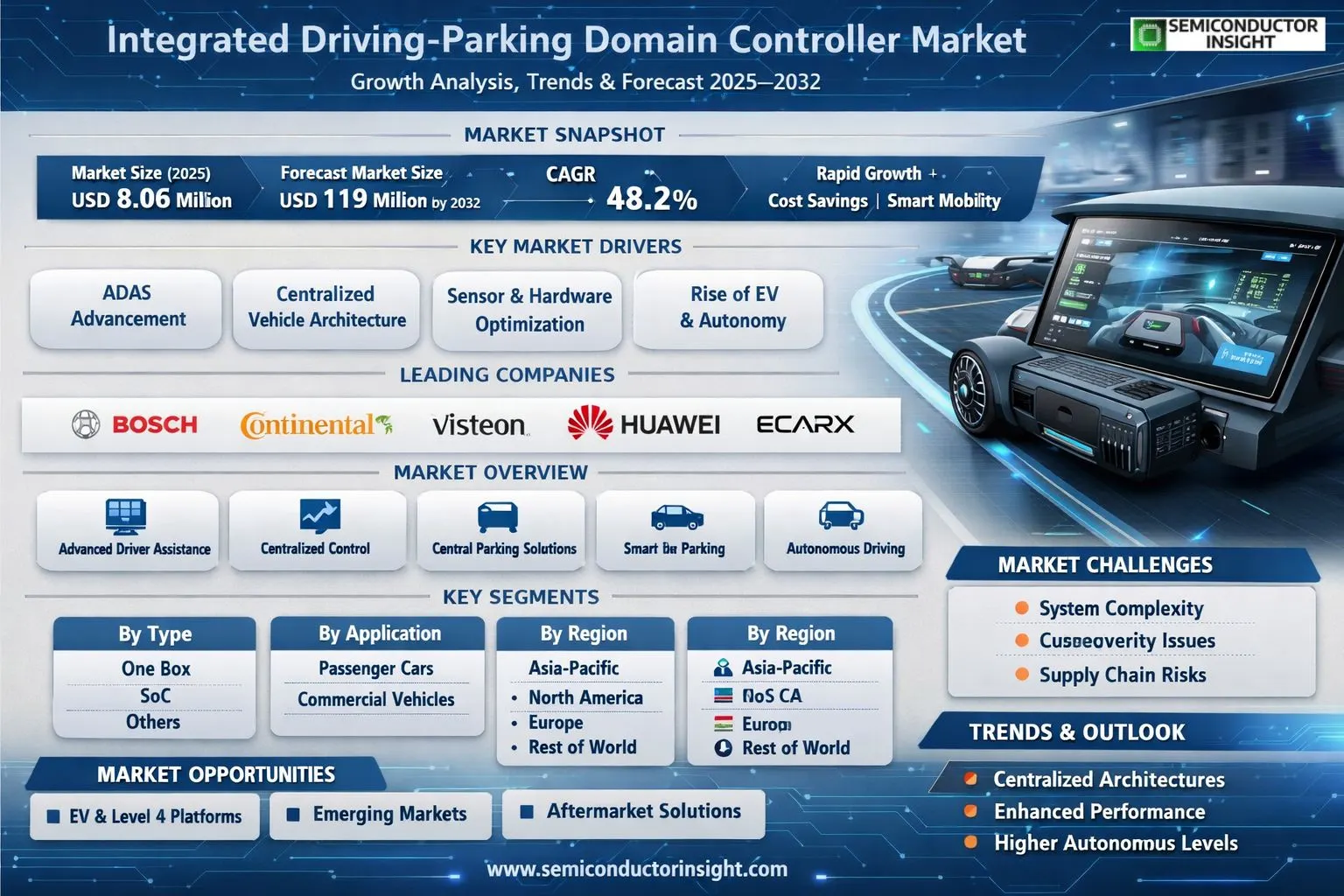
MARKET DRIVERS
Advancements in ADAS and Autonomous Driving
Integrated Driving-parking Domain Controller Market is propelled by the rapid evolution of advanced driver-assistance systems (ADAS), where integrated controllers consolidate driving and parking functions for enhanced vehicle intelligence. Automakers are increasingly adopting these systems to meet consumer demand for safer, more convenient mobility solutions, with global ADAS penetration expected to reach 65% in new vehicles by 2028.
Transition to Centralized Vehicle Architectures
This shift reduces wiring complexity and costs by up to 30%, enabling scalable domain control for electric vehicles (EVs). Major OEMs like Tesla and Volkswagen are leading with zonal architectures that incorporate driving-parking integration, driving market expansion.
➤ The market is forecasted to grow at a 22% CAGR through 2030, fueled by regulatory mandates for Level 2+ autonomy in Europe and China.
Furthermore, partnerships between semiconductor firms and Tier-1 suppliers are accelerating innovation, ensuring robust performance in real-world scenarios.
MARKET CHALLENGES
Complexity in System Integration
Integrating driving and parking domains into a single controller poses significant software-hardware synchronization issues, often leading to extended validation cycles that delay production timelines by 12-18 months for new platforms.
Other Challenges
Cybersecurity vulnerabilities remain a critical concern, with rising incidents of vehicle hacks prompting stricter standards from bodies like ISO/SAE 21434.
Supply Chain Disruptions
Semiconductor shortages, exacerbated by geopolitical tensions, have increased lead times for high-performance chips essential for domain controllers, impacting 25% of automotive production globally.Additionally, interoperability across diverse sensor suites from multiple vendors complicates deployment in heterogeneous fleets.
MARKET RESTRAINTS
High Initial Development and Certification Costs
Developing integrated driving-parking domain controllers demands substantial R&D investment, often exceeding $500 million per program, deterring smaller OEMs from adoption.Regulatory compliance for functional safety (ASIL-D levels) adds layers of testing, slowing market entry in conservative regions like North America.Legacy vehicle architectures further restrain retrofitting, limiting near-term volume growth to premium segments.Finally, dependency on advanced computing chips ties growth to supplier capacity, vulnerable to market fluctuations.
MARKET OPPORTUNITIES
Expansion in EV and Level 4 Autonomy Platforms
The surge in electric vehicle sales, projected to hit 40 million units annually by 2030, creates demand for efficient domain controllers that optimize energy use in driving-parking maneuvers.Emerging markets in Asia-Pacific offer untapped potential, with China’s NEV policies mandating integrated systems for urban parking automation.Aftermarket upgrades for existing fleets present retrofit opportunities, potentially capturing 15% market share through modular designs.Strategic alliances with tech giants like NVIDIA and Qualcomm can unlock AI-enhanced features, positioning leaders in Integrated Driving-parking Domain Controller Market for dominance.
Integrated Driving-parking Domain Controller Market Trends
Shift Toward Centralized Electrical Architecture
Integrated Driving-parking Domain Controller Market is witnessing a pivotal shift as automotive electronics transition from traditional distributed architectures to centralized domain control systems. This evolution integrates driving and parking functionalities into a single domain controller, enabling deeper reuse of sensors and hardware originally designed for these systems. Such integration addresses key demands from original equipment manufacturers (OEMs) seeking cost reductions and efficiency gains in vehicle production.
Other Trends
Enhanced Performance and Development Efficiency
By consolidating control units, Integrated Driving-parking Domain Controller Market facilitates significant performance improvements, allowing vehicles to meet advanced intelligent driving requirements. This setup not only optimizes hardware utilization but also accelerates iterative function development, paving the way for breakthroughs in higher-order autonomous driving capabilities. Industry surveys indicate that manufacturers are prioritizing these controllers to overcome barriers in scaling intelligent features across passenger and commercial vehicles.
Rising Prominence of Key Players and Regional Dynamics
Leading companies such as Bosch, Continental, Visteon, HUAWEI, Desay SV, Neusoft Reach, and ECARX dominate Integrated Driving-parking Domain Controller Market, driving innovation through product types like One Box and SoC solutions. North America, particularly the U.S., alongside Asia-Pacific regions including China and Japan, are focal points for adoption, fueled by demand in passenger cars and emerging commercial applications. This competitive landscape underscores trends toward strategic mergers, advanced R&D, and tailored solutions for regional market needs, ensuring sustained growth amid evolving industry challenges and policy influences.
COMPETITIVE LANDSCAPE
Key Industry Players
Global Leaders in Integrated Driving-Parking Domain Controllers
Integrated Driving-parking Domain Controller Market is characterized by a competitive landscape dominated by established automotive tier-1 suppliers and innovative technology firms transitioning from distributed to centralized electrical architectures. Leading players such as Bosch and Continental hold substantial market shares, leveraging their expertise in advanced driver assistance systems (ADAS) to deliver integrated solutions that enable deep hardware reuse of driving and parking sensors. This consolidation reduces costs for OEMs while enhancing performance and supporting higher-order intelligent driving capabilities. In 2025, the global top five players, including Visteon and HUAWEI alongside Bosch and Continental, accounted for a significant revenue portion, underscoring their pivotal role in a market projected to grow from US$8.06 million in 2025 to US$119 million by 2032 at a 48.2% CAGR.
Beyond the frontrunners, niche and regional players like Desay SV, Neusoft Reach, and ECARX are carving out strong positions, particularly in Asia-Pacific where demand for passenger and commercial vehicle applications surges. These companies focus on specialized offerings such as One Box and SoC architectures, fostering rapid function iteration and addressing OEM needs for cost efficiency and scalability. Other significant contributors, including Flex, Aptiv, and Beijing Jingwei Hirain Technologies, contribute to a dynamic ecosystem marked by mergers, acquisitions, and technological advancements, enabling the industry to overcome barriers to advanced autonomous driving amid evolving regional demands in North America, Europe, and Asia.
List of Key Integrated Driving-parking Domain Controller Companies Profiled
- Bosch
- Continental
- Visteon
- HUAWEI
- Desay SV
- Neusoft Reach
- ECARX
- Flex
- Aptiv
- Beijing Jingwei Hirain Technologies
- iMotion Automotive Technology
- Zhejiang Dahua Technology
Segment Analysis:
| Segment Category | Sub-Segments | Key Insights |
| By Type |
|
One Box
|
| By Application |
|
Passenger Cars
|
| By End User |
|
OEMs
|
| By Autonomy Level |
|
Level 2+
|
| By Powertrain Type |
|
Electric Vehicles
|
Regional Analysis: Integrated Driving-parking Domain Controller Market
Asia-Pacific
Surging EV production and ADAS mandates fuel demand for integrated controllers. Urbanization heightens need for efficient parking automation, with OEMs prioritizing compact, high-performance solutions. Investments in 5G and V2X communication enhance real-time decision-making capabilities.
Localized semiconductor fabrication and tier-one supplier clusters reduce lead times and costs. Proximity to battery and sensor manufacturers streamlines integration, giving regional players a competitive edge in scaling domain controller deployments.
R&D centers in Shenzhen and Tokyo lead advancements in multi-domain computing, merging parking precision with highway autonomy. Partnerships with global tech giants accelerate software-defined vehicle architectures.
Intense competition and cybersecurity concerns necessitate robust standards. Navigating diverse regulatory landscapes across countries demands adaptive strategies, yet fosters resilience in market offerings.
North America
North America exhibits robust growth in Integrated Driving-parking Domain Controller Market, anchored by pioneering tech ecosystems in the US and Canada. Leading OEMs and startups collaborate on sophisticated domain controllers, emphasizing software scalability for Level 3+ autonomy. Consumer preference for premium features like remote parking boosts premium segment uptake. Venture capital inflows support cutting-edge sensor integration and over-the-air updates, while stringent safety regulations drive quality enhancements. Supply chain diversification efforts mitigate risks, positioning the region for steady expansion amid evolving smart city initiatives.
Europe
Europe advances steadily in Integrated Driving-parking Domain Controller Market, with Germany, France, and Sweden at the helm. Premium automakers integrate domain controllers for enhanced ADAS and parking autonomy, aligning with EU emissions and connectivity mandates. Collaborative projects under Horizon Europe fund innovations in edge computing and V2X protocols. Focus on sustainable mobility encourages electrified platforms, where integrated controllers optimize energy use. Trade dynamics and skilled workforce sustain competitiveness, though harmonizing cross-border standards remains key to broader adoption.
South America
South America emerges as a burgeoning arena in Integrated Driving-parking Domain Controller Market, led by Brazil and Mexico’s automotive hubs. Rising middle-class demand spurs affordable ADAS solutions with parking aids tailored to urban congestion. Local assembly plants adapt global technologies, supported by trade agreements. Investments in infrastructure modernization pave the way for connected vehicles, while partnerships with Asian suppliers accelerate technology transfer. Economic volatility poses hurdles, but growing vehicle parc signals promising trajectories.
Middle East & Africa
Middle East & Africa show nascent yet accelerating potential in Integrated Driving-parking Domain Controller Market, driven by Gulf states’ visionary smart city projects and South Africa’s manufacturing base. Oil-rich nations diversify into high-tech automotive sectors, importing advanced controllers for luxury fleets. Focus on autonomous shuttles for harsh climates spurs specialized developments. Infrastructure gaps challenge scalability, but public-private partnerships and foreign investments bridge divides, unlocking opportunities in urban mobility solutions.
Report Scope
This market research report provides a comprehensive analysis of Integrated Driving-parking Domain Controller Market, covering the forecast period 2025–2032. It offers detailed insights into market dynamics, technological advancements, competitive landscape, and key trends shaping the industry.
Key focus areas of the report include:
- Market Overview: The report begins with an overview outlining its current market scenario, key growth indicators, and industry transformation drivers. It discusses macroeconomic factors, demand–supply balance, regulatory landscape, and the strategic role of domain controllers in powering advancements across industries such as automotive, intelligent driving, and advanced driver assistance systems.
- Market Size & Forecast: Historical data and future projections for revenue, unit shipments, and market value across major regions and segments.
- Segmentation Analysis: Detailed breakdown by product type, technology, application, and end-user industry to identify high-growth segments and investment opportunities.
- Regional Insights: Insights into market performance across North America, Europe, Asia-Pacific, Latin America, and the Middle East & Africa, including country-level analysis where relevant.
- Competitive Landscape: Profiles of leading market participants, including their product offerings, R&D focus, manufacturing capacity, pricing strategies, and recent developments such as mergers, acquisitions, and partnerships.
- Technology Trends & Innovation: Assessment of emerging technologies, integration of AI/IoT, semiconductor design trends, fabrication techniques, and evolving industry standards.
- Market Drivers & Restraints: Evaluation of factors driving market growth along with challenges, supply chain constraints, regulatory issues, and market-entry barriers.
- Stakeholder Insights: Insights for component suppliers, OEMs, system integrators, investors, and policymakers regarding the evolving ecosystem and strategic opportunities.
Primary and secondary research methods are employed, including interviews with industry experts, data from verified sources, and real-time market intelligence to ensure the accuracy and reliability of the insights presented.
FREQUENTLY ASKED QUESTIONS:
What is the current market size of Integrated Driving-parking Domain Controller Market?
-> Integrated Driving-parking Domain Controller Market was valued at USD 8.06 million in 2025 and is expected to reach USD 119 million by 2032, at a CAGR of 48.2% during the forecast period.
Which key companies operate in Integrated Driving-parking Domain Controller Market?
-> Key players include Bosch, Continental, Visteon, HUAWEI, Desay SV, Neusoft Reach, ECARX, Flex, Aptiv, Beijing Jingwei Hirain Technologies, among others.
What are the key growth drivers?
-> Key growth drivers include evolution from distributed to centralized electrical architecture, integration of driving and parking systems, hardware cost savings, performance improvements, and enabling higher levels of intelligent driving.
Which region dominates the market?
-> Asia is the fastest-growing region, while China holds significant market potential.
What are the emerging trends?
-> Emerging trends include deep reuse of sensors and hardware, improved function iteration efficiency, and breaking barriers to higher-order autonomous driving.

Get Sample Report PDF for Exclusive Insights
Report Sample Includes
- Table of Contents
- List of Tables & Figures
- Charts, Research Methodology, and more...
 Download Sample Report PDF