MARKET INSIGHTS
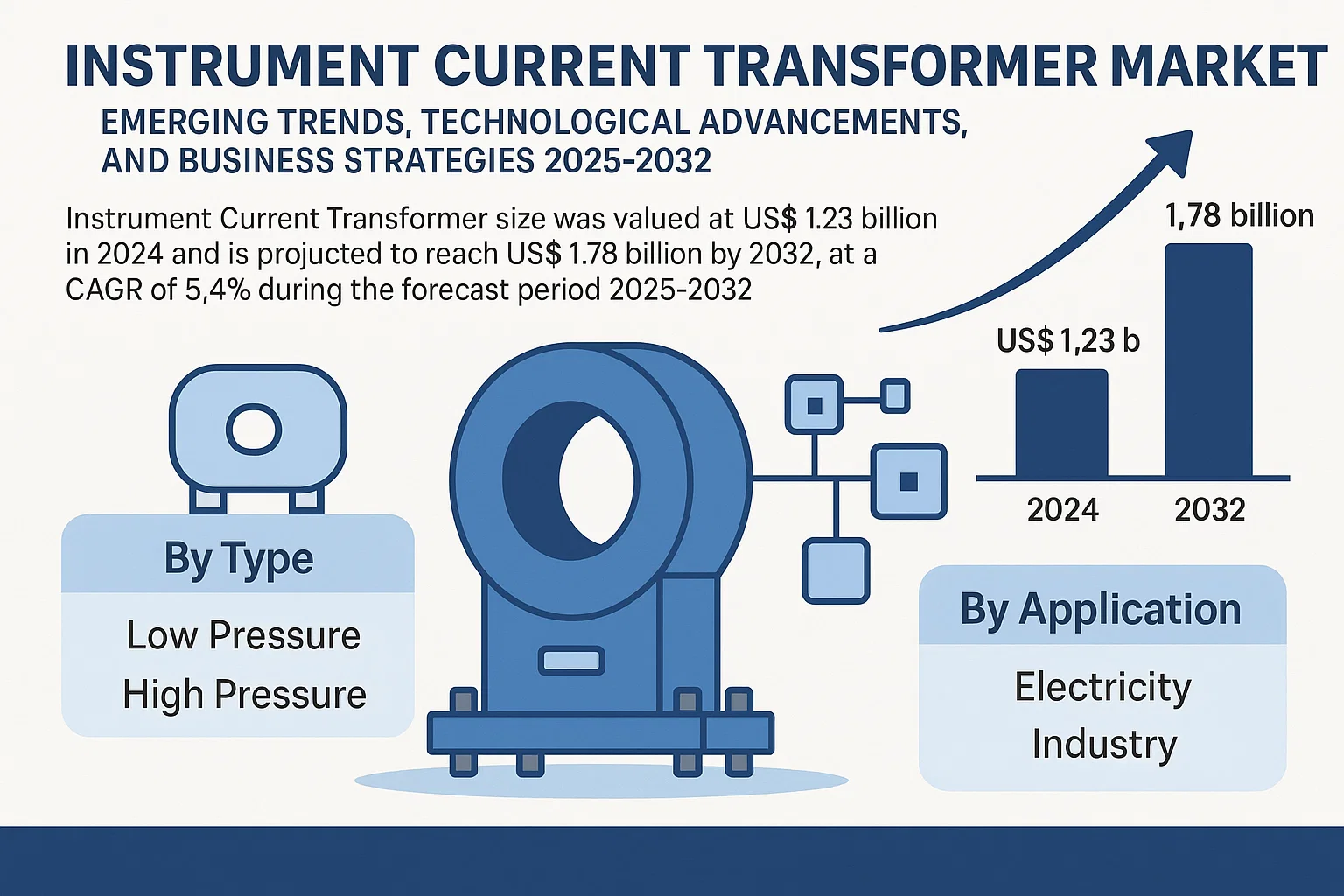
Global Instrument Current Transformer size was valued at US$ 1.23 billion in 2024 and is projected to reach US$ 1.78 billion by 2032, at a CAGR of 5.4% during the forecast period 2025-2032. The U.S. market accounted for 25% of global revenue share in 2024, while China is expected to witness the fastest growth with a projected CAGR of 6.8% through 2032.
Instrument Current Transformers (ICTs) are precision measurement devices that scale down high alternating currents to standardized, measurable levels while maintaining phase relationship accuracy. These critical components are essential for energy monitoring, protection relaying, and power quality analysis in electrical systems. The product range includes both low pressure (below 1kV) and high pressure (above 1kV) variants, with applications spanning utilities, industrial plants, and commercial facilities.
The market growth is primarily driven by increasing investments in smart grid infrastructure and renewable energy integration, which require advanced current measurement solutions. However, supply chain constraints for precision magnetic materials present ongoing challenges. Key industry players like TE Connectivity and Littelfuse are expanding their product portfolios with IoT-enabled transformers, while Asian manufacturers are gaining market share through competitive pricing strategies. The recent introduction of compact, high-accuracy Rogowski coil designs by companies such as HIOKI represents a significant technological advancement in this space.
MARKET DYNAMICS
MARKET DRIVERS
Rising Demand for Energy Efficiency and Grid Modernization Accelerates Market Growth
The global push toward energy efficiency and smart grid modernization is a primary driver for the instrument current transformer market. As nations worldwide invest in upgrading aging power infrastructure, the demand for precise current measurement solutions has surged. Instrument current transformers play a pivotal role in monitoring and protecting electrical systems, ensuring optimal performance while reducing energy losses. Recent data indicates that smart grid investments across North America and Europe have grown by approximately 18% annually, directly fueling demand for these critical components.
Expansion of Renewable Energy Infrastructure Creates Sustained Demand
The rapid growth of renewable energy projects significantly contributes to market expansion. Solar and wind farms require highly accurate current measurement solutions to integrate smoothly with existing grids. With global renewable energy capacity projected to increase by over 60% within the next five years, instrument current transformers are becoming indispensable for voltage regulation and power quality management. This trend is particularly evident in Asia-Pacific markets, where countries are aggressively expanding their clean energy portfolios.
Industrial Automation Boom Drives Precision Measurement Needs
Industrial automation advancements are creating substantial opportunities for instrument current transformer manufacturers. Modern manufacturing facilities increasingly rely on precise current monitoring for equipment protection and process optimization. The industrial IoT revolution has elevated requirements for measurement accuracy, with many facilities now demanding error rates below 0.5%. This shift is particularly evident in the automotive and electronics manufacturing sectors, where production lines require real-time monitoring for quality control and energy management.
MARKET RESTRAINTS
High Initial Costs and Complex Installation Limit Market Penetration
While instrument current transformers offer significant benefits, their high initial costs and installation complexity present notable barriers to adoption. Advanced models with high accuracy ratings can cost several times more than conventional transformers, making them prohibitive for smaller utilities and industrial facilities. Additionally, retrofitting existing systems often requires specialized expertise and downtime, factors that deter many potential customers from upgrading their current measurement infrastructure.
Other Restraints
Technological Compatibility Issues
Many older electrical systems cannot readily accommodate modern instrument current transformers without costly modifications. This compatibility challenge slows adoption rates, particularly in regions with aging infrastructure where the need for upgrades is most acute.
Supply Chain Vulnerabilities
The market faces ongoing challenges from global supply chain disruptions affecting critical raw materials like silicon steel and specialty alloys. These materials shortages have led to extended lead times and price volatility, negatively impacting manufacturers’ ability to meet growing demand.
MARKET CHALLENGES
Intense Price Competition Squeezes Profit Margins
The instrument current transformer market faces significant pricing pressures as new competitors enter the space, particularly from emerging economies. This competitive landscape has compressed profit margins, forcing established players to either reduce costs or differentiate through value-added features. While this benefits end-users through lower prices, it strains manufacturers’ ability to fund research and development for next-generation products.
Other Challenges
Rapid Technological Obsolescence
The fast pace of technological advancement in measurement systems means products can become outdated quickly. Manufacturers must continuously innovate to stay relevant, requiring substantial ongoing R&D investments that may not yield immediate returns.
Regulatory Fragmentation
Varying international standards and certification requirements complicate global market expansion. Companies must navigate differing compliance frameworks across regions, increasing both development costs and time-to-market for new products.
MARKET OPPORTUNITIES
Digital Transformation of Power Systems Opens New Applications
The ongoing digital transformation of power distribution networks presents significant growth opportunities. Smart grids demand instrument current transformers with advanced communication capabilities, creating a new market segment for digital and IoT-enabled devices. Industry projections suggest the market for smart grid-compatible current transformers could grow at nearly double the rate of conventional products over the next five years.
Emerging Economies Offer Untapped Potential
Developing nations undergoing rapid industrialization represent substantial untapped markets. As these countries expand their electrical infrastructure to support economic growth, demand for reliable current measurement solutions will increase exponentially. Strategic market entry and localized product development could yield significant returns for companies able to navigate these complex but rewarding markets.
Innovation in Composite Materials Enhances Performance
Breakthroughs in composite materials and manufacturing techniques are enabling next-generation instrument current transformers with superior performance characteristics. These innovations allow for lighter, more compact designs with improved accuracy and temperature stability, creating opportunities to penetrate new application areas such as electric vehicle charging infrastructure and aerospace power systems.
INSTRUMENT CURRENT TRANSFORMER MARKET TRENDS
Rising Demand for Smart Grid Infrastructure Driving Market Growth
The global transition toward smart grid infrastructure is significantly boosting the instrument current transformer market. As utility providers worldwide invest in grid modernization, the need for precise current measurement and protection devices has surged. By 2032, the market is projected to reach US$ million, growing at a CAGR of % from 2024. Governments across North America and Asia-Pacific are allocating substantial budgets for smart meter installations, with the U.S. market alone estimated at $ million in 2024. This shift toward digital energy monitoring creates robust demand for high-accuracy current transformers that can integrate with IoT-enabled power systems.
Other Trends
Renewable Energy Integration
The rapid expansion of renewable energy projects is reshaping transformer requirements. Solar farms and wind turbines increasingly demand instrument current transformers capable of handling variable loads and harmonic distortions. China’s push toward $ million in renewable investments by 2032 illustrates this trend, requiring specialized transformers for grid interconnection. Manufacturers are responding with products featuring wider dynamic ranges and improved phase accuracy to accommodate renewable energy’s fluctuating nature while maintaining measurement precision below 0.2% error.
Technological Advancements in Core Materials
Innovations in nanocrystalline and amorphous core materials are transforming transformer efficiency. These advanced materials reduce core losses by up to 80% compared to traditional silicon steel, enabling compact designs with higher accuracy classes. Leading manufacturers like TE Connectivity and VAC are patenting new core geometries that optimize magnetic flux distribution. The low pressure segment, projected to reach $ million by 2032, benefits particularly from these advancements as they allow for lighter, more cost-effective solutions in commercial power distribution networks.
COMPETITIVE LANDSCAPE
Key Industry Players
Technological Innovation Drives Market Competition in Current Transformer Segment
The global instrument current transformer market features a moderately fragmented competitive landscape, with major players holding approximately 35-40% of the total market share as of 2024. TE Connectivity and HIOKI have emerged as dominant players, leveraging their extensive product portfolios and strong distribution networks across North America and Asia-Pacific regions. TE Connectivity recently expanded its low-pressure current transformer line, capturing nearly 18% of segment revenue.
Littelfuse and Accuenergy have gained significant traction in the industrial applications sector, particularly in smart grid implementations. Littelfuse reported a 12% year-over-year growth in current transformer sales in 2024, driven by increased demand for precision measurement solutions in renewable energy projects.
Market consolidation continues as mid-sized players pursue strategic acquisitions. For instance, Electromagnetic Industries LLP acquired two regional manufacturers in 2023 to strengthen its European market position. Simultaneously, Japanese firm HIOKI invested heavily in R&D for high-accuracy current sensors, launching three new models in Q1 2024.
Emerging competitors like YUANXING ELECTRONICS are disrupting traditional pricing models with cost-effective solutions, particularly in Southeast Asian markets. However, established manufacturers counter this through value-added services including calibration certifications and extended warranties.
List of Leading Instrument Current Transformer Manufacturers
- TE Connectivity (Switzerland)
- HIOKI (Japan)
- Falco Construction (Italy)
- ELECTROHMS (India)
- Accuenergy (Canada)
- IME Spa (Italy)
- Littelfuse (U.S.)
- YUANXING ELECTRONICS CO.,LTD. (China)
- VAC (Germany)
- Electromagnetic Industries LLP (India)
- Megacon AS (Norway)
Segment Analysis:
By Type
Low Pressure Segment Leads Due to Growing Adoption in Industrial Applications
The Instrument Current Transformer market is segmented based on type into:
- Low Pressure
- High Pressure
By Application
Electricity Segment Dominates Owing to Rising Energy Demand and Grid Modernization
The market is segmented based on application into:
- Electricity
- Subtypes: Power generation, transmission, and distribution
- Industry
- Subtypes: Manufacturing, oil & gas, and mining
By End User
Energy & Utilities Segment Holds Maximum Share Due to Infrastructure Development
The market is segmented based on end user into:
- Energy & Utilities
- Industrial Manufacturing
- Commercial Buildings
- Others
By Technology
Digital Instrument Transformers Gaining Traction with Smart Grid Deployments
The market is segmented based on technology into:
- Analog
- Digital
Regional Analysis: Instrument Current Transformer Market
North America
The North American market for Instrument Current Transformers (ICTs) is driven by robust demand from the power sector, particularly in grid modernization projects and renewable energy integration. The U.S. leads the region due to substantial investments in smart grid infrastructure, with federal initiatives such as the Bipartisan Infrastructure Law allocating billions toward energy reliability upgrades. Stringent safety standards by organizations like ANSI and IEEE shape product specifications, emphasizing accuracy and durability. While the U.S. dominates, Canada is witnessing steady growth with provincial investments in hydroelectric and wind energy projects, further boosting ICT adoption. High-pressure segment transformers are particularly sought after for industrial applications, though cost sensitivity in smaller utilities remains a constraint.
Europe
Europe’s ICT market thrives on stringent IEC standards and the push for energy efficiency under the EU Green Deal. Countries like Germany and France lead in deploying high-precision ICTs for smart metering and grid automation, driven by policies mandating phased replacement of aging infrastructure. The Nordic region shows notable demand due to its focus on renewable energy integration, particularly in offshore wind farms. However, supply chain disruptions and material shortages post-pandemic have tempered growth slightly. Manufacturers are responding by localizing production—Italy’s IME Spa and Germany’s VAC are expanding capacities to mitigate dependencies. The market’s maturity ensures steady adoption, though price competition from Asian manufacturers poses challenges.
Asia-Pacific
Asia-Pacific is the fastest-growing ICT market, with China, India, and Japan accounting for over 60% of regional demand. China’s dominance stems from its power infrastructure expansion, including ultra-high-voltage transmission projects, while India’s focus on rural electrification and smart cities fuels demand for cost-effective low-pressure ICTs. Japan and South Korea prioritize advanced ICTs for industrial automation and renewable energy grids. Despite growth, the region faces fragmentation—Southeast Asian markets rely heavily on imports, and local manufacturing is nascent. However, government subsidies for localized production, such as India’s PLI scheme, aim to reduce import dependency. Price competition remains fierce, with local players like YUANXING ELECTRONICS gaining traction.
South America
South America’s ICT market is emerging, with Brazil and Argentina leading demand due to incremental upgrades in transmission networks and hydropower projects. Brazil’s privatization of Eletrobras has spurred grid investments, creating opportunities for ICT suppliers. However, economic instability and currency fluctuations hinder large-scale procurements, pushing utilities toward budget-friendly solutions. Colombia and Chile show promise with renewable energy projects, but adoption rates lag due to bureaucratic delays. Local manufacturing is limited, leaving the region reliant on imports from Europe and Asia. While growth is steady, the lack of standardized regulations across countries complicates market entry for global players.
Middle East & Africa
The Middle East’s ICT demand centers on GCC countries, where grid modernization and smart city initiatives (e.g., Saudi Arabia’s NEOM) drive uptake of high-accuracy transformers. The UAE’s focus on solar energy integration further boosts the market. Africa, while nascent, shows potential with electrification projects in Nigeria and South Africa, though funding gaps and unreliable infrastructure slow adoption. Local production is minimal, leaving the market dependent on imports, particularly from China and India. Political instability in parts of Africa adds risk, but long-term opportunities exist as utilities prioritize energy efficiency and loss reduction. The region remains price-sensitive, favoring mid-tier ICTs over premium offerings.
Report Scope
This market research report provides a comprehensive analysis of the Global and regional Instrument Current Transformer markets, covering the forecast period 2025–2032. It offers detailed insights into market dynamics, technological advancements, competitive landscape, and key trends shaping the industry.
Key focus areas of the report include:
- Market Size & Forecast: Historical data and future projections for revenue, unit shipments, and market value across major regions and segments.
- Segmentation Analysis: Detailed breakdown by product type (Low Pressure, High Pressure), application (Electricity, Industry), and end-user sectors to identify high-growth opportunities.
- Regional Outlook: Insights into market performance across North America, Europe, Asia-Pacific, Latin America, and Middle East & Africa, with country-level analysis.
- Competitive Landscape: Profiles of leading manufacturers including TE Connectivity, HIOKI, and Littelfuse, covering product portfolios, market share, and strategic developments.
- Technology Trends: Assessment of precision measurement technologies, miniaturization trends, and smart grid integration.
- Market Drivers & Restraints: Evaluation of grid modernization initiatives versus supply chain challenges and raw material price volatility.
- Stakeholder Analysis: Strategic insights for utilities, industrial operators, component suppliers, and investors.
The analysis combines primary interviews with industry experts and verified secondary data sources to ensure accuracy and reliability.
FREQUENTLY ASKED QUESTIONS:
What is the current market size of Global Instrument Current Transformer Market?
-> Instrument Current Transformer size was valued at US$ 1.23 billion in 2024 and is projected to reach US$ 1.78 billion by 2032, at a CAGR of 5.4% during the forecast period 2025-2032.
Which key companies operate in this market?
-> Major players include TE Connectivity, HIOKI, Littelfuse, Accuenergy, and VAC, with the top five companies holding 35-40% market share.
What are the key growth drivers?
-> Key drivers include smart grid deployments, renewable energy integration, and industrial automation investments.
Which region dominates the market?
-> Asia-Pacific accounts for 42% of global demand, led by China’s power infrastructure expansion.
What are the emerging trends?
-> Emerging trends include IoT-enabled transformers, nanotechnology applications, and high-accuracy designs for precision measurement.

Get Sample Report PDF for Exclusive Insights
Report Sample Includes
- Table of Contents
- List of Tables & Figures
- Charts, Research Methodology, and more...
 Download Sample Report PDF