Inference AI Chip Market Insights
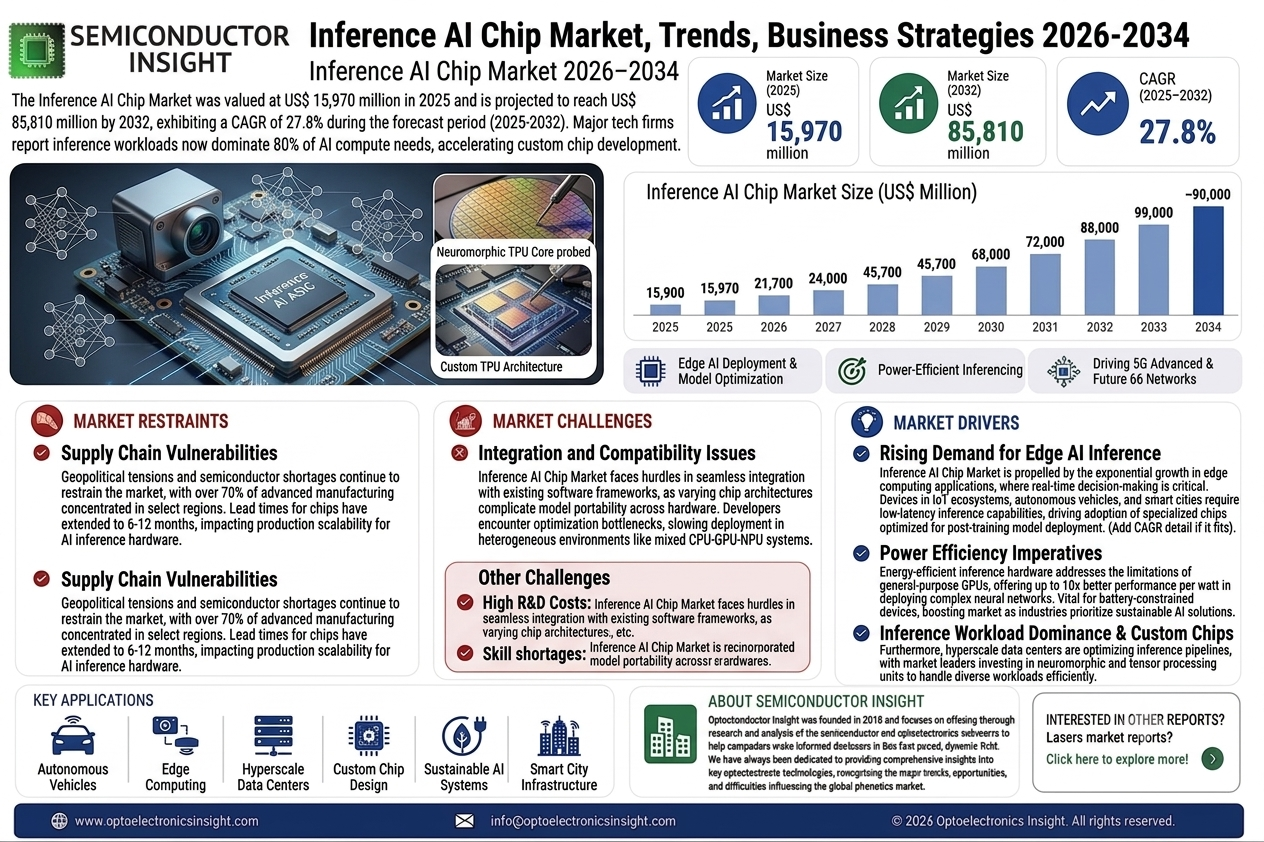
Global Inference AI Chip market was valued at USD 15.97 billion in 2025 and is projected to reach USD 85.81 billion by 2032, exhibiting a CAGR of 27.8% during the forecast period.
Inference AI chips are hardware accelerators specially designed to perform artificial intelligence model inference tasks. Compared with traditional processors (such as CPUs), inference AI chips can efficiently handle a large number of matrix operations and vector calculations in machine learning models by optimizing the computing architecture, significantly improving inference speed and energy efficiency. They usually integrate a large number of parallel computing units and specialized hardware modules, such as tensor processing units (TPU), neural network processing units (NPU), etc., which can accelerate the inference process of deep learning models in edge devices or data centers. Inference AI chips are widely used in scenarios that require efficient reasoning, such as autonomous driving, smart cameras, speech recognition, and recommendation systems.
The market is experiencing rapid growth due to several factors, including surging demand for edge AI computing, expansion of data centers, and advancements in deep learning models for real-time applications. Furthermore, the proliferation of autonomous vehicles and IoT devices is driving adoption. Initiatives by key players are fueling further expansion. For instance, in March 2024, NVIDIA unveiled its Blackwell GPU architecture at GTC, delivering up to 30 times faster inference for large language models compared to prior generations. Nvidia, Huawei, Intel, Qualcomm, Advanced Micro Devices, Enflame Technology, Google, Amazon, Microsoft, and Baidu are some of the key players operating in the market with diverse portfolios.
MARKET DRIVERS
Rising Demand for Edge AI Inference
Inference AI Chip Market is propelled by the exponential growth in edge computing applications, where real-time decision-making is critical. Devices in IoT ecosystems, autonomous vehicles, and smart cities require low-latency inference capabilities, driving adoption of specialized chips optimized for post-training model deployment. Projections indicate the market could expand at a CAGR of over 25% through 2030, fueled by this shift from cloud to edge processing.
Power Efficiency Imperatives
Energy-efficient inference hardware addresses the limitations of general-purpose GPUs, offering up to 10x better performance per watt in deploying complex neural networks. This is particularly vital for battery-constrained devices, boosting Inference AI Chip Market as industries prioritize sustainable AI solutions amid rising data volumes from 5G networks.
➤ Major tech firms report inference workloads now dominate 80% of AI compute needs, accelerating custom chip development.
Furthermore, hyperscale data centers are optimizing inference pipelines, with Inference AI Chip Market leaders investing in neuromorphic and tensor processing units to handle diverse workloads efficiently.
MARKET CHALLENGES
Integration and Compatibility Issues
Inference AI Chip Market faces hurdles in seamless integration with existing software frameworks, as varying chip architectures complicate model portability across hardware. Developers often encounter optimization bottlenecks, slowing deployment in heterogeneous environments like mixed CPU-GPU-NPU systems.
Other Challenges
High R&D Costs
Developing Inference AI Chip Market solutions demands substantial investment, with fabrication costs soaring due to advanced nodes like 5nm and below. Startups struggle against incumbents with deeper pockets.
Skill shortages in AI hardware design exacerbate these issues, limiting innovation pace and market entry for new players in Inference AI Chip Market.
MARKET RESTRAINTS
Supply Chain Vulnerabilities
Geopolitical tensions and semiconductor shortages continue to restrain Inference AI Chip Market, with over 70% of advanced manufacturing concentrated in select regions. Lead times for chips have extended to 6-12 months, impacting production scalability for AI inference hardware.
Standardization Gaps hinder interoperability, as proprietary formats from vendors fragment the ecosystem. This raises development costs and delays adoption in Inference AI Chip Market.
Additionally, thermal management challenges in dense inference deployments limit performance, posing ongoing restraints despite cooling innovations.
MARKET OPPORTUNITIES
Expansion into Automotive and Healthcare
Inference AI Chip Market holds significant potential in automotive ADAS and in-vehicle inference, where Level 4 autonomy demands robust, secure chips. Healthcare applications like real-time diagnostics further amplify growth, with edge AI projected to capture 40% market share by 2028.
Emerging 6G and federated learning paradigms open avenues for distributed inference, favoring specialized chips in Inference AI Chip Market.
Strategic partnerships between chipmakers and software platforms will unlock customized solutions, driving adoption across industrial IoT and consumer electronics.
Inference AI Chip Market Trends
Rising Demand for Terminal Inference Capabilities
In Inference AI Chip Market, a key trend is the surge in terminal inference AI chips tailored for edge devices, enabling efficient execution of artificial intelligence model inference tasks. These specialized hardware accelerators outperform traditional processors like CPUs by optimizing for intensive matrix operations and vector calculations inherent in machine learning models. Equipped with numerous parallel computing units and dedicated modules such as tensor processing units (TPUs) and neural processing units (NPUs), they deliver substantial gains in inference speed and energy efficiency. This trend is particularly evident in real-time scenarios demanding low latency, including autonomous driving systems, smart cameras, and speech recognition applications, where edge deployment reduces reliance on cloud connectivity and enhances data privacy.
Other Trends
Expansion of Cloud-Based Inference Deployments
Parallel to edge advancements, Inference AI Chip Market witnesses robust growth in cloud-based inference chips, predominantly utilized in data centers to manage high-volume inference workloads for recommendation systems and large-scale analytics. Manufacturers are refining chip architectures to support scalable parallel processing, addressing the escalating needs of AI-driven services. This segment’s evolution underscores a hybrid approach, balancing cloud power with edge agility, as industry surveys highlight ongoing innovations in handling diverse model complexities while mitigating power constraints in centralized environments.
Intensifying Competition and Innovation Among Key Players
The competitive dynamics in Inference AI Chip Market are intensifying, with leading manufacturers like Nvidia, Huawei, Intel, Qualcomm, Advanced Micro Devices, Enflame Technology, Google, Amazon, Microsoft, and Baidu driving relentless innovation. Analysis of recent developments reveals a focus on customized chip designs for specific applications such as autopilot and data centers, alongside strategic mergers and expansions to bolster market positioning. Surveys of suppliers and experts indicate that top players are prioritizing enhancements in hardware efficiency and integration capabilities, navigating challenges like supply chain obstacles and evolving standards to capture emerging opportunities in regional markets, particularly in Asia and North America.
COMPETITIVE LANDSCAPE
Key Industry Players
Inference AI Chip Market Competitive Overview
Inference AI Chip Market is dominated by a few technology giants that leverage their expertise in semiconductor design and AI acceleration to capture significant market share. Nvidia leads with its GPUs optimized for inference tasks, such as the A100 and H100 series, which excel in data center deployments for high-throughput AI workloads. Huawei and Intel follow closely, with Huawei’s Ascend chips powering edge and cloud inference in Asia, and Intel’s Habana Gaudi processors targeting cost-effective alternatives to GPUs. Qualcomm contributes through its mobile-focused AI engines in Snapdragon platforms. The market structure is oligopolistic, with the global top five players—Nvidia, Huawei, Intel, Qualcomm, and AMD—collectively holding a substantial revenue share as of 2025, driven by their integrated ecosystems spanning hardware, software, and cloud services. This concentration fosters intense innovation but also creates high barriers for new entrants due to R&D costs and supply chain complexities.
Beyond the frontrunners, several niche and emerging players are carving out specialized positions, particularly in regional markets and specific applications like edge computing and autonomous systems. Advanced Micro Devices (AMD) challenges Nvidia with its Instinct accelerators, while hyperscalers like Google, Amazon, and Microsoft develop custom inference silicon—Google’s TPUs, AWS Inferentia, and Azure’s Maia—to optimize their cloud infrastructures. Chinese firms such as Baidu, Alibaba Cloud, Tencent Cloud, Enflame Technology, Cambrian, Bitmain Technologies, and ThinkForce are rapidly advancing, focusing on domestic data sovereignty and cost-competitive NPUs for autopilot and smart devices. These players emphasize energy-efficient designs for terminal inference, addressing growing demand in Asia-Pacific. The competitive dynamics highlight a blend of global incumbents and agile innovators, with mergers, partnerships, and IP developments shaping future trajectories amid rising geopolitical tensions and supply chain shifts.
List of Key Inference AI Chip Companies Profiled
- Nvidia
- Huawei
- Intel
- Qualcomm
- Advanced Micro Devices
- Enflame Technology
- Amazon
- Microsoft
- Baidu
- Alibaba Cloud
- Tencent Cloud
- Cambrian
- Bitmain Technologies
- ThinkForce
Segment Analysis:
| Segment Category | Sub-Segments | Key Insights |
| By Type |
|
Cloud-based Inference AI Chip
|
| By Application |
|
Data Center
|
| By End User |
|
Cloud Service Providers
|
| By Technology |
|
ASIC-based
|
| By Industry Vertical |
|
Automotive
|
Regional Analysis: Inference AI Chip Market
North America
Pioneering firms advance specialized inference architectures, focusing on tensor processing units for edge computing. Innovations in quantization techniques reduce model sizes without accuracy loss, ideal for consumer gadgets. Academic-industry partnerships yield breakthroughs in hardware-software co-design, boosting throughput in data centers.
Enterprises rapidly adopt inference chips for operational AI, from fraud detection in finance to personalized recommendations in e-commerce. Hyperscale providers integrate them into serverless platforms, enhancing scalability. Sectors like manufacturing leverage predictive maintenance, driving demand for ruggedized inference hardware.
Abundant venture capital targets inference startups, spurring R&D in sustainable chip designs. Strategic alliances with cloud majors secure supply chains. Government grants support AI infrastructure, amplifying ecosystem growth and positioning the region as an investment magnet.
Favorable policies promote AI innovation while addressing data privacy. Standards for energy-efficient chips align with green initiatives. Balanced oversight encourages ethical inference deployments, fostering trust among enterprises and consumers alike.
Europe
Europe’s Inference AI Chip Market thrives on strong research foundations and regulatory frameworks emphasizing trustworthy AI. Key players collaborate on open-source inference hardware, targeting industrial automation and smart grids. The region’s focus on privacy-preserving inference appeals to sectors like finance and healthcare, where federated learning integrates seamlessly. Manufacturing hubs develop low-power chips for edge devices in agriculture and logistics. EU-funded projects drive standardization, enhancing interoperability across borders. Automotive firms embed inference processors in connected vehicles, prioritizing safety features. Challenges like talent mobility spur cross-national partnerships, bolstering competitiveness. Sustainability initiatives favor eco-friendly silicon, aligning with broader green tech agendas. Europe’s methodical approach positions it as a hub for reliable, compliant Inference AI Chip Market solutions.
Asia-Pacific
Asia-Pacific emerges as a powerhouse in Inference AI Chip Market, fueled by manufacturing prowess and rapid digital transformation. Taiwan and South Korea dominate fabrication, supplying advanced nodes for high-performance inference chips. China’s vast consumer base accelerates deployments in smartphones and surveillance systems. India leverages software ecosystems for optimized inference frameworks on cost-effective hardware. Telecom giants push 5G-enabled edge inference for smart cities. Government incentives spur local chip design, reducing import dependency. Supply chain resilience amid global shifts strengthens regional influence. Diverse applications from e-commerce personalization to industrial robotics highlight versatility. Asia-Pacific’s scale and agility challenge established leaders, shaping Inference AI Chip Market trajectories.
South America
South America’s Inference AI Chip Market gains momentum amid economic diversification and tech adoption. Brazil leads with investments in agrotech, deploying inference chips for crop monitoring and yield prediction. Urban centers in Mexico and Chile embrace smart city initiatives, favoring edge inference for traffic management. Limited local manufacturing prompts reliance on imports, yet growing assembler ecosystems emerge. Educational programs bridge skill gaps, enabling custom AI solutions in energy and mining. Public-private partnerships accelerate broadband rollout, unlocking inference potential in remote areas. Regulatory evolution supports data sovereignty, attracting international vendors. The region’s youthful demographics drive consumer electronics demand, fostering Inference AI Chip Market expansion despite infrastructural hurdles.
Middle East & Africa
The Middle East & Africa Inference AI Chip Market evolves through strategic diversification beyond oil. UAE and Saudi Arabia invest heavily in sovereign AI clouds, prioritizing inference hardware for vision AI in security. African nations like South Africa and Kenya apply chips to fintech and healthcare diagnostics, addressing access challenges. Solar-powered edge inference suits off-grid deployments in agriculture. Regional hubs foster startup incubators blending local needs with global tech. Infrastructure upgrades via Belt and Road initiatives enhance connectivity. Talent development programs import expertise, spurring indigenous innovation. Geopolitical stability efforts in the Gulf bolster confidence. This nascent market promises growth in Inference AI Chip applications tailored to unique socio-economic contexts.
Report Scope
This market research report provides a comprehensive analysis of the Inference AI Chip Market , covering the forecast period 2026–2034. It offers detailed insights into market dynamics, technological advancements, competitive landscape, and key trends shaping the industry.
Key focus areas of the report include:
- Market Overview: The report begins with an overview outlining its current market scenario, key growth indicators, and industry transformation drivers. It discusses macroeconomic factors, demand–supply balance, regulatory landscape, and the strategic role of semiconductors in powering advancements across industries such as automotive, telecommunications, consumer electronics, and industrial automation.
- Market Size & Forecast: Historical data and future projections for revenue, unit shipments, and market value across major regions and segments.
- Segmentation Analysis: Detailed breakdown by product type, technology, application, and end-user industry to identify high-growth segments and investment opportunities.
- Regional Insights: Insights into market performance across North America, Europe, Asia-Pacific, Latin America, and the Middle East & Africa, including country-level analysis where relevant.
- Competitive Landscape: Profiles of leading market participants, including their product offerings, R&D focus, manufacturing capacity, pricing strategies, and recent developments such as mergers, acquisitions, and partnerships.
- Technology Trends & Innovation: Assessment of emerging technologies, integration of AI/IoT, semiconductor design trends, fabrication techniques, and evolving industry standards.
- Market Drivers & Restraints: Evaluation of factors driving market growth along with challenges, supply chain constraints, regulatory issues, and market-entry barriers.
- Stakeholder Insights: Insights for component suppliers, OEMs, system integrators, investors, and policymakers regarding the evolving ecosystem and strategic opportunities.
Primary and secondary research methods are employed, including interviews with industry experts, data from verified sources, and real-time market intelligence to ensure the accuracy and reliability of the insights presented.
FREQUENTLY ASKED QUESTIONS:
What is the current market size of Inference AI Chip Market?
-> Global Inference AI Chip market was valued at USD 15,970 million in 2025 and is projected to reach USD 85,810 million by 2032, at a CAGR of 27.8% during the forecast period.
Which key companies operate in Inference AI Chip Market?
-> Key players include Nvidia, Huawei, Intel, Qualcomm, Advanced Micro Devices, Enflame Technology, Google, Amazon, Microsoft, and Baidu, among others.
What are the key growth drivers?
-> Key growth drivers include demand for efficient AI inference in autonomous driving, smart cameras, speech recognition, and recommendation systems, along with advancements in energy-efficient hardware accelerators like TPUs and NPUs.
Which region dominates the market?
-> Asia is the fastest-growing region, while North America remains a dominant market.
What are the emerging trends?
-> Emerging trends include cloud-based and terminal inference AI chips, integration of parallel computing units for edge devices and data centers, and optimized architectures for matrix operations in deep learning models.

Get Sample Report PDF for Exclusive Insights
Report Sample Includes
- Table of Contents
- List of Tables & Figures
- Charts, Research Methodology, and more...