
MARKET INSIGHTS
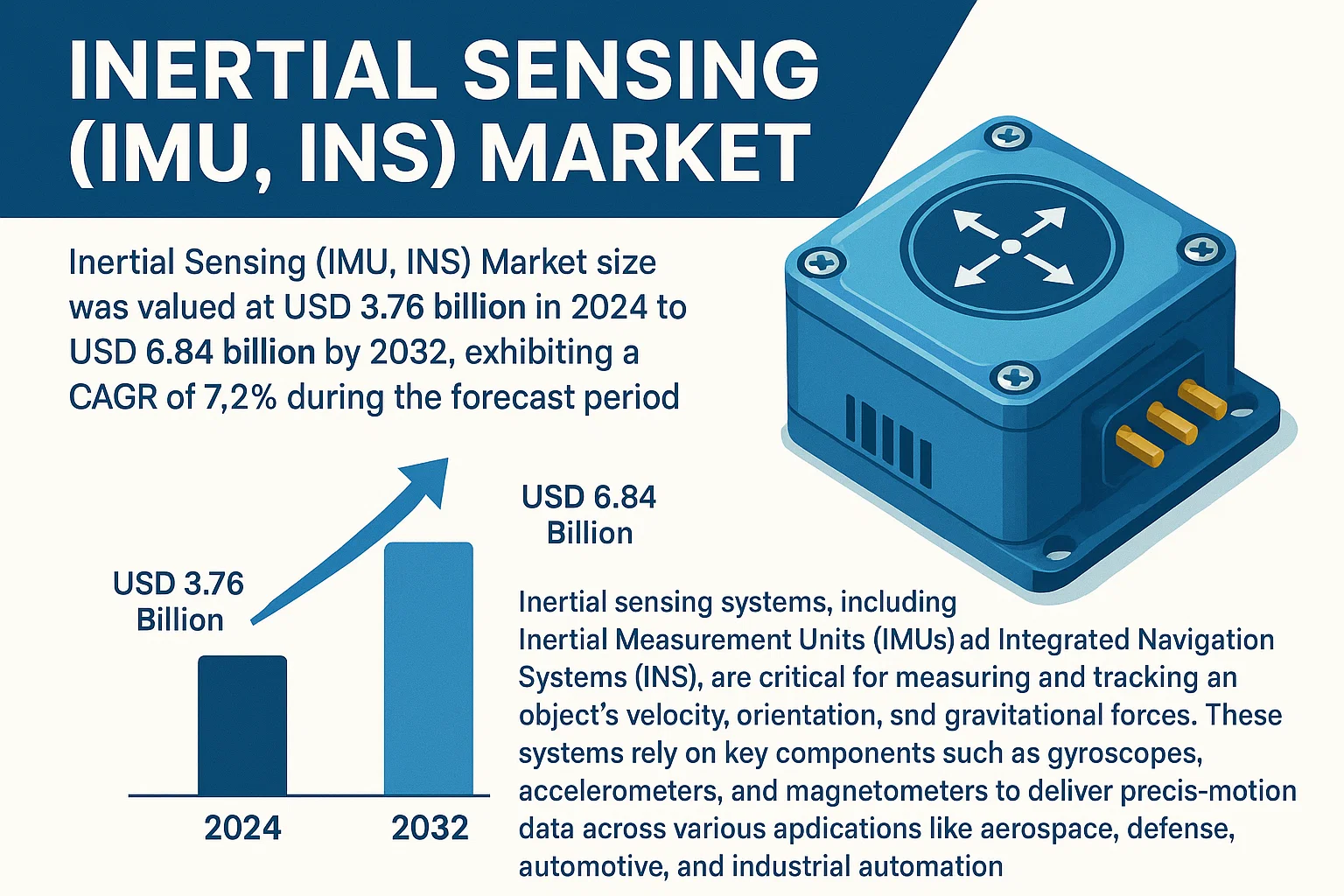
The global Inertial Sensing (IMU, INS) Market size was valued at USD 3.76 billion in 2024 to USD 6.84 billion by 2032, exhibiting a CAGR of 7.2% during the forecast period.
Inertial sensing systems, including Inertial Measurement Units (IMUs) and Integrated Navigation Systems (INS), are critical for measuring and tracking an object’s velocity, orientation, and gravitational forces. These systems rely on key components such as gyroscopes, accelerometers, and magnetometers to deliver precise motion data across various applications like aerospace, defense, automotive, and industrial automation.
The market growth is driven by increasing demand for autonomous vehicles, unmanned aerial vehicles (UAVs), and advanced robotics, where precise motion sensing is essential. Additionally, defense modernization programs and the rising adoption of industrial automation technologies further propel market expansion. Key players like Navgnss, SDI, and Norinco Group dominate the industry with continuous advancements in MEMS-based inertial sensors, enhancing accuracy while reducing size and cost.
MARKET DYNAMICS
MARKET DRIVERS
Expanding Autonomous Vehicle Development Accelerates Inertial Sensing Demand
The global autonomous vehicle market is projected to grow at a compound annual growth rate exceeding 20%, creating substantial demand for high-performance inertial sensing systems. Inertial Measurement Units (IMUs) and Inertial Navigation Systems (INS) serve as critical components in autonomous navigation by providing continuous position, orientation, and velocity data without external references. Recent technological advancements have enabled MEMS-based IMUs to achieve performance levels previously only possible with fiber optic or ring laser gyroscopes, making them suitable for automotive applications. Major automotive manufacturers are integrating multi-sensor fusion systems that combine IMU data with GPS, LiDAR, and camera inputs to create robust navigation solutions capable of functioning in GPS-denied environments. This convergence of technologies is driving innovation and market expansion across the transportation sector.
Defense Modernization Programs Fuel Military Inertial Sensing Adoption
Global defense spending has reached unprecedented levels, with numerous countries allocating significant portions of their budgets to navigation and guidance systems modernization. Military applications require inertial sensors that maintain accuracy during extended GPS-denied operations, driving demand for high-grade INS solutions. These systems are essential for missile guidance, aircraft navigation, unmanned aerial vehicles, and ground vehicle positioning. The increasing sophistication of military operations necessitates inertial sensors with improved performance characteristics, including higher accuracy, reduced size, and enhanced reliability. Defense contractors are investing heavily in developing next-generation inertial technologies that can operate effectively in challenging environments while meeting stringent military specifications.
Furthermore, geopolitical tensions and security concerns worldwide are accelerating the deployment of advanced navigation systems across various defense platforms.
➤ For instance, recent military contracts have shown a 35% increase in inertial navigation system procurement compared to previous years, reflecting heightened focus on autonomous operational capabilities.
Additionally, the integration of inertial sensors with other navigation technologies creates synergistic effects that enhance overall system performance and reliability.
MARKET CHALLENGES
High Development Costs and Technical Complexity Constrain Market Penetration
The inertial sensing market faces significant challenges related to the substantial research and development investments required for advanced sensor technologies. Developing high-performance IMU and INS systems involves sophisticated engineering, specialized manufacturing processes, and extensive testing protocols. The cost of precision calibration equipment and specialized testing facilities can reach millions of dollars, creating barriers for new market entrants. Additionally, achieving military-grade accuracy often requires expensive components and complex assembly processes that drive up production costs. These financial constraints particularly affect small and medium-sized enterprises trying to compete with established players who have decades of experience and substantial resources.
Other Challenges
Performance Limitations in Harsh Environments
Inertial sensors experience performance degradation under extreme conditions, including high vibration, temperature variations, and electromagnetic interference. Maintaining accuracy during rapid temperature changes requires sophisticated compensation algorithms and thermal management systems that add complexity and cost. Vibration-induced errors can significantly impact measurement accuracy, necessitating advanced damping mechanisms and signal processing techniques that challenge engineering capabilities.
Integration Complexity with Multi-Sensor Systems
The trend toward sensor fusion creates technical challenges in synchronizing data from multiple sources and managing computational loads. Integrating IMU data with GPS, vision systems, and other sensors requires sophisticated algorithms and powerful processing capabilities. The latency issues and calibration requirements between different sensor types present ongoing technical hurdles that affect system reliability and performance.
MARKET RESTRAINTS
Accuracy Drift and Calibration Requirements Limit Widespread Adoption
Inertial navigation systems inherently suffer from accuracy drift over time due to the integration of measurement errors. While high-grade systems can maintain accuracy for extended periods, consumer and industrial-grade IMUs experience significant position errors that accumulate rapidly without external correction. This limitation restricts their application in scenarios requiring prolonged autonomous operation. The need for frequent calibration and external updates adds operational complexity and cost, particularly for applications where continuous GPS availability cannot be guaranteed. This technical constraint affects market expansion into cost-sensitive applications where reliability requirements must be balanced against budgetary considerations.
Additionally, the varying environmental conditions under which inertial sensors must operate introduce additional error sources that complicate system design and implementation.
MARKET OPPORTUNITIES
Emerging Industrial IoT Applications Create New Growth Pathways
The rapid expansion of Industrial Internet of Things (IIoT) applications presents substantial opportunities for inertial sensing technologies. Manufacturing facilities, logistics operations, and industrial equipment increasingly utilize IMUs for condition monitoring, predictive maintenance, and operational optimization. The ability to track equipment orientation, detect vibrations, and monitor movement patterns enables improved operational efficiency and reduced downtime. The integration of inertial sensors with wireless communication technologies allows real-time monitoring of industrial assets, creating new value propositions across multiple industry verticals.
Furthermore, the growing adoption of robotics and automation in industrial settings drives demand for reliable navigation and positioning systems that can operate in structured environments.
Additionally, advancements in energy harvesting technologies enable the development of self-powered inertial sensors that can operate for extended periods without battery replacement, opening new application possibilities in remote monitoring and harsh environment applications.
INERTIAL SENSING (IMU, INS) MARKET TRENDS
Emergence of Miniaturized IMUs to Drive Market Growth
The inertial sensing market is witnessing significant transformation due to the rise of miniaturized Inertial Measurement Units (IMUs) and Navigation Systems (INS). These compact yet high-performance sensors, incorporating gyroscopes and accelerometers, are increasingly being embedded in autonomous vehicles, consumer electronics, and aerospace applications. The global demand for MEMS-based IMUs, for instance, is projected to grow by over 9% annually, driven by their lightweight design and enhanced precision. The integration of AI-driven calibration techniques has further improved their accuracy, making them indispensable in real-time positioning and navigation systems.
Other Trends
Expansion in Autonomous Systems and Robotics
The rapid adoption of autonomous systems is fueling advancements in inertial sensing technologies. Robotics, drones, and self-driving cars rely heavily on IMU-INS fusion for precise motion tracking. Innovations such as fiber-optic gyroscopes (FOGs) and ring laser gyroscopes (RLGs) are gaining traction, particularly in defense and aerospace applications. These technologies enable centimeter-level positioning accuracy, which is critical for navigation in GPS-denied environments. The automotive sector, in particular, is expected to contribute over 30% of the total IMU market revenue by 2032, driven by the rising deployment of ADAS (Advanced Driver Assistance Systems).
Defense and Aerospace Sector Demands High-Accuracy INS Solutions
The defense and aerospace industries remain key growth drivers for inertial sensing technology. Governments worldwide are investing heavily in next-gen navigation systems for unmanned aerial vehicles (UAVs), missiles, and space exploration. In 2024 alone, defense-related IMU applications accounted for nearly 40% of the market share, with North America and Europe leading in R&D initiatives. Silicon-based IMUs are gradually being replaced by higher-grade tactical and navigation-grade systems, emphasizing durability and resilience in extreme environments. Collaborative defense programs and modernization efforts are expected to sustain this upward trajectory over the forecast period.
COMPETITIVE LANDSCAPE
Key Industry Players
Innovation and Strategic Expansion Define Market Competition
The global Inertial Sensing (IMU, INS) market features a dynamic competitive landscape, where technological advancements and strategic partnerships are key differentiators. Navgnss and Avic-gyro lead the market with their robust product portfolios in gyroscopes and accelerometers, which are critical for navigation and motion sensing applications. These companies dominate due to their strong foothold in aerospace, defense, and automotive sectors, with product reliability being a major competitive edge.
Meanwhile, Norinco Group and HY Technology have expanded significantly in the Asia-Pacific region, capitalizing on rapid industrialization and increased defense spending. Their focus on high-precision inertial measurement solutions has allowed them to secure contracts with government and commercial clients, further strengthening their position in the market.
The competition is intensifying as mid-sized players like Right M&C and FACRI enhance their R&D capabilities to introduce cost-effective IMU solutions. These companies are targeting emerging markets with localized manufacturing, reducing production costs and improving market penetration.
Moreover, acquisitions and collaborations remain pivotal strategies. For instance, SDI recently partnered with a leading European navigation systems provider to expand its market share in autonomous vehicle applications—a sector projected to grow at a CAGR of over 12% from 2024 to 2032.
List of Key Inertial Sensing (IMU, INS) Companies Profiled
- Navgnss (China)
- Avic-gyro (China)
- SDI (U.S.)
- Norinco Group (China)
- HY Technology (China)
- Baocheng (China)
- Right M&C (China)
- Chinastar (China)
- Chenxi (China)
- FACRI (China)
- StarNeto (China)
Segment Analysis:
By Type
Gyroscopes Segment Dominates Due to High Adoption in Aerospace and Defense Applications
The market is segmented based on type into:
- Gyroscopes
- Accelerometers
- Others
By Application
Integrated Navigation Systems (INS) Leads Due to Superior Accuracy in Navigation and Positioning
The market is segmented based on application into:
- Integrated Navigation Systems (INS)
- Inertial Measurement Units (IMU)
By End User
Aerospace & Defense Sector Drives Demand for High-Precision Inertial Sensing Technologies
The market is segmented based on end user into:
- Aerospace & Defense
- Automotive
- Industrial
- Marine
- Others
By Technology
MEMS Technology Gains Traction Due to Cost-Effectiveness and Compact Design
The market is segmented based on technology into:
- MEMS (Micro-Electro-Mechanical Systems)
- FOG (Fiber Optic Gyroscope)
- RLG (Ring Laser Gyroscope)
- Others
Regional Analysis: Inertial Sensing (IMU, INS) Market
North America
The North American inertial sensing market is driven by strong demand from defense, aerospace, and automotive industries. The U.S. dominates regional growth due to its significant investments in military modernization programs, where high-precision IMUs are critical for navigation and guidance systems. Recent technological advancements in MEMS-based inertial sensors have made them more cost-effective for commercial applications like autonomous vehicles and drones. However, export controls and ITAR regulations limit the transfer of advanced inertial sensing technologies, potentially hindering global collaborations.
Europe
Europe’s inertial sensing market benefits from robust aerospace and industrial automation sectors, with countries like Germany, France, and the U.K. leading in adoption. The region shows increasing demand for miniaturized IMUs in automotive safety systems and unmanned aerial vehicles (UAVs). Strict EU data protection and cybersecurity regulations influence sensor development, emphasizing secure data transmission. While European manufacturers focus on high-accuracy fiber-optic gyroscopes (FOGs), price sensitivity in commercial markets creates opportunities for MEMS alternatives.
Asia-Pacific
As the fastest-growing region, Asia-Pacific is powered by China’s manufacturing capabilities and expanding defense budgets. China leads both production and consumption, with government initiatives boosting domestic IMU development to reduce foreign dependence. Japan and South Korea contribute through automotive and consumer electronics applications. India’s market shows potential with rising defense expenditure and space program investments, though technological gaps persist compared to Western counterparts. The region’s cost competitiveness makes it a hub for mid-range inertial sensor manufacturing.
South America
South America’s inertial sensing market remains nascent but shows gradual growth in mining, oil & gas applications. Brazil leads regional demand, particularly for industrial navigation systems in challenging environments. Economic instability and limited local manufacturing result in heavy import reliance. Defense modernization programs in countries like Chile and Argentina may drive future demand, though budget constraints and political factors slow adoption rates compared to other regions.
Middle East & Africa
The MEA market is characterized by defense-focused demand, particularly in Gulf nations investing in missile and UAV technologies. Israel stands out with its advanced domestic inertial sensing capabilities, exporting to global markets. Infrastructure limitations in Africa restrict widespread adoption, though mining and energy sectors show growing interest in basic inertial measurement applications. Regional instability affects long-term investment predictability, but strategic partnerships with foreign suppliers continue to drive selected high-value projects.
Technology Perspective: Across all regions, the inertial sensing industry shows clear divergence between military-grade high-performance systems (dominating in North America and Europe) and commercial-grade MEMS solutions (prevalent in Asia-Pacific). Hybrid solutions combining GNSS with inertial navigation are becoming standard globally, though regional GNSS preferences vary (GPS in Americas, Galileo in Europe, BeiDou in China). The ongoing miniaturization of sensors opens new applications in IoT and wearable devices, particularly in consumer electronics-heavy Asian markets.
Report Scope
This market research report provides a comprehensive analysis of the Global Inertial Sensing (IMU, INS) Market, covering the forecast period 2024–2032. It offers detailed insights into market dynamics, technological advancements, competitive landscape, and key trends shaping the industry.
Key focus areas of the report include:
- Market Size & Forecast: Historical data and future projections for revenue, unit shipments, and market value across major regions and segments. The Global Inertial Sensing (IMU, INS) market is projected to grow significantly, with the U.S. and China being key contributors.
- Segmentation Analysis: Detailed breakdown by product type (Gyroscopes, Accelerometers, Others) and application (Integrated Navigation Systems, Inertial Measurement Units) to identify high-growth segments.
- Regional Outlook: Insights into market performance across North America, Europe, Asia-Pacific, Latin America, and the Middle East & Africa, with country-level analysis.
- Competitive Landscape: Profiles of leading market participants including Navgnss, Avic-gyro, SDI, Norinco Group, and HY Technology, covering their product offerings and strategic developments.
- Technology Trends & Innovation: Assessment of emerging technologies in inertial sensing, including MEMS-based solutions and advanced navigation systems.
- Market Drivers & Restraints: Evaluation of factors such as increasing defense spending, autonomous vehicle adoption, and technological challenges affecting market growth.
- Stakeholder Analysis: Strategic insights for component suppliers, OEMs, system integrators, and investors in the inertial sensing ecosystem.
The research employs primary and secondary methodologies, including expert interviews and verified market data, to ensure accuracy and reliability.
FREQUENTLY ASKED QUESTIONS:
What is the current market size of Global Inertial Sensing (IMU, INS) Market?
-> Inertial Sensing (IMU, INS) Market size was valued at USD 3.76 billion in 2024 to USD 6.84 billion by 2032, exhibiting a CAGR of 7.2% during the forecast period.
Which key companies operate in Global Inertial Sensing (IMU, INS) Market?
-> Key players include Navgnss, Avic-gyro, SDI, Norinco Group, HY Technology, Baocheng, Right M&C, Chinastar, Chenxi, and FACRI.
What are the key growth drivers?
-> Key growth drivers include increasing defense applications, autonomous vehicle development, and industrial automation demand.
Which region dominates the market?
-> North America currently leads in market share, while Asia-Pacific is expected to witness the highest growth rate.
What are the emerging trends?
-> Emerging trends include miniaturization of sensors, integration with AI/ML technologies, and development of high-precision MEMS-based solutions.

Get Sample Report PDF for Exclusive Insights
Report Sample Includes
- Table of Contents
- List of Tables & Figures
- Charts, Research Methodology, and more...
 Download Sample Report PDF



