MARKET INSIGHTS
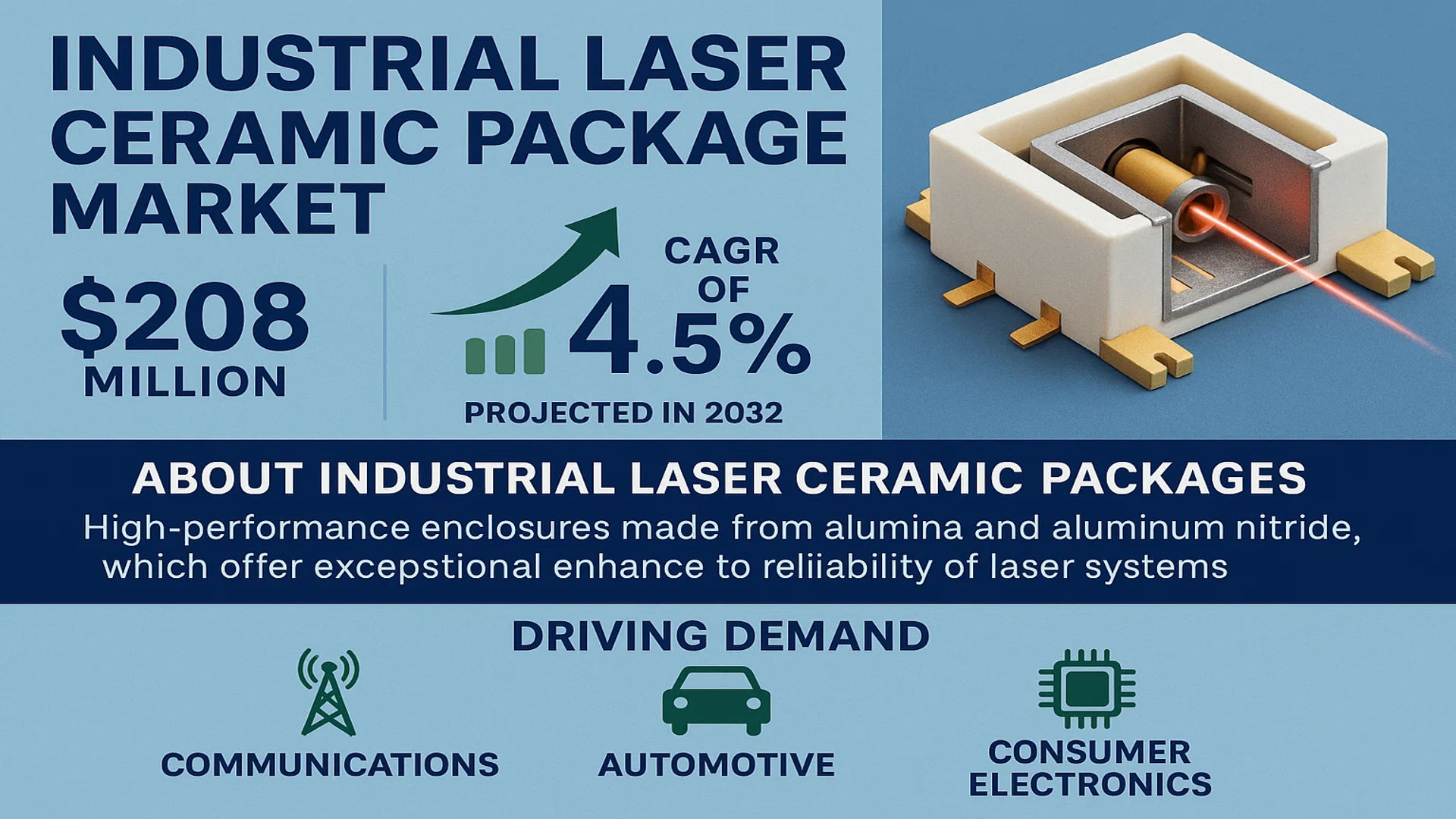
The global Industrial Laser Ceramic Package market was valued at 208 million in 2024 and is projected to reach US$ 284 million by 2032, at a CAGR of 4.5% during the forecast period.
Industrial laser ceramic packages are high-performance enclosures designed to protect and enhance the reliability of laser systems. These packages are primarily made from advanced ceramic materials such as alumina and aluminum nitride, which offer exceptional thermal conductivity, electrical insulation, and resistance to harsh environments. They play a critical role in ensuring the stability and longevity of industrial lasers across various applications.
The market growth is driven by increasing demand from industries like communications, automotive, and consumer electronics, where precision and durability are paramount. However, cost constraints and material limitations pose challenges. Key players such as Kyocera, Schott, and Materion dominate the market with continuous innovations in ceramic packaging solutions to meet evolving industry needs.
MARKET DYNAMICS
MARKET DRIVERS
Rising Adoption of High-Power Industrial Lasers Boosts Demand for Ceramic Packaging
The industrial laser market is experiencing robust growth across multiple sectors including manufacturing, automotive, and telecommunications, which in turn drives demand for reliable ceramic packaging solutions. Industrial lasers capable of operating at power levels exceeding 1 kW now represent over 35% of the global laser market, requiring advanced thermal management solutions that ceramic packages excel at providing. The shift toward fiber lasers in material processing applications has been particularly significant, with shipments growing at approximately 8% annually. Ceramic packages offer superior heat dissipation and hermetic sealing compared to traditional metal housings, making them indispensable for maintaining laser diode performance and longevity.
Expansion of 5G Infrastructure Fuels Market Growth
The global rollout of 5G networks represents a major growth driver for industrial laser ceramic packages, particularly for RF laser components in base station equipment. With over 2 million 5G base stations expected to be deployed worldwide by 2026, the demand for high-frequency laser packages with excellent dielectric properties has surged. Ceramic materials like aluminum nitride (AlN) exhibit the necessary combination of high thermal conductivity (typically 170-200 W/mK) and low signal loss characteristics required for these applications. Leading suppliers have reported order volumes for ceramic laser packages increasing by 15-20% annually to meet telecommunications infrastructure requirements.
Automotive Electrification Creates New Application Areas
The transition to electric vehicles is creating substantial opportunities for industrial laser ceramic packages in battery manufacturing and automotive LiDAR systems. Battery welding lasers using ceramic-packaged diodes now account for nearly 25% of all industrial laser applications in the automotive sector. Meanwhile, autonomous vehicle development is driving demand for ceramic-packaged lasers in long-range LiDAR systems where thermal stability and hermetic sealing are critical for outdoor operation. Major automakers’ investments exceeding $300 billion in electrification programs through 2030 will sustain this demand growth for precision laser components.
MARKET RESTRAINTS
High Material and Processing Costs Limit Market Penetration
While ceramic packages offer superior performance characteristics, their adoption is constrained by high manufacturing costs that can be 2-3 times greater than equivalent metal packages. Premium alumina ceramics used in laser packaging typically range from $5-$15 per unit for basic configurations, with specialized aluminum nitride variants reaching $30-$50 per package. The sintering process for ceramic packages requires precise temperature control in specialized kilns operating at 1600-1800°C for extended periods, contributing significantly to production expenses. These cost factors make ceramic solutions economically challenging for price-sensitive applications that might tolerate slightly lower performance from alternative materials.
Complex Supply Chain Vulnerabilities Impact Production Stability
The industrial laser ceramic package market faces logistical challenges due to concentrated supply of key raw materials. Over 70% of high-purity alumina powder production originates from just five countries, creating potential bottlenecks during geopolitical or economic disruptions. The specialized nature of ceramic processing also means limited options for alternative suppliers when primary manufacturers encounter production issues. Several major laser system integrators reported component lead times extending to 6-8 months during recent supply chain disruptions, highlighting vulnerabilities in the ceramic packaging ecosystem that could constrain market growth during periods of high demand.
Technical Limitations in Miniaturization Present Design Challenges
As industrial lasers continue toward higher power densities in smaller form factors, ceramic packaging faces physical limitations in wall thickness and thermal stress management. For applications requiring packages smaller than 5mm x 5mm, ceramic materials can become prone to cracking during thermal cycling due to their brittle nature. This presents challenges for next-generation laser designs where spatial constraints are critical, potentially driving some manufacturers toward alternative packaging solutions despite ceramic advantages. Current development efforts focus on composite ceramic-metal solutions that balance performance with structural integrity in compact designs.
MARKET OPPORTUNITIES
Emerging Photonics Applications Open New Growth Frontiers
Advanced photonic integrated circuits (PICs) represent a high-growth opportunity for industrial laser ceramic packaging, with the PIC market projected to exceed $3 billion by 2027. Ceramic packages capable of housing multiple laser diodes alongside other optical components in hermetic environments are in strong demand for quantum computing, biomedical sensing, and advanced optical communications applications. Recent advancements in co-fired ceramic technologies enable packages integrating electrical, optical, and thermal management functions in a single compact assembly, particularly valuable for space-constrained photonic systems.
Defense and Aerospace Sector Presents Premium Market Segment
Military applications for industrial lasers including directed energy weapons and secure communications systems require ceramic packages that meet stringent reliability standards for extreme environments. The defense sector’s laser systems market is growing at approximately 7% CAGR, with ceramic packages preferred for their ability to withstand shock, vibration, and wide temperature ranges (-55°C to +200°C). Recent contracts for ceramic-packaged laser components in defense applications have exceeded $150 million annually, representing a high-value niche for manufacturers willing to navigate the complex certification processes.
Silicon Photonics Integration Creates Novel Packaging Requirements
The convergence of silicon photonics with industrial laser technologies is driving innovation in ceramic packaging solutions. Emerging hybrid integration approaches require ceramic packages with through-silicon vias (TSVs) and precise optical alignment features, representing a $500 million market opportunity by 2025. Several leading foundries have invested in specialized ceramic packaging lines to support silicon photonics applications, particularly for data center interconnects where laser reliability directly impacts system uptime. The unique thermal management capabilities of ceramics make them particularly suitable for densely integrated photonic systems with multiple heat-generating components.
MARKET CHALLENGES
Intense Competition from Alternative Packaging Technologies
While ceramic packages dominate high-performance laser applications, they face increasing competition from advanced metal-ceramic composites and plastic package solutions. New thermally conductive polymer formulations with thermal conductivity exceeding 10 W/mK now address many mid-range laser applications at 30-40% lower cost than ceramic options. Glass-sealed metal packages have also gained traction for certain industrial laser types, leveraging mature manufacturing processes that allow faster production scaling. This competitive pressure is particularly acute in consumer electronics applications where cost considerations often outweigh the performance advantages of pure ceramic solutions.
Other Challenges
Standardization Gaps in Emerging Applications
The rapid evolution of laser technologies in fields like medical devices and aerospace has outpaced the development of standardized ceramic package specifications, creating integration challenges. Suppliers must often develop custom solutions for each new application, increasing development costs and lead times for system integrators.
Workforce Shortages in Precision Ceramics Manufacturing
Specialized skills in ceramic engineering and precision manufacturing are in short supply globally, with an estimated 15% vacancy rate for qualified personnel in the sector. This expertise gap threatens to constrain production capacity expansion as market demand grows, potentially creating bottlenecks in the supply chain for critical industrial laser components.
Environmental Regulations Impacting Material Sourcing
Increasing environmental regulations on rare earth oxides used in ceramic formulations may impact material availability and costs. Some key dopants for performance-enhancing ceramic formulations face potential supply constraints as sustainability requirements tighten across global supply chains.
INDUSTRIAL LASER CERAMIC PACKAGE MARKET TRENDS
Rising Demand for High-Performance Laser Applications Drives Market Growth
The global industrial laser ceramic package market is experiencing significant growth, driven by increasing demand for high-performance laser systems across multiple industries. Industrial laser ceramic packages, primarily made from materials like alumina and aluminum nitride ceramics, are critical for ensuring thermal stability, electrical insulation, and corrosion resistance in laser applications. The market was valued at $208 million in 2024 and is projected to reach $284 million by 2032, growing at a CAGR of 4.5%. This surge is fueled by the expanding use of lasers in telecommunications, automotive manufacturing, and consumer electronics—sectors that require reliable, long-lasting laser packaging solutions.
Other Trends
Adoption of Advanced Ceramic Materials
Alumina ceramics dominate the market due to their superior thermal conductivity and mechanical strength, making them ideal for high-power laser packaging. However, aluminum nitride ceramics are gaining traction because of their higher thermal conductivity (up to 170–180 W/mK) and better heat dissipation properties, which are crucial for next-generation laser systems. Manufacturers are increasingly focusing on material innovations to improve performance and durability, particularly in applications like fiber lasers and semiconductor laser diodes. Companies such as Kyocera and Ceramtec Group are actively investing in R&D to enhance ceramic packaging solutions for industrial lasers.
Expansion of Fiber Laser and 5G Networks Accelerates Market Growth
The deployment of fiber lasers in industrial cutting, welding, and additive manufacturing is a key driver for ceramic package demand. These lasers require robust packaging to withstand extreme operational conditions without compromising efficiency. Additionally, the rollout of 5G networks is boosting the telecommunications sector, where laser diodes with ceramic packaging are essential for high-speed data transmission. With China and the U.S. leading 5G infrastructure investments, the market for industrial laser ceramic packages is expected to see sustained growth. The increasing adoption of laser-based automation in the automotive and aerospace industries further reinforces this trend, as precision and reliability become paramount in manufacturing processes.
COMPETITIVE LANDSCAPE
Key Industry Players
Established Players and Innovators Drive the Industrial Laser Ceramic Package Market
The global industrial laser ceramic package market exhibits a dynamic competitive landscape with a mix of multinational corporations and specialized manufacturers vying for market share. Kyocera Corporation emerges as a dominant player, leveraging its decades-long expertise in advanced ceramic technologies and strong R&D capabilities. The company accounted for approximately 18% of the global ceramic packaging revenue in 2024, primarily serving high-power laser applications in the automotive and industrial sectors.
Materion Corporation and Ceramtec Group follow closely, with their comprehensive product portfolios spanning alumina and aluminum nitride ceramics. These companies have strengthened their positions through strategic acquisitions and technology partnerships, particularly in the growing medical laser segment. Meanwhile, Schott AG has been focusing on innovation in hermetic ceramic packaging, addressing the stringent requirements of aerospace and defense applications.
Asian manufacturers like NTK Ceramic (NGK Spark Plug Group) and MARUWA are gaining significant traction, supported by their cost-competitive offerings and strong presence in the consumer electronics supply chain. These players have been aggressively expanding their production capacities to meet the surging demand from Chinese and South Korean laser manufacturers.
The market has witnessed several notable developments in 2024, including Kyocera’s launch of a new thermally-enhanced ceramic package for high-power UV lasers and Ceramtec’s expansion of its U.S. manufacturing facility. Such moves indicate an industry-wide focus on innovation and localization to better serve regional markets and overcome supply chain constraints.
List of Key Industrial Laser Ceramic Package Manufacturers
- Kyocera Corporation (Japan)
- Materion Corporation (U.S.)
- Ceramtec Group (Germany)
- Schott AG (Germany)
- NTK Ceramic (NGK Spark Plug Group) (Japan)
- MARUWA Co., Ltd. (Japan)
- KOA Corporation (Japan)
- AMETEK Inc. (U.S.)
- Tensky International (Taiwan)
- Texas Instruments (U.S.)
- SHENGDA TECHNOLOGY (China)
- Jiaxing Glead Electronics (China)
Segment Analysis:
By Type
Alumina Ceramics Segment Leads Due to Superior Thermal and Mechanical Properties
The market is segmented based on type into:
- Alumina Ceramics
- Subtypes: High-purity alumina, Standard alumina
- Aluminum Nitride Ceramics
- Subtypes: Standard AlN, High-thermal-conductivity AlN
- Others
By Application
Communications Industry Dominates With Increasing Demand for High-Performance Laser Packaging
The market is segmented based on application into:
- Communications Industry
- Automotive Industry
- Industrial
- Consumer Electronics Industry
- Others
By End User
Laser Manufacturers Hold the Largest Share Due to Direct Requirements for Ceramic Packages
The market is segmented based on end user into:
- Laser Manufacturers
- Semiconductor Companies
- Electronics Component Suppliers
- Research Institutions
By Material Grade
High Purity Materials Segment Grows Rapidly for Critical Laser Applications
The market is segmented based on material grade into:
- Technical Grade
- High Purity Grade
- Ultra-High Purity Grade
Regional Analysis: Industrial Laser Ceramic Package Market
Asia-Pacific
The Asia-Pacific region dominates the industrial laser ceramic package market, accounting for the largest revenue share due to rapid industrialization and strong manufacturing growth. China leads the market, driven by heavy investments in semiconductor and electronics manufacturing. The country’s “Made in China 2025” initiative promotes advanced manufacturing technologies requiring high-performance laser packaging solutions. Japan follows closely, with key players like Kyocera and NGK Spark Plugs driving innovation in alumina and aluminum nitride ceramic packages. South Korea and Taiwan contribute significantly through their thriving semiconductor industries. While cost competitiveness remains crucial, manufacturers are gradually shifting toward high-value ceramic solutions to meet the demands of 5G infrastructure and electric vehicle production.
North America
North America represents a technologically advanced market for industrial laser ceramic packages, with the U.S. contributing the majority of regional demand. Stringent quality standards and the presence of leading laser system manufacturers drive the adoption of premium ceramic packaging solutions. The region shows strong demand from defense, medical, and aerospace applications, where reliability and thermal stability are critical. However, higher production costs and reliance on imports for some ceramic components create pricing pressures. Recent reshoring initiatives in semiconductor manufacturing may stimulate local demand for laser packaging materials in coming years.
Europe
Europe maintains a strong position in the industrial laser ceramic package market, characterized by innovation and stringent performance requirements. Germany leads regional consumption, supported by its robust automotive and industrial laser sectors. Companies like Ceramtec Group and Schott provide specialized ceramic solutions for high-power laser applications. The EU’s focus on clean energy and electric mobility is creating new opportunities for laser packaging in battery manufacturing and renewable energy systems. However, slower industrialization growth compared to Asia and high regulatory compliance costs present challenges for market expansion.
South America
The South American market remains in developing stages, with Brazil representing the primary consumer of industrial laser ceramic packages. Growth is constrained by limited local manufacturing capabilities and economic instability, leading to dependency on imports. However, gradual development in automotive and electronics assembly sectors is generating demand for basic laser packaging solutions. The lack of specialized suppliers and technical expertise in ceramic package manufacturing hinders market advancement, though foreign investments in industrial automation may drive future growth.
Middle East & Africa
This emerging market shows potential for industrial laser ceramic packages, primarily driven by infrastructure development and oil & gas applications. The UAE and Saudi Arabia are establishing technology hubs that may create demand for laser systems requiring ceramic packaging. However, the market remains small due to limited local manufacturing and technical capabilities. Most ceramic packages are imported for maintenance and repair operations rather than original equipment manufacturing. Strategic investments in industrial diversification could unlock long-term growth opportunities in the region.
Report Scope
This market research report provides a comprehensive analysis of the Global Industrial Laser Ceramic Package Market, covering the forecast period 2024–2032. It offers detailed insights into market dynamics, technological advancements, competitive landscape, and key trends shaping the industry.
Key focus areas of the report include:
- Market Size & Forecast: Historical data and future projections for revenue, unit shipments, and market value across major regions and segments. The market was valued at USD 208 million in 2024 and is projected to reach USD 284 million by 2032, growing at a CAGR of 4.5%.
- Segmentation Analysis: Detailed breakdown by product type (Alumina Ceramics, Aluminum Nitride Ceramics), application (Communications, Automotive, Industrial, Consumer Electronics), and end-user industry to identify high-growth segments.
- Regional Outlook: Insights into market performance across North America, Europe, Asia-Pacific, Latin America, and the Middle East & Africa. The U.S. and China are key markets, with Asia-Pacific leading in growth.
- Competitive Landscape: Profiles of leading market participants, including Materion, Kyocera, Schott, Ceramtec Group, and NGK Spark Plugs, with analysis of their market share, product portfolios, and strategic initiatives.
- Technology Trends & Innovation: Assessment of emerging materials, thermal management solutions, and advancements in laser packaging technologies.
- Market Drivers & Restraints: Evaluation of factors such as increasing demand for high-power lasers, growth in telecommunications, and challenges related to material costs and supply chain disruptions.
- Stakeholder Analysis: Strategic insights for manufacturers, suppliers, investors, and policymakers to navigate market opportunities and challenges.
The report employs rigorous primary and secondary research methodologies, including expert interviews, company financials, and verified market data to ensure accuracy and reliability.
FREQUENTLY ASKED QUESTIONS:
What is the current market size of Global Industrial Laser Ceramic Package Market?
-> Industrial Laser Ceramic Package market was valued at 208 million in 2024 and is projected to reach US$ 284 million by 2032, at a CAGR of 4.5% during the forecast period.
Which key companies operate in this market?
-> Leading players include Materion, Kyocera, Schott, Ceramtec Group, NGK Spark Plugs, Texas Instruments, and MARUWA.
What are the key growth drivers?
-> Growth is driven by rising demand for high-power lasers in telecommunications, automotive applications, and increasing adoption in consumer electronics.
Which region dominates the market?
-> Asia-Pacific leads in market share and growth, followed by North America and Europe.
What are the emerging trends?
-> Key trends include development of advanced ceramic materials, miniaturization of laser packages, and integration with IoT-enabled devices.

Get Sample Report PDF for Exclusive Insights
Report Sample Includes
- Table of Contents
- List of Tables & Figures
- Charts, Research Methodology, and more...
 Download Sample Report PDF