Industrial IoT Embedded Market Insights
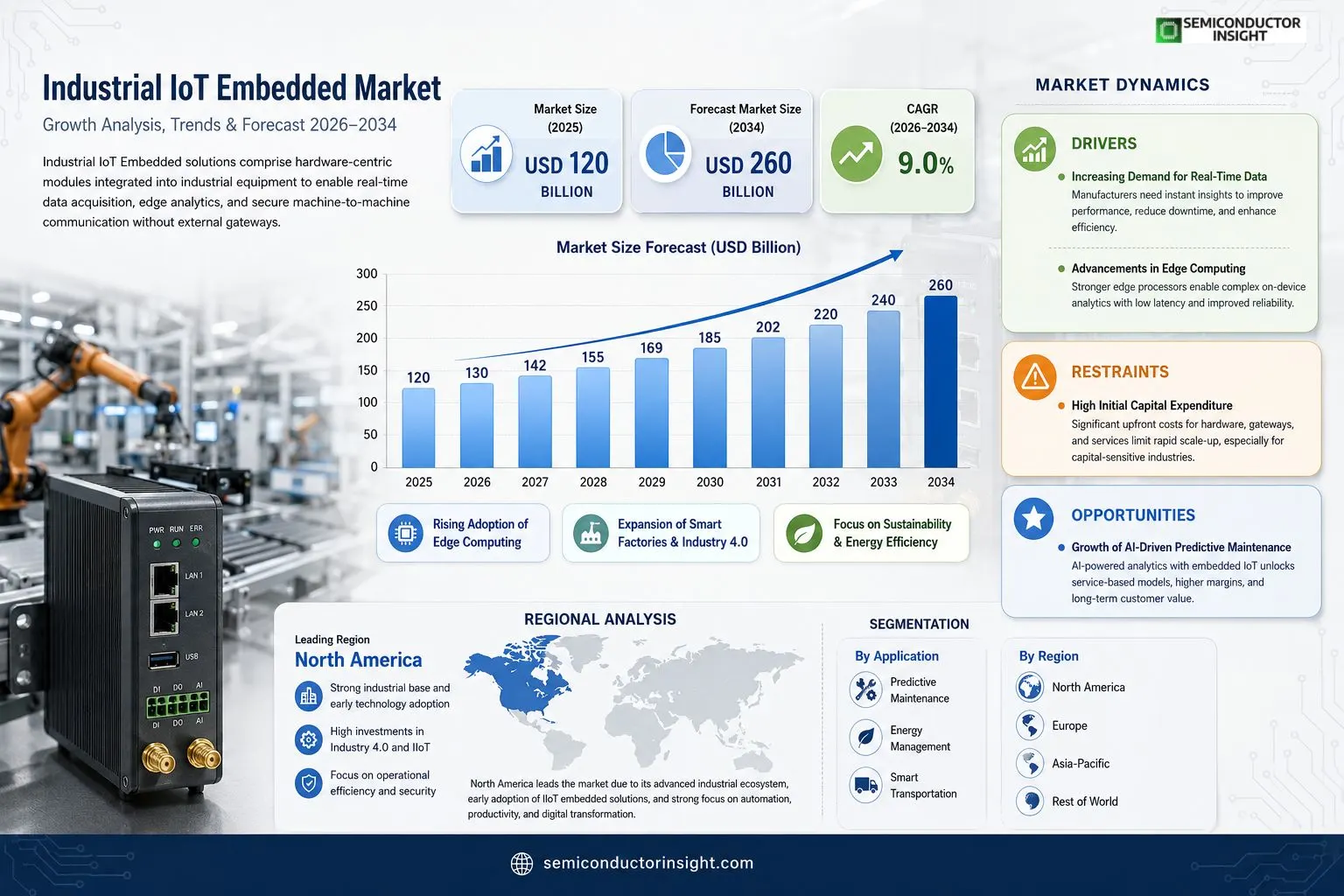
Global Industrial IoT Embedded market size was valued at USD 120 billion in 2025. The market is projected to grow from USD 130 billion in 2026 to USD 260 billion by 2034, exhibiting a CAGR of 9.0% during the forecast period.
Industrial IoT Embedded solutions comprise hardware‑centric modules such as microcontrollers, sensors, and communication stacks that are integrated directly into manufacturing equipment, energy systems, and transportation assets. These embedded components enable real‑time data acquisition, edge analytics, and secure machine‑to‑machine communication without reliance on external gateways.
The market is experiencing rapid growth due to rising demand for predictive maintenance, increasing adoption of edge computing, and heightened focus on sustainability across sectors. Furthermore, expanding investments in smart factories and government initiatives supporting Industry 4.0 are accelerating deployment. Key players,including Siemens AG, Bosch Software Innovations, Cisco Systems, and Schneider Electric,are expanding their portfolios through strategic partnerships and acquisitions to capture emerging opportunities.
MARKET DRIVERS
Increasing Demand for Real‑Time Data
Industrial IoT Embedded Market is being propelled by manufacturers’ need for instantaneous insight into equipment performance. Modern factories are integrating embedded sensors that transmit data to control systems, enabling predictive maintenance and reducing unplanned downtime. This shift toward data‑centric operations creates a robust revenue stream for embedded solutions providers.
Advancements in Edge Computing
Edge‑computing capabilities embedded directly in industrial devices lower latency and lessen reliance on cloud bandwidth. As edge processors become more powerful and energy‑efficient, they support complex analytics at the source, driving wider adoption of Industrial IoT Embedded Market across sectors such as automotive, energy, and aerospace.
➤ “By 2025, more than 60 % of new industrial equipment will incorporate embedded IoT modules, accelerating digital transformation initiatives.”
Regulatory pushes for safety and emissions reporting also compel firms to embed smarter monitoring hardware, further reinforcing market momentum and creating long‑term growth pathways.
MARKET CHALLENGES
Cybersecurity Risks in Connected Devices
Embedded devices expand the attack surface of operational technology networks. Organizations often lack mature security frameworks for firmware updates and authentication, which can delay procurement decisions and elevate total cost of ownership within Industrial IoT Embedded Market.
Other Challenges
Integration Complexity
Legacy equipment frequently requires custom adapters and extensive testing to interface with modern IoT platforms. This integration burden raises project timelines and can deter smaller manufacturers from investing in embedded solutions.
MARKET RESTRAINTS
High Initial Capital Expenditure
Deploying embedded IoT hardware often involves significant upfront spending on sensors, gateways, and engineering services. For capital‑sensitive industries, this cost barrier restricts rapid scale‑up and may slow overall market penetration, especially in regions with limited financing options.
MARKET OPPORTUNITIES
Growth of AI‑Driven Predictive Maintenance
The convergence of AI algorithms with embedded IoT data streams opens lucrative opportunities for service‑based revenue models. Companies that bundle analytics platforms with hardware can capture higher margins and differentiate themselves in the competitive Industrial IoT Embedded Market.
Industrial IoT Embedded Market Trends
Edge‑Enabled Predictive Maintenance
Manufacturers are increasingly embedding microcontrollers, high‑resolution sensors, and low‑latency communication stacks directly into equipment to capture operational data at the source. This architecture allows Industrial IoT Embedded Market to deliver edge analytics that identify component wear before failure occurs, reducing unplanned downtime and maintenance costs. Real‑time anomaly detection is now performed on‑device, eliminating the need for separate gateway hardware and supporting tighter security controls. The convergence of edge computing with robust embedded firmware is therefore a primary catalyst for broader adoption across automotive assembly lines, chemical processing plants, and power generation assets.
Other Trends
Sustainability and Energy Efficiency
Environmental regulations and corporate sustainability goals are prompting factories to monitor energy consumption at the component level. Embedded sensors provide granular power usage data that feed into advanced control loops, enabling dynamic load balancing and waste reduction. By integrating energy‑aware algorithms within the same microcontroller that runs production monitoring, operators can achieve measurable reductions in carbon intensity without extensive retrofitting. This trend is reinforced by government incentive programs that reward the deployment of low‑power, embedded solutions in industrial settings, making sustainability a core consideration for investment decisions.
Strategic Partnerships and Platform Consolidation
Leading technology firms are forming alliances to combine expertise in hardware design, secure connectivity, and industrial software services. Recent collaborations between semiconductor manufacturers and cloud providers have produced unified development kits that simplify the creation of end‑to‑end IoT solutions. At the same time, major players such as Siemens, Bosch Software Innovations, Cisco Systems, and Schneider Electric are consolidating their embedded portfolios through acquisitions, creating comprehensive platforms that address the full device lifecycle,from design and testing to remote diagnostics and OTA updates. These strategic moves reduce integration complexity for OEMs and accelerate time‑to‑market for new smart‑factory applications, reinforcing the overall momentum of Industrial IoT Embedded Market.
COMPETITIVE LANDSCAPEKey Industry Players
Industrial IoT Embedded Market Overview
Industrial IoT Embedded Market is dominated by a few large system integrators and semiconductor specialists that combine hardware modules, edge‑analytics software, and secure connectivity stacks into a single offering. Siemens AG leads the space with its extensive portfolio of industrial controllers, modular I/O, and AI‑enabled edge solutions that are deeply embedded in manufacturing equipment. Bosch Software Innovations follows closely, leveraging its sensor expertise and open‑source IoT frameworks to address predictive‑maintenance use cases. Cisco Systems and Schneider Electric complement the hardware focus with robust networking fabrics and energy‑management platforms, respectively, creating a tiered ecosystem where the largest players dictate standards, drive consolidation, and capture the bulk of high‑value contracts across smart‑factory and smart‑grid deployments.Beyond these market anchors, a diverse set of niche innovators enriches the competitive landscape with specialized capabilities. ABB Ltd. and Honeywell International bring advanced process‑control modules and safety‑critical firmware to heavy‑industry segments. Rockwell Automation and GE Digital focus on tightly integrated automation stacks for legacy equipment retrofits. Semiconductor leaders such as Intel Corporation, Texas Instruments, STMicroelectronics, NXP Semiconductors, and Analog Devices supply the micro‑controller, sensor, and RF building blocks that power edge nodes. Software‑centric firms like PTC Inc. and Advantech Co., Ltd. add rapid‑deployment platforms and ruggedized edge gateways, allowing smaller OEMs to embed IoT functionality without large R&D investments.
List of Key Industrial IoT Embedded Companies Profiled
- Siemens AG
- Bosch Software Innovations
- Cisco Systems
- Schneider Electric
- ABB Ltd.
- Honeywell International
- Rockwell Automation
- GE Digital
- Intel Corporation
- Texas Instruments
- STMicroelectronics
- NXP Semiconductors
- Analog Devices
- PTC Inc.
- Advantech Co., Ltd.
Segment Analysis:
| Segment Category | Sub-Segments | Key Insights |
| By Type |
|
Sensor‑Embedded Controllers are favored for their ability to process data at the edge, enabling real‑time decision making and reducing latency. • Integration eliminates the need for external gateways, simplifying system architecture. • Built‑in redundancy and ruggedization improve reliability in harsh industrial environments. • They support autonomous operation, aligning with Industry 4.0 objectives. |
| By Application |
|
Predictive Maintenance leverages embedded analytics to anticipate equipment wear before failure occurs. • Continuous sensor streams feed edge algorithms that trigger timely interventions, reducing unplanned downtime. • The approach fosters a shift from reactive to proactive asset stewardship, improving overall equipment effectiveness. • It also aligns with sustainability goals by extending asset lifecycles and minimizing waste. |
| By End User |
|
Manufacturing embraces embedded IoT to enable smart factories where machines communicate directly, driving continuous optimization. • Edge processing reduces reliance on cloud latency, supporting real‑time quality control. • Integrated modules enhance modularity, allowing rapid reconfiguration of production lines. • The resulting agility supports rapid product customization and shorter time‑to‑market cycles. |
| By Connectivity |
|
5G‑Native Modules are emerging as a leading connectivity choice for mission‑critical industrial deployments. • Extremely low latency supports time‑sensitive control loops and closed‑loop automation. • High bandwidth enables simultaneous transmission of sensor data, video, and diagnostic information. • The flexible spectrum usage allows seamless scaling across diverse factory footprints. |
| By Industry |
|
Automotive leverages embedded IoT to embed intelligence directly within vehicle subsystems, facilitating on‑board diagnostics and over‑the‑air updates. • Edge analytics monitor component health, enabling predictive service strategies. • Integrated security features protect critical control networks from cyber threats. • This embedded approach accelerates adoption of autonomous driving functionalities and enhances overall vehicle safety. |
Regional Analysis: North America
North America
The automotive sector in North America is at the forefront of IIoT embedded adoption, focusing on connected vehicles, autonomous driving, and smart manufacturing processes. Embedded systems play a crucial role in enhancing vehicle safety, improving fuel efficiency, and enabling over-the-air updates.
The aerospace and defense industries in North America heavily rely on sophisticated embedded systems for mission-critical applications. These systems ensure reliability, safety, and secure communication in demanding operational environments.
North American manufacturing is increasingly leveraging IIoT embedded technologies to optimize production processes, improve quality control, and enhance supply chain visibility. This includes deploying sensors, actuators, and embedded gateways to monitor equipment performance and automate tasks.
The energy and utilities sectors are utilizing embedded systems for smart grids, remote monitoring of infrastructure, and predictive maintenance of assets. This contributes to improved energy efficiency and reduced operational costs.
Europe
Europe represents a significant and steadily growing market for Industrial IoT Embedded solutions. Driven by stringent regulatory frameworks focused on sustainability and industrial automation, the region is witnessing increasing adoption across various sectors. The focus on energy efficiency and circular economy principles is further propelling the demand for embedded systems that optimize resource utilization and minimize environmental impact. The convergence of Industry 4.0 initiatives and the IIoT embedded market is creating compelling opportunities for technological innovation.
Asia-Pacific
Asia-Pacific is emerging as the fastest-growing market for Industrial IoT Embedded technologies. The region’s rapid industrialization, coupled with government initiatives promoting smart manufacturing and digital transformation, is fueling significant demand. Countries like China and India are investing heavily in IIoT embedded solutions to enhance productivity, improve efficiency, and drive economic growth. The large manufacturing base and increasing adoption of cloud computing further support the growth of the embedded market.
South America
South America presents a promising, albeit developing, market for Industrial IoT Embedded. The region’s agricultural and mining sectors are key drivers of demand, leveraging embedded systems for precision agriculture, asset tracking, and remote monitoring. Increasing investments in infrastructure projects and a growing focus on industrial automation are expected to further boost the market in the coming years. The adoption rate is influenced by factors such as connectivity infrastructure and investment capital.
Middle East & Africa
The Middle East & Africa region is experiencing increasing interest in Industrial IoT Embedded solutions, driven by the expansion of industries like oil & gas, construction, and logistics. Smart city initiatives and a focus on infrastructure development are also contributing to market growth. The region’s unique challenges, such as extreme weather conditions, necessitate robust and reliable embedded systems for industrial applications. Government support for technological advancements is fostering innovation and adoption.
Report Scope
This market research report provides a comprehensive analysis of the Industrial IoT Embedded Market , covering the forecast period 2026–2034. It offers detailed insights into market dynamics, technological advancements, competitive landscape, and key trends shaping the industry.
Key focus areas of the report include:
- Market Overview: ✅ The report begins with an overview outlining its current market scenario, key growth indicators, and industry transformation drivers. It discusses macroeconomic factors, demand–supply balance, regulatory landscape, and the strategic role of semiconductors in powering advancements across industries such as automotive, telecommunications, consumer electronics, and industrial automation.
- ✅ Market Size & Forecast: Historical data and future projections for revenue, unit shipments, and market value across major regions and segments.
- ✅ Segmentation Analysis: Detailed breakdown by product type, technology, application, and end-user industry to identify high-growth segments and investment opportunities.
- ✅ Regional Insights: Insights into market performance across North America, Europe, Asia-Pacific, Latin America, and the Middle East & Africa, including country-level analysis where relevant.
- ✅ Competitive Landscape: Profiles of leading market participants, including their product offerings, R&D focus, manufacturing capacity, pricing strategies, and recent developments such as mergers, acquisitions, and partnerships.
- ✅ Technology Trends & Innovation: Assessment of emerging technologies, integration of AI/IoT, semiconductor design trends, fabrication techniques, and evolving industry standards.
- ✅ Market Drivers & Restraints: Evaluation of factors driving market growth along with challenges, supply chain constraints, regulatory issues, and market-entry barriers.
- ✅ Stakeholder Insights: Insights for component suppliers, OEMs, system integrators, investors, and policymakers regarding the evolving ecosystem and strategic opportunities.
Primary and secondary research methods are employed, including interviews with industry experts, data from verified sources, and real-time market intelligence to ensure the accuracy and reliability of the insights presented.
FREQUENTLY ASKED QUESTIONS:
What is the current market size of Industrial IoT Embedded Market?
-> Industrial IoT Embedded Market was valued at USD 120 billion in 2025 and is expected to reach USD 260 billion by 2034, exhibiting a CAGR of 9.0% during the forecast period.
Which key companies operate in Industrial IoT Embedded Market?
-> Key players include Siemens AG, Bosch Software Innovations, Cisco Systems, and Schneider Electric, among others.
What are the key growth drivers?
-> Key growth drivers include rising demand for predictive maintenance, increasing adoption of edge computing, and heightened focus on sustainability and smart‑factory initiatives.
Which region dominates the market?
-> The market is experiencing strong adoption across North America, Europe, and Asia‑Pacific, with especially rapid deployment in regions investing heavily in Industry 4.0 and smart‑factory projects.
What are the emerging trends?
-> Emerging trends include edge analytics, integration of AI/IoT in embedded modules, secure machine‑to‑machine communication, and the development of unified hardware‑centric platforms for Industry 4.0.
Get Sample Report PDF for Exclusive Insights
Report Sample Includes
- Table of Contents
- List of Tables & Figures
- Charts, Research Methodology, and more...