
MARKET INSIGHTS
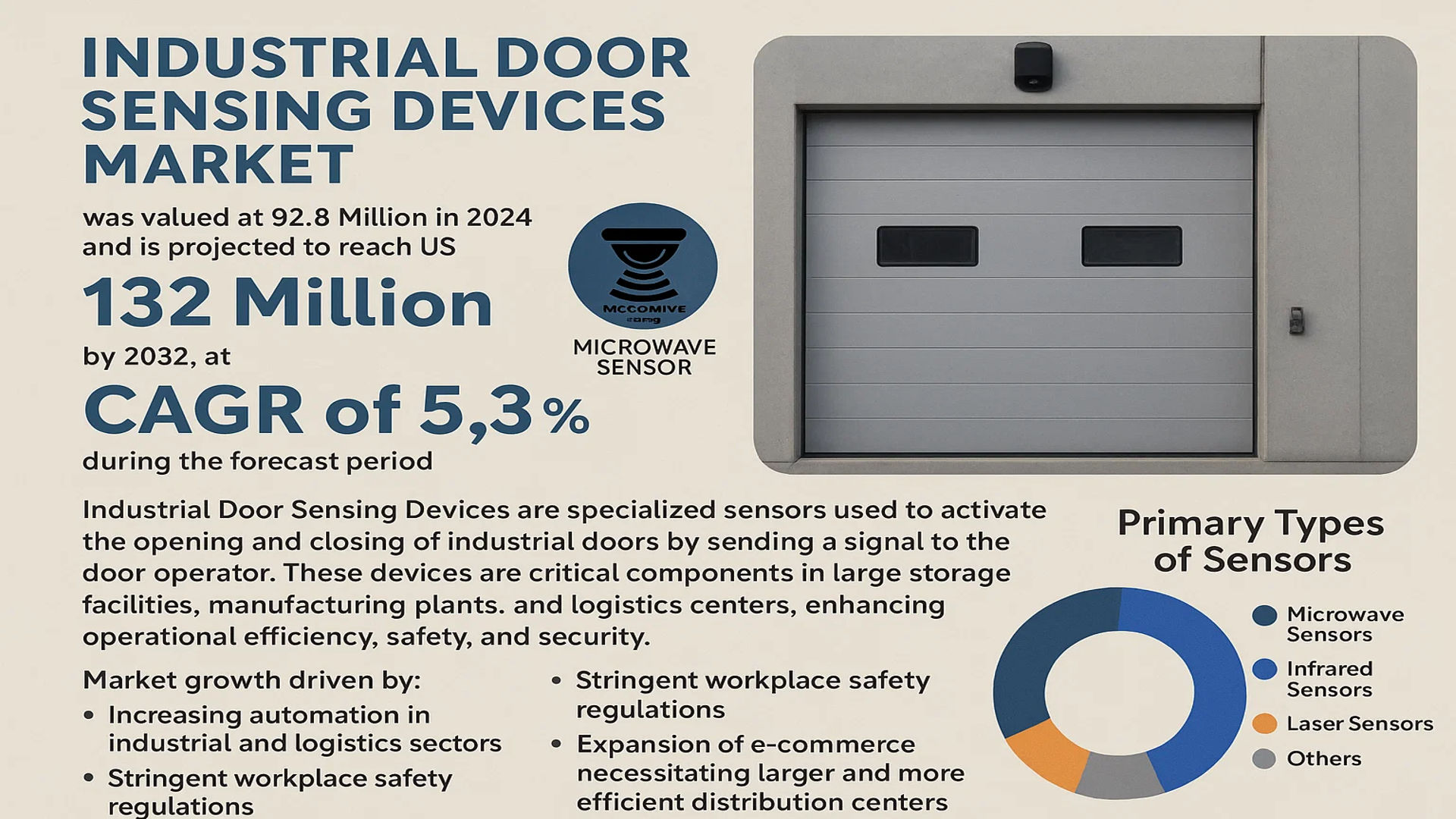
The global Industrial Door Sensing Devices Market was valued at 92.8 million in 2024 and is projected to reach US$ 132 million by 2032, at a CAGR of 5.3% during the forecast period.
Industrial Door Sensing Devices are specialized sensors used to activate the opening and closing of industrial doors by sending a signal to the door operator. These devices are critical components in large storage facilities, manufacturing plants, and logistics centers, enhancing operational efficiency, safety, and security. The primary types of sensors include Microwave Sensors, Infrared Sensors, Laser Sensors, and others, each catering to specific environmental and operational requirements.
The market growth is primarily driven by increasing automation in industrial and logistics sectors, stringent workplace safety regulations, and the expansion of e-commerce necessitating larger and more efficient distribution centers. Europe held the dominant market share of over 47% in 2019, a trend supported by its strong manufacturing base and advanced safety standards. Key market players such as BEA, Optex, and BIRCHER collectively account for a significant portion of the market, with revenue shares of 30.83%, 22.52%, and 9.47% respectively, due to their extensive product portfolios and technological innovations.
MARKET DYNAMICS
MARKET DRIVERS
Rising Industrial Automation and Safety Regulations to Propel Market Expansion
The global industrial sector is witnessing unprecedented growth in automation investments, with manufacturing facilities increasingly adopting smart technologies to enhance operational efficiency and worker safety. Industrial door sensing devices play a critical role in this transformation by providing reliable detection and activation systems for automated doors in high-traffic industrial environments. Recent data indicates that manufacturing automation spending reached approximately $242 billion globally in 2023, representing a significant increase from previous years. This surge is primarily driven by the need to optimize material handling processes and reduce operational costs while maintaining stringent safety standards. Regulatory bodies worldwide have implemented stricter safety requirements for industrial facilities, mandating the use of advanced sensing technologies to prevent accidents and ensure compliance. These regulations particularly emphasize the protection of personnel working in areas with automated door systems, creating substantial demand for reliable sensing solutions.
Expansion of Logistics and Warehouse Infrastructure to Accelerate Market Growth
The rapid growth of e-commerce and global supply chain networks has triggered massive investments in logistics and distribution centers worldwide. Modern warehouse facilities require sophisticated door control systems to maintain temperature control, security, and efficient material flow. Industrial door sensing devices have become essential components in these facilities, ensuring smooth operation of high-speed doors that separate different environmental zones and enable rapid vehicle movement. The global warehouse automation market is projected to grow at a compound annual growth rate of over 14% through 2030, directly influencing the demand for advanced door sensing technologies. These devices help prevent collisions, reduce energy loss, and maintain operational continuity in facilities handling increasing volumes of goods. The integration of sensing devices with warehouse management systems further enhances their value proposition, creating a compelling case for widespread adoption across the logistics sector.
Technological Advancements in Sensor Capabilities to Drive Market Adoption
Recent technological innovations have significantly enhanced the performance and reliability of industrial door sensing devices. Modern sensors now incorporate advanced features such as microwave technology for superior detection range, infrared sensors for precise object recognition, and laser-based systems for high-accuracy measurement. These technological improvements address previous limitations related to environmental interference, false triggers, and maintenance requirements. The development of IoT-enabled sensors that provide real-time monitoring and predictive maintenance capabilities has particularly revolutionized the market. These smart sensors can communicate with central control systems, alert operators to potential issues before failures occur, and optimize door operation based on traffic patterns. The integration of artificial intelligence and machine learning algorithms further enhances detection accuracy while reducing energy consumption. Such advancements make modern sensing devices more attractive to industrial operators seeking to upgrade their facilities with future-proof technologies.
MARKET CHALLENGES
High Initial Investment and Installation Complexity to Hinder Market Penetration
The industrial door sensing devices market faces significant challenges related to the substantial upfront costs associated with advanced sensor systems. High-quality sensing devices, particularly those incorporating microwave and laser technologies, require considerable capital investment that can be prohibitive for small and medium-sized enterprises. The installation process often involves complex integration with existing door operators and control systems, necessitating specialized technical expertise that may not be readily available in all markets. This complexity increases both the time and cost of implementation, creating barriers to adoption particularly in price-sensitive regions and among smaller industrial operators. Additionally, retrofitting older facilities with modern sensing technology frequently requires structural modifications and electrical upgrades, further adding to the total cost of ownership.
Other Challenges
Environmental Sensitivity and Performance Limitations
Industrial environments present numerous challenges for sensing devices, including extreme temperatures, dust, moisture, and electromagnetic interference that can affect sensor performance and reliability. Certain sensor technologies struggle to maintain accuracy in harsh conditions, leading to false triggers or detection failures that compromise safety and operational efficiency. The varying nature of industrial applications means that no single sensor type can address all environmental challenges, requiring customized solutions that increase complexity and cost. These performance limitations necessitate frequent maintenance and calibration, creating ongoing operational expenses that some facility operators find burdensome.
Interoperability Issues with Legacy Systems
Many industrial facilities operate with aging door systems and control infrastructure that may not be compatible with modern sensing technologies. The lack of standardized communication protocols across different manufacturers creates integration challenges that can delay implementation and increase costs. This interoperability problem is particularly acute in facilities that have undergone multiple expansion phases using equipment from various vendors. The need for custom interface solutions and additional hardware components to bridge communication gaps between new sensors and existing systems presents technical hurdles that can discourage potential buyers from upgrading their sensing capabilities.
MARKET RESTRAINTS
Economic Volatility and Capital Expenditure Constraints to Limit Market Growth
Global economic uncertainties and fluctuating industrial investment patterns pose significant restraints on the industrial door sensing devices market. During periods of economic downturn, industrial facilities often defer capital expenditures on non-essential equipment upgrades, prioritizing only critical maintenance and safety investments. The discretionary nature of many sensing device installations makes them vulnerable to budget cuts when companies face financial pressures. Recent global economic challenges have caused many manufacturing and logistics companies to reassess their automation investments, delaying or canceling projects that include door sensing system upgrades. This cautious approach to capital expenditure is particularly evident in regions experiencing industrial slowdowns or trade disruptions, where companies focus on preserving cash flow rather than investing in advanced technologies.
Limited Technical Expertise and Maintenance Capabilities to Restrict Market Expansion
The sophistication of modern industrial door sensing devices requires specialized technical knowledge for proper installation, configuration, and maintenance. Many industrial markets face a shortage of qualified technicians who understand both the electronic aspects of sensor technology and the mechanical requirements of door systems. This skills gap becomes particularly problematic in emerging economies and rural industrial areas where technical training infrastructure may be limited. The complexity of troubleshooting advanced sensor systems often leads to extended downtime when issues occur, as facilities must wait for specialized service providers to address problems. This dependency on external expertise creates operational vulnerabilities that make some companies hesitant to adopt advanced sensing technologies, preferring simpler mechanical solutions that their existing maintenance teams can manage independently.
Price Competition from Alternative Safety Solutions to Impact Market Share
The industrial door sensing devices market faces increasing competition from alternative safety technologies that offer similar protection at lower costs. Mechanical safety edges, presence detection mats, and simple photoelectric sensors provide basic protection for industrial doors at a fraction of the cost of advanced sensing systems. While these alternatives may not offer the same level of sophistication or integration capabilities, they adequately meet minimum safety requirements in many applications. This price sensitivity is particularly evident in cost-conscious market segments and regions with less stringent regulatory enforcement. The availability of these lower-cost alternatives creates constant pressure on sensing device manufacturers to justify the premium pricing of their advanced systems, often requiring demonstrations of clear return on investment through improved efficiency, reduced downtime, or enhanced safety performance.
MARKET OPPORTUNITIES
Integration with Industry 4.0 and Smart Factory Initiatives to Create New Growth Avenues
The ongoing transformation toward Industry 4.0 and smart manufacturing presents substantial opportunities for advanced industrial door sensing devices. Modern factories increasingly require interconnected systems that provide real-time data and automated control across all operational aspects. Door sensing devices equipped with IoT capabilities can integrate seamlessly with broader manufacturing execution systems, providing valuable data on traffic patterns, energy efficiency, and maintenance needs. This integration enables predictive maintenance strategies that reduce unexpected downtime and extend equipment lifespan. The ability to monitor door operation remotely and receive automated alerts for potential issues aligns perfectly with the smart factory concept, creating compelling value propositions for facility operators. As more industrial facilities embark on digital transformation journeys, the demand for intelligent sensing solutions that contribute to overall operational intelligence is expected to grow significantly.
Emerging Markets and Infrastructure Development to Offer Expansion Potential
Rapid industrialization in emerging economies presents substantial growth opportunities for industrial door sensing device manufacturers. Countries across Asia, Latin America, and Eastern Europe are investing heavily in manufacturing infrastructure and logistics networks to support economic development. These new facilities often incorporate modern automation technologies from the outset, including advanced door control systems with sophisticated sensing capabilities. The greenfield nature of these projects eliminates compatibility issues with legacy systems that often hinder adoption in established markets. Additionally, growing awareness of workplace safety standards and increasing regulatory requirements in these regions create natural demand for safety-enhancing technologies. The expansion of cold chain logistics and temperature-controlled facilities in response to growing pharmaceutical and food processing industries further drives the need for reliable door sensing devices that maintain environmental integrity.
Development of Multi-Technology Sensor Solutions to Address Application Diversity
The diverse requirements of different industrial applications create opportunities for innovative sensing solutions that combine multiple technologies to address specific challenges. Hybrid sensors that incorporate both microwave and infrared detection capabilities can overcome limitations associated with single-technology systems, providing more reliable performance across varying environmental conditions. The development of customizable sensing solutions that can be tailored to specific industry verticals or application requirements represents a significant growth opportunity. Manufacturers that can offer flexible platforms allowing customers to select appropriate technology combinations for their unique needs will likely gain competitive advantage. Additionally, the integration of vision systems and artificial intelligence with traditional sensing technologies opens new possibilities for advanced object recognition and predictive operation, creating opportunities for premium solutions that command higher margins and address previously unmet market needs.
INDUSTRIAL DOOR SENSING DEVICES MARKET TRENDS
Integration of IoT and Smart Factory Technologies to Emerge as a Dominant Trend
The global industrial landscape is undergoing a profound transformation, driven by the widespread adoption of Industry 4.0 principles and the Internet of Things (IoT). This evolution is a primary catalyst for innovation within the industrial door sensing devices market. Modern sensors are increasingly being equipped with advanced connectivity features, enabling real-time data transmission to centralized control systems for predictive maintenance, remote monitoring, and seamless integration with automated material handling systems. This shift towards smart factories, where equipment interoperability is paramount, demands sensors that offer more than just basic detection; they must provide diagnostic data and operational intelligence. For instance, the ability to monitor a sensor’s health and predict potential failures before they cause downtime is becoming a standard expectation, moving beyond traditional functionality to become a critical node in the industrial IoT ecosystem. This trend is directly contributing to the market’s projected growth, supporting the transition from reactive maintenance schedules to proactive, data-driven operational management.
Other Trends
Enhanced Safety and Regulatory Compliance
Stringent global workplace safety regulations are compelling industries to invest in advanced safety solutions, significantly boosting the demand for highly reliable door sensing devices. Regulatory bodies are continually updating standards to mitigate risks associated with high-traffic industrial doors, particularly in environments involving forklifts, automated guided vehicles (AGVs), and personnel. This has led to a surge in the adoption of sophisticated sensing technologies like 3D LiDAR and safety laser scanners, which offer wide-area protection zones and are capable of differentiating between objects and people to reduce nuisance stoppages. Furthermore, the integration of these devices with safety-rated monitoring systems ensures compliance with international standards such as ISO 13849 and IEC 62061. The focus on reducing workplace accidents is not just a regulatory mandate but also a significant operational priority, as it directly impacts productivity and liability, making advanced sensing a non-negotiable investment for modern industrial facilities.
Rising Demand in the E-commerce and Logistics Sector
The exponential growth of e-commerce has placed unprecedented pressure on logistics and distribution centers to optimize efficiency and throughput. This sector’s expansion is a major driver for the industrial door sensing devices market, as these facilities rely on the rapid and uninterrupted flow of goods through numerous dock doors and internal partitions. The need for high-speed door operations to maintain temperature control and energy efficiency further amplifies the requirement for fast-response, accurate sensors. Technologies like microwave sensors, which are less affected by environmental factors such as dust, fog, or temperature fluctuations compared to traditional infrared sensors, are seeing increased adoption in these demanding environments. The market is responding with robust solutions designed for 24/7 operation, capable of withstanding harsh conditions while ensuring reliable detection that minimizes door cycle times and maximizes operational efficiency in these high-volume applications.
COMPETITIVE LANDSCAPE
Key Industry Players
Strategic Product Innovation and Regional Dominance Define Market Leadership
The global industrial door sensing devices market exhibits a semi-consolidated structure, characterized by the presence of several established international players alongside numerous regional specialists. This competitive dynamic is fueled by the critical need for safety, reliability, and automation in industrial and logistics operations worldwide. Market leadership is largely determined by a company’s technological prowess, product portfolio diversity, and its ability to secure a strong foothold in key geographical markets, particularly Europe, which historically commands the largest revenue share.
BEA (Belgium) stands as the undisputed market leader, holding a dominant revenue share of approximately 30.83% as of recent analyses. This preeminence is primarily attributed to its comprehensive range of advanced sensing solutions, including microwave, infrared, and laser sensors, and its deeply entrenched distribution and service networks across Europe and North America. Similarly, Optex (Japan) and BIRCHER (Switzerland) are formidable competitors, holding significant shares of 22.52% and 9.47%, respectively. Their growth is driven by continuous innovation in detection technologies and strategic focus on high-growth end-markets like automated logistics centers and smart manufacturing facilities.
Furthermore, these leading companies are actively pursuing growth through strategic initiatives such as geographical expansion into emerging markets in Asia-Pacific and South America, alongside new product launches designed to meet evolving safety standards and integration with Industry 4.0 systems. For instance, the development of IoT-enabled sensors that provide predictive maintenance data is a key innovation area, creating new revenue streams and strengthening customer retention.
Meanwhile, other significant players like Pepperl+Fuchs (Germany) and CEDES (Switzerland) are strengthening their competitive positions through substantial investments in research and development and by forming strategic partnerships with major industrial door manufacturers. This ensures their technologies are embedded into new door systems from the outset, securing long-term contracts and reinforcing their market presence. The competitive intensity is expected to increase further as companies vie for contracts in large-scale infrastructure projects, such as new airports and automated warehouses, where the demand for robust and reliable sensing devices is paramount.
List of Key Industrial Door Sensing Device Companies Profiled
- BEA S.A. (Belgium)
- Optex Inc. (Japan)
- BIRCHER AG (Switzerland)
- CEDES AG (Switzerland)
- Pepperl+Fuchs AG (Germany)
- Telco Sensors (Italy)
- Hotron Ltd. (Taiwan)
- MS Sedco (United States)
- FAAC S.p.A. (Italy)
- Carlo Gavazzi Holding AG (Switzerland)
- Ditec S.p.A. (Italy)
Segment Analysis:
By Type
Infrared Sensor Segment Leads Due to Cost-Effectiveness and High Reliability
The market is segmented based on type into:
- Microwave Sensor
- Infrared Sensor
- Laser Sensor
- Others
By Application
Logistics and Distribution Center Segment Dominates Owing to High Demand for Automation and Safety
The market is segmented based on application into:
- Manufacturing Facility
- Logistics and Distribution Center
- Others
By Technology
Active Infrared Technology Holds Significant Share Due to its Precision in Object Detection
The market is segmented based on technology into:
- Active Infrared
- Passive Infrared
- Microwave Doppler
- Laser Time-of-Flight
By End-User Industry
Warehousing and Storage Sector is a Key End-User Driven by E-commerce Growth
The market is segmented based on end-user industry into:
- Manufacturing
- Logistics & Transportation
- Warehousing & Storage
- Food & Beverage
- Automotive
Regional Analysis: Industrial Door Sensing Devices Market
Europe
Europe holds the dominant position in the global Industrial Door Sensing Devices market, accounting for over 47% of global revenue as of 2019. This leadership is driven by stringent workplace safety regulations, such as the EU Machinery Directive, which mandate high safety standards in industrial automation. The region’s advanced manufacturing sector, particularly in Germany and Italy, and its extensive network of automated logistics hubs create robust demand for reliable safety sensors. Leading manufacturers like BEA (Belgium), BIRCHER (Switzerland), and CEDES (Switzerland) are headquartered here, fostering a strong ecosystem of innovation focused on developing advanced, compliant sensing solutions like laser and infrared sensors to enhance operational efficiency and worker safety.
North America
The North American market is characterized by a strong emphasis on safety compliance and technological adoption. Regulations from bodies like OSHA (Occupational Safety and Health Administration) compel industries to integrate advanced safety systems, including door sensors, to prevent accidents in high-traffic areas like manufacturing plants and distribution centers. The region’s thriving e-commerce sector, which necessitates highly automated warehouses, is a significant growth driver. While the market is mature, there is a consistent demand for upgrading to more sophisticated, non-contact sensing technologies. Key players are actively involved in providing solutions that offer high reliability in diverse environmental conditions.
Asia-Pacific
The Asia-Pacific region is the fastest-growing market for Industrial Door Sensing Devices, propelled by rapid industrialization and massive investments in infrastructure. Countries like China and India are witnessing an explosion in the construction of new manufacturing facilities and logistics parks to support their expanding economies. While cost sensitivity leads to a higher volume of conventional infrared and microwave sensors, there is a clear and growing trend toward adopting more advanced laser-based systems for their precision and durability. The market is highly competitive, with both international players and local manufacturers vying for share, though awareness and enforcement of safety standards are still developing compared to Western markets.
South America
The market in South America is emerging, with growth primarily tied to the modernization of industrial sectors in countries like Brazil and Argentina. Economic volatility often constrains large-scale investments in advanced automation, leading to a slower adoption rate of high-end sensing devices. Demand is largely generated by specific industries such as automotive manufacturing and food and beverage, where safety and hygiene regulations are more strictly enforced. The market currently relies heavily on imported technology and cost-effective solutions, but presents long-term potential as economic conditions stabilize and industrial activities intensify.
Middle East & Africa
This region represents a nascent but promising market. Growth is fueled by ambitious economic diversification plans, such as Saudi Arabia’s Vision 2030, which includes developing new industrial cities and logistics hubs. Investment in large-scale infrastructure projects creates opportunities for installing industrial door systems equipped with sensors. However, the market’s expansion is tempered by factors like limited local manufacturing, a reliance on imports, and varying levels of regulatory enforcement across different countries. The focus is predominantly on durable and reliable products that can withstand harsh environmental conditions, with growth expected to be gradual over the coming years.
Report Scope
This market research report provides a comprehensive analysis of the global and regional Industrial Door Sensing Devices markets, covering the forecast period 2025–2032. It offers detailed insights into market dynamics, technological advancements, competitive landscape, and key trends shaping the industry.
Key focus areas of the report include:
- Market Size & Forecast: Historical data and future projections for revenue, unit shipments, and market value across major regions and segments.
- Segmentation Analysis: Detailed breakdown by product type, technology, application, and end-user industry to identify high-growth segments and investment opportunities.
- Regional Outlook: Insights into market performance across North America, Europe, Asia-Pacific, Latin America, and the Middle East & Africa, including country-level analysis where relevant.
- Competitive Landscape: Profiles of leading market participants, including their product offerings, R&D focus, manufacturing capacity, pricing strategies, and recent developments such as mergers, acquisitions, and partnerships.
- Technology Trends & Innovation: Assessment of emerging technologies, integration of AI/IoT, sensor design trends, manufacturing techniques, and evolving industry standards.
- Market Drivers & Restraints: Evaluation of factors driving market growth along with challenges, supply chain constraints, regulatory issues, and market-entry barriers.
- Stakeholder Analysis: Insights for component suppliers, OEMs, system integrators, investors, and policymakers regarding the evolving ecosystem and strategic opportunities.
Primary and secondary research methods are employed, including interviews with industry experts, data from verified sources, and real-time market intelligence to ensure the accuracy and reliability of the insights presented.
FREQUENTLY ASKED QUESTIONS:
What is the current market size of Global Industrial Door Sensing Devices Market?
-> Industrial Door Sensing Devices Market was valued at 92.8 million in 2024 and is projected to reach US$ 132 million by 2032, at a CAGR of 5.3% during the forecast period.
Which key companies operate in Global Industrial Door Sensing Devices Market?
-> Key players include BEA, Optex, BIRCHER, CEDES, and Pepperl+Fuchs, among others.
What are the key growth drivers?
-> Key growth drivers include increased automation in logistics, expansion of manufacturing facilities, and stringent workplace safety regulations.
Which region dominates the market?
-> Europe is the dominant market, holding over 47% revenue share, while Asia-Pacific shows the fastest growth rate.
What are the emerging trends?
-> Emerging trends include integration of IoT for predictive maintenance, development of multi-technology sensors, and increased adoption of laser-based safety systems.

Get Sample Report PDF for Exclusive Insights
Report Sample Includes
- Table of Contents
- List of Tables & Figures
- Charts, Research Methodology, and more...
 Download Sample Report PDF


