Industrial AI Control Market Insights
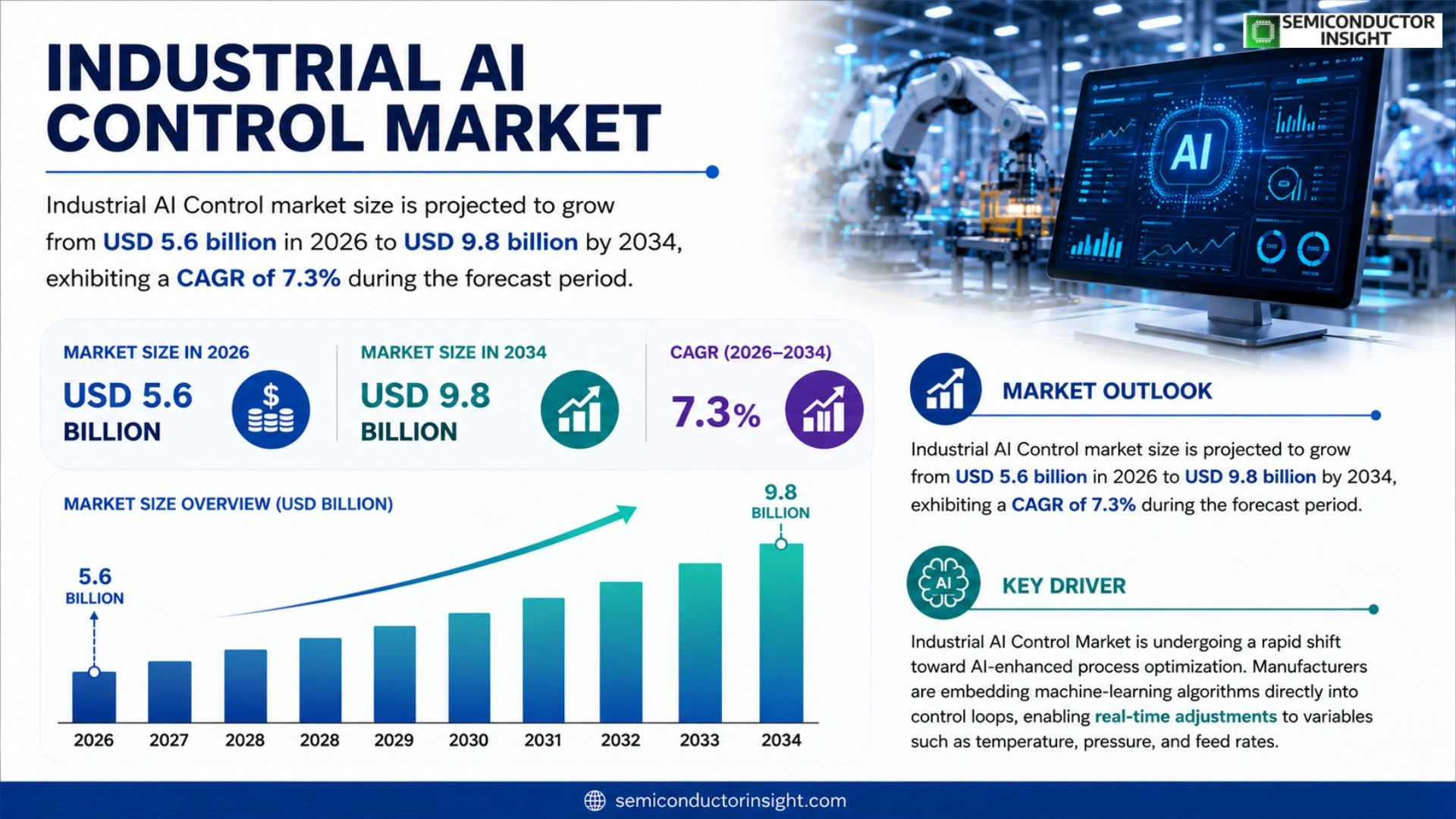
Global Industrial AI Control market size was valued at USD 5.2 billion in 2025. The market is projected to grow from USD 5.6 billion in 2026 to USD 9.8 billion by 2034, exhibiting a CAGR of 7.3% during the forecast period.
Industrial AI Control refers to the integration of artificial‑intelligence algorithms with conventional process‑control hardware, enabling real‑time optimization, autonomous decision‑making and predictive maintenance across manufacturing plants, energy networks and logistics hubs.
The market accelerates because manufacturers are pursuing Industry 4\.0 digital transformation while rising demand for edge‑computing analytics fuels adoption of smart controllers.Furthermore, strategic collaborations,such as Siemens partnering with NVIDIA on AI‑enabled control platforms,expand the ecosystem. Key players including Siemens,ABB,Rockwell Automation,Schneider Electric and Honeywell continue heavy R&D investment and portfolio expansion.
MARKET DRIVERS
Growing Adoption of AI‑Enabled Automation
Industrial AI Control Market is being propelled by manufacturers seeking higher throughput and lower defect rates. Advanced AI algorithms now enable real‑time process adjustments, which translates into up to 15% productivity gains in high‑mix production lines.
Increasing Data Connectivity
5G roll‑outs and edge‑cloud integrations have reduced latency, allowing AI control loops to operate within sub‑second windows. Companies that embed AI at the edge report a 20% reduction in downtime compared with legacy PLC‑only systems.
➤ “AI‑driven control architectures are now the default blueprint for new plants launched after 2023.”
Energy‑intensive sectors such as steel and chemicals are also investing heavily, attracted by the promise of significant carbon‑footprint reductions through optimized load management.
MARKET CHALLENGES
Integration Complexity
Legacy control hardware often lacks the open interfaces required for seamless AI integration. As a result, projects experience schedule overruns of 30% on average, eroding expected ROI.
Other Challenges
Talent Shortage
The scarcity of engineers proficient in both industrial automation and machine learning forces firms to rely on external consultants, inflating implementation costs.
Regulatory compliance is another hurdle; standards for safety‑critical AI decisions are still evolving, creating uncertainty for manufacturers operating in highly regulated jurisdictions.
MARKET RESTRAINTS
High Capital Expenditure
Deploying AI controllers requires substantial upfront investment in sensors, edge devices, and high‑performance compute. Small‑ to medium‑sized enterprises often find the payback period exceeding five years, limiting adoption.
Cybersecurity concerns also act as a restraint. Connecting control loops to broader networks expands the attack surface, and many firms postpone AI projects until robust security frameworks are verified.
Finally, incompatibility with entrenched legacy systems forces companies to run parallel architectures, increasing operational complexity and maintenance overhead.
MARKET OPPORTUNITIES
Edge AI Deployment
Edge computing enables AI models to execute locally, reducing latency and bandwidth costs. This creates a sizable opportunity for vendors offering plug‑and‑play AI modules tailored to specific equipment families.
Predictive maintenance, powered by AI‑driven anomaly detection, is expected to generate multi‑billion‑dollar revenue streams as manufacturers shift from reactive to condition‑based servicing.
Custom AI solutions that incorporate domain‑specific knowledge,such as metallurgical process optimization,present a differentiated value proposition, allowing early adopters to capture market share quickly.
Industrial AI Control Market Trends
AI‑Driven Process Optimization
Industrial AI Control Market is undergoing a rapid shift toward AI‑enhanced process optimization. Manufacturers are embedding machine‑learning algorithms directly into control loops, enabling real‑time adjustments to variables such as temperature, pressure, and feed rates. This integration reduces material waste, shortens production cycles, and raises overall equipment effectiveness. By exploiting high‑frequency sensor data, plants move from reactive maintenance to predictive strategies that anticipate component degradation before downtime occurs. The convergence of traditional automation hardware with AI also supports autonomous decision‑making in energy‑intensive operations, allowing systems to respond instantly to load fluctuations and sustainability targets.
Other Trends
Edge Computing Integration
Edge computing is becoming a cornerstone of Industrial AI Control Market as data latency and bandwidth constraints intensify. Deploying AI models at the edge allows factories to process massive data streams locally, delivering sub‑second response times for safety‑critical control actions. This architecture also reduces dependence on cloud connectivity, enhancing resilience against network outages. As edge hardware becomes more power‑efficient, manufacturers can scale AI capabilities across dispersed sites while maintaining consistent performance and security standards.
Strategic Partnerships and Ecosystem Expansion
Strategic collaborations are accelerating the maturity of Industrial AI Control Market. Leading system integrators are joining forces with AI technology providers to create unified platforms that combine proprietary control hardware with advanced analytics. These partnerships broaden the ecosystem, offering standardized interfaces and shared development roadmaps that lower integration barriers for end users. Continuous R&D investment from major players ensures a pipeline of next‑generation controllers capable of handling increasingly complex AI workloads, reinforcing the market’s growth trajectory.
COMPETITIVE LANDSCAPE
Key Industry Players
Industrial AI Control Market – Competitive Overview
Industrial AI Control Market, valued at approximately USD 5.2 billion in 2025, is dominated by a handful of multinational automation leaders that combine deep process‑control expertise with AI research capabilities. Siemens, leveraging its partnership with NVIDIA, offers AI‑enabled control platforms that integrate edge‑computing analytics into traditional PLC architectures, positioning it as the de‑facto market anchor. ABB and Rockwell Automation follow closely, expanding their portfolios through heavy R&D investment in predictive‑maintenance algorithms and autonomous decision‑making modules. Schneider Electric and Honeywell round out the core group, each delivering end‑to‑end solutions that span energy management, factory automation, and logistics optimization, thereby creating a consolidated market structure where a few large players capture the bulk of enterprise contracts while setting industry standards for safety and interoperability.
Beyond the dominant tier, a diverse set of niche and regionally strong players contributes to the market’s depth and innovation velocity. Mitsubishi Electric and Yokogawa provide specialty AI controllers tailored for high‑precision process industries, while Bosch Rexroth targets the robotics and motion‑control segment with modular AI edge nodes. Emerson and GE Digital deliver AI‑driven asset‑performance platforms that complement their historical control hardware legacy. Emerging challengers such as Uptake, Falkonry, and SparkCognition bring pure‑software AI analytics that integrate with legacy PLCs, expanding the ecosystem for mid‑size manufacturers. Additionally, European specialist Avedo and Japanese firm Advantech supply low‑latency AI edge gateways that enable real‑time optimization in smart factories, reinforcing the competitive landscape with a blend of established and agile innovators.
List of Key Industrial AI Control Companies Profiled
- Siemens
- ABB
- Rockwell Automation
- Schneider Electric
- Honeywell
- Mitsubishi Electric
- Yokogawa
- Bosch Rexroth
- Emerson
- GE Digital
- Uptake
- Falkonry
- SparkCognition
- Avedo
- Advantech
Segment Analysis:
| Segment Category | Sub-Segments | Key Insights |
| By Type |
|
Predictive AI Controllers
|
| By Application |
|
Process Optimization
|
| By End User |
|
Automotive Manufacturing
|
| By Deployment Mode |
|
On‑Premise Edge Controllers
|
| By Industry Vertical |
|
Heavy Machinery
|
Regional Analysis: North America
United States
The manufacturing sector in the United States is undergoing a significant transformation, with a growing emphasis on automation and data-driven decision-making. This shift is creating a strong impetus for the adoption of Industrial AI Control Market solutions to enhance production processes and improve overall operational performance. The integration of AI in manufacturing is not just about automation; it’s about creating smarter, more responsive, and more efficient factories.
Predictive maintenance is emerging as a critical application of Industrial AI Control Market in the United States. By leveraging AI algorithms to analyze sensor data and identify potential equipment failures, businesses can proactively schedule maintenance, minimizing downtime and reducing costly repairs. This approach significantly enhances operational reliability and maximizes asset utilization. The ROI on predictive maintenance initiatives is proving compelling for many industrial organizations.
As industrial systems become increasingly connected and reliant on AI, cybersecurity has emerged as a paramount concern. Protecting critical infrastructure and sensitive data from cyber threats is a major focus for businesses and government agencies in the United States. Robust cybersecurity measures are essential to ensuring the safe and reliable operation of Industrial AI Control Market systems.
Despite the growing adoption of Industrial AI Control Market, a significant skills gap exists in the United States. There is a shortage of qualified professionals with the expertise to develop, deploy, and maintain AI-powered control systems. Addressing this skills gap through training and education initiatives is crucial for sustained market growth.
Europe
Europe represents a significant and evolving market for Industrial AI Control Market solutions. While adoption rates might lag slightly behind the United States, the region is experiencing substantial growth, particularly in countries like Germany, France, and the United Kingdom. The emphasis on sustainability and resource efficiency is driving demand for AI-powered solutions that optimize energy consumption and reduce environmental impact. The strong regulatory environment and focus on data privacy, as exemplified by GDPR, are shaping the development and deployment of Industrial AI Control Market technologies in Europe. Several European initiatives are promoting Industry 4.0 and digital transformation, further accelerating the adoption of AI in industrial settings. Businesses are actively exploring the potential of Industrial AI Control Market to enhance competitiveness and meet evolving customer demands. The integration of AI is seen as vital for maintaining European industrial leadership in the global market.
Asia-Pacific
The Asia-Pacific region is poised to become the fastest-growing market for Industrial AI Control Market in the coming years. Countries like China, Japan, and South Korea are investing heavily in digital transformation and Industry 4.0 initiatives. The region’s large manufacturing base and increasing industrial automation are driving a surge in demand for AI-powered control systems. The availability of cost-effective talent and a supportive government environment are further fueling market expansion. The focus on smart manufacturing and the development of advanced industrial ecosystems are key trends in the Asia-Pacific region. While data privacy and security concerns remain, the potential for Industrial AI Control Market to enhance productivity and efficiency is attracting significant investment.
South America
South America presents a promising, yet relatively nascent, market for Industrial AI Control Market. Brazil and Argentina are the leading economies in the region and are showing increasing interest in adopting AI technologies to modernize their industries. The demand for Industrial AI Control Market is primarily driven by the need for improved operational efficiency in sectors such as agriculture, mining, and manufacturing. However, challenges related to infrastructure development, access to finance, and a shortage of skilled professionals are hindering wider adoption. Government initiatives aimed at promoting technological innovation and attracting foreign investment could accelerate the growth of Industrial AI Control Market in South America.
Middle East & Africa
The Middle East & Africa region is witnessing a gradual but steady growth Industrial AI Control Market. Countries like Saudi Arabia and the United Arab Emirates are investing heavily in diversifying their economies and developing advanced industrial sectors. The demand for Industrial AI Control Market is driven by the need for improved efficiency in oil and gas, construction, and manufacturing industries. The region’s focus on smart cities and infrastructure development is also creating opportunities for AI-powered control systems. Challenges related to regulatory frameworks, data security, and a lack of skilled talent need to be addressed to unlock the full potential of Industrial AI Control Market in this region.
Report Scope
This market research report provides a comprehensive analysis of the Industrial AI Control Market , covering the forecast period 2026–2034. It offers detailed insights into market dynamics, technological advancements, competitive landscape, and key trends shaping the industry.
Key focus areas of the report include:
- Market Overview: The report begins with an overview outlining its current market scenario, key growth indicators, and industry transformation drivers. It discusses macroeconomic factors, demand–supply balance, regulatory landscape, and the strategic role of semiconductors in powering advancements across industries such as automotive, telecommunications, consumer electronics, and industrial automation.
- Market Size & Forecast: Historical data and future projections for revenue, unit shipments, and market value across major regions and segments.
- Segmentation Analysis: Detailed breakdown by product type, technology, application, and end-user industry to identify high-growth segments and investment opportunities.
- Regional Insights: Insights into market performance across North America, Europe, Asia-Pacific, Latin America, and the Middle East & Africa, including country-level analysis where relevant.
- Competitive Landscape: Profiles of leading market participants, including their product offerings, R&D focus, manufacturing capacity, pricing strategies, and recent developments such as mergers, acquisitions, and partnerships.
- Technology Trends & Innovation: Assessment of emerging technologies, integration of AI/IoT, semiconductor design trends, fabrication techniques, and evolving industry standards.
- Market Drivers & Restraints: Evaluation of factors driving market growth along with challenges, supply chain constraints, regulatory issues, and market-entry barriers.
- Stakeholder Insights: Insights for component suppliers, OEMs, system integrators, investors, and policymakers regarding the evolving ecosystem and strategic opportunities.
Primary and secondary research methods are employed, including interviews with industry experts, data from verified sources, and real-time market intelligence to ensure the accuracy and reliability of the insights presented.
FREQUENTLY ASKED QUESTIONS:
What is the current market size of Industrial AI Control Market?
-> Industrial AI Control Market was valued at USD 5.2 billion in 2025 and is expected to reach USD 9.8 billion by 2034.
Which key companies operate Industrial AI Control Market?
-> Key players include Siemens, ABB, Rockwell Automation, Schneider Electric and Honeywell, among others.
What are the key growth drivers?
-> Key growth drivers include Industry 4.0 digital transformation, rising demand for edge‑computing analytics, and strategic AI‑enabled controller collaborations.
Which region dominates the market?
-> The reference does not provide specific regional dominance information.
What are the emerging trends?
-> Emerging trends include AI‑enabled control platforms, edge‑computing integration, and increased adoption of smart controllers in Industry 4.0 environments.

Get Sample Report PDF for Exclusive Insights
Report Sample Includes
- Table of Contents
- List of Tables & Figures
- Charts, Research Methodology, and more...
 Download Sample Report PDF