Key Statistics
Key Takeaways
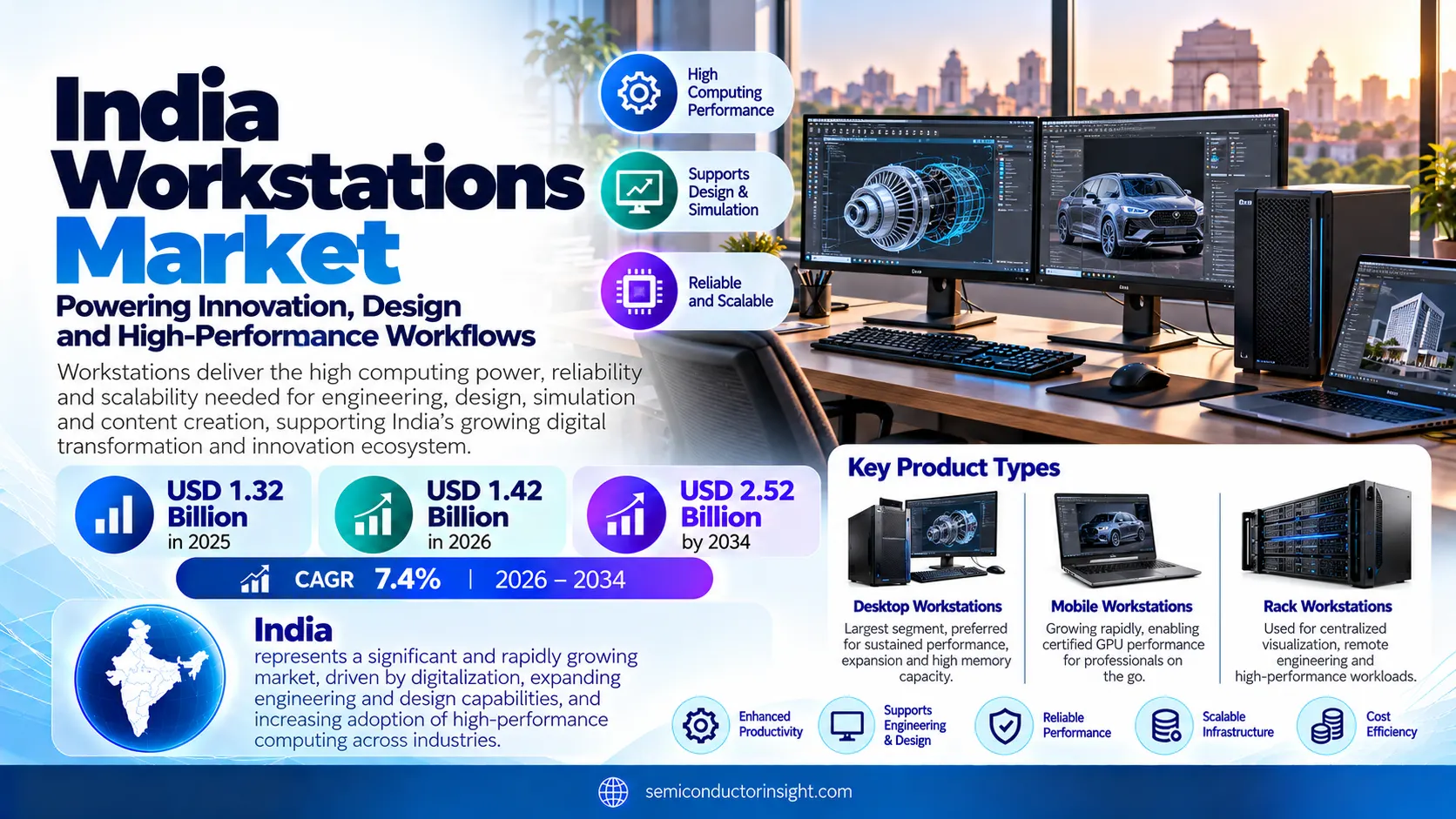
- The market is valued at USD 1.32 billion in 2025 and is projected to reach USD 2.52 billion by 2034, representing a 7.4% CAGR over 2026–2034.
- Desktop Workstations is a major product segment, while adjacent variants are expanding as performance, integration and cost requirements evolve.
- CAD/BIM & Engineering is a leading application area, supported by demand across Media & Entertainment, AI & Data Science.
- South & West India is the largest market in 2025 based on current demand, manufacturing concentration and ecosystem maturity.
India Workstations Market Overview
India Workstations are professional desktop, mobile and rack computers engineered for sustained engineering, design, visualization, simulation, media and scientific workloads. Compared with mainstream PCs, they typically offer certified professional graphics, larger memory capacity, stronger thermals, expanded storage and enterprise support that reduce risk when running critical CAD, CAE, content and data applications.
India’s demand is widening beyond traditional CAD and animation into AI development, digital engineering and data science. Current workstation platforms now combine high-core-count CPUs with NVIDIA RTX PRO or Radeon Pro graphics, large ECC-capable memory and fast NVMe storage. This creates a broader replacement cycle as enterprises move advanced visualization and AI experimentation closer to individual engineering teams.
Segment Analysis: By Type
Desktop workstations remain the largest value segment because engineering, design and simulation users need sustained thermals, memory capacity and expansion. Mobile workstations are growing faster as professionals require certified GPU performance away from fixed offices, while rack systems serve centralized visualization and remote engineering. Within this segment, customers increasingly compare lifecycle support, qualification requirements, integration effort and total ownership cost rather than relying on a single specification or upfront price.
| Type | Market relevance |
|---|---|
| Desktop Workstations | Highest expandability and sustained performance. |
| Mobile Workstations | Portable professional performance with certified graphics. |
| Rack Workstations | Centralized remote workstation and datacenter use. |
Segment Analysis: By Application
CAD, BIM and engineering form the largest installed base, while AI and data science are the fastest-growing workloads as local model development, data preprocessing and visualization move onto professional systems with larger GPU memory and ECC-capable configurations. Within this segment, customers increasingly compare lifecycle support, qualification requirements, integration effort and total ownership cost rather than relying on a single specification or upfront price.
| Application | Market relevance |
|---|---|
| CAD/BIM & Engineering | Largest established professional workload. |
| Media & Entertainment | Rendering, animation and visual effects. |
| AI & Data Science | Fastest-growing local accelerator workload. |
| Scientific & Technical Computing | Simulation, research and analytics. |
| Financial & Other Professional Workloads | Risk, trading, visualization and specialist software. |
Segment Analysis: By Processor Platform
Intel Xeon and Core Ultra platforms retain broad OEM support, while AMD Ryzen Threadripper and Ryzen Pro expand in highly threaded rendering, engineering and content workflows. Platform choice increasingly reflects software certification, core count, memory channels and accelerator compatibility rather than CPU brand alone. Within this segment, customers increasingly compare lifecycle support, qualification requirements, integration effort and total ownership cost rather than relying on a single specification or upfront price.
| Processor Platform | Market relevance |
|---|---|
| Intel Xeon / Core Ultra | Broad OEM and ISV support. |
| AMD Ryzen Threadripper / Ryzen Pro | Strong multi-core and workstation performance. |
| Other | Specialized or entry configurations. |
Segment Analysis: By Graphics Class
Professional GPUs dominate high-value workstations because ISV certification, ECC memory and large VRAM pools matter in CAD, simulation and visualization. High-end consumer GPUs appear in creator and AI systems where raw compute is more important than certified application support. Within this segment, customers increasingly compare lifecycle support, qualification requirements, integration effort and total ownership cost rather than relying on a single specification or upfront price.
| Graphics Class | Market relevance |
|---|---|
| Professional GPU | ISV-certified and large-memory workflows. |
| High-End Consumer GPU | High compute per rupee in creator/AI systems. |
| Integrated / Entry Professional Graphics | Entry design and office visualization. |
Regional Analysis
South and West India lead because Bengaluru, Hyderabad, Chennai, Pune and Mumbai concentrate engineering services, IT, automotive, media, semiconductor design and enterprise R&D. North India adds strong government, AEC and corporate demand, while other regions expand through manufacturing digitization. Regional share also reflects supplier depth, engineering support, manufacturing concentration and the speed at which new India Workstations designs can move from evaluation into repeat deployment.
| Region | 2025 Position | Growth Outlook | Demand Profile |
|---|---|---|---|
| South India | Largest | Strong | IT, semiconductor design and engineering led |
| West India | Large | Strong | Automotive, BFSI, media and engineering led |
| North India | Large | Moderate-strong | Government, AEC and enterprise led |
| East India | Developing | Moderate | Engineering, education and public sector led |
| Central & Other India | Emerging | Moderate | Manufacturing and education led |
Detailed Regional Blocks
Why is South India important to this market?
South India leads through Bengaluru, Hyderabad and Chennai, where global engineering centers, semiconductor teams, automotive R&D and software companies deploy high-end mobile and desktop workstations. Demand is particularly strong for systems supporting CAD, AI, verification and visualization. In South India, procurement decisions also depend on service coverage, qualification resources, logistics and long-term availability, so ecosystem maturity can materially influence adoption even when core technology performance is similar.
| Country / Subregion | Role | Market Context |
|---|---|---|
| Bengaluru | Engineering and AI hub | Semiconductor, software and product-development teams drive premium systems. |
| Hyderabad | Technology and life-science hub | Data science and engineering expand demand. |
| Chennai | Automotive and industrial hub | CAD/CAE and manufacturing design support desktop workstations. |
- HP India positions the Z6 G5 for computational fluid dynamics, finite-element analysis, ML/AI, model training and visualization.
- Dell India currently offers Precision towers with NVIDIA RTX PRO Blackwell options and large ECC-memory configurations.
- Lenovo India markets ThinkStation and ThinkPad P systems specifically for AI/data science, AEC and product-development workflows.
Why is West India important to this market?
West India is a large workstation market through Pune, Mumbai and Gujarat, combining automotive engineering, finance, animation, architecture and industrial design. Desktop systems remain important where users need multiple GPUs, PCIe expansion and large local storage. In West India, procurement decisions also depend on service coverage, qualification resources, logistics and long-term availability, so ecosystem maturity can materially influence adoption even when core technology performance is similar.
| Country / Subregion | Role | Market Context |
|---|---|---|
| Pune | Automotive and engineering | CAD/CAE and product design sustain workstation demand. |
| Mumbai | Finance and media | Visualization, content and quantitative workloads support high-end systems. |
| Gujarat | Industrial engineering | Manufacturing modernization expands professional computing. |
- Rack and tower workstations are useful when firms need centralized compute but retain workstation-class software environments.
- Professional GPU certification remains important in automotive and AEC applications where software stability matters.
- Local AI workflows are increasing demand for larger GPU memory configurations.
Why is North India important to this market?
Delhi NCR and nearby markets support workstation demand from architecture, engineering, public-sector research, media and enterprise technology teams. Mobile workstations are especially relevant for consultants and field-based design professionals. In North India, procurement decisions also depend on service coverage, qualification resources, logistics and long-term availability, so ecosystem maturity can materially influence adoption even when core technology performance is similar.
| Country / Subregion | Role | Market Context |
|---|---|---|
| Delhi NCR | Corporate and government hub | AEC, engineering and public-sector users drive demand. |
| Noida / Gurugram | IT and design cluster | Software, VFX and engineering teams support mobile workstations. |
- Mobile workstation adoption benefits from professional GPUs now being offered in thinner 16-inch systems.
- ISV-certified configurations reduce deployment risk for design firms with standardized CAD applications.
- Enterprise support and warranty coverage influence procurement alongside hardware specifications.
Why is East India important to this market?
East India is smaller but growing through industrial engineering, education and government modernization. Kolkata is the main commercial hub, while technical institutes and manufacturing sites create specialist demand. In East India, procurement decisions also depend on service coverage, qualification resources, logistics and long-term availability, so ecosystem maturity can materially influence adoption even when core technology performance is similar.
| Country / Subregion | Role | Market Context |
|---|---|---|
| West Bengal | Largest eastern market | Engineering and education create professional-computing demand. |
| Odisha | Industrial design niche | Mining and manufacturing projects support CAD and simulation. |
- Educational engineering labs often prioritize upgradeable tower workstations.
- Industrial users value reliability and vendor support over consumer gaming performance.
- Price sensitivity favors carefully configured mid-range professional systems.
Why is Central & Other India important to this market?
Central and tier-two Indian cities are emerging as engineering and design locations as manufacturing investment spreads beyond traditional metros. Demand centers on affordable desktop and mobile workstations with strong lifecycle support. In Central & Other India, procurement decisions also depend on service coverage, qualification resources, logistics and long-term availability, so ecosystem maturity can materially influence adoption even when core technology performance is similar.
| Country / Subregion | Role | Market Context |
|---|---|---|
| Madhya Pradesh | Manufacturing and education | Technical design and research create demand. |
| Rajasthan | AEC and industrial growth | Professional visualization supports new projects. |
- Remote collaboration allows professional users outside major metros to access centralized engineering teams.
- Mobile workstations provide flexibility where office infrastructure is distributed.
- Channel and service availability remain important barriers outside major cities.
Competitive Landscape
HP, Dell and Lenovo dominate branded workstation supply, supported by NVIDIA, AMD and Intel platform ecosystems. Competition centers on ISV certification, professional GPU range, memory capacity, AI-ready configurations, thermal design, service coverage and the ability to support standardized enterprise images.
| Company | Position | Relevant capability |
|---|---|---|
| HP India | Key participant | Z workstation portfolio spans mainstream towers, high-end multi-GPU systems and AI-focused professional configurations. |
| Dell Technologies India | Key participant | Precision towers, rack and mobile workstations with current NVIDIA RTX PRO Blackwell graphics options. |
| Lenovo India | Key participant | ThinkStation and ThinkPad P families positioned for AI, AEC, engineering and media workflows. |
| Apple India | Key participant | Competes through product breadth, integration capability, qualification and customer support. |
| ASUS India | Key participant | Competes through product breadth, integration capability, qualification and customer support. |
| Acer India | Key participant | Competes through product breadth, integration capability, qualification and customer support. |
Production Capacity Analysis
Workstation supply depends on enterprise PC assembly, CPUs, professional GPUs, ECC memory, power supplies and service logistics rather than unique fabrication capacity. High-end GPU availability can still constrain shipment timing because workstation vendors share accelerator supply with broader AI markets. Scaling output without degrading consistency requires stable upstream materials, disciplined process control and final testing that catches performance drift before products reach high-value customer systems.
India is primarily an end market and systems-integration location, with major OEMs sourcing globally. Effective capacity depends on channel inventory, enterprise configuration services and nationwide support, especially for large engineering organizations that standardize on a narrow set of certified models. Second-source planning and regional technical support therefore become increasingly important as deployments expand and buyers seek supply continuity without repeating lengthy qualification work.
Market Dynamics
The strongest market shift is the convergence of workstation and AI-development hardware. Professional users increasingly need local GPU compute for inference, model tuning and data preparation alongside established CAD, rendering and simulation tasks. This raises average system memory and GPU requirements. This is changing competitive behavior because vendors increasingly sell system-level value, workflow integration and lifecycle economics rather than an isolated component specification.
At the same time, cloud rendering and virtual workstations compete with physical devices. Local systems remain attractive where latency, data sovereignty, software licensing or predictable performance matter, creating a hybrid market rather than a simple move from desktop hardware to cloud-only computing. Buyers consequently evaluate total ownership cost, qualification effort and roadmap stability across the life of a program instead of focusing only on initial purchase price.
Market Drivers
| Factor | Analyst Interpretation |
|---|---|
| Engineering digitization | CAD, CAE, BIM and simulation remain foundational workstation workloads. |
| AI development | Local model experimentation increases GPU and memory requirements. |
| Media and animation growth | Rendering, VFX and game development support professional graphics demand. |
| Enterprise refresh cycles | New CPU and GPU platforms encourage standardized fleet upgrades. |
Market Restraints
| Factor | Analyst Interpretation |
|---|---|
| High upfront cost | Professional GPUs, ECC memory and support raise prices above mainstream PCs. |
| Cloud alternatives | Virtual workstations can replace some local high-end systems. |
| GPU supply volatility | Premium accelerators may face allocation during AI investment cycles. |
| Long replacement cycles | Well-specified workstations can remain useful for several years. |
Market Opportunities
| Factor | Analyst Interpretation |
|---|---|
| AI workstations | Large-memory professional GPUs create a new category between PCs and servers. |
| Remote rack workstations | Centralized systems can serve distributed engineers securely. |
| Indian engineering GCCs | Global capability centers expand high-end design and simulation seats. |
| Mobile professional systems | Thinner certified workstations broaden adoption beyond fixed engineering desks. |
Supply Chain Analysis
The value chain combines CPUs, professional GPUs, memory, storage, chassis engineering, ISV certification, enterprise imaging and support. System vendors assemble these elements into validated configurations for specific professional workloads. Traceability and coordination between component suppliers, integrators and end users are important because failures found late in the chain can be far more expensive than the underlying part itself.
| Supply Chain Stage | Role in the Market |
|---|---|
| CPU, GPU and memory platforms | Intel, AMD and NVIDIA provide the main compute components. |
| OEM system engineering | HP, Dell, Lenovo and others design thermals, power and expansion around workstation workloads. |
| ISV certification and enterprise integration | Systems are tested with CAD, CAE and content software and prepared for fleet deployment. |
| Channel and lifecycle support | Indian distributors and service organizations support procurement, warranty and upgrades. |
Recent Developments
| Date | Development | Source |
|---|---|---|
| 2026 | Dell India currently offers Precision tower and rack workstations with NVIDIA RTX PRO Blackwell professional graphics, including 96GB-class configurations on high-end systems. | Dell Technologies |
| 2026 | HP India positions current Z workstations for CAD/BIM, 3D rendering, CFD, finite-element analysis, AI model training and computer vision. | HP India |
| 2026 | Lenovo India continues its ThinkStation and ThinkPad P workstation portfolio for AI/data science, AEC, product development and media workloads. | Lenovo India |
Report Scope & Segmentation
| Scope Item | Coverage |
|---|---|
| Base Year | 2025 |
| Estimated Year | 2026 |
| Forecast Period | 2026–2034 |
| 2025 Market Size | USD 1.32 billion |
| 2026 Estimated Size | USD 1.42 billion |
| 2034 Forecast Size | USD 2.52 billion |
| CAGR (2026–2034) | 7.4% |
| Largest Market in 2025 | South & West India |
| Category | Professional Computing / Workstations / India |
| By Type | Desktop Workstations, Mobile Workstations, Rack Workstations |
| By Application | CAD/BIM & Engineering, Media & Entertainment, AI & Data Science, Scientific & Technical Computing, Financial & Other Professional Workloads |
| By Processor Platform | Intel Xeon / Core Ultra, AMD Ryzen Threadripper / Ryzen Pro, Other |
| By Graphics Class | Professional GPU, High-End Consumer GPU, Integrated / Entry Professional Graphics |
Frequently Asked Questions
What is the 2025 market size of the India Workstations market?
The market is valued at USD 1.32 billion in 2025.
What is the projected 2034 market size of the India Workstations market?
The market is projected to reach USD 2.52 billion by 2034.
What is the CAGR of the India Workstations market from 2026 to 2034?
The market is expected to expand at a CAGR of 7.4% during 2026–2034.
Which region leads the India Workstations market?
South & West India is the largest market in 2025 based on the current demand, manufacturing and deployment structure.
Which type segment is important in the India Workstations market?
Desktop Workstations is a major segment, while adjacent product variants are gaining share as performance and integration requirements evolve.
What is the main application for India Workstations products?
CAD/BIM & Engineering is a leading application, with additional growth coming from Media & Entertainment, AI & Data Science.
What drives growth in the India Workstations market?
CAD, CAE, BIM and simulation remain foundational workstation workloads.
What is a key restraint for the India Workstations market?
Professional GPUs, ECC memory and support raise prices above mainstream PCs.
Which companies participate in the India Workstations market?
Key participants include HP India, Dell Technologies India, Lenovo India, Apple India, ASUS India, alongside other specialized suppliers and system companies.
What technology trend is shaping the India Workstations market?
Large-memory professional GPUs create a new category between PCs and servers.
Research Sources & Evidence Base
View research sources used for this overview.
- Dell Technologies India — Precision 7960 Tower: Current professional GPU, OS and workstation configuration options in India. Source
- HP India — Z Workstation Desktops: Current workload positioning and CPU/GPU/memory capability. Source
- Lenovo India — ThinkStation and ThinkPad P Workstations: Current professional workstation families and application positioning. Source
Get Sample Report PDF for Exclusive Insights
Report Sample Includes
- Table of Contents
- List of Tables & Figures
- Charts, Research Methodology, and more...
 Download Sample Report PDF