Key Statistics
Key Takeaways
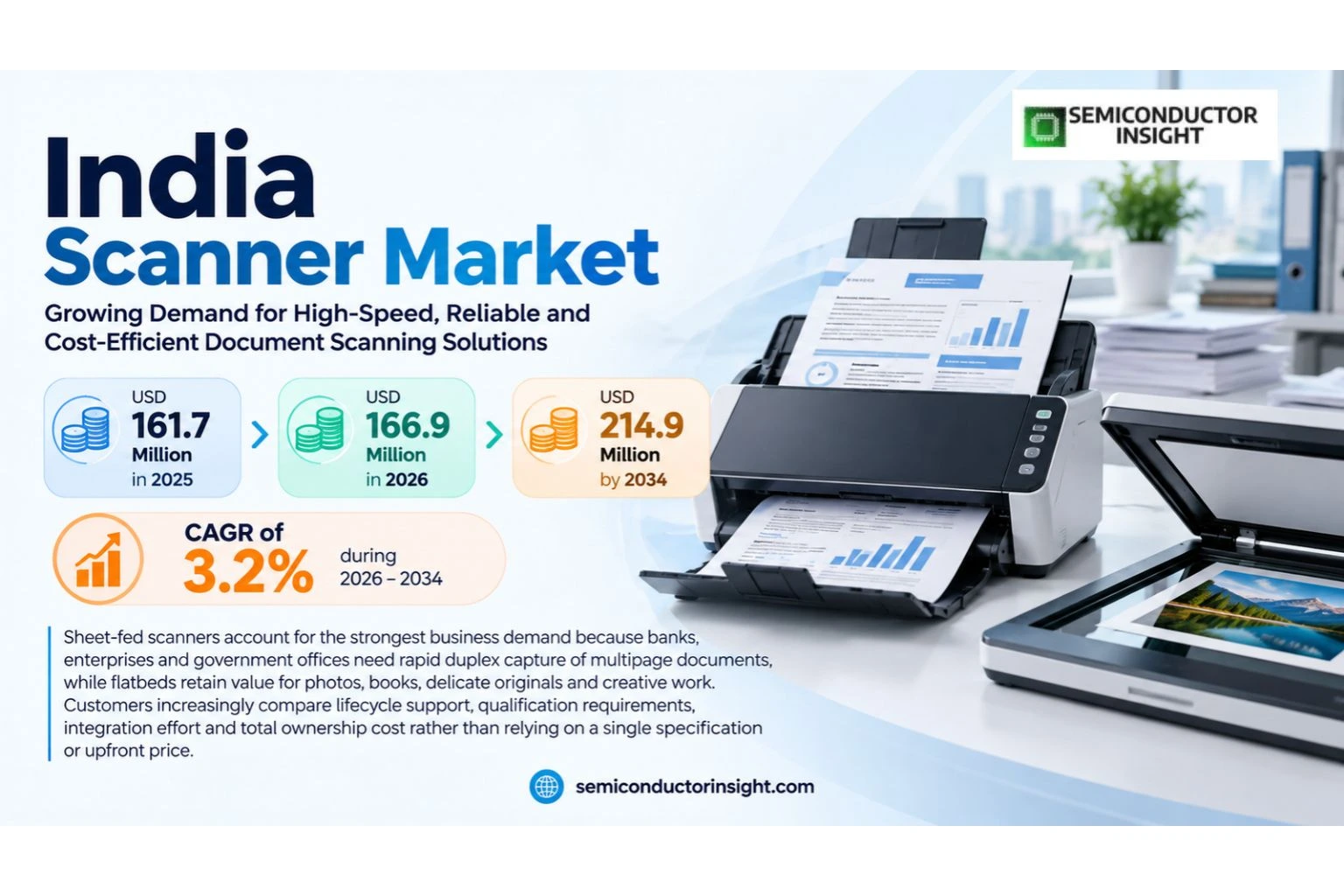
- The market is valued at USD 161.7 million in 2025 and is projected to reach USD 214.9 million by 2034, representing a 3.2% CAGR over 2026–2034.
- Flatbed is a major product segment, while adjacent variants are expanding as performance, integration and cost requirements evolve.
- Art & Design is a leading application area, supported by demand across Engineering, Industrial.
- West & South India is the largest market in 2025 based on the current concentration of demand, manufacturing capacity and ecosystem maturity.
India Scanner Market Overview
India Scanner market demand is anchored in document digitization, records management, banking, healthcare, education and professional imaging. Dedicated scanners remain relevant where organizations need reliable duplex feeding, OCR-ready image quality, controlled workflows and higher daily duty cycles than multifunction printers or smartphone scanning can provide. Commercial adoption of India Scanner products is therefore shaped by system-level productivity, integration requirements, reliability expectations and the cost of replacing established workflows or technologies.
Market growth is moderate because smartphone apps and multifunction devices absorb low-volume consumer use, but enterprise scanners continue to improve through faster feeding, compact vertical paths, paper protection, network connectivity and workflow software. This keeps replacement demand healthy in offices and regulated environments where repeatability, security and bulk processing matter more than convenience alone.
Segment Analysis: By Type
Sheet-fed scanners account for the strongest business demand because banks, enterprises and government offices need rapid duplex capture of multipage documents, while flatbeds retain value for photos, books, delicate originals and creative work. Within this segment, customers increasingly compare lifecycle support, qualification requirements, integration effort and total ownership cost rather than relying on a single specification or upfront price.
| Type | Market relevance |
|---|---|
| Flatbed | Photos, books and fragile originals. |
| Sheet-Fed | Highest office workflow productivity. |
| Handheld | Mobile and field capture. |
| Drum Scanner | Specialist prepress and archival use. |
| Portable Scanner | Compact travel and mobile business use. |
Segment Analysis: By Application
Industrial, engineering and office-document workflows provide recurring demand, while education and healthcare create large distributed installed bases where digitization, OCR and secure document capture support operational efficiency. Within this segment, customers increasingly compare lifecycle support, qualification requirements, integration effort and total ownership cost rather than relying on a single specification or upfront price.
| Application | Market relevance |
|---|---|
| Art & Design | Photo, artwork and design digitization. |
| Engineering | Drawings, plans and technical records. |
| Industrial | Quality, logistics and production documents. |
| Science & Education | Libraries, labs and classrooms. |
| Healthcare | Patient and administrative records. |
| Others | General office and personal scanning. |
Segment Analysis: By Connectivity
USB remains the simplest connection for individual desks, Ethernet supports shared departmental scanners, and wireless connectivity is gaining value where devices must serve flexible workspaces without dedicated PCs. Within this segment, customers increasingly compare lifecycle support, qualification requirements, integration effort and total ownership cost rather than relying on a single specification or upfront price.
| Connectivity | Market relevance |
|---|---|
| USB | Simple direct connection. |
| Ethernet | Shared workgroup deployment. |
| Wi-Fi / Wireless | Flexible cable-free workflows. |
Segment Analysis: By End User
Enterprises and government organizations drive the highest utilization, while healthcare and education benefit from structured digitization. Creative professionals and consumers remain smaller but stable niches for high-resolution flatbed and photo scanning. Within this segment, customers increasingly compare lifecycle support, qualification requirements, integration effort and total ownership cost rather than relying on a single specification or upfront price.
| End User | Market relevance |
|---|---|
| Enterprises | Highest document volumes. |
| Government & Education | Large digitization programs. |
| Healthcare | Compliance and patient-record workflows. |
| Creative Professionals | High-resolution image quality needs. |
| Consumers | Occasional personal-document use. |
Regional Analysis
Demand is strongest in western and southern business centers where banking, IT services, healthcare, education and enterprise document workflows are concentrated, while public-sector digitization supports broader national adoption. Regional share also depends on supplier depth, local engineering support, channel structure and the speed at which new India Scanner designs can move from evaluation into repeat deployment.
| Region | 2025 Position | Growth Outlook | Demand Profile |
|---|---|---|---|
| West India | Largest | Steady | Enterprise, BFSI and services led |
| South India | Large | Strong | IT, healthcare and education led |
| North India | Large public-sector market | Moderate | Government, education and enterprise led |
| East India | Developing | Moderate | Government, education and industry led |
| Central & Other India | Emerging | Moderate | Government and SME led |
Detailed Regional Blocks
Why is West India important to this market?
Mumbai, Pune and Ahmedabad create a dense base of banking, insurance, IT and professional-services users that rely on document capture, archiving and workflow automation. High-volume sheet-fed scanners are especially relevant where compliance and transaction records must be digitized quickly and consistently. In West India, buyers also weigh service coverage, logistics, qualification resources and long-term availability, so ecosystem maturity can materially influence adoption even when core product performance is similar.
| Country / Subregion | Role | Market Context |
|---|---|---|
| Maharashtra | Largest commercial base | BFSI, IT and enterprise services support high scanner utilization. |
| Gujarat | Industrial and administrative demand | Engineering and government workflows create recurring demand. |
- Epson India lists business sheet-fed models ranging from compact DS-C330 units to high-volume DS-32000 systems.
- The DS-C330 scans up to 30 ppm/60 ipm and handles passports, long paper and mixed media.
- The DS-32000 supports up to 40,000 pages per day for high-volume environments.
Why is South India important to this market?
Bengaluru, Hyderabad and Chennai support strong scanner demand through IT services, hospitals, universities and corporate shared-service centers. Network scanners and compact departmental devices fit distributed digital-workflow environments. In South India, buyers also weigh service coverage, logistics, qualification resources and long-term availability, so ecosystem maturity can materially influence adoption even when core product performance is similar.
| Country / Subregion | Role | Market Context |
|---|---|---|
| Karnataka | IT and services hub | Large offices and digital workflows support shared scanners. |
| Tamil Nadu | Healthcare and manufacturing | Hospital and industrial records create demand. |
| Telangana | Technology and government services | Digitization programs support deployment. |
- OCR and searchable-PDF workflows are increasingly important in shared-service and back-office operations.
- Wireless and Ethernet models reduce dependence on dedicated scanning PCs.
- Healthcare users value dependable feeding and image quality for administrative records.
Why is North India important to this market?
Delhi NCR and surrounding states support demand from ministries, courts, education, corporate offices and service providers. Public-sector record conversion sustains both production scanning and flatbed use for mixed document types. In North India, buyers also weigh service coverage, logistics, qualification resources and long-term availability, so ecosystem maturity can materially influence adoption even when core product performance is similar.
| Country / Subregion | Role | Market Context |
|---|---|---|
| Delhi NCR | Government and corporate hub | Large digitization projects create high-volume requirements. |
| Uttar Pradesh | Public-sector and education demand | Distributed offices broaden scanner installations. |
- Large ADF capacities reduce operator intervention in bulk document projects.
- Flatbeds remain useful for bound, fragile and non-standard originals.
- National service coverage is important for government procurement.
Why is East India important to this market?
East India has a smaller commercial base but stable scanner demand from public administration, universities, utilities and industrial enterprises. Kolkata is the principal regional hub. In East India, buyers also weigh service coverage, logistics, qualification resources and long-term availability, so ecosystem maturity can materially influence adoption even when core product performance is similar.
| Country / Subregion | Role | Market Context |
|---|---|---|
| West Bengal | Largest eastern market | Government and enterprise users drive demand. |
| Odisha | Industrial and public-sector demand | Records and engineering documentation support use. |
- Price-sensitive buyers favor durable mid-range scanners with strong local support.
- Shared scanners can replace multiple desktop units in departmental workflows.
- Digitization demand rises as archives move toward searchable records.
Why is Central & Other India important to this market?
Central and tier-two cities are expanding through e-governance, healthcare and SME digitization. Demand favors compact, reliable devices that are easy to service and integrate with common document-management software. In Central & Other India, buyers also weigh service coverage, logistics, qualification resources and long-term availability, so ecosystem maturity can materially influence adoption even when core product performance is similar.
| Country / Subregion | Role | Market Context |
|---|---|---|
| Madhya Pradesh | Government and education demand | Digitization creates distributed installations. |
| Rajasthan | Public-sector and SME demand | Administrative workflows support steady use. |
- Compact sheet-fed scanners fit smaller offices with limited desk space.
- Portable units serve field workers and mobile professionals.
- Service-network reach materially affects procurement decisions.
Competitive Landscape
Epson, Canon, Ricoh/PFU, HP, Brother and other vendors compete across portable, flatbed and production scanning. Differentiation centers on feed reliability, duty cycle, OCR software, network integration, security and service coverage rather than optical resolution alone.
| Company | Position | Relevant capability |
|---|---|---|
| Epson India | Key participant | Broad portfolio from portable and compact sheet-fed devices to high-volume A3 scanners, supported by a large Indian service network. |
| Canon India | Key participant | Broad imaging and office-document ecosystem with scanner and multifunction products. |
| Ricoh / PFU | Key participant | Strong fi-series presence in business document capture and production scanning. |
| HP India | Key participant | Competes through product breadth, integration capability, qualification and customer support. |
| Brother India | Key participant | Competes through product breadth, integration capability, qualification and customer support. |
| Kodak Alaris | Key participant | Competes through product breadth, integration capability, qualification and customer support. |
| Xerox India | Key participant | Competes through product breadth, integration capability, qualification and customer support. |
| Panasonic India | Key participant | Competes through product breadth, integration capability, qualification and customer support. |
Production Capacity Analysis
Scanner supply is based on image sensors, optics, rollers, motors, controllers and final assembly rather than leading-edge semiconductor capacity. Manufacturers can scale output efficiently, but high-volume production scanners require more robust mechanical engineering and reliability testing. Scaling output without degrading quality requires stable upstream materials, disciplined process control and final test coverage that catches performance drift before products reach customers.
India is primarily a consumption and distribution market, with products supplied through global manufacturing networks. Effective market capacity depends heavily on channel inventory, software integration and local service coverage because enterprises expect rapid maintenance for high-utilization devices. Second-source planning and regional technical support therefore become increasingly important as deployments grow and customers seek continuity without repeating lengthy qualification cycles.
Market Dynamics
Dedicated scanner demand is shifting away from casual home use and toward workflow-driven business applications. Smartphone scanning is sufficient for occasional capture, but it cannot match high-speed duplex feeding, paper protection, unattended ADF operation or predictable OCR quality in large document batches. This is changing competitive behavior because vendors increasingly sell system-level value, workflow integration and lifecycle economics rather than an isolated component specification.
Vendors are responding with smaller footprints, wireless connectivity and workflow software that routes files directly into searchable PDFs, network folders and document-management systems. The commercial value proposition is therefore productivity and process control rather than simply converting paper into an image. Buyers consequently evaluate total ownership cost, qualification effort and roadmap stability across the life of a program instead of focusing only on initial purchase price.
Market Drivers
| Factor | Analyst Interpretation |
|---|---|
| Enterprise digitization | Banks, offices and service centers continue moving paper records into searchable digital workflows. |
| Government records modernization | Public agencies and education institutions maintain large scanning requirements. |
| Healthcare digitization | Hospitals and clinics need dependable capture of administrative and historical records. |
| Compact high-speed products | Smaller scanners with strong duty cycles expand deployment in constrained offices. |
Market Restraints
| Factor | Analyst Interpretation |
|---|---|
| Smartphone scanning substitution | Low-volume users can avoid dedicated hardware. |
| Multifunction-printer competition | Office MFPs absorb basic scanning needs. |
| Moderate replacement cycles | Reliable scanners often remain in service for many years. |
| Price sensitivity | SMEs may prioritize low upfront cost over advanced workflow functions. |
Market Opportunities
| Factor | Analyst Interpretation |
|---|---|
| Network workflow scanners | Direct scanning to cloud and enterprise systems can reduce PC dependence. |
| High-volume digitization projects | Government, legal and archival programs create production-scanner demand. |
| Portable business scanners | Field workers and hybrid employees need compact capture devices. |
| AI-assisted document capture | Automatic classification and extraction can raise software value around scanner hardware. |
Supply Chain Analysis
The supply chain combines image sensors, optics, sheet-feed mechanics, controllers, enclosures and document-capture software. Enterprise value increasingly comes from the full workflow, including OCR, security, routing and service support. Traceability and coordination between component suppliers, integrators and end users are important because failures found late in the chain can be far more expensive than the underlying part itself.
| Supply Chain Stage | Role in the Market |
|---|---|
| Optics and image sensors | CIS or CCD assemblies capture document images. |
| Mechanical feed systems | Rollers, ADFs and paper-protection mechanisms control document movement. |
| Scanner electronics and firmware | Controllers manage imaging, connectivity and device functions. |
| Software and service channels | OCR, workflow applications and field support complete enterprise deployments. |
Recent Developments
| Date | Development | Source |
|---|---|---|
| 2026 | Epson India continues a broad document-scanner portfolio including compact, network and high-volume sheet-fed models for business workflows. | Epson India |
| 2026 | Epson's DS-C330 provides 30 ppm/60 ipm duplex scanning in an ultra-compact design with passport and long-document handling. | Epson India |
| 2026 | Epson's DS-32000 supports A3 duplex scanning and a daily duty cycle up to 40,000 pages for production environments. | Epson India |
Report Scope & Segmentation
| Scope Item | Coverage |
|---|---|
| Base Year | 2025 |
| Estimated Year | 2026 |
| Forecast Period | 2026–2034 |
| 2025 Market Size | USD 161.7 million |
| 2026 Estimated Size | USD 166.9 million |
| 2034 Forecast Size | USD 214.9 million |
| CAGR (2026–2034) | 3.2% |
| Largest Market in 2025 | West & South India |
| Category | Imaging Systems / Document Scanners / India |
| By Type | Flatbed, Sheet-Fed, Handheld, Drum Scanner, Portable Scanner |
| By Application | Art & Design, Engineering, Industrial, Science & Education, Healthcare, Others |
| By Connectivity | USB, Ethernet, Wi-Fi / Wireless |
| By End User | Enterprises, Government & Education, Healthcare, Creative Professionals, Consumers |
Frequently Asked Questions
What is the 2025 market size of the India Scanner market?
The market is valued at USD 161.7 million in 2025.
What is the projected 2034 market size of the India Scanner market?
The market is projected to reach USD 214.9 million by 2034.
What is the CAGR of the India Scanner market from 2026 to 2034?
The market is expected to expand at a CAGR of 3.2% during 2026–2034.
Which region leads the India Scanner market?
West & South India is the largest market in 2025 based on the current demand, manufacturing and deployment structure.
Which type segment is important in the India Scanner market?
Flatbed is a major segment, while adjacent product variants are gaining share as performance and integration requirements evolve.
What is the main application for India Scanner products?
Art & Design is a leading application, with additional growth coming from Engineering, Industrial.
What drives growth in the India Scanner market?
Banks, offices and service centers continue moving paper records into searchable digital workflows.
What is a key restraint for the India Scanner market?
Low-volume users can avoid dedicated hardware.
Which companies participate in the India Scanner market?
Key participants include Epson India, Canon India, Ricoh / PFU, HP India, Brother India, alongside other specialized suppliers and system companies.
What technology trend is shaping the India Scanner market?
Direct scanning to cloud and enterprise systems can reduce PC dependence.
Research Sources & Evidence Base
View research sources used for this overview.

Get Sample Report PDF for Exclusive Insights
Report Sample Includes
- Table of Contents
- List of Tables & Figures
- Charts, Research Methodology, and more...
 Download Sample Report PDF