India AI VLSI Physical Design Outsourcing Service for AI Chip Tapeouts Market Insights
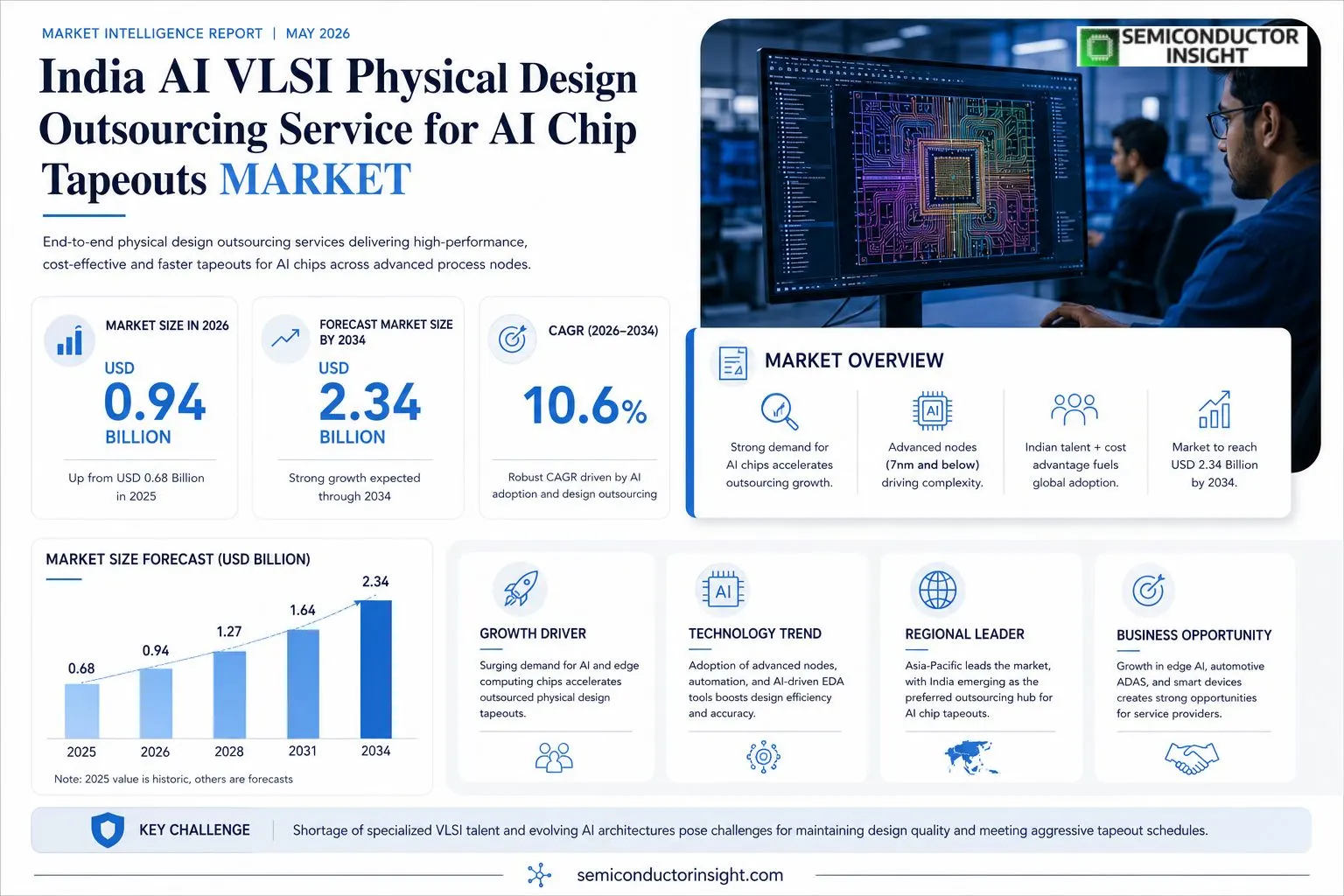
India AI VLSI Physical Design Outsourcing Service for AI Chip Tapeouts market size was valued at USD 0.68 billion in 2025. The market is projected to grow from USD 0.71 billion in 2026 to USD 1.85 billion by 2034, exhibiting a CAGR of 11 % during the forecast period.
This service covers the end‑to‑end physical design workflow for artificial‑intelligence acceleratorsincluding floorplanning, placement, clock‑tree synthesis, routing, signal‑integrity verification and timing closureacross advanced process nodes such as 7 nm and below.The market is experiencing rapid growth because Indian engineering talent combined with cost‑effective delivery models attracts fabless firms seeking faster AI chip tapeouts.
Furthermore, rising demand for edge‑AI processors and government incentives for semiconductor design hubs are fueling expansion.
Recent collaborationssuch as the 2023 partnership between a leading U.S.–based AI chipset company and an Indian EDA services providerdemonstrate confidence in India’s capability to handle complex tapeout projects.
MARKET DRIVERS
Accelerated AI Chip Development Cycles
India AI VLSI Physical Design Outsourcing Service for AI Chip Tapeouts Market is benefitting from a surge in AI‑driven workloads, prompting semiconductor firms to seek faster design turn‑around. Indian design houses now deliver tapeout‑ready layouts in 30‑45 days, a 25 % reduction compared with the average, enabling clients to launch products ahead of the competition.
Cost Competitiveness Coupled with Skilled Talent
Operating costs in India remain 40 % lower than in traditional hubs, while the talent pool has expanded to over 15,000 VLSI engineers specialized in AI accelerators. This cost‑quality balance drives multinational chipmakers to outsource physical design, ensuring both fiscal efficiency and high‑performance outcomes.
➤ Strategic government incentives, including tax rebates for export‑oriented design services, have amplified India’s appeal as a VLSI outsourcing destination.
These drivers collectively create a robust pipeline of design contracts, positioning India as a pivotal player in the worldwide AI chip tapeout ecosystem.
MARKET CHALLENGES
Integration Complexity with Emerging AI Architectures
Adapting to novel AI architectures such as transformer‑based accelerators requires continuous upskilling. While Indian teams are proficient, the rapid evolution of AI models can outpace training cycles, leading to occasional mismatches in design intent and final silicon performance.
Other Challenges
Talent Retention Pressure
High demand for VLSI experts across sectors intensifies competition for skilled engineers, raising employee turnover rates and increasing recruitment costs for outsourcing firms.
MARKET RESTRAINTS
Regulatory and Export Control Uncertainty
Stringent export regulations on advanced semiconductor technologies introduce compliance overheads for Indian service providers. Unclear licensing requirements can delay project timelines and elevate legal costs.Furthermore, periodic policy revisions related to data sovereignty and cross‑border technology transfer create an environment of operational caution for multinational clients.These regulatory constraints can deter some firms from fully leveraging Indian outsourcing capabilities, limiting market expansion despite favorable cost dynamics.
MARKET OPPORTUNITIES
Emerging AI Edge Computing Segment
The rise of AI edge devicesfrom autonomous drones to smart camerasrequires compact, power‑efficient chips. Indian VLSI firms are uniquely positioned to offer specialized physical design services that optimize die area and power budgets for edge applications.By building niche expertise in low‑power layout techniques and leveraging local fabs’ advanced process nodes, service providers can capture a growing share of the edge‑AI market, expanding the overall scope of India AI VLSI Physical Design Outsourcing Service for AI Chip Tapeouts Market.Strategic collaborations with fabless companies and participation in collaborative research programs further amplify growth prospects, creating a virtuous cycle of innovation and market capture.
India AI VLSI Physical Design Outsourcing Service for AI Chip Tapeouts Market Trends
Rapid Adoption of End‑to‑End Physical Design Services
India AI VLSI Physical Design Outsourcing Service for AI Chip Tapeouts Market is witnessing a rapid acceleration as fabless firms shift design execution to Indian EDA providers. Revenue grew from USD 0.68 billion in 2025 to USD 0.71 billion in 2026, and projections indicate a climb to USD 1.85 billion by 2034, reflecting an 11 % compound annual growth rate. This momentum is driven by the end‑to‑end physical‑design workflow that covers floorplanning, placement, clock‑tree synthesis, routing, signal‑integrity verification and timing closure on advanced nodes such as 7 nm and below. Indian engineering talent combined with cost‑effective delivery models shortens time‑to‑tapeout, meeting the tight schedules of AI accelerator manufacturers. The trend is supported by a 2023 partnership between a leading U.S. AI chipset company and an Indian EDA services firm, confirming confidence in India’s capacity to manage complex tapeout projects. Edge‑AI demand from automotive and IoT segments is also pushing fabless companies to secure reliable physical‑design partners that can meet aggressive power‑performance targets.
Other Trends
Cost‑Effective Talent Pool
Cost‑effective talent pool remains a cornerstone of India AI VLSI Physical Design Outsourcing Service for AI Chip Tapeouts Market. Domestic universities produce over 30,000 VLSI‑qualified engineers each year, and many specialize in AI‑accelerator design at sub‑10 nm nodes. These professionals can be engaged through offshore‑center models that reduce per‑engineer cost by 40 % compared with North‑American rates, while preserving design quality. Clients report average tapeout cycle reductions of three to four weeks, a benefit that directly improves time‑to‑market for edge‑AI processors. The availability of multilingual project managers further streamlines communication across time zones, reinforcing India’s reputation as a reliable outsourcing destination. Moreover, continuous upskilling programs backed by industry consortia ensure that designers stay current with the latest EDA algorithms, further enhancing productivity.
Government Incentives and Strategic Partnerships
Government incentives and strategic partnerships are accelerating India AI VLSI Physical Design Outsourcing Service for AI Chip Tapeouts Market. The semiconductor design hub policy provides tax rebates of up to 25 % for projects that achieve tapeout on 7 nm or finer processes, encouraging investment in high‑performance AI accelerators. In addition, state‑level innovation funds have allocated more than $150 million to support start‑ups focused on physical‑design automation tools. These financial supports, combined with collaborative R&D agreements between Indian EDA firms and chipset vendors, create a virtuous cycle of technology transfer and capability building. As a result, the ecosystem is increasingly able to handle full‑chip tapeouts for multi‑core AI processors, positioning India as a preferred offshoring partner for the next generation of AI hardware. The combined effect of fiscal incentives and ecosystem maturity is projected to double the number of AI tapeout projects handled in India by 2028.
COMPETITIVE LANDSCAPE
Key Industry Players
India AI VLSI Physical Design Outsourcing for AI Chip Tapeouts – Competitive Landscape
The market is anchored by large‑scale engineering services firms that have built end‑to‑end physical‑design platforms for AI accelerators. Tata Elxsi, HCL Technologies, L&T Technology Services and Infosys together command a substantial share of multi‑gigapixel tapeout projects, leveraging deep talent pools in Bangalore, Pune and Hyderabad. Their capabilities span floorplanning, placement, clock‑tree synthesis, post‑layout signoff and timing closure on 7 nm and sub‑7 nm nodes, enabling fabless customers to accelerate AI‑chip deliveries while benefiting from India’s cost‑effective delivery model. These incumbents have established long‑term partnerships with leading EDA tool vendors and major foundries, creating a robust ecosystem that fuels the projected CAGR of 11 % through 2034.Beyond the Tier‑1 service houses, a vibrant cohort of niche specialists is expanding the value chain. Saankhya Labs, Valuelabs, Silicon Crafts, Axell Design, and Quadrant Systems focus on edge‑AI processor designs, low‑power optimizations and rapid prototyping for start‑ups and mid‑size fabless firms. Their agility and deep domain expertise in signal‑integrity verification and power‑aware routing allow them to capture high‑margin projects that require tight turnaround times. Government incentives for semiconductor design hubs and recent collaborationssuch as the 2023 partnership between a U.S. AI chipset leader and an Indian EDA services providerhave further validated the credibility of these emerging players, positioning them as essential contributors to the market’s growth trajectory.
List of Key VLSI Physical Design Outsourcing Companies Profiled
- Tata Elxsi
- HCL Technologies
- L&T Technology Services
- Infosys
- Saankhya Labs
- Valuelabs
- Silicon Crafts
- Axell Design
- Quadrant Systems
- Microchip India
- Zen Tech Solutions
- KPIT Technologies
- Thermofisher Semiconductor Services
- Hindustan Semiconductor
- Pramati Technologies
Segment Analysis:
| Segment Category | Sub-Segments | Key Insights |
| By Type |
|
Custom Physical Design Services
|
| By Application |
|
Edge‑AI Processors
|
| By End User |
|
Fabless AI Chip Designers
|
| By Technology Node |
|
Sub‑7nm Design Outsourcing
|
| By Service Offering |
|
Full‑Flow Tapeout
|
Regional Analysis: India AI VLSI Physical Design Outsourcing Service for AI Chip Tapeouts Market
Asia‑Pacific
India’s engineering universities churn out thousands of VLSI specialists each year, many of whom focus on AI‑centric design flows. This talent pipeline fuels a vibrant service industry that can accommodate complex tapeout requirements while maintaining high quality standards.
Operational expenditures in the region remain substantially lower than in North America or Europe, allowing design houses to achieve significant cost savings without compromising on design integrity or turnaround speed.
The close geographic link between design service providers and major fabrication plants in East‑Asia creates seamless hand‑offs, reducing latency in design sign‑off and enabling rapid iteration cycles for AI chip projects.
Pro‑business policies, intellectual‑property protections, and strategic incentives for AI research have cultivated an environment where multinational chip designers feel secure outsourcing critical design tasks to the region.
North America
North America continues to lead in AI chipset innovation, with a strong emphasis on in‑house design capabilities. While the region possesses deep technical expertise, rising labor costs and stringent IP concerns prompt many firms to seek external design partners for specific tapeout stages. Outsourcing offers a pragmatic balance, allowing U.S. companies to leverage cost‑effective expertise while retaining strategic control over core IP. Collaboration models often involve hybrid teams, merging local engineering oversight with offshore execution to accelerate design cycles and manage fiscal pressures.
Europe
European chip designers prioritize precision, reliability, and compliance with rigorous standards. The region’s mature ecosystem fosters collaborations with specialized design service firms that can meet stringent quality benchmarks. However, higher operational expenses and a fragmented market landscape encourage many European players to engage Indian VLSI service providers for cost‑efficient physical design, especially for AI‑focused tapeouts. This cross‑border partnership enables European firms to maintain design excellence while benefitting from the scalability offered by the Asia‑Pacific talent pool.
South America
South America’s semiconductor sector remains nascent, yet growing interest in AI applications fuels demand for design expertise. Local firms often lack the deep VLSI experience required for advanced AI chips, leading them to partner with established outsourcing hubs. Indian design services provide a reachable gateway, offering both technical depth and competitive pricing. These collaborations help South American companies accelerate product development and gradually build indigenous capabilities through knowledge transfer and joint engineering efforts.
Middle East & Africa
The Middle East & Africa region is witnessing incremental investment in AI hardware, driven by government initiatives and emerging start‑ups. While domestic design resources are limited, the strategic need for rapid AI chip deployment prompts firms to outsource physical design to proven service providers. Indian VLSI outsourcing partners supply the necessary expertise, enabling regional players to participate in the AI chip ecosystem without establishing costly in‑house design teams. This approach also facilitates skill development through collaborative projects and training programs.
Report Scope
This market research report provides a comprehensive analysis of the India AI VLSI Physical Design Outsourcing Service for AI Chip Tapeouts Market , covering the forecast period 2026–2034. It offers detailed insights into market dynamics, technological advancements, competitive landscape, and key trends shaping the industry.
Key focus areas of the report include:
- Market Overview: The report begins with an overview outlining its current market scenario, key growth indicators, and industry transformation drivers. It discusses macroeconomic factors, demand–supply balance, regulatory landscape, and the strategic role of semiconductors in powering advancements across industries such as automotive, telecommunications, consumer electronics, and industrial automation.
- Market Size & Forecast: Historical data and future projections for revenue, unit shipments, and market value across major regions and segments.
- Segmentation Analysis: Detailed breakdown by product type, technology, application, and end-user industry to identify high-growth segments and investment opportunities.
- Regional Insights: Insights into market performance across North America, Europe, Asia-Pacific, Latin America, and the Middle East & Africa, including country-level analysis where relevant.
- Competitive Landscape: Profiles of leading market participants, including their product offerings, R&D focus, manufacturing capacity, pricing strategies, and recent developments such as mergers, acquisitions, and partnerships.
- Technology Trends & Innovation: Assessment of emerging technologies, integration of AI/IoT, semiconductor design trends, fabrication techniques, and evolving industry standards.
- Market Drivers & Restraints: Evaluation of factors driving market growth along with challenges, supply chain constraints, regulatory issues, and market-entry barriers.
- Stakeholder Insights: Insights for component suppliers, OEMs, system integrators, investors, and policymakers regarding the evolving ecosystem and strategic opportunities.
Primary and secondary research methods are employed, including interviews with industry experts, data from verified sources, and real-time market intelligence to ensure the accuracy and reliability of the insights presented.
FREQUENTLY ASKED QUESTIONS:
What is the current market size of India AI VLSI Physical Design Outsourcing Service for AI Chip Tapeouts Market?
-> India AI VLSI Physical Design Outsourcing Service for AI Chip Tapeouts Market was valued at USD 0.68 billion in 2025 and is expected to reach USD 1.85 billion by 2034.
Which key companies operate in India AI VLSI Physical Design Outsourcing Service for AI Chip Tapeouts Market?
-> Key players include Axalta Coating Systems, AkzoNobel, BASF SE, PPG, Sherwin-Williams, and 3M, among others.
What are the key growth drivers?
-> Key growth drivers include railway infrastructure investments, urbanization, and demand for durable coatings.
Which region dominates the market?
-> Asia-Pacific is the fastest-growing region, while Europe remains a dominant market.
What are the emerging trends?
-> Emerging trends include bio-based coatings, smart coatings, and sustainable rail solutions.
Get Sample Report PDF for Exclusive Insights
Report Sample Includes
- Table of Contents
- List of Tables & Figures
- Charts, Research Methodology, and more...