India AI Chip Design Services Market Insights
Global AI chip design services market size was valued at USD 3.48 billion in 2025. The market is projected to grow from USD 3.48 billion in 2025 to USD 7.21 billion by 2034, exhibiting a CAGR of 7.6% during the forecast period.
AI chip design services encompass architecture definition, RTL coding, verification, power optimization and IP integration tailored for artificial‑intelligence workloads such as deep‑learning inference and training accelerators. Providers collaborate closely with semiconductor fabs and system integrators to deliver silicon‑ready designs that meet latency‑sensitive and energy‑efficient requirements.
The sector is gaining momentum because enterprises across manufacturing, healthcare and finance are deploying edge‑AI solutions that demand specialized processors. Government programmes like India’s National Programme on Artificial Intelligence and rising venture capital inflows are encouraging domestic startups while multinational firms such as Intel India, Qualcomm India and Tata Elxsi expand their service portfolios.
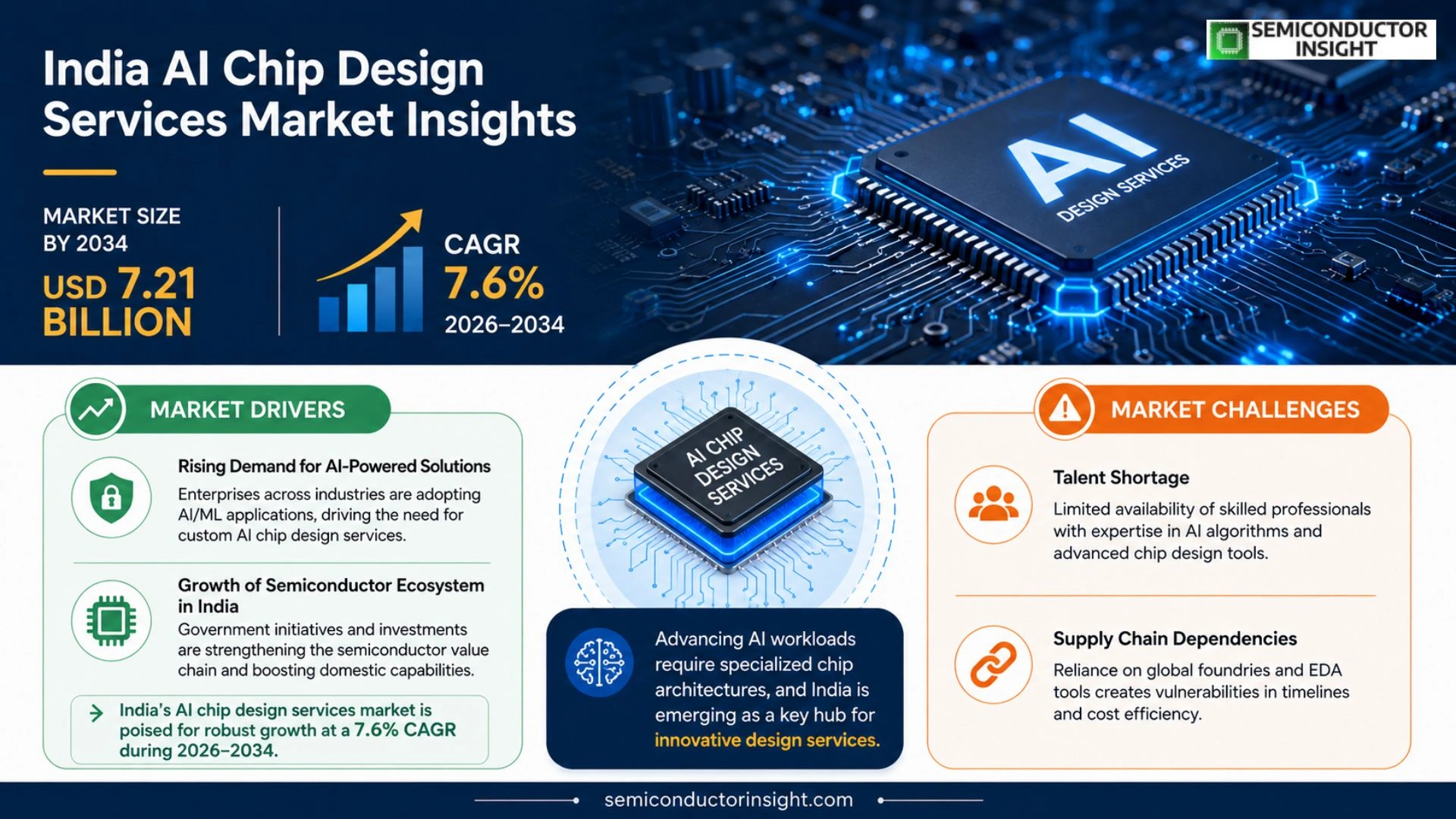
MARKET DRIVERS
Rising Demand for Edge AI
India AI Chip Design Services Market is gaining traction as enterprises shift workloads to edge devices to reduce latency and bandwidth costs. Companies in automotive, healthcare and smart‑city domains are commissioning custom silicon that can execute inference locally, a trend that pushes design firms to expand capacity and refine toolchains.
Government Incentives Accelerating Adoption
Recent policy measures, including tax rebates for R&D and dedicated AI accelerator funds, are lowering the effective cost of chip development for start‑ups and midsize firms. This fiscal backdrop encourages firms to move from off‑the‑shelf solutions to differentiated designs, thereby creating a pipeline of projects for service providers.
➤ Design houses that bundle verification, power‑optimisation and post‑silicon support are increasingly becoming preferred partners for AI‑driven product launches.
Because AI workloads demand high compute density while staying within strict power envelopes, the market is rewarding providers that can deliver fast‑turnaround prototypes and robust validation frameworks. The competitive edge lies in the ability to shorten time‑to‑market without compromising performance.
MARKET CHALLENGES
Talent Shortage
Designing AI‑optimised chips requires expertise in both hardware architecture and machine‑learning algorithms. The pool of engineers who can bridge these domains remains limited, leading to recruitment cycles that extend project timelines and increase overhead for service firms.
Other Challenges
Cost Sensitivity
While clients appreciate the value of custom silicon, many operate under tight budget constraints. Price‑pressure forces design houses to adopt lean development models, which can restrict exploration of innovative architectures.
MARKET RESTRAINTS
Supply Chain Dependencies
Access to advanced process nodes remains uneven, with a reliance on a handful of foundries outside India. Any disruption,whether geopolitical or capacity‑related,can delay tape‑out schedules, eroding confidence in the ability of local design services to meet aggressive launch windows.
MARKET OPPORTUNITIES
Emerging Application Segments
Industries such as precision agriculture, immersive media and autonomous logistics are embryonic yet demand specialised AI accelerators. Early entrants that align design expertise with these niche use‑cases can capture premium contracts and set standards that shape subsequent market activity.
India AI Chip Design Services Market Trends
Rising Edge‑AI Demand Fuels Design Services
India AI Chip Design Services Market is feeling the pressure of a surge in edge‑AI deployments across manufacturing lines, medical imaging stations, and real‑time fraud detection platforms. Clients are no longer satisfied with generic processors; they require silicon that can execute deep‑learning inference under tight latency budgets while keeping power draw to a minimum. This shift compels design houses to prioritize architecture that merges high‑throughput matrix operations with aggressive power‑gating techniques, a combination that directly translates into faster time‑to‑market for end‑users. Consequently, service providers that can deliver end‑to‑end flows, from RTL coding through silicon validation, are seeing stronger commercial contracts and higher billable rates.
Other Trends
Government Initiatives and Talent Pipeline
National programmes aimed at accelerating artificial‑intelligence adoption have injected both policy direction and funding into the domestic ecosystem. The rollout of India’s National Programme on Artificial Intelligence has created a clear mandate for home‑grown chip design capabilities, prompting universities to expand curricula in VLSI and machine‑learning accelerators. Simultaneously, venture capital funds are earmarking capital for start‑ups that can bridge the gap between algorithmic research and manufacturable IP, reinforcing a talent pipeline that feeds design service firms with fresh engineering expertise.
Consolidation and Global Partnerships
Multinational players such as Intel India, Qualcomm India, and Tata Elxsi are deepening their footprints by forging joint ventures with local design boutiques. These collaborations enable rapid integration of globally vetted IP libraries while preserving the flexibility needed to tailor solutions for region‑specific regulatory and performance constraints. The resulting ecosystem is more interconnected, allowing smaller firms to access advanced EDA tools and fab capacity through shared agreements, thereby raising the overall quality bar for India AI Chip Design Services Market offerings.
COMPETITIVE LANDSCAPE
Key Industry Players
India AI Chip Design Services – Competitive Overview
Intel India and Qualcomm India dominate the high‑performance segment, leveraging deep R&D investments and close ties with global foundries to deliver silicon‑ready AI accelerators for data‑center and edge workloads. Tata Elxsi, long‑standing in systems integration, has translated its software‑centric expertise into a full‑stack design offering that attracts enterprises seeking end‑to‑end solutions within the Indian ecosystem. The market displays a clear tiered structure: multinational firms occupy the upper tier with broad IP portfolios, while domestic champions such as HCL Technologies and Wipro provide large‑scale design outsourcing to global chip makers, capitalising on cost‑effective talent pools. This hierarchy shapes pricing dynamics and influences client selection, as customers balance design sophistication against delivery speed and localisation requirements.
Beyond the headline names, a constellation of specialised houses adds depth to the competitive set. Cadence Design Systems and Synopsys India supply the EDA backbone that underpins most design cycles, while startups like EdgeAI Labs and InnoChip focus on low‑power inference cores for automotive and IoT applications. Analog Devices India and NXP Semiconductors India contribute niche analog and mixed‑signal IP that enhances AI silicon efficiency. Samsung R&D India and STMicroelectronics India maintain regional design centres that serve both internal product lines and external customers, creating a diverse supply of design services that can be rapidly re‑tasked to emerging AI workloads.
List of Key AI Chip Design Services Companies Profiled
- Intel India
- Qualcomm India
- Tata Elxsi
- Cadence Design Systems India
- Synopsys India
- HCL Technologies
- Wipro
- Infosys
- Tech Mahindra
- GlobalFoundries India
- STMicroelectronics India
- NXP Semiconductors India
- Analog Devices India
- Samsung R&D India
- EdgeAI Labs
- InnoChip
Segment Analysis:
| Segment Category | Sub-Segments | Key Insights |
| By Type |
|
ASIC Design Services
|
| By Application |
|
Edge AI Accelerators
|
| By End User |
|
Manufacturing
|
| By Technology |
|
Low‑Power Design
|
| By Deployment Model |
|
Turnkey Design Services
|
Regional Analysis: India AI Chip Design Services Market
Asia‑Pacific
Universities in India have redesigned curricula to embed AI hardware modules, while start‑up incubators funnel fresh graduates into design houses. This pipeline sharpens the skill set of engineers, enabling the market to deliver sophisticated chip architectures with reduced lead times.
Recent fiscal incentives and streamlined patent processes signal governmental commitment to high‑performance semiconductor design. These measures lower entry barriers for new firms and incentivize established players to expand their design capabilities within the region.
Proximity to a diversified electronics manufacturing base allows design service providers to collaborate closely with component assemblers, shortening feedback loops and enhancing design validation cycles across the value chain.
Enterprises in sectors such as automotive, telecom and healthcare are increasingly seeking bespoke AI accelerators. Their demand for localized design expertise reinforces India’s position as a preferred destination for end‑to‑end chip development services.
North America
North American firms continue to view India as a strategic design hub rather than a mere cost centre. The emphasis lies on leveraging Indian architectural ingenuity to complement domestic silicon fabrication capabilities. Organizations are allocating design budgets to Indian partners for complex system‑on‑chip projects, recognizing the advantage of having design cycles run parallel to hardware production in the United States. This collaborative model enhances time‑to‑market for AI‑enabled devices while preserving intellectual property through robust contractual frameworks.
Europe
European chip designers are attracted by India’s ability to deliver high‑fidelity simulation and verification services at scale. The continent’s focus on sustainability and energy‑efficient AI workloads aligns with Indian teams’ proficiency in low‑power architecture design. Joint ventures are emerging, particularly in automotive AI, where European OEMs rely on Indian design houses to meet stringent regulatory timelines without sacrificing performance targets.
South America
In South America, burgeoning interest in edge AI for agricultural analytics and smart city initiatives is prompting regional firms to outsource design tasks to Indian specialists. The cost advantage, coupled with the Indian market’s agility, enables South American companies to experiment with niche AI chips without the overhead of building in‑house design teams. This outsourcing trend also encourages technology transfer, gradually elevating local engineering capabilities.
Middle East & Africa
The Middle East and Africa are witnessing a gradual shift from hardware procurement to co‑development of AI processors tailored for security and fintech applications. Indian design services are positioned to provide end‑to‑end solutions that integrate with regional data centre strategies. Partnerships often revolve around customized neural network accelerators, allowing Middle Eastern firms to differentiate their product portfolios while capitalizing on India’s seasoned design workforce.
Report Scope
This market research report provides a comprehensive analysis of the India AI Chip Design Services Market , covering the forecast period 2026–2034. It offers detailed insights into market dynamics, technological advancements, competitive landscape, and key trends shaping the industry.
Key focus areas of the report include:
- Market Overview: The report begins with an overview outlining its current market scenario, key growth indicators, and industry transformation drivers. It discusses macroeconomic factors, demand–supply balance, regulatory landscape, and the strategic role of semiconductors in powering advancements across industries such as automotive, telecommunications, consumer electronics, and industrial automation.
- Market Size & Forecast: Historical data and future projections for revenue, unit shipments, and market value across major regions and segments.
- Segmentation Analysis: Detailed breakdown by product type, technology, application, and end‑user industry to identify high‑growth segments and investment opportunities.
- Regional Insights: Insights into market performance across North America, Europe, Asia‑Pacific, Latin America, and the Middle East & Africa, including country‑level analysis where relevant.
- Competitive Landscape: Profiles of leading market participants, including their product offerings, R&D focus, manufacturing capacity, pricing strategies, and recent developments such as mergers, acquisitions, and partnerships.
- Technology Trends & Innovation: Assessment of emerging technologies, integration of AI/IoT, semiconductor design trends, fabrication techniques, and evolving industry standards.
- Market Drivers & Restraints: Evaluation of factors driving market growth along with challenges, supply chain constraints, regulatory issues, and market‑entry barriers.
- Stakeholder Insights: Insights for component suppliers, OEMs, system integrators, investors, and policymakers regarding the evolving ecosystem and strategic opportunities.
Primary and secondary research methods are employed, including interviews with industry experts, data from verified sources, and real‑time market intelligence to ensure the accuracy and reliability of the insights presented.
FREQUENTLY ASKED QUESTIONS:
What is the current market size of India AI Chip Design Services Market?
-> AI chip design services market is projected to grow from USD 3.48 billion in 2025 to USD 7.21 billion by 2034, exhibiting a CAGR of 7.6%
Which key companies operate in India AI Chip Design Services Market?
-> Key players include Intel India, Qualcomm India, Tata Elxsi, among others.
What are the key growth drivers?
-> Key growth drivers include adoption of edge‑AI solutions across manufacturing, healthcare and finance, government initiatives such as India’s National Programme on Artificial Intelligence, and rising venture‑capital funding for semiconductor startups.
Which region dominates the market?
-> Asia‑Pacific is the fastest‑growing region, with India playing a pivotal role in regional growth.
What are the emerging trends?
-> Emerging trends include low‑power AI accelerator designs, integration of AI/IoT for edge devices, and silicon‑ready IP blocks for rapid time‑to‑market.

Get Sample Report PDF for Exclusive Insights
Report Sample Includes
- Table of Contents
- List of Tables & Figures
- Charts, Research Methodology, and more...
 Download Sample Report PDF