India AI-Based VLSI Verification Engineering Services Market Insights
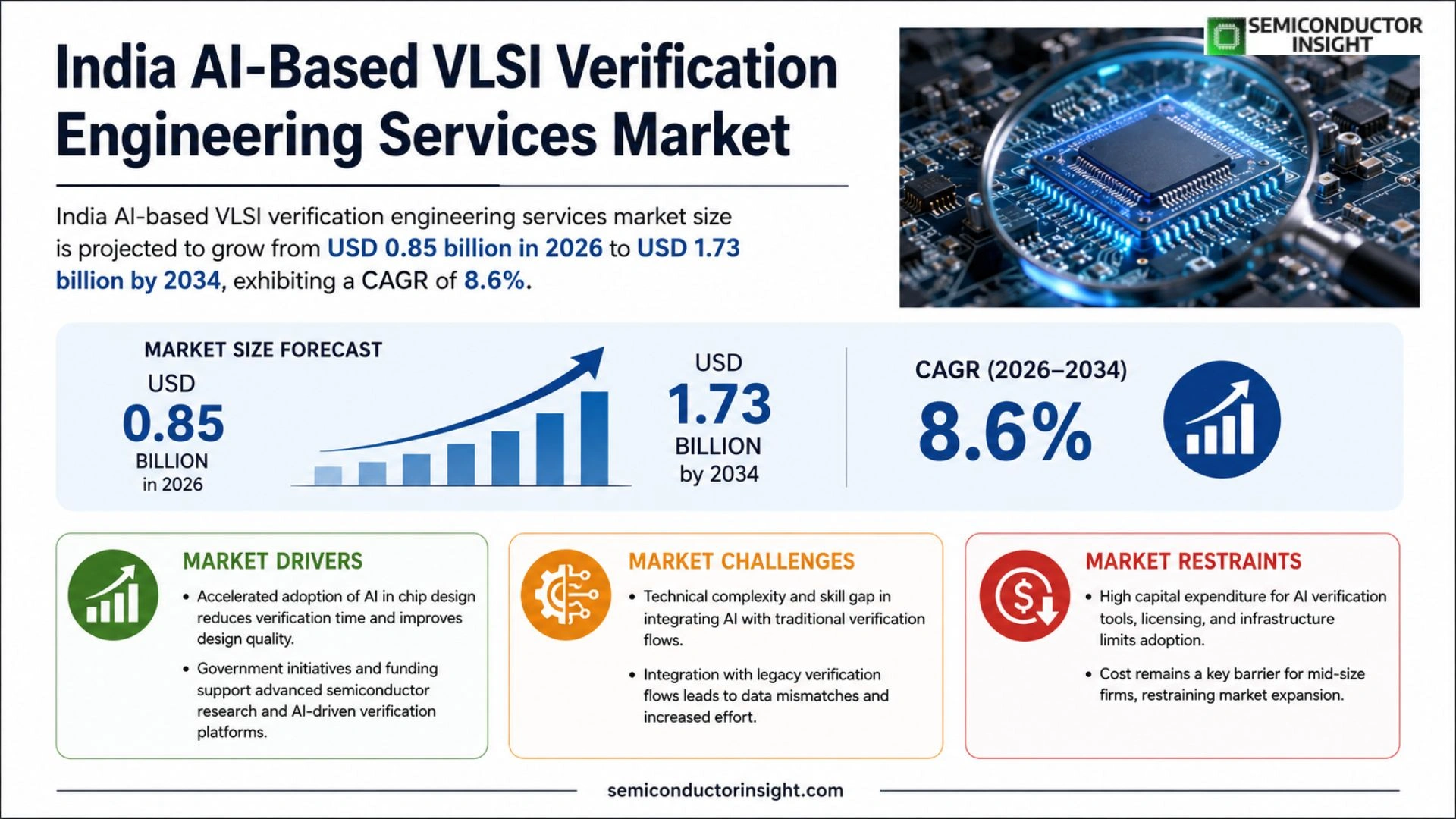
Global India AI‑based VLSI verification engineering services market size was valued at USD 0.78 billion in 2025. The market is projected to grow from USD 0.85 billion in 2026 to USD 1.73 billion by 2034, exhibiting a CAGR of 8.6% during the forecast period.
AI‑based VLSI verification engineering services encompass advanced functional verification, formal verification, and coverage analysis of integrated circuits using machine‑learning algorithms, natural‑language processing of design specifications, and automated test‑pattern generation. These services accelerate detection of design bugs, reduce turnaround time, and improve overall chip reliability.
The market is experiencing rapid growth because semiconductor design cycles are becoming increasingly complex and Indian semiconductor firms are leveraging government incentives such as the Production‑Linked Incentive scheme. Furthermore, rising adoption of autonomous vehicles, IoT devices, and data‑center processors fuels demand for higher‑quality verification solutions.
MARKET DRIVERS
Accelerated Adoption of AI in Chip Design
Design houses across India are integrating AI‑based verification engines to reduce cycle time. This shift enables faster bug detection and improves overall design quality, fueling growth in India AI-Based VLSI Verification Engineering Services Market.
Government Initiatives & Funding
Recent policy roll‑outs allocate multi‑billion rupee grants for advanced semiconductor research, directly supporting AI‑driven verification platforms. The fiscal incentives encourage both start‑ups and established firms to expand service capabilities.
➤ “AI‑enhanced verification reduces time‑to‑market by up to 30 % while trimming validation costs.”
Clients are also prioritizing compliance with emerging safety standards, prompting service providers to embed AI models that automatically generate compliance reports, thereby creating a virtuous cycle of demand.
MARKET CHALLENGES
Technical Complexity and Skill Gap
Implementing AI algorithms within traditional verification flows requires deep expertise in both semiconductor physics and machine learning. The shortage of engineers proficient in this hybrid skill set hampers rapid scaling of India AI-Based VLSI Verification Engineering Services Market.
Other Challenges
Integration with Legacy Verification Flows
Many design teams still rely on legacy tools that are not AI‑ready. Aligning new AI modules with older verification ecosystems often leads to data format mismatches and increased integration effort.
MARKET RESTRAINTS
High Capital Expenditure for Tooling
Acquiring state‑of‑the‑art AI verification suites demands substantial upfront investment. For many mid‑size firms, the cost of licensing, hardware acceleration, and model training infrastructure acts as a deterrent, constraining market expansion.
MARKET OPPORTUNITIES
Emerging Demand from Automotive & IoT Segments
Growth in safety‑critical automotive ASICs and high‑volume IoT chips is creating a fertile environment for AI‑based verification services. Companies that can tailor AI models to meet stringent functional safety standards stand to capture significant share of India AI-Based VLSI Verification Engineering Services Market.
India AI-Based VLSI Verification Engineering Services Market Trends
Increasing Design Complexity Drives Demand
India AI-Based VLSI Verification Engineering Services Market is responding to a surge in design intricacy across semiconductor projects. Machine‑learning‑enhanced verification tools now enable faster identification of functional bugs, formal inconsistencies, and coverage gaps that traditional methodologies miss. Indian design houses are adopting these AI‑driven workflows to shorten verification cycles, reduce tape‑out risk, and meet the reliability expectations of high‑performance chips. The trend is reinforced by the broader industry shift toward system‑on‑chip (SoC) integration, where hundreds of millions of transistors must be validated within compressed development windows. As a result, service providers are expanding their AI capabilities, integrating natural‑language processing for specification parsing, and automating test‑pattern generation to sustain competitive lead times.
Other Trends
Policy Support and Skill Development
Government initiatives such as the Production‑Linked Incentive (PLI) scheme are creating a favorable fiscal environment for verification service firms in India. The scheme subsidizes capital expenditure on advanced EDA tools, which accelerates the deployment of AI‑based verification platforms. Concurrently, academic collaborations and industry‑led training programs are cultivating a talent pool proficient in both VLSI design and data‑science techniques. This dual expertise reduces the reliance on overseas specialists and strengthens the domestic ecosystem. Companies like Tata Elxsi and Wipro are leveraging these policy advantages to establish dedicated AI verification centers, thereby increasing local service capacity and fostering long‑term client relationships.
Expansion into Autonomous and Edge Computing
Emerging application domains such as autonomous vehicles, Internet‑of‑Things (IoT) endpoints, and data‑center accelerators are creating new verification requirements that stress timing closure, power management, and safety compliance. Indian verification service providers are tailoring AI models to address these domain‑specific challenges, offering predictive analytics that anticipate failure modes in safety‑critical designs. The shift toward edge computing further amplifies the need for compact, low‑power chips, prompting verification teams to adopt coverage analysis techniques that guarantee functional correctness under stringent resource constraints. By aligning service portfolios with these high‑growth segments, India AI-Based VLSI Verification Engineering Services Market is positioning itself as a critical partner for global semiconductor OEMs seeking reliable, cost‑effective verification solutions.
COMPETITIVE LANDSCAPE
Key Industry Players
India AI‑Based VLSI Verification Engineering Services Market Overview
Indian AI‑driven VLSI verification segment is anchored by global EDA powerhouses that have entrenched design‑house relationships and extensive AI research capabilities. Cadence Design Systems and Synopsys Inc. dominate the high‑value formal verification and coverage analysis space, leveraging proprietary machine‑learning models to accelerate bug detection across complex SoC projects. Siemens EDA (formerly Mentor) complements this tier with its AI‑enhanced simulation suite, which many Indian fabless startups adopt to meet stringent automotive and IoT timelines. Domestic champions such as Tata Elxsi and Wipro have rapidly expanded dedicated verification service lines, integrating AI pipelines into their consulting portfolios and capitalising on the Production‑Linked Incentive scheme. Collectively, these leaders shape a market structure that blends multinational tool expertise with Indian execution talent, creating a hybrid ecosystem that drives the projected CAGR of 8.6 % through 2034.
Beyond the dominant tier, a spectrum of niche players contributes depth and specialization. Infosys and HCL Technologies offer AI‑augmented verification as part of broader digital engineering services, targeting large enterprises seeking end‑to‑end chip design support. L&T Technology Services and Tech Mahindra focus on domain‑specific solutions for autonomous‑vehicle and data‑center processors, embedding custom neural‑network accelerators into verification flows. Emerging firms such as VLSI Verification Solutions, Cogniteq, and ChipVerify bring boutique AI models that address verification bottlenecks for small‑volume ASICs and FPGA‑centric designs. These agile participants often partner with academia and government labs, ensuring a pipeline of talent and research that sustains innovation across the Indian verification landscape.
List of Key VLSI Verification Engineering Services Companies Profiled
- Cadence Design Systems
- Synopsys Inc.
- Siemens EDA (Mentor)
- Tata Elxsi
- Wipro
- Infosys
- HCL Technologies
- L&T Technology Services
- Tech Mahindra
- VLSI Verification Solutions
- Cogniteq
- ChipVerify
- AMSSwiss
- Altius Design Services
- Silicon Labs India
Segment Analysis:
| Segment Category | Sub-Segments | Key Insights |
| By Type |
|
Functional Verification Services are emerging as the dominant type because they directly address the escalating complexity of modern chip designs. – Clients value the ability of AI‑driven test generation to uncover hidden bugs early in the design cycle. – Service providers highlight rapid turnaround and improved design confidence as key differentiators. – The collaborative ecosystem between Indian design houses and global EDA vendors reinforces this preference. |
| By Application |
|
Automotive and Autonomous Vehicles lead the application segment due to stringent safety and reliability requirements. – AI‑enabled verification accelerates validation of complex sensor fusion algorithms. – Service firms emphasize the necessity of exhaustive functional coverage for safety‑critical systems. – The convergence of automotive IP design and AI verification creates a compelling value chain within India. |
| By End User |
|
Semiconductor Design Companies dominate because they own the primary verification workload and seek AI‑augmented tools to shorten design cycles. – They appreciate the modular service model that enables scaling of verification effort. – Partnerships with Indian service providers allow them to tap specialized talent pools while maintaining design ownership. |
| By Technology Stack |
|
Machine‑Learning‑Enhanced Verification is the leading technology because it offers predictive bug detection and intelligent test pattern generation. – Companies highlight reduced manual effort and higher confidence in design quality. – The Indian market benefits from strong academic research in AI and close collaboration with global EDA vendors. |
| By Service Delivery Model |
|
Full‑Lifecycle Outsourced Verification is gaining traction as firms seek end‑to‑end coverage without expanding internal headcount. – Indian providers leverage government incentives to deliver cost‑effective yet high‑quality services. – The model enables rapid scaling of verification capacity aligning with fluctuating design schedules. |
Regional Analysis: India AI-Based VLSI Verification Engineering Services Market
North America
The surge in AI‑enabled design tools, coupled with escalating chip complexity, pushes North American companies to seek external verification expertise. Indian service firms leverage AI algorithms to accelerate coverage analysis, delivering faster turnaround while maintaining high verification quality.
Emerging domains such as autonomous vehicles and smart sensors generate bespoke verification requirements. Indian providers can capture niche projects by offering AI‑driven predictive testing and customized verification IP libraries tailored to these applications.
A handful of Indian firms have established long‑term alliances with U.S. design houses, creating an ecosystem where expertise, reliability, and rapid scaling become differentiators against other low‑cost outsourcing destinations.
Export‑control regimes and data‑security standards shape collaboration frameworks. Indian providers invest in compliance programs to meet U.S. export regulations, ensuring uninterrupted access to high‑value verification contracts.
Europe
European semiconductor designers are increasingly adopting AI‑assisted verification to meet stringent performance benchmarks. Indian verification services appeal due to their blend of cost efficiency and advanced AI capabilities, supporting EU projects in automotive electronics and industrial IoT. Collaborative R&D programs between Indian institutes and European research centers further enhance methodological alignment, enabling smoother technology transfer. While price sensitivity remains, the focus is shifting toward quality assurance and compliance with EU data‑privacy norms, fostering deeper, value‑oriented engagements.
Asia‑Pacific
The Asia‑Pacific region, anchored by fast‑growing markets in China, Japan, and South Korea, presents a complementary landscape where local design firms seek AI‑driven verification to accelerate time‑sensitive product launches. Indian providers benefit from geographic proximity and cultural affinity, offering near‑shore delivery models. Regional emphasis on advanced driver‑assistance systems and 5G infrastructure drives demand for high‑throughput verification, prompting Indian companies to expand AI‑based test automation suites tailored to APAC standards.
South America
South American semiconductor initiatives are still nascent, yet the region shows a rising appetite for AI‑enhanced verification services to support localized chip development for automotive and renewable‑energy applications. Indian firms capitalize on this by offering flexible engagement models and knowledge‑transfer programs, helping South American design teams adopt best‑in‑class verification workflows without extensive capital outlay.
Middle East & Africa
In the Middle East and Africa, emerging technology hubs are beginning to explore AI‑powered VLSI verification as part of broader digital transformation strategies. Indian service providers are positioned to offer turnkey verification solutions that align with regional initiatives in smart city infrastructure and defense electronics. Emphasis on compliance with local security requirements and the provision of on‑site training further strengthens partnership potential across these markets.
Report Scope
This market research report provides a comprehensive analysis of the India AI-Based VLSI Verification Engineering Services Market , covering the forecast period 2026–2034. It offers detailed insights into market dynamics, technological advancements, competitive landscape, and key trends shaping the industry.
Key focus areas of the report include:
- Market Overview: The report begins with an overview outlining its current market scenario, key growth indicators, and industry transformation drivers. It discusses macroeconomic factors, demand–supply balance, regulatory landscape, and the strategic role of semiconductors in powering advancements across industries such as automotive, telecommunications, consumer electronics, and industrial automation.
- Market Size & Forecast: Historical data and future projections for revenue, unit shipments, and market value across major regions and segments.
- Segmentation Analysis: Detailed breakdown by product type, technology, application, and end-user industry to identify high-growth segments and investment opportunities.
- Regional Insights: Insights into market performance across North America, Europe, Asia-Pacific, Latin America, and the Middle East & Africa, including country-level analysis where relevant.
- Competitive Landscape: Profiles of leading market participants, including their product offerings, R&D focus, manufacturing capacity, pricing strategies, and recent developments such as mergers, acquisitions, and partnerships.
- Technology Trends & Innovation: Assessment of emerging technologies, integration of AI/IoT, semiconductor design trends, fabrication techniques, and evolving industry standards.
- Market Drivers & Restraints: Evaluation of factors driving market growth along with challenges, supply chain constraints, regulatory issues, and market-entry barriers.
- Stakeholder Insights: Insights for component suppliers, OEMs, system integrators, investors, and policymakers regarding the evolving ecosystem and strategic opportunities.
Primary and secondary research methods are employed, including interviews with industry experts, data from verified sources, and real-time market intelligence to ensure the accuracy and reliability of the insights presented.
FREQUENTLY ASKED QUESTIONS:
What is the current market size of India AI-Based VLSI Verification Engineering Services Market?
-> India AI‑based VLSI verification engineering services market size is projected to grow from USD 0.85 billion in 2026 to USD 1.73 billion by 2034
Which key companies operate in India AI-Based VLSI Verification Engineering Services Market?
-> Key players include Cadence Design Systems, Synopsys Inc., Siemens EDA (formerly Mentor), Tata Elxsi, and Wipro, among others.
What are the key growth drivers?
-> Key growth drivers include increasing design complexity, government incentives such as the Production‑Linked Incentive scheme, and rising adoption of autonomous vehicles, IoT devices, and data‑center processors.
Which region dominates the market?
-> Asia-Pacific is the fastest‑growing region, while Europe remains a dominant market.
What are the emerging trends?
-> Emerging trends include AI‑driven functional and formal verification, machine‑learning based test‑pattern generation, and integration of natural‑language processing for design specification analysis.

Get Sample Report PDF for Exclusive Insights
Report Sample Includes
- Table of Contents
- List of Tables & Figures
- Charts, Research Methodology, and more...
 Download Sample Report PDF