Market Insights
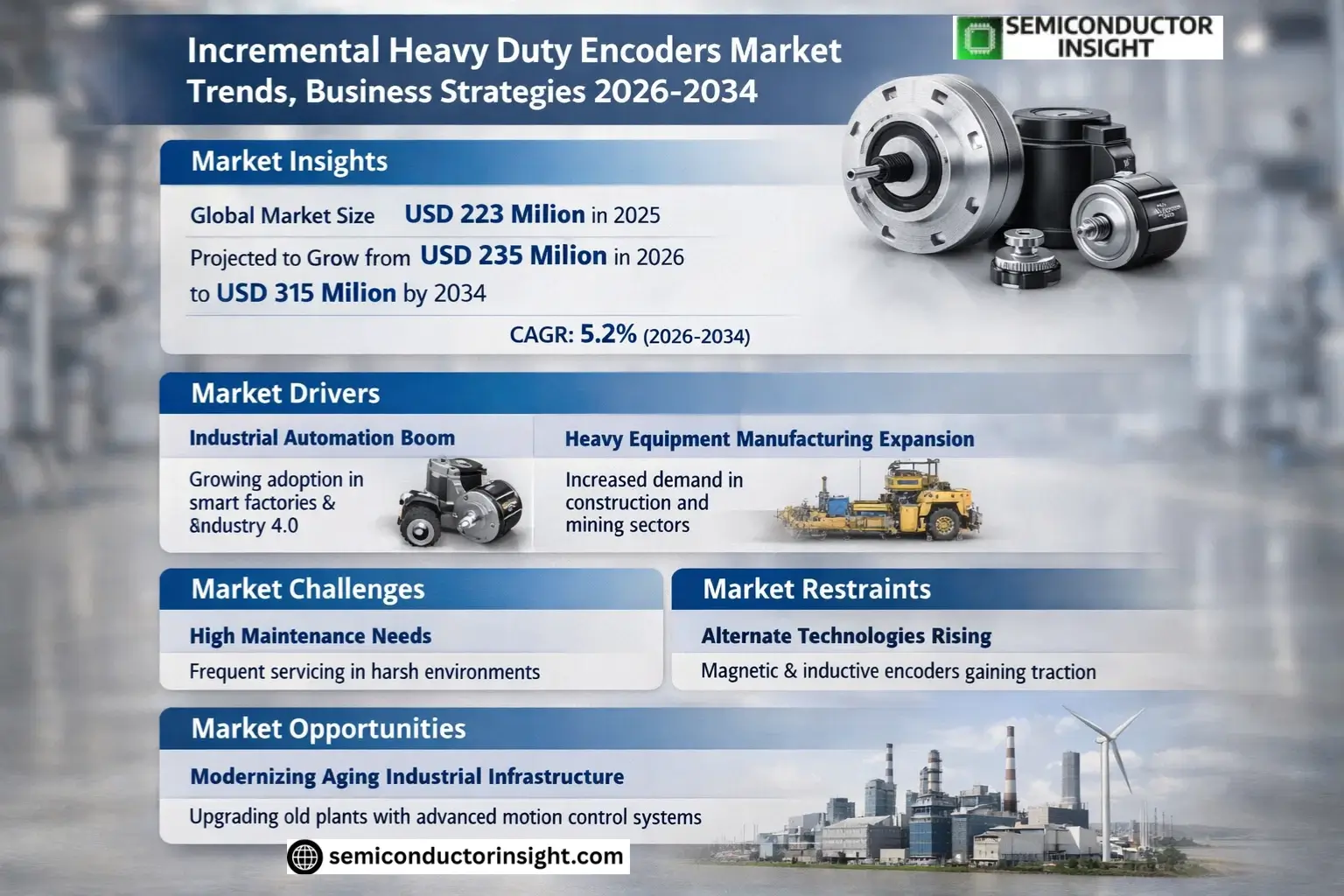
Global Incremental Heavy Duty Encoders Market size was valued at USD 223 million in 2025. The market is projected to grow from USD 235 million in 2026 to USD 315 million by 2034, exhibiting a CAGR of 5.2% during the forecast period.
Incremental heavy-duty encoders are specialized sensors used to measure rotational position, speed, and direction of machinery in demanding industrial environments. These devices provide critical feedback to control systems, ensuring precise operation of heavy-duty equipment across sectors such as steel manufacturing, oil and gas, and paper production. The product range includes optical, magnetic, and inductive encoder variants, each offering distinct performance characteristics for different application requirements.
Market growth is driven by increasing industrial automation demands and the need for reliable motion control in harsh operating conditions. While optical encoders currently dominate market share due to their high precision, magnetic variants are gaining traction in environments with extreme temperatures or contamination risks. Key manufacturers like Dynapar and Baumer continue to innovate with ruggedized designs featuring enhanced sealing and vibration resistance.
MARKET DRIVERS
Industrial Automation Boom Driving Demand
Global Incremental Heavy Duty Encoders Market is experiencing significant growth due to increasing adoption in industrial automation. These encoders provide high-resolution position feedback for heavy machinery in manufacturing sectors, with demand growing at approximately 7.2% annually. The rise of Industry 4.0 initiatives has particularly boosted the need for reliable motion control systems.
Expansion in Heavy Equipment Manufacturing
Construction and mining equipment manufacturers are increasingly specifying heavy duty encoders for their durability in harsh environments. The market has seen a 12% increase in adoption for off-highway vehicle applications since 2022, with Asia-Pacific showing the strongest growth.
Energy sector investments are further propelling the market, particularly in wind turbine pitch control systems where incremental heavy duty encoders provide essential positioning data.
MARKET CHALLENGES
High Maintenance Requirements in Rugged Environments
While incremental heavy duty encoders are designed for tough conditions, they still require frequent maintenance in extreme environments like steel mills or offshore platforms. This results in higher total cost of ownership compared to alternative sensor technologies.
Other Challenges
Intense Price Competition
The market faces pricing pressures from Asian manufacturers offering lower-cost alternatives, creating margin compression for established brands.
Technical Limitations in High-Speed Applications
Incremental encoders typically max out at 10,000 RPM, limiting their use in ultra-high-speed machinery where absolute encoders may be preferred.
MARKET RESTRAINTS
Alternate Technologies Gaining Traction
Magnetic and inductive encoder technologies are making inroads in applications traditionally dominated by optical incremental heavy duty encoders. These alternatives offer better contamination resistance while maintaining position accuracy, particularly in oil and gas applications.
MARKET OPPORTUNITIES
Modernization of Aging Industrial Infrastructure
The ongoing replacement cycle in traditional manufacturing plants presents significant opportunities for incremental heavy duty encoder suppliers. Many facilities operating with 20+ year old equipment are now upgrading to modern motion control systems that require precise position feedback.
Incremental Heavy Duty Encoders Market Trends
Growing Demand in Heavy Industrial Applications
Incremental Heavy Duty Encoders Market continues to expand due to increased automation in heavy industries. These rugged sensors provide critical motion feedback in steel plants, paper mills, and oil/gas operations where standard encoders would fail under extreme conditions. Manufacturers now focus on higher IP-rated encoders for dust, moisture, and vibration resistance.
Other Trends
Optical Encoder Technology Dominance
Optical incremental encoders maintain over 45% market share due to their precision in position detection. Recent developments incorporate advanced LED light sources and high-resolution optical disks to improve performance while maintaining durability in industrial environments. This technology shows particular strength in steel and paper manufacturing applications where precise motion control is crucial.
Regional Market Developments
Asia-Pacific leads market growth, driven by China’s expanding industrial sector and Japan’s advanced manufacturing base. North American and European markets show steady demand, particularly for encoders with enhanced cybersecurity features for Industry 4.0 implementations. Emerging economies are adopting mid-range encoders as local manufacturers upgrade production facilities.
Material Science Advancements
Encoder manufacturers now use specialized alloys and composite materials for housings that withstand corrosive industrial environments longer than traditional materials. Stainless steel variants gain popularity in food processing and chemical plants where washdown conditions are common.
Competitive Landscape Shifts
The competitive landscape shows consolidation among mid-tier manufacturers while top players expand their product portfolios. Companies now offer modular encoder systems that simplify maintenance and reduce downtime costs. Service and support capabilities have become key differentiators in industrial equipment procurement decisions.
COMPETITIVE LANDSCAPE
Key Industry Players
Intense Competition Among Established Manufacturers in Heavy Duty Encoders Space
Global Incremental Heavy Duty Encoders Market is characterized by strong competition among established manufacturers, with the top five players holding significant market share in 2025. Dynapar emerges as a leader in this space, known for its rugged encoder solutions for harsh industrial environments. Leine & Linde and BEI Sensors follow closely, with strong technological capabilities and extensive product portfolios. These companies maintain dominance through continuous innovation in optical and magnetic encoder technologies for steel, paper, and oil & gas industries.
Other notable players like Baumer, Kubler, and Pepperl+Fuchs specialize in niche applications, offering customized solutions for specific industrial requirements. Japanese manufacturers including OMRON and Nidec Industrial Solutions lead in technological advancements, particularly for Asian markets. Smaller but technologically advanced players like TR-Electronic and SCANCON are gaining traction with specialized encoder solutions.
List of Key Incremental Heavy Duty Encoders Companies Profiled
- Dynapar
- Leine & Linde
- Baumer
- BEI Sensors
- Kubler
- Pepperl+Fuchs
- Nidec Industrial Solution
- OMRON
- TR-Electronic
- SCANCON
- Hohner Automaticos
- Encoder Products Company
- Yuheng Optics
- Lika Electronic
Segment Analysis:
| Segment Category | Sub-Segments | Key Insights |
| By Type |
|
Optical Incremental Encoders dominate due to their superior precision and reliability in harsh industrial environments:
|
| By Application |
|
Steel Industrial represents the most critical application segment with specific demands:
|
| By End User |
|
Heavy Machinery Manufacturers lead as primary end users with distinct requirements:
|
| By Protection Level |
|
High IP68-69K protection level is gaining traction across industries:
|
| By Output Signal |
|
Line Driver output maintains dominance in critical applications:
|
Regional Analysis: Global Incremental Heavy Duty Encoders Market
North America
North American manufacturers lead in incremental encoder miniaturization without compromising durability, with several patented sealing technologies that enhance product lifespan in harsh environments. This technical advantage maintains premium pricing power.
Proximity to major industrial equipment OEMs allows just-in-time encoder deliveries with customized interface options. Localized R&D centers enable rapid prototyping for specialized heavy duty applications.
Compliance with ASME and UL standards provides automatic qualification for government contracts in defense and infrastructure projects. North American safety certifications are widely recognized globally.
Comprehensive maintenance networks offer encoder recalibration and seal replacement services, extending product lifecycles. Many suppliers provide lifetime technical support for heavy duty models.
Europe
Europe represents the second-largest market for incremental heavy duty encoders, characterized by precision engineering requirements in German and Italian industrial machinery. The region sees growing demand from offshore wind turbine installations requiring explosion-proof encoder variants. European manufacturers focus on energy-efficient designs with reduced electromagnetic interference. There’s notable traction in retrofitting older industrial equipment with modern incremental encoders to complement digital transformation initiatives. Stringent EU machinery directives continue to push encoder performance standards upward.
Asia-Pacific
The Asia-Pacific Incremental Heavy Duty Encoders Market grows rapidly alongside regional manufacturing expansion, particularly in China’s automation equipment exports. Local producers increasingly compete on durability rather than just price, with improved IP ratings for dust and moisture protection. Southeast Asian nations show surging demand from food processing and packaging machinery applications. Japanese encoder specialists maintain technology leadership in high-speed incremental models for robotics applications throughout the region. There’s growing interest in modular encoder designs that simplify maintenance in remote locations.
South America
Mining and mineral processing drive heavy duty encoder adoption in South America, where equipment must withstand continuous vibration and particulate exposure. Brazilian manufacturers focus on cost-optimized solutions for regional commodity producers. There’s emerging demand from hydroelectric power projects in the Andes requiring submersion-resistant incremental encoders for turbine monitoring, though imports still dominate high-end applications.
Middle East & Africa
The Middle East incremental heavy duty encoder market centers around oilfield equipment applications requiring intrinsically safe designs. African adoption grows in cement production and bulk material handling, where encoder dustproofing is critical. Both regions show preference for stainless steel housing options that withstand coastal salt environments. Limited local manufacturing maintains reliance on European and Asian imports for precision applications.
Report Scope
This market research report provides a comprehensive analysis of the Incremental Heavy Duty Encoders Market , covering the forecast period 2025–2034. It offers detailed insights into market dynamics, technological advancements, competitive landscape, and key trends shaping the industry.
Key focus areas of the report include:
- Market Overview: The report begins with an overview outlining its current market scenario, key growth indicators, and industry transformation drivers. It discusses macroeconomic factors, demand–supply balance, regulatory landscape, and the strategic role of sensors in powering advancements across industries such as steel, paper, oil & gas, and industrial automation.
- Market Size & Forecast: Historical data and future projections for revenue, unit shipments, and market value across major regions and segments.
- Segmentation Analysis: Detailed breakdown by product type, technology, application, and end-user industry to identify high-growth segments and investment opportunities.
- Regional Insights: Insights into market performance across North America, Europe, Asia, South America, and Middle East & Africa, including country-level analysis.
- Competitive Landscape: Profiles of leading market participants, including their product offerings, R&D focus, manufacturing capacity, pricing strategies, and recent developments.
- Technology Trends & Innovation: Assessment of emerging encoder technologies, integration with control systems, and evolving industry standards.
- Market Drivers & Restraints: Evaluation of factors driving market growth along with challenges, supply chain constraints, and market-entry barriers.
- Stakeholder Insights: Insights for component suppliers, OEMs, system integrators, and investors regarding strategic opportunities.
Primary and secondary research methods are employed, including interviews with industry experts and data from verified sources to ensure the accuracy of the insights presented.
FREQUENTLY ASKED QUESTIONS:
What is the current market size of Incremental Heavy Duty Encoders Market?
-> Incremental Heavy Duty Encoders Market size was valued at USD 223 million in 2025. The market is projected to grow from USD 235 million in 2026 to USD 315 million by 2034, exhibiting a CAGR of 5.2% during the forecast period.
What is the growth rate of the Incremental Heavy Duty Encoders Market?
-> The market is projected to grow at a CAGR of 5.2% during the forecast period 2025-2034.
Which key companies operate in Incremental Heavy Duty Encoders Market?
-> Key players include Dynapar, Leine & Linde, BEI Sensor, Baumer, Kubler, Pepperl+Fuchs, Nidec Industrial Solution, OMRON, TR-Electronic, and SCANCON among others.
What are the main product segments in this market?
-> Major segments include Optical Incremental Encoders, Magnetic Incremental Encoders, Inductive Incremental Encoders and others.
What are the key application areas?
-> Primary applications are in Steel Industrial, Paper Industrial, Elevator, Oil and Gas sectors.
Get Sample Report PDF for Exclusive Insights
Report Sample Includes
- Table of Contents
- List of Tables & Figures
- Charts, Research Methodology, and more...
 Download Sample Report PDF