MARKET INSIGHTS
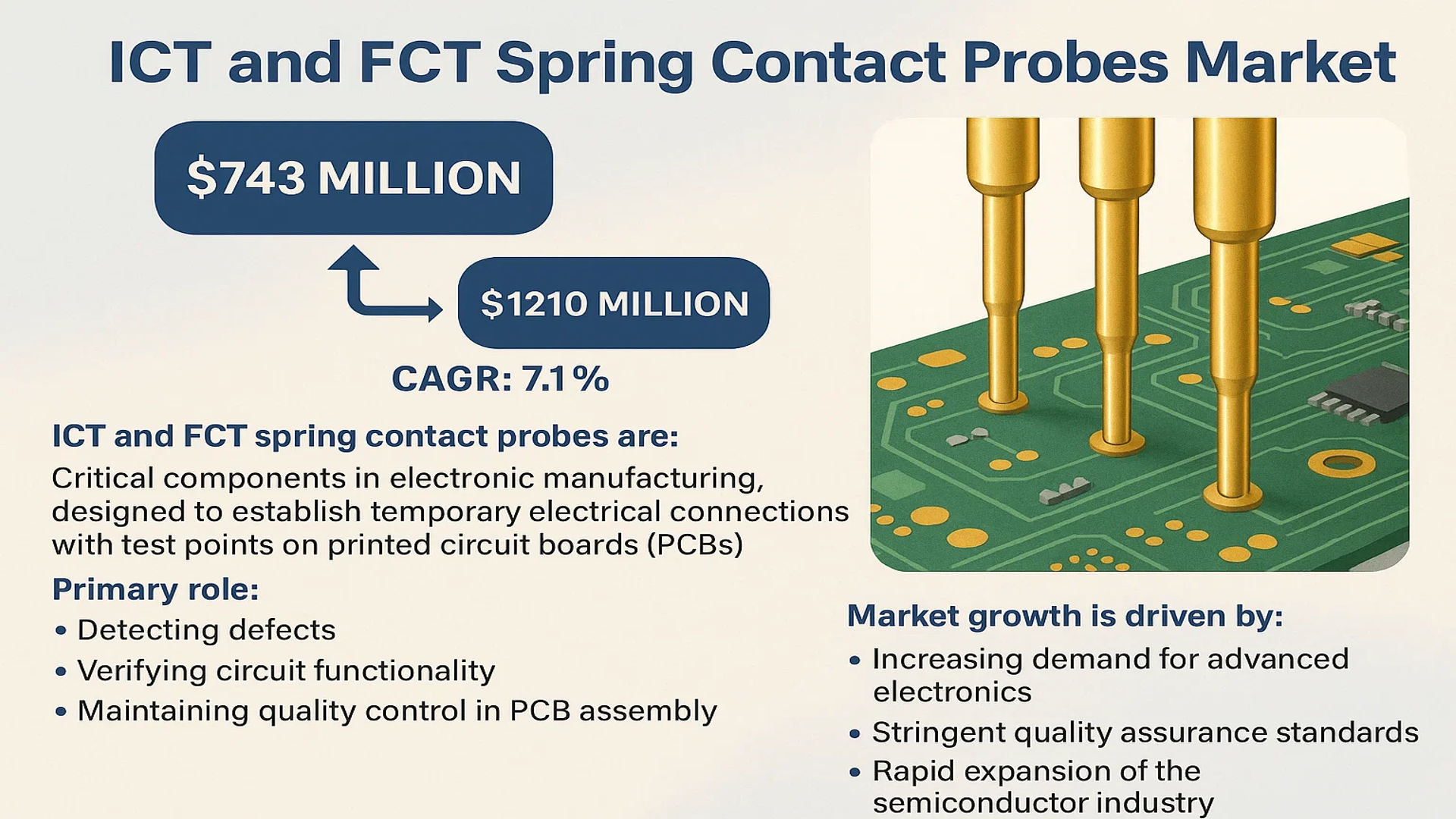
The global ICT and FCT Spring Contact Probes Market was valued at 743 million in 2024 and is projected to reach US$ 1210 million by 2032, at a CAGR of 7.1% during the forecast period.
ICT (In-Circuit Test) and FCT (Functional Test) spring contact probes are critical components in electronic manufacturing, designed to establish temporary electrical connections with test points on printed circuit boards (PCBs). These probes utilize a spring-loaded mechanism to ensure consistent contact pressure, enabling precise signal transmission for in-circuit and functional testing. Their primary role involves detecting defects, verifying circuit functionality, and maintaining quality control in PCB assembly.
The market growth is driven by increasing demand for advanced electronics, stringent quality assurance standards, and rapid expansion of the semiconductor industry. The U.S. holds a significant market share, while China is emerging as a key growth region due to its booming electronics manufacturing sector. Leading market players like INGUN, Everett Charles Technologies, and Feinmetall are investing in R&D to enhance probe durability and precision, further accelerating market expansion.
MARKET DYNAMICS
MARKET DRIVERS
Expansion of Electronics Manufacturing to Fuel Demand for ICT and FCT Spring Contact Probes
The global electronics manufacturing industry is experiencing robust growth, with production volumes increasing by an average of 5-7% annually. This expansion is directly driving demand for reliable testing solutions like ICT and FCT spring contact probes, which ensure product quality and functionality. Automotive electronics, in particular, are witnessing a surge with the average vehicle now containing over $1,500 worth of electronic components, creating significant testing requirements. The growing complexity of printed circuit boards, with features shrinking to below 0.5mm pitch in advanced applications, is pushing manufacturers to adopt higher precision testing solutions.
Rise of 5G Technology Accelerates Adoption of High-Frequency Testing Probes
The global rollout of 5G networks is creating substantial demand for advanced testing solutions capable of handling high-frequency signals up to 60GHz. Spring contact probes optimized for 5G applications are seeing particularly strong uptake, as they enable reliable testing of RF components and antenna modules. The telecom infrastructure market is projected to grow at over 8% CAGR through 2030, with base station deployments increasing by approximately 30% year-over-year in key markets. This technological shift is prompting manufacturers to develop specialized probes with improved signal integrity characteristics to address the stringent requirements of 5G device testing.
Automation in Electronics Testing Drives Probe Market Growth
Increasing automation in electronics manufacturing is creating sustained demand for durable, high-cycle life spring contact probes. Automated test equipment installations are growing at nearly 10% annually as manufacturers seek to improve throughput and reduce labor costs. Modern production lines now require probes capable of withstanding over 1 million actuations while maintaining consistent electrical performance, pushing suppliers to innovate in materials and design. The transition to Industry 4.0 standards, with real-time quality monitoring, is further amplifying the need for reliable test interfaces across the manufacturing value chain.
MARKET RESTRAINTS
High Initial Investment Costs Limit Market Penetration
While the ICT and FCT spring contact probes market shows strong growth potential, the significant capital expenditure required for advanced testing systems presents a barrier to adoption. A complete automated test solution incorporating high-performance probes can cost upwards of $250,000, making it challenging for smaller manufacturers to justify the investment. The ongoing operational costs associated with probe maintenance and replacement further add to the total cost of ownership, with some specialized probes costing over $50 per unit. These financial considerations are particularly impactful in price-sensitive emerging markets where cost competitiveness is paramount.
Miniaturization Trends Create Technical Challenges
The continuous trend toward smaller electronic components is testing the limits of spring contact probe technology. With IC package sizes shrinking below 3mm x 3mm and pad pitches approaching 0.3mm, conventional probe designs face reliability challenges in making consistent contact. The industry reports contact failure rates increasing by 15-20% when testing ultra-fine pitch components, leading to higher scrap rates and production delays. Developing probes that can reliably contact these miniature features while maintaining sufficient mechanical life requires expensive materials like beryllium copper and advanced plating processes, driving up costs.
MARKET OPPORTUNITIES
Emerging Applications in Medical Electronics Present Growth Potential
The medical electronics sector is creating new opportunities for specialized spring contact probes, with the market for medical PCBs projected to exceed $4 billion by 2028. Implantable devices and diagnostic equipment require particularly stringent testing protocols, driving demand for high-reliability probe solutions. Recent developments in minimally invasive surgical tools and wearable health monitors are prompting probe manufacturers to develop specialized solutions capable of testing flexible circuits and unconventional form factors. The growing emphasis on medical device quality standards is further amplifying the need for comprehensive test coverage during production.
Advancements in Material Science Enable Next-Generation Probes
Innovations in contact materials and plating technologies are opening new possibilities for spring probe performance. The development of novel palladium-cobalt alloys has shown 30-40% improvement in wear resistance compared to traditional gold plating, significantly extending probe service life in high-cycle applications. Research into carbon nanotube-enhanced contact tips promises to enhance current carrying capacity while reducing contact resistance variability. These material advancements are particularly relevant for power electronics testing, where probes must handle increasing current densities without degradation.
MARKET CHALLENGES
Supply Chain Disruptions Impact Probe Manufacturing
The global nature of spring contact probe production makes the industry vulnerable to supply chain interruptions. Critical raw materials like phosphor bronze and specialty platings often face lead time extensions exceeding 12 weeks, disrupting production schedules. The recent shortage of semiconductor test equipment components has created a ripple effect, with some probe manufacturers reporting order fulfillment delays of up to six months. These disruptions are particularly challenging for just-in-time manufacturing environments where production schedules depend on reliable test system availability.
Intense Price Competition Squeezes Profit Margins
The spring contact probe market faces growing price pressure as competitors from emerging economies enter the space with lower-cost alternatives. Standard probe prices have declined by 5-7% annually over the past five years, forcing established manufacturers to either reduce costs or differentiate through enhanced performance. This pricing environment makes it challenging to recoup R&D investments in advanced probe technologies, potentially slowing innovation cycles. The situation is exacerbated by the increasing bargaining power of large electronics manufacturers who consolidate their supply bases and negotiate volume-based discounts.
ICT AND FCT SPRING CONTACT PROBES MARKET TRENDS
Growing Demand for High-Speed and Miniaturized Electronic Testing Solutions
The global ICT and FCT spring contact probes market is witnessing substantial growth, primarily driven by the increasing complexity of printed circuit boards (PCBs) and the rising demand for high-speed testing solutions in electronics manufacturing. As PCBs become denser and more sophisticated with features like multi-layered designs and micro-sized components, traditional testing methods struggle to keep up. Manufacturers are increasingly adopting high-precision spring contact probes capable of handling signal frequencies beyond 10 GHz to ensure accurate in-circuit and functional testing. This trend is especially prominent in 5G infrastructure, AI hardware, and advanced automotive electronics, where signal integrity testing is critical.
Other Trends
Automotive Electronics Testing Expansion
The automotive sector is fueling significant demand growth for ICT and FCT spring contact probes, particularly with the rapid development of electric vehicles (EVs) and advanced driver-assistance systems (ADAS). Modern vehicles incorporate hundreds of PCBs responsible for everything from battery management to sensor arrays, requiring rigorous testing at multiple production stages. The lead-free segment is gaining particular traction in automotive applications due to stringent environmental regulations, with lead-free probes expected to grow at a CAGR exceeding 7.3% between 2024-2032. Test requirements for vehicle-to-everything (V2X) communication modules and autonomous driving systems are creating new opportunities for specialized contact probe solutions.
Regional Manufacturing Shifts Impacting Supply Chains
The ongoing diversification of electronics manufacturing bases is reshaping the spring contact probes market dynamics. While China remains the dominant manufacturing hub, accounting for over 35% of global PCB production, increasing investments in Southeast Asia and India are creating new regional demand centers. This geographical shift is prompting probe manufacturers to expand distribution networks and develop localized service capabilities. Simultaneously, reshoring efforts in North America and Europe are driving demand for automated test solutions, where spring probes play a crucial role in reducing testing cycle times by up to 30% compared to traditional methods.
COMPETITIVE LANDSCAPE
Key Industry Players
Innovation and Quality Drive Market Competition Among Leading Manufacturers
The global ICT and FCT Spring Contact Probes market is characterized by intense competition, with several well-established players and emerging companies vying for market share. Market leaders are focusing on delivering high-precision probes with consistent durability to cater to the evolving demands of electronics manufacturing. The competitive landscape remains semi-consolidated, with multinational corporations maintaining strong footholds while regional players capitalize on localized supply chains.
INGUN Prüfmittelbau GmbH (Germany) leads the market with its comprehensive probe solutions, holding approximately 15% revenue share in 2024. The company’s dominance stems from its 50+ years of expertise in spring contact technology and continuous R&D investments. Similarly, Everett Charles Technologies (ECT) (U.S.) has maintained its position as a key competitor through its patented Xpresso™ technology which delivers superior signal integrity in high-frequency testing applications.
Asia-based manufacturers are gaining momentum, with Suzhou Shengyi Furui Electronic Technology (China) emerging as the largest regional player. Their competitive pricing strategy and growing production capacity have enabled them to capture 12% market share in the Asia-Pacific region. Meanwhile, Feinmetall GmbH (Germany) differentiates itself through customized probe solutions for automotive and medical applications – two of the fastest-growing end-use segments.
Market participants are increasingly focusing on strategic collaborations to enhance their technological capabilities. Recent developments include Tecon’s (Italy) partnership with automotive OEMs to develop high-temperature resistant probes, while Japanese firm Misumi has expanded its quick-delivery probe solutions to European markets.
List of Key ICT and FCT Spring Contact Probe Manufacturers
- INGUN Prüfmittelbau GmbH (Germany)
- Suzhou Shengyi Furui Electronic Technology (China)
- UIGreen Precision Technology (Taiwan)
- Tecon Srl (Italy)
- Everett Charles Technologies (U.S.)
- FIXTEST Technology (China)
- Tronic GmbH (Germany)
- Feinmetall GmbH (Germany)
- Equip Test Technologies (U.S.)
- Jiahang Electronics (China)
- Misumi Corporation (Japan)
- Peak Test Services (U.K.)
- Hsinlink Precision (Taiwan)
- QA Technology Company (U.S.)
- CPM Test Solutions (U.S.)
Segment Analysis:
By Type
Leaded Probes Segment Dominates Due to Superior Electrical Conductivity and Durability
The ICT and FCT Spring Contact Probes market is segmented based on type into:
- Leaded
- Subtypes: Gold-plated, Nickel-plated, and others
- Lead-free
- Subtypes: RoHS-compliant alloys
By Application
Consumer Electronics Segment Leads Owing to High Volume PCB Testing Requirements
The market is segmented based on application into:
- Consumer Electronics
- Subtypes: Smartphones, Tablets, Wearables
- Automotive
- Subtypes: ECU testing, Infotainment systems
- Medical Equipment
- Subtypes: Diagnostic devices, Imaging systems
- Industrial
- Others
By Test Type
ICT Segment Holds Major Share Due to Comprehensive PCB Testing Capabilities
The market is segmented based on test type into:
- In-Circuit Test (ICT)
- Functional Test (FCT)
- Boundary Scan
By End-Use
EMS Providers Represent Key Segment Due to Volume Manufacturing Requirements
The market is segmented based on end-use into:
- Electronics Manufacturing Services (EMS) Providers
- Original Equipment Manufacturers (OEMs)
- Test Houses
- Research Institutions
Regional Analysis: ICT and FCT Spring Contact Probes Market
Asia-Pacific
The Asia-Pacific region dominates the global ICT and FCT spring contact probes market, accounting for over 45% of revenue share in 2024. This leadership stems from China’s massive electronics manufacturing sector, where companies like Foxconn and Pegatron consume high volumes of testing solutions. Japan and South Korea follow closely, with their advanced semiconductor and automotive electronics industries demanding precision probes for quality assurance. The region benefits from strong government support for electronics R&D along with cost-competitive manufacturing clusters. While leaded probes remain popular due to lower costs, environmental regulations in countries like Japan are accelerating the shift toward lead-free variants. Emerging markets like India and Vietnam show growing demand as electronic production expands beyond traditional hubs.
North America
North America’s market is driven by high-value applications in aerospace, medical devices, and automotive electronics, where reliability standards exceed basic consumer electronics requirements. The U.S. leads with robust R&D investments—home to key players like Everett Charles Technologies and QA Technology. Regulatory pressures (e.g., REACH, RoHS) encourage lead-free probe adoption, while defense contracts demand specialized high-durability solutions. Canada’s growing EV sector also contributes to demand, though supply chain localization challenges persist post-pandemic. The region prioritizes miniaturized and high-frequency probes compatible with next-gen PCB designs.
Europe
Europe thrives on precision engineering and automation, with Germany’s automotive sector and Italy’s industrial electronics driving steady probe demand. INGUN and Feinmetall (based in Germany) lead innovation in corrosion-resistant and high-cycle-life probes. EU directives on hazardous substance restrictions push manufacturers toward sustainable materials, though cost sensitivity in Eastern Europe slows full compliance. The region’s focus on Industry 4.0 and IoT devices supports demand for multi-functional testing solutions. However, energy price volatility and component shortages pose intermittent challenges for local suppliers.
South America
This region shows niche growth, primarily servicing Brazil’s consumer electronics and automotive repair markets. Economic instability limits large-scale manufacturing investments, keeping probe demand reliant on imports. However, Argentina’s developing medical equipment sector presents opportunities for specialized suppliers. Infrastructure gaps and fluctuating import tariffs hinder market expansion, though regional trade agreements could improve access to cost-effective solutions from Asia. Local assembly plants prioritize budget-friendly leaded probes, with minimal regulatory oversight on material compliance.
Middle East & Africa
The market remains nascent but exhibits potential through UAE and Saudi Arabia’s electronics service sectors and Israel’s tech-driven manufacturing. Demand concentrates on durable probes for harsh-environment applications (e.g., oil/gas equipment testing). Limited local production capabilities mean most probes are imported, with pricing sensitivity favoring Asian suppliers. South Africa’s automotive component testing offers a stable niche, though political and currency risks deter large-scale investments. Prospects may improve with increasing FDI in Egyptian and Moroccan electronics assembly zones.
Report Scope
This market research report provides a comprehensive analysis of the global ICT and FCT Spring Contact Probes market, covering the forecast period 2024–2032. It offers detailed insights into market dynamics, technological advancements, competitive landscape, and key trends shaping the industry.
Key focus areas of the report include:
- Market Size & Forecast: Historical data and future projections for revenue, unit shipments, and market value across major regions and segments. The global market was valued at USD 743 million in 2024 and is projected to reach USD 1210 million by 2032, growing at a CAGR of 7.1%.
- Segmentation Analysis: Detailed breakdown by product type (Leaded vs. Lead-free), application (Consumer Electronics, Automotive, Medical Equipment, Others), and end-user industry to identify high-growth segments.
- Regional Outlook: Insights into market performance across North America, Europe, Asia-Pacific, Latin America, and Middle East & Africa. The U.S. and China represent key growth markets.
- Competitive Landscape: Profiles of 15+ leading manufacturers including INGUN, Everett Charles Technologies, Feinmetall, and emerging Asian players like Suzhou Shengyi Furui Electronic Technology.
- Technology Trends: Analysis of probe miniaturization, high-frequency testing capabilities, and material innovations for enhanced durability.
- Market Dynamics: Evaluation of growth drivers (electronics manufacturing expansion, quality testing requirements) and challenges (price pressures, supply chain complexities).
- Stakeholder Value: Strategic insights for PCB manufacturers, test equipment providers, and component suppliers across the electronics value chain.
The report employs primary research (industry interviews) and secondary research (verified market data) to deliver accurate, actionable intelligence for strategic decision-making.
FREQUENTLY ASKED QUESTIONS:
What is the current market size of Global ICT and FCT Spring Contact Probes Market?
-> ICT and FCT Spring Contact Probes Market was valued at 743 million in 2024 and is projected to reach US$ 1210 million by 2032, at a CAGR of 7.1% during the forecast period.
Which key companies operate in this market?
-> Major players include INGUN, Everett Charles Technologies, Feinmetall, Suzhou Shengyi Furui Electronic Technology, UIGreen, Tecon, and FIXTEST.
What are the key growth drivers?
-> Growth is driven by rising electronics production, stricter quality standards, and automotive electronics demand, particularly for EVs and ADAS systems.
Which region dominates the market?
-> Asia-Pacific leads in both production and consumption, while North America shows strong growth in high-end applications.
What are the emerging trends?
-> Key trends include miniaturized probes for high-density PCBs, gold-plated contacts for reliability, and automated testing solutions.

Get Sample Report PDF for Exclusive Insights
Report Sample Includes
- Table of Contents
- List of Tables & Figures
- Charts, Research Methodology, and more...