
Hydrogen Sensor Module Market Insights
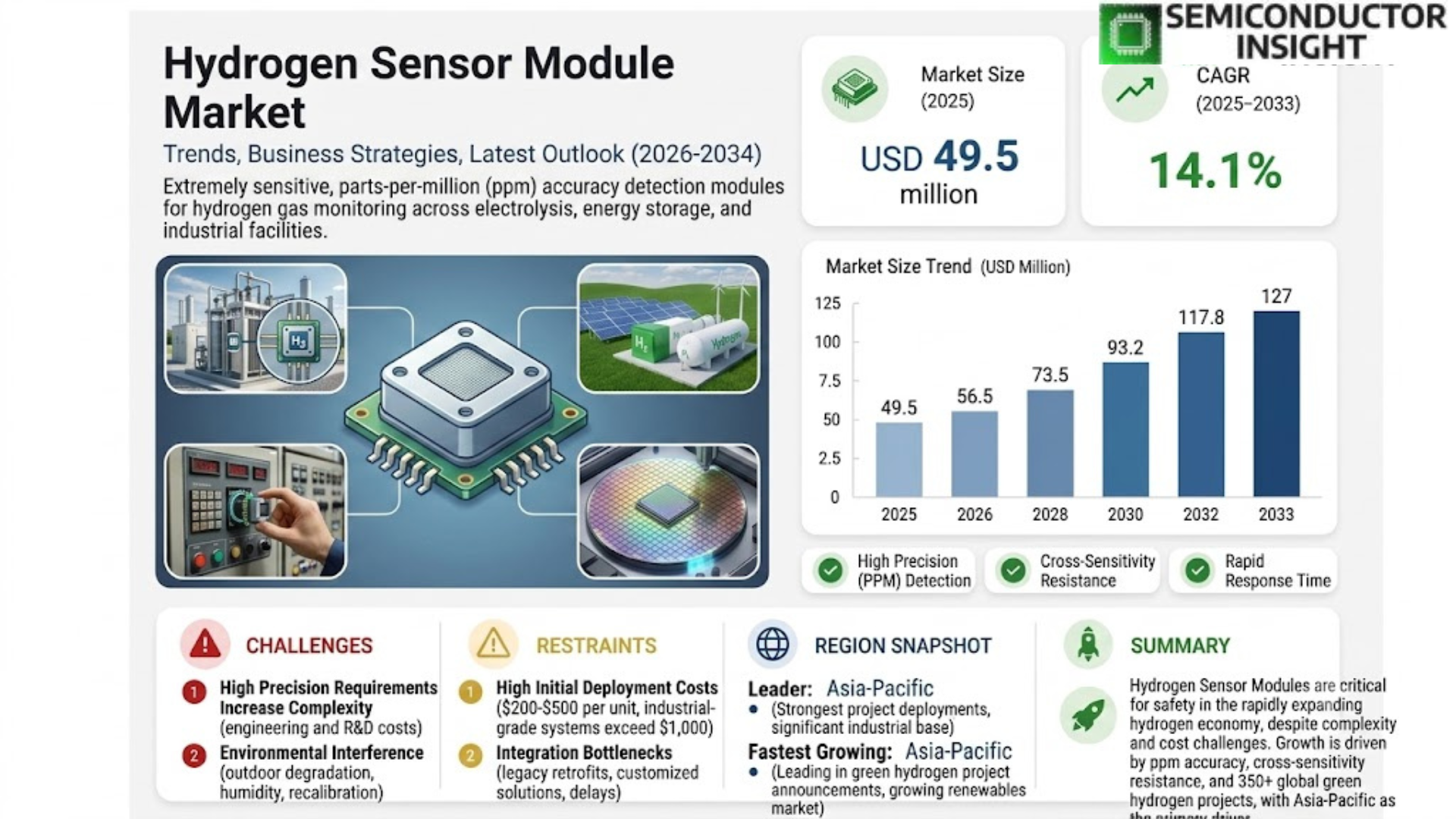
The global hydrogen sensor module market was valued at USD 49.5 million in 2024 and is projected to reach USD 127 million by 2032, exhibiting a CAGR of 14.1% during the forecast period.
Hydrogen sensor modules are critical components designed to detect hydrogen concentration in various environments. These modules consist of sensitive elements that react to hydrogen presence, conversion elements that transform these reactions into measurable electrical signals, and auxiliary circuits for enhanced functionality. The sensitive element typically undergoes physical or chemical changes—such as adsorption or catalytic reactions—when exposed to hydrogen, enabling precise detection.
The market growth is driven by increasing demand for hydrogen detection in industries like automotive, oil & gas, and power plants, where safety and leak prevention are paramount. Key players such as Figaro, Honeywell, and Amphenol dominate the market, collectively holding around 60% share. North America leads globally with a 32% market share, followed by Asia-Pacific (29%) and Europe (28%). Electrochemical hydrogen sensors remain the most widely used type, accounting for approximately 47% of the market.
 MARKET DRIVERS
Growing Demand for Clean Energy Solutions
The global push toward hydrogen fuel adoption is driving significant demand for hydrogen sensor modules. With over 18 countries implementing national hydrogen strategies, safety monitoring systems are becoming essential. Hydrogen sensor modules play a critical role in detecting leaks across fuel cell vehicles, refueling stations, and industrial applications.
Stringent Safety Regulations
Regulatory bodies worldwide are mandating stricter safety protocols for hydrogen handling. The Hydrogen Sensor Module Market benefits from compliance requirements in sectors like oil & gas, where explosive risk mitigation is prioritized. Recent standards from organizations like ISO and NFPA emphasize real-time monitoring.
➤ The European Clean Hydrogen Alliance projects a 150% increase in hydrogen infrastructure investments by 2030, directly boosting sensor module demand.
Technological advancements in MEMS-based sensors further accelerate adoption, offering higher precision at reduced costs.
MARKET CHALLENGES
High Precision Requirements Increase Complexity
Hydrogen’s low ignition energy (0.02mJ) demands extremely sensitive detection thresholds. Sensor modules must maintain parts-per-million (ppm) accuracy while resisting cross-sensitivity to other gases, creating engineering challenges that elevate R&D costs.
Other Challenges
Environmental Interference
Outdoor installations face performance degradation from humidity, temperature swings, and particulate contamination, requiring frequent recalibration.
Integration Bottlenecks
Retrofitting sensor modules into legacy industrial systems often requires customized solutions, delaying deployment timelines.
MARKET RESTRAINTS
High Initial Deployment Costs
Average hydrogen sensor module prices range between $200-$500 per unit, with industrial-grade systems exceeding $1,000. This creates adoption barriers for small-scale operators despite long-term cost benefits. The Hydrogen Sensor Module Market also faces competition from traditional gas detection systems still prevalent in developing economies.
MARKET OPPORTUNITIES
Emerging Green Hydrogen Projects
Over 350 large-scale green hydrogen projects announced globally present massive installation opportunities. The Hydrogen Sensor Module Market will directly benefit from monitoring needs across electrolyzer plants and renewable energy storage facilities, with Asia-Pacific leading project deployments.
Smart Manufacturing Integration
Industry 4.0 adoption enables predictive maintenance capabilities for hydrogen sensors through IoT connectivity. Manufacturers offering cloud-based monitoring platforms with real-time analytics command 28% higher profit margins in the Hydrogen Sensor Module Market.
Hydrogen Sensor Module Market Trends
Accelerated Growth in Hydrogen Detection Technologies
The global Hydrogen Sensor Module market is experiencing robust expansion, projected to grow from $49.5 million in 2024 to $127 million by 2032 at a 14.1% CAGR. This surge is driven by stringent safety regulations across industries and the rising adoption of hydrogen as a clean energy source. Electrochemical sensors currently dominate with 47% market share due to their precision in detecting low hydrogen concentrations.
Other Trends
Regional Market Dynamics
North America leads with 32% market share, fueled by advanced industrial safety standards and growing hydrogen infrastructure investments. Asia-Pacific follows closely at 29%, with China and Japan accelerating adoption in power generation and transportation sectors. Europe maintains strong demand (28% share) through clean energy initiatives.
Industry-Specific Adoption Patterns
Power plants represent the largest application segment (25%), utilizing sensors for leakage detection in hydrogen-cooled generators. The automotive sector shows rapid growth as fuel cell vehicle production increases 18% annually. Oil & gas applications focus on refinery process monitoring, where explosion-proof sensor modules are becoming mandatory.
Technological Advancements
Leading manufacturers like Figaro and Honeywell are integrating MEMS technology to improve response times below 5 seconds. New solid-state sensors offer extended lifespan exceeding 5 years, reducing maintenance costs. Wireless-enabled modules with IoT connectivity now comprise 12% of new installations.
Competitive Landscape Shifts
The top five players control 60% of the market, with Honeywell and Amphenol expanding their portfolios through strategic acquisitions. Emerging Chinese manufacturers like Zhengzhou Winsen are gaining traction with cost-competitive solutions, particularly in Southeast Asian markets.
COMPETITIVE LANDSCAPE
Key Industry Players
Global Hydrogen Sensor Module Market Dominated by Five Major Players Holding 60% Share
The hydrogen sensor module market is consolidated with Figaro, Honeywell, Amphenol, Membrapor, and Nissha FIS collectively controlling approximately 60% of global revenues. Figaro leads with advanced electrochemical sensor technology, particularly for industrial safety applications. Honeywell dominates in integrated solutions for aerospace and defense sectors, leveraging its global distribution network. The market structure shows regional specialization, with North American players focusing on high-precision applications while Asian manufacturers cater to cost-sensitive industrial segments.
Emerging players like neo hydrogen sensors GmbH and ProSense Technologies are gaining traction with MEMS-based innovations for automotive applications. Chinese manufacturers such as Zhengzhou Winsen and Suzhou TaKrMEMS are expanding globally through competitive pricing and government-supported R&D initiatives. The competitive intensity is increasing as companies develop IoT-enabled sensors with wireless connectivity capabilities for Industry 4.0 applications.
List of Key Hydrogen Sensor Module Companies Profiled
- Figaro
- Honeywell
- Amphenol
- Membrapor
- Nissha FIS
- First Sensor
- NTM Sensors
- Sensirion
- ProSense Technologies
- neo hydrogen sensors GmbH
- Zhengzhou Winsen
- Suzhou TaKrMEMS
- Suzhou NanoGrid
- STANGE Elektronik
Segment Analysis:
| Segment Category | Sub-Segments | Key Insights |
| By Type |
|
Electrochemical Hydrogen Sensor dominates the market due to:
|
| By Application |
|
Power Plants show strongest demand because:
|
| By End User |
|
Industrial Sector leads consumption owing to:
|
| By Detection Range |
|
0-1000 ppm Range sees most adoption due to:
|
| By Output Signal |
|
Analog Output remains preferred choice because:
|
Regional Analysis: Hydrogen Sensor Module Market
North America maintains the most comprehensive safety standards for hydrogen applications, driving consistent demand for certified sensor modules across all industrial sectors.
The region leads in developing advanced electrochemical and optical hydrogen sensors with enhanced precision and faster response times for critical safety applications.
Strong penetration across oil refineries, chemical plants, and emerging hydrogen fuel cell vehicle infrastructure creates sustained market growth potential.
Collaborative projects between national laboratories, universities, and private firms accelerate commercialization of next-generation hydrogen detection technologies.
Europe
Europe represents the second-largest market for hydrogen sensor modules, propelled by ambitious clean energy transition policies. The EU’s hydrogen strategy demonstrates strong commitment to scaling up renewable hydrogen production, directly increasing demand for monitoring solutions. Countries like Germany, France, and Scandinavia are investing heavily in green hydrogen projects that require sophisticated sensing technologies. Automotive applications are particularly strong, with sensor-equipped hydrogen fueling stations expanding across major transportation corridors. Strict workplace safety directives ensure steady replacement demand in industrial settings.
Asia-Pacific
The Asia-Pacific hydrogen sensor module market is experiencing rapid growth driven by expanding industrial base and clean energy initiatives. Japan and South Korea lead regional adoption with their hydrogen economy roadmaps, while China’s manufacturing sector shows increasing focus on workplace safety. Emerging applications in fuel cell vehicles and power generation create new opportunities, though price sensitivity influences technology adoption patterns. Local manufacturers are developing cost-competitive solutions tailored to regional requirements.
Middle East & Africa
This region shows growing interest in hydrogen sensor modules as part of economic diversification into new energy sectors. GCC countries are incorporating hydrogen technologies into their energy transition plans, with sensor demand emerging around pilot projects. South Africa demonstrates potential with industrial applications, though market development remains at early stages compared to other regions.
South America
South America presents niche opportunities in the hydrogen sensor module market, primarily around industrial safety applications. Brazil leads regional adoption with its substantial chemical and refining sectors. Chile’s renewable hydrogen ambitions show promise for future market expansion, though current infrastructure limitations constrain growth potential compared to other global regions.
Report Scope
This market research report provides a comprehensive analysis of the Hydrogen Sensor Module Market, covering the forecast period 2025–2032. It offers detailed insights into market dynamics, technological advancements, competitive landscape, and key trends shaping the industry.
Key focus areas of the report include:
- Market Overview: The report begins with an overview outlining its current market scenario, key growth indicators, and industry transformation drivers. It discusses macroeconomic factors, demand–supply balance, regulatory landscape, and the strategic role of hydrogen sensing technologies across industries such as automotive, oil & gas, aerospace, healthcare, and power generation.
- Market Size & Forecast: Historical data and future projections for revenue, unit shipments, and market value across major regions and segments.
- Segmentation Analysis: Detailed breakdown by product type, technology, application, and end-user industry to identify high-growth segments and investment opportunities.
- Regional Insights: Insights into market performance across North America, Europe, Asia-Pacific, Latin America, and the Middle East & Africa, including country-level analysis where relevant.
- Competitive Landscape: Profiles of leading market participants, including their product offerings, R&D focus, manufacturing capacity, pricing strategies, and recent developments such as mergers, acquisitions, and partnerships.
- Technology Trends & Innovation: Assessment of emerging technologies, integration of IoT/IIoT, sensor design trends, and evolving industry standards.
- Market Drivers & Restraints: Evaluation of factors driving market growth along with challenges, supply chain constraints, regulatory issues, and market-entry barriers.
- Stakeholder Insights: Insights for component suppliers, OEMs, system integrators, investors, and policymakers regarding the evolving ecosystem and strategic opportunities.
Primary and secondary research methods are employed, including interviews with industry experts, data from verified sources, and real-time market intelligence to ensure the accuracy and reliability of the insights presented.
FREQUENTLY ASKED QUESTIONS:
What is the current market size of Hydrogen Sensor Module Market?
-> The Hydrogen Sensor Module Market was valued at USD 49.5 million in 2024 and is projected to reach USD 127 million by 2032, growing at a CAGR of 14.1% during the forecast period.
Which key companies operate in Hydrogen Sensor Module Market?
-> Key players include Figaro, Honeywell, Amphenol, Membrapor, Nissha FIS, First Sensor, NTM Sensors, Sensirion, ProSense Technologies, neo hydrogen sensors GmbH, among others. The top five players hold about 60% market share.
What are the key growth drivers?
-> Key growth drivers include increasing adoption in power plants, stringent safety regulations in oil & gas industry, growing hydrogen fuel cell applications, and rising demand from automotive sector.
Which region dominates the market?
-> North America holds the largest market share at 32%, followed by Asia-Pacific (29%) and Europe (28%).
What are the emerging trends?
-> Emerging trends include development of MEMS-based sensors, integration of IoT capabilities, advancements in electrochemical sensing technologies, and miniaturization of sensor modules.

Get Sample Report PDF for Exclusive Insights
Report Sample Includes
- Table of Contents
- List of Tables & Figures
- Charts, Research Methodology, and more...




