Hybrid Vision Sensors Market Insights
Global Hybrid Vision Sensors market size was valued at USD 705 million in 2025. The market is projected to grow from USD 791 million in 2026 to USD 1420 million by 2034, exhibiting a CAGR of 12.2% during the forecast period.
Hybrid vision sensors are advanced devices that integrate multiple sensing technologies to provide more comprehensive, accurate, and reliable environmental perception capabilities. By combining different types of sensor data,such as from cameras, LiDAR, millimeter-wave radar, and ultrasonic sensors,these systems can simultaneously capture rich information including images, distance, speed, and shape. This multimodal approach is crucial for complex applications like autonomous vehicles and industrial automation where a single sensor type is insufficient.
The market is experiencing rapid growth due to several key factors, including the escalating demand for advanced driver-assistance systems (ADAS) and autonomous driving solutions, which require robust sensor fusion. Furthermore, the expansion of industrial automation and smart robotics is creating significant demand for more intelligent perception systems. Initiatives by leading players are also propelling the market forward; for instance, companies like NXP Semiconductors and OmniVision are continuously innovating to integrate more functions onto single chipsets. Key players operating in this space with diverse portfolios include NXP Semiconductors, Huawei HiSilicon, OmniVision Group (now part of Will Semiconductor), AlpsenTek Ltd., and Anhui Eyevolution Technology Co., Ltd., among others.
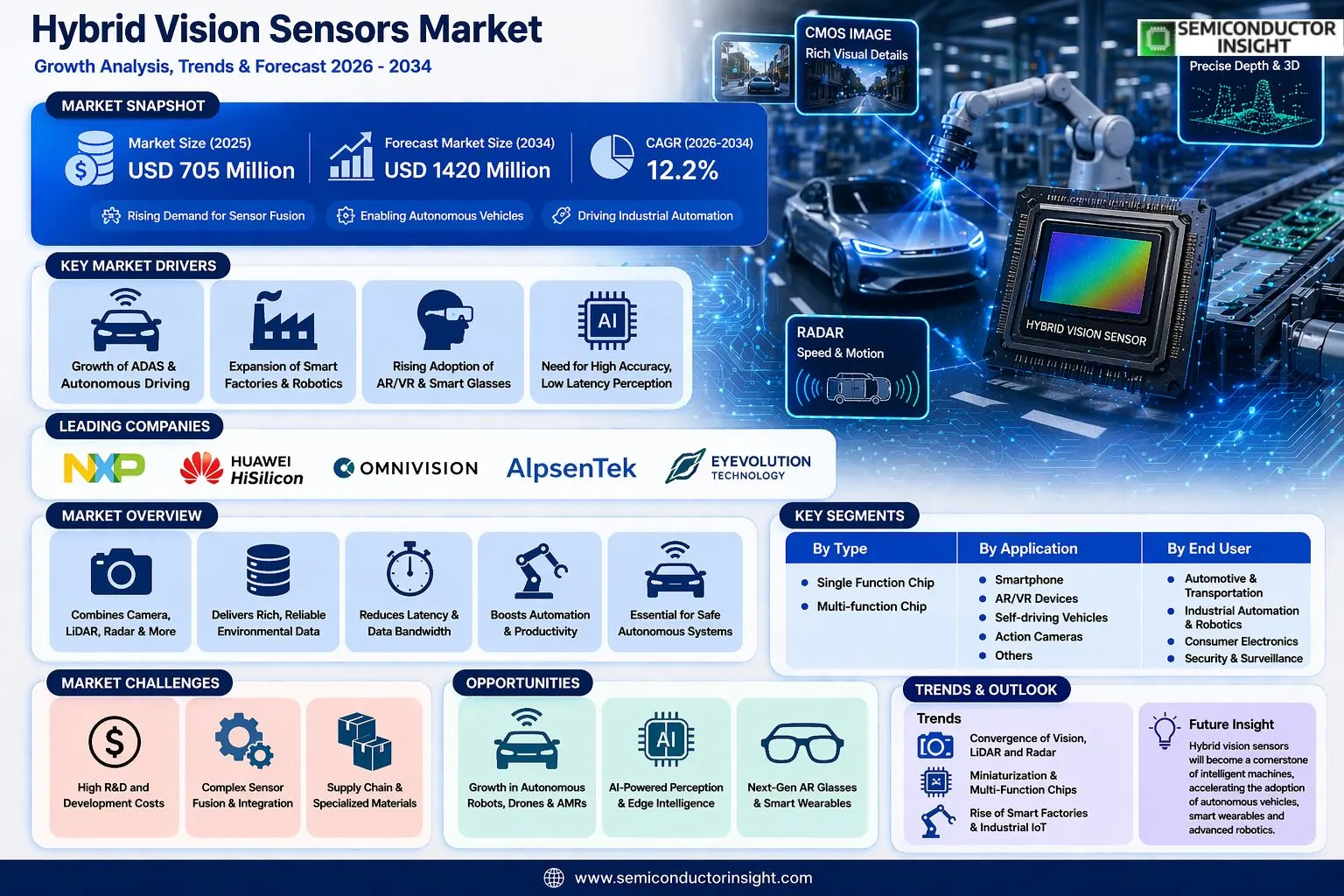
MARKET DRIVERS
Proliferation of Smart Factories and Industry 4.0
Global push towards industrial automation and connected ecosystems is a primary catalyst for the Hybrid Vision Sensors Market. These sensors uniquely combine the high-speed, power-efficient processing of event data with the detailed context of traditional frame-based imaging. This is critical for real-time robotic guidance and quality inspection in dynamic production environments. The demand for more responsive and intelligent automation is directly fueling adoption of this technology.
Rising Demand for High-Performance, Low-Latency Vision
Applications in autonomous vehicles, drones, and advanced robotics necessitate vision systems that operate with minimal delay and high data efficiency. The Hybrid Vision Sensors Market addresses this by using event-based sensing to transmit only pixel-level changes, drastically reducing latency and data bandwidth compared to conventional cameras sending full frames at fixed intervals, even when nothing has changed.
➤ The unique architecture of hybrid vision sensors makes them exceptionally suited for environments with challenging lighting or requiring rapid motion detection, a key advantage driving their integration.
Additionally, advancements in AI and machine learning are creating synergistic growth. The sparse, efficient data output from the event-based component of a hybrid sensor is ideal for training and deploying neural networks for object recognition and predictive maintenance, further solidifying their role in next-generation intelligent systems.
MARKET CHALLENGES
Technical Complexity and System Integration Hurdles
Despite their advantages, the Hybrid Vision Sensors Market faces significant challenges in design and implementation. Developing systems that effectively fuse asynchronous event streams with synchronous frame data requires sophisticated algorithms and processing hardware. This integration complexity can increase development time and cost, posing a barrier for OEMs and system integrators new to the technology.
Other Challenges
High Initial Development Cost and Niche Expertise
The relatively nascent stage of the technology means development kits and sensor modules carry a higher cost premium than mature, mass-produced conventional cameras. Furthermore, a scarcity of engineers with specialized expertise in event-based vision and sensor fusion can slow down product development cycles and market penetration.
Standardization and Ecosystem Maturity
The lack of universal standards for data formats and processing pipelines specific to hybrid vision outputs complicates interoperability. A less mature software ecosystem, compared to the vast libraries available for traditional computer vision, requires companies to invest more in proprietary solutions, potentially limiting widespread adoption.
MARKET RESTRAINTS
Competition from Established Vision Technologies
A key restraint on the Hybrid Vision Sensors Market is the entrenched position and continuous improvement of conventional CMOS image sensors and 3D vision systems. For many applications where extreme low latency is not critical, these mature, cost-effective, and well-understood technologies present a formidable alternative, causing potential customers to delay or forego adoption of newer hybrid solutions.
Perceived Risk in New Technology Adoption
The inherent conservatism in sectors like automotive and industrial manufacturing acts as a market restraint. Integrating a novel sensor technology like a hybrid vision sensor involves validation risks and concerns over long-term supplier viability and support. This perceived risk can lead to elongated sales cycles and preference for incremental improvements to legacy vision systems rather than architectural shifts.
MARKET OPPORTUNITIES
Expansion into Autonomous Mobile Robots and Drones
The rapid growth of logistics automation and last-mile delivery presents a substantial opportunity for the Hybrid Vision Sensors Market. Autonomous Mobile Robots (AMRs) and drones require robust, real-time navigation and obstacle avoidance in unpredictable environments. Hybrid sensors offer a compelling solution by providing efficient, high-dynamic-range perception, making them ideal for these mobile platforms.
Growth in Edge AI and Intelligent Security Systems
The convergence of edge computing and AI creates a significant growth vector. Hybrid vision sensors enable ultra-low-power, always-on situational awareness for smart security cameras and perimeter monitoring systems. Their ability to detect minute changes or movements while ignoring irrelevant static scenes allows for smarter alerting and reduced data storage needs at the edge, a key value proposition for this market segment.
Advancements in Automotive Driver Monitoring
Beyond autonomous driving, the interior sensing segment for driver and occupant monitoring systems represents a high-potential opportunity. Hybrid vision sensors can reliably track micro-expressions, gaze direction, and physiological signs of drowsiness in rapidly changing ambient light conditions inside a vehicle, enhancing safety features and enabling new in-cabin experiences for automotive OEMs.
Hybrid Vision Sensors Market Trends
Technological Convergence Driving Sensor Fusion
A dominant trend in the Hybrid Vision Sensors Market is the accelerated integration of multimodal sensing technologies within a single system. These advanced sensors are increasingly designed to provide more comprehensive environmental perception by simultaneously processing data from cameras, LiDAR, and radar. The fusion of these disparate data streams enhances accuracy and reliability, which is critical for applications where safety and precision are paramount, such as in autonomous navigation and industrial robotics. This convergence trend directly addresses the industry’s need for robust perception systems that can function effectively under varied and challenging conditions.
Other Trends
Accelerated Demand from Autonomous Systems
The expansion of autonomous vehicle development and advanced robotics is a primary catalyst for the Hybrid Vision Sensors Market. These systems rely on redundant and complementary sensing to build a real-time understanding of their surroundings, making hybrid sensors a foundational component. The trend extends beyond self-driving cars into industrial automation and smart security, where automated guided vehicles and surveillance systems require the depth, visual, and spatial data that hybrid solutions provide. This demand is pushing innovation in sensor packaging and data processing algorithms.
Focus on Cost-Effective and Compact Designs
As the market matures, a key industry trend is the development of more cost-effective and physically integrated sensor packages. Manufacturers are challenged to combine multiple sensing modalities without dramatically increasing the system’s size or price. This is leading to innovations in chip design, with a noted market segment focus on multi-function chips that consolidate processing. The goal is to deliver the performance benefits of a hybrid vision sensor system at a scale and cost suitable for high-volume applications, including consumer electronics like next-generation smartphones and AR/VR devices.
Geographic Expansion and Supply Chain Development
The Hybrid Vision Sensors Market is experiencing robust geographic expansion, with significant investments and manufacturing capabilities growing beyond established technology hubs. Leading companies, including NXP and OmniVision Group, are competing with emerging players in key regions to secure market share. This geographic diversification supports the trend of localized supply chains for critical automotive and industrial components, influencing manufacturing strategies and partnership formations across North America, Europe, and Asia-Pacific to meet escalating global demand.
COMPETITIVE LANDSCAPE
Key Industry Players
Dominated by Established Semiconductor and Vision Tech Giants
Global hybrid vision sensors market is characterized by intense competition, with the landscape dominated by major semiconductor companies and specialized image sensor manufacturers. According to recent analysis, the top five players collectively held a significant revenue share of the market in 2025, indicating a moderately concentrated environment. The market is led by players with strong R&D capabilities, extensive patent portfolios, and established supply chains, with a key competitive differentiator being the ability to integrate multiple sensing modalities,such as CMOS image sensors, LiDAR, radar, and ultrasonic data,onto advanced single or multi-function chips. Leading companies like NXP Semiconductors and Huawei HiSilicon leverage their expertise in automotive semiconductors and mobile processors, respectively, to capture substantial shares in high-growth applications like autonomous vehicles and smartphones.
Beyond the top-tier players, a cohort of innovative and niche-focused companies are carving out significant market positions by addressing specific application needs or advancing particular technologies. Companies such as OmniVision Group and AlpsenTek are pivotal in pushing the boundaries of image sensing and fusion algorithms, catering to demanding sectors like action cameras, AR/VR devices, and smart security. The competitive dynamics are further shaped by strategic mergers, acquisitions, and partnerships aimed at consolidating technological expertise and expanding geographic footprint, particularly in high-growth regions such as Asia-Pacific, where local players like Anhui Eyevolution Technology are increasingly active.
List of Key Hybrid Vision Sensors Companies Profiled
- NXP Semiconductors
- Huawei HiSilicon
- OmniVision Group
- AlpsenTek
- Anhui Eyevolution Technology
- Sony Semiconductor Solutions Corporation
- Samsung Electronics
- Texas Instruments
- STMicroelectronics
- Infineon Technologies
- ON Semiconductor
- Teledyne Technologies
- Ams-OSRAM AG
- Panasonic Corporation
- Lumentum Holdings Inc.
Segment Analysis:
| Segment Category | Sub-Segments | Key Insights |
| By Type |
|
Multi-function Chip The integration of multiple sensing modalities onto a single chip represents the cutting edge of sensor technology, driving market leadership.
|
| By Application |
|
Self-driving Vehicles This application area acts as the primary catalyst for technological advancement and represents a highly demanding and value-accretive segment.
|
| By End User |
|
Automotive Industry The automotive sector is the dominant and most influential end-user, setting the pace for innovation and adoption.
|
| By Integration Level |
|
Sensor-level Fusion This approach to integration, where complementary raw data is fused at the earliest point, is gaining prominence for its performance benefits.
|
| By Sensing Modality |
|
Multi-modal (Vision + LiDAR + Radar) Systems combining three or more sensing technologies are emerging as the gold standard for high-assurance applications.
|
Regional Analysis: Hybrid Vision Sensors Market
North America
The United States spearheads innovation in the Hybrid Vision Sensors Market, with major tech hubs driving the development of advanced sensor fusion algorithms and integration with AI and machine learning platforms. This leadership is supported by a strong venture capital landscape funding specialized startups.
In North America, the automotive industry’s shift towards autonomous driving systems and advanced driver-assistance systems (ADAS) creates substantial demand. Concurrently, electronics manufacturers utilize these sensors for intricate PCB inspection and assembly line quality assurance.
Compliance with strict safety and quality standards in pharmaceuticals and food & beverage sectors mandates high-accuracy inspection, which hybrid vision sensors provide. Strategic partnerships between sensor developers and end-user industries in the region accelerate tailored solution deployment.
The region’s complex, high-volume manufacturing and logistics networks rely on hybrid vision sensors for automation, robotics guidance, and inventory management. This integration enhances operational efficiency and resilience, solidifying the technology’s role in modern industrial strategy.
Europe
Europe represents a highly significant and mature market for hybrid vision sensors, characterized by a strong industrial manufacturing base and rigorous regulatory standards. The region’s leadership in premium automotive manufacturing, especially in Germany, creates a high-value demand for sensors used in precision assembly and quality control. Furthermore, Europe’s proactive regulatory environment concerning industrial safety, environmental sustainability, and product quality pushes manufacturers to adopt advanced vision systems that ensure compliance and reduce waste. Collaborative initiatives between academia, research institutes, and industry foster innovation, particularly in integrating these sensors with robotics for smart factory applications across the continent.
Asia-Pacific
The Asia-Pacific region is the fastest-growing market for the Hybrid Vision Sensors Market, driven by rapid industrialization, massive electronics manufacturing, and substantial government investments in smart manufacturing initiatives. Countries like China, Japan, and South Korea are pivotal, with their vast consumer electronics and automotive production ecosystems. The region benefits from cost-competitive manufacturing and a strong focus on export-oriented quality, making advanced inspection technologies essential. Local governments are actively promoting Industry 4.0, which accelerates the adoption of automation technologies, including hybrid vision sensors, to maintain global competitiveness and improve production efficiency.
South America
The hybrid vision sensors market in South America is in a developing phase, with growth primarily influenced by the modernization of key sectors such as agriculture, mining, and food processing. Brazil and Argentina are the main contributors, where industries are beginning to invest in automation to enhance productivity and product quality. While adoption lags behind more technologically advanced regions, increasing awareness of the benefits of industrial automation and gradual economic stabilization present future growth opportunities for sensor integration in quality inspection and process control applications.
Middle East & Africa
The hybrid vision sensors market in the Middle East & Africa region is emerging, with growth centered on economic diversification projects and smart city developments, particularly in Gulf Cooperation Council (GCC) countries. Investments in manufacturing, logistics, and infrastructure are creating initial demand for automation technologies. In Africa, the market is nascent, with potential seen in sectors like packaging and simple assembly where basic automation is being introduced. The overall market dynamics are shaped by long-term strategic visions to reduce oil dependency and build technology-driven industrial sectors.
Report Scope
This market research report provides a comprehensive analysis of the Hybrid Vision Sensors Market, covering the forecast period 2026–2034. It offers detailed insights into market dynamics, technological advancements, competitive landscape, and key trends shaping the industry.
Key focus areas of the report include:
- Market Overview: The report begins with an overview outlining the current market scenario, key growth indicators, and industry transformation drivers. It discusses macroeconomic factors, demand–supply balance, regulatory landscape, and the critical role of these sensors in enabling advancements across industries such as autonomous vehicles, industrial automation, smart security, and consumer electronics.
- Market Size & Forecast: Historical data and future projections for revenue, unit shipments, and market value across major regions and segments, including CAGR analysis.
- Segmentation Analysis: Detailed breakdown by product type (e.g., Single Function Chip, Multi-function Chip), application (e.g., Smartphone, AR/VR Devices, Self-driving Vehicles), and end-user industry to identify high-growth segments and investment opportunities.
- Regional Insights: Insights into market performance across North America, Europe, Asia-Pacific, Latin America, and the Middle East & Africa, including detailed country-level analysis for key markets such as the U.S., China, Germany, and Japan.
- Competitive Landscape: Profiles of leading market participants, including their product offerings, revenue share, sales data, R&D focus, manufacturing capacity, pricing strategies, and recent developments such as mergers, acquisitions, and partnerships.
- Technology Trends & Innovation: Assessment of emerging technologies, integration of multimodal perception (cameras, LiDAR, radar), AI-driven data fusion, evolving industry standards, and fabrication techniques.
- Market Drivers & Restraints: Evaluation of factors driving market growth along with challenges, supply chain constraints, regulatory issues, and market-entry barriers.
- Stakeholder Insights: Insights for component suppliers, OEMs, system integrators, investors, and policymakers regarding the evolving ecosystem and strategic opportunities.
Primary and secondary research methods are employed, including interviews with industry experts, surveys of manufacturers and suppliers, data from verified sources, and real-time market intelligence to ensure the accuracy and reliability of the insights presented.
FREQUENTLY ASKED QUESTIONS:
What is the current market size and growth forecast for the Hybrid Vision Sensors Market?
-> Global Hybrid Vision Sensors market was valued at USD 705 million in 2025 and is projected to reach USD 1420 million by 2034, growing at a CAGR of 12.2% during the forecast period.
Which key companies operate in the Hybrid Vision Sensors Market?
-> Key players include NXP, Huawei HiSilicon, OmniVision Group, AlpsenTek, and Anhui Eyevolution Technology, among others. Global top five players held a significant revenue share in 2025.
What are the primary applications of Hybrid Vision Sensors?
-> They are widely used in Smartphones, AR/VR Devices, Self-driving Vehicles, Action Cameras, and other applications requiring comprehensive environmental perception for autonomous operations, robotics, and industrial automation.
What are the key segments in this market?
-> The market is segmented by Type (Single Function Chip, Multi-function Chip) and by Application. The Single Function Chip segment is projected to show significant growth through 2034.
Which regions are analyzed in the report?
-> The report provides detailed analysis for regions including North America, Europe, Asia, South America, and the Middle East & Africa, with country-level coverage for the U.S., China, Germany, Japan, and other key nations.

Get Sample Report PDF for Exclusive Insights
Report Sample Includes
- Table of Contents
- List of Tables & Figures
- Charts, Research Methodology, and more...
 Download Sample Report PDF