High Transmittance Glan Laser Prism Market Insights
Global High Transmittance Glan Laser Prism market size was valued at USD 218 million in 2025. The market is projected to grow from USD 229.6 million in 2026 to USD 347.8 million by 2034, exhibiting a CAGR of 5.3% during the forecast period.
High Transmittance Glan Laser Prism is a high-performance polarizing optical device fabricated from Iceland spar (calcite) crystal or other advanced birefringent materials such as α-BBO and YVO4. These prisms are engineered to deliver excellent transmittance across a wide spectral range while maintaining exceptionally high polarization purity. The design typically incorporates an air gap structure to minimize reflection losses, and the crystal assembly is often encased with absorptive black glass to provide additional protection and suppress stray light. Their precision optical characteristics make them indispensable components across laser technology, optical measurement, and spectral analysis applications.
The market is advancing steadily, driven by the expanding deployment of laser-based systems in industrial manufacturing, scientific research, and defense sectors. Growing investment in photonics infrastructure and increasing adoption of high-power laser platforms are reinforcing demand for reliable polarization management components. Key global manufacturers operating in this space include Edmund Optics, Thorlabs, MKS Instruments, EKSMA Optics, OptoSigma, Karl Lambrecht, Optogama, FOCtek Photonics, DayOptics, and Crystock, among others, collectively holding a significant share of global revenues in 2025.
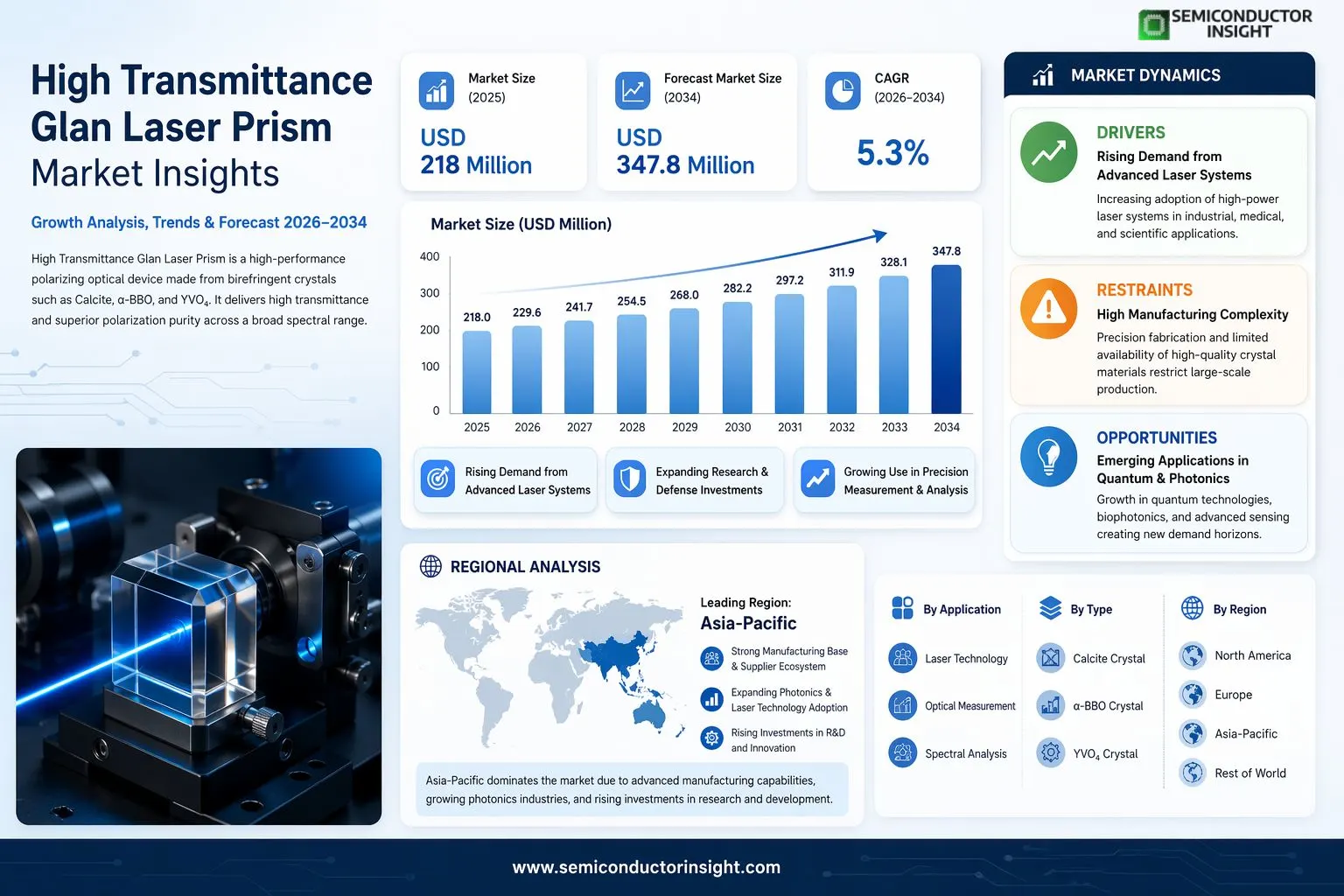
MARKET DRIVERS
Rising Demand from Advanced Laser Systems and Photonics Applications
High Transmittance Glan Laser Prism Market is experiencing sustained growth driven by the rapid expansion of laser-based technologies across industrial, scientific, and medical sectors. Glan laser prisms, renowned for their exceptional extinction ratios and high transmittance properties, are increasingly specified in high-power laser systems where precise polarization control is non-negotiable. As laser output powers continue to rise in cutting, welding, and materials processing applications, the demand for optical components capable of withstanding intense beam densities has intensified considerably, positioning high transmittance Glan laser prisms as critical enablers of next-generation laser performance.
Expansion of Scientific Research and Defense Sector Investments
Government and private investments in scientific research infrastructure, quantum optics, and defense-grade laser systems are serving as powerful catalysts for High Transmittance Glan Laser Prism Market. Research institutions engaged in spectroscopy, interferometry, and nonlinear optics routinely depend on the superior polarization purity that Glan laser prisms deliver. Simultaneously, defense agencies across North America, Europe, and Asia-Pacific are advancing directed-energy programs and laser rangefinding systems, all of which require optically precise polarization components. This dual demand from research and defense verticals is providing a structurally robust foundation for market growth.
➤ The increasing adoption of ultrafast laser systems in precision manufacturing and biophotonics is directly amplifying procurement volumes for high transmittance Glan laser prisms, as these applications demand components with minimal optical losses and outstanding damage thresholds.
The proliferation of fiber-coupled and free-space laser platforms in telecommunications and sensing applications is further broadening the addressable market for high transmittance Glan laser prisms. As photonic integration becomes more mainstream and optical system designers prioritize component reliability alongside performance, suppliers offering prisms with verified high transmittance values and rigorous quality certifications are gaining a competitive edge. The convergence of increasing laser adoption rates with the technical requirements of polarization management continues to reinforce the growth trajectory of this specialized optical components market.
MARKET CHALLENGES
High Manufacturing Complexity and Precision Requirements Limiting Scale
One of the foremost challenges confronting High Transmittance Glan Laser Prism Market is the inherent complexity of manufacturing prisms that simultaneously achieve high transmittance and the optical purity demanded by advanced laser applications. Fabricating Glan laser prisms from calcite or alpha-barium borate (α-BBO) requires sourcing optically homogeneous crystal materials with minimal inclusions, followed by multi-stage polishing and cement-free air-spaced assembly processes. Maintaining consistent angular tolerances, surface flatness, and anti-reflection coating performance across production batches remains a significant technical challenge, particularly as customer specifications continue to tighten in response to increasingly demanding system requirements.
Other Challenges
Limited Availability of High-Quality Raw Crystal Materials
High Transmittance Glan Laser Prism Market is constrained by the geographically concentrated supply of high-grade calcite and α-BBO crystals. Natural calcite of optical quality is sourced from a limited number of deposits globally, and any supply disruption can create bottlenecks throughout the value chain. Synthetic crystal growth for α-BBO, while offering greater consistency, involves lengthy production cycles and significant capital investment, restricting the number of qualified suppliers capable of meeting volume demand without compromising material quality.
Intense Price Competition from Low-Cost Regional Manufacturers
Established optical component manufacturers in North America and Europe face growing pricing pressure from lower-cost producers, particularly in parts of Asia where manufacturing overheads are structurally lower. While premium buyers in defense and high-end research prioritize certified performance, a segment of the market , particularly in general industrial laser applications , exhibits significant price sensitivity. This dynamic compresses margins for quality-focused manufacturers and creates market segmentation challenges within the broader High Transmittance Glan Laser Prism Market.
MARKET RESTRAINTS
Vulnerability to Substitution by Alternative Polarization Technologies
High Transmittance Glan Laser Prism Market faces a meaningful restraint in the form of substitution risk from alternative polarization management solutions. Thin-film polarizers, wire-grid polarizers, and polarizing beam splitter cubes have advanced considerably in performance and are increasingly competitive across a range of laser wavelengths and power levels. For system designers operating under tight spatial or cost constraints, these alternatives can present attractive trade-offs, particularly in applications where the superior extinction ratio of a Glan laser prism is not strictly required. As competing technologies continue to mature, the market must navigate the risk that a portion of addressable demand migrates toward substitute components.
Stringent Export Controls and Regulatory Compliance Burdens
High transmittance Glan laser prisms, particularly those specified for defense and dual-use laser systems, are subject to export control regulations in major producing countries, including controls under frameworks such as the Wassenaar Arrangement. Compliance with these regulations introduces administrative complexity, lead time extensions, and additional costs for manufacturers and distributors operating in international markets. Smaller market participants may find the regulatory burden disproportionately constraining, limiting their ability to compete effectively across geographies and potentially concentrating market share among larger, compliance-capable organizations within High Transmittance Glan Laser Prism Market.
MARKET OPPORTUNITIES
Quantum Technologies and Emerging Photonics Applications Creating New Demand Horizons
The emergence of quantum computing, quantum communications, and quantum sensing represents a significant long-term opportunity for High Transmittance Glan Laser Prism Market. These nascent but rapidly advancing fields place extraordinary demands on polarization control precision, often requiring components that exceed the performance specifications of conventional optical systems. Glan laser prisms, with their established track record of delivering high extinction ratios and reliable polarization purity, are well-positioned to address these requirements. As government-backed quantum initiatives scale globally and private investment in quantum photonics accelerates, the addressable market for high-performance polarization optics is expected to expand in ways that could meaningfully benefit leading Glan laser prism suppliers.
Advancements in Laser-Based Medical Diagnostics and Therapeutic Systems
The medical sector presents a compelling growth opportunity for High Transmittance Glan Laser Prism Market, driven by the increasing deployment of laser systems in ophthalmology, dermatology, oncology, and surgical applications. Medical laser platforms operating across UV, visible, and near-infrared wavelengths increasingly incorporate polarization optics to improve beam quality, diagnostic accuracy, and treatment precision. The growing global demand for minimally invasive procedures, combined with the expansion of laser-based imaging modalities such as optical coherence tomography, is expected to drive incremental procurement of high transmittance Glan laser prisms over the coming years, particularly in markets where healthcare infrastructure investment is accelerating.
Customization and Value-Added Services as Differentiation Levers
Manufacturers operating in High Transmittance Glan Laser Prism Market have an opportunity to strengthen market position and improve margin profiles by expanding their capabilities in custom optical design and application-specific engineering services. As end-users in research, defense, and industrial sectors increasingly require prisms optimized for specific wavelength ranges, damage thresholds, or mounting configurations, suppliers able to offer rapid prototyping, application engineering support, and integrated optical assembly are likely to command premium pricing and foster deeper customer relationships. Investing in advanced coating technologies, precision metrology, and digital customer engagement platforms represents a strategic pathway to differentiation in what remains a technically specialized and relationship-driven market segment.
Trends
Growing Adoption Across Laser Technology Applications Driving Market Expansion
High Transmittance Glan Laser Prism Market is witnessing sustained growth, driven by increasing demand from laser technology, optical measurement, and spectral analysis sectors. These high-performance polarizing devices, fabricated from birefringent materials such as Calcite (Iceland spar), α-BBO, and YVO4 crystals, are gaining wider adoption due to their ability to deliver superior polarization purity alongside excellent transmittance across a broad spectral range. The air gap structure inherent in Glan laser prism designs continues to be a preferred configuration among end-users, as it significantly reduces reflection losses and enhances overall optical efficiency in precision applications.
Other Trends
Shift Toward Advanced Crystal Materials
A notable trend in High Transmittance Glan Laser Prism Market is the gradual transition from conventional Calcite crystal-based prisms toward advanced alternatives including α-BBO and YVO4 crystals. These materials offer improved damage thresholds and broader wavelength compatibility, making them increasingly suitable for high-power laser systems. As laser technology evolves to support industrial processing, medical equipment, and scientific research, demand for prisms capable of withstanding higher optical intensities is accelerating innovation in crystal material selection and fabrication techniques.
Expanding Role in Optical Measurement and Spectral Analysis
Beyond laser technology, High Transmittance Glan Laser Prism Market is benefiting from expanding use in optical measurement instrumentation and spectral analysis equipment. Precision industries such as semiconductor manufacturing, aerospace testing, and biomedical diagnostics increasingly rely on polarization-based measurement systems where consistent transmittance and polarization purity are critical. This broadening application base is encouraging manufacturers to develop prisms with tighter tolerances and enhanced surface quality coatings, including absorptive black glass protection that minimizes stray light interference.
Competitive Landscape and Regional Manufacturing Trends
The competitive environment within High Transmittance Glan Laser Prism Market remains concentrated among established global players, including Edmund Optics, Thorlabs, MKS Instruments, EKSMA Optics, OptoSigma, Karl Lambrecht, FOCtek Photonics, and DayOptics, among others. Asian manufacturers, particularly those based in China, are increasingly active in expanding production capacity and improving product quality to compete in international markets. This regional manufacturing growth is contributing to greater supply chain diversification and more competitive pricing structures globally.
Customization and Integration With Modular Optical Systems Emerging as Key Differentiator
A growing trend shaping High Transmittance Glan Laser Prism Market is the rising demand for customized optical components designed for integration into modular and compact optical systems. Research institutions and industrial users are increasingly requesting prisms with application-specific aperture sizes, wavelength ranges, and mounting configurations. Manufacturers responding to this demand with flexible design capabilities and shorter lead times are positioning themselves competitively. As photonics technology continues to advance, the ability to offer tailored solutions alongside reliable optical performance is expected to remain a defining trend across the global market.
COMPETITIVE LANDSCAPE
Key Industry Players
High Transmittance Glan Laser Prism Market , Competitive Dynamics and Leading Manufacturer Profiles
The global High Transmittance Glan Laser Prism market, valued at approximately US$ 218 million in 2025 and projected to reach US$ 311 million by 2032 at a CAGR of 5.3%, is characterized by a moderately consolidated competitive landscape. Edmund Optics and Thorlabs collectively command a significant portion of the market, leveraging their extensive global distribution networks, broad optical component portfolios, and long-standing reputations for precision manufacturing. MKS Instruments further reinforces the upper competitive tier through its integration of photonics and laser optics solutions within a broader instrumentation ecosystem. These leading players invest substantially in R&D to advance birefringent crystal processing , particularly for Calcite, α-BBO, and YVO4 substrates , ensuring high polarization purity and superior transmittance performance across wide spectral ranges, which are critical requirements in laser technology, optical measurement, and spectral analysis applications.
Beyond the dominant tier, several specialized manufacturers play pivotal roles in shaping the competitive dynamics of High Transmittance Glan Laser Prism Market. EKSMA Optics and OptoSigma are well-regarded for their precision-engineered polarizing optics tailored for demanding laser and scientific instrumentation environments. Karl Lambrecht and Optogama serve niche segments with highly customized Glan laser prism configurations, while FOCtek Photonics, DayOptics, CASTECH, and Fuzhou Hundreds Optics represent a growing cohort of Asia-Pacific manufacturers that are increasingly competitive on both quality and cost efficiency. Companies such as MT-Optics, JCOPTIX, Ultra Photonics, Crystock, and A-STAR PHOTONICS further diversify the supply landscape, catering to regional demand across China, Southeast Asia, and emerging markets. The competitive interplay among these players continues to intensify as downstream demand from laser technology and optical measurement sectors accelerates through the forecast period.
List of Key High Transmittance Glan Laser Prism Companies Profiled
- Edmund Optics
- Thorlabs
- MKS Instruments
- EKSMA Optics
- OptoSigma
- Karl Lambrecht
- Optogama
- FOCtek Photonics
- DayOptics
- Crystock
- MT-Optics
- CASTECH
- JCOPTIX
- Ultra Photonics
- Fuzhou Hundreds Optics
- A-STAR PHOTONICS
Segment Analysis:
| Segment Category | Sub-Segments | Key Insights |
| By Type |
|
Calcite Crystal holds the leading position in High Transmittance Glan Laser Prism Market by type, owing to its long-standing reputation as Iceland spar , a naturally occurring birefringent material recognized for its exceptional optical clarity and polarization performance.
|
| By Application |
|
Laser Technology represents the dominant application segment for High Transmittance Glan Laser Prisms, driven by the increasing proliferation and sophistication of laser-based industrial, scientific, and medical systems worldwide.
|
| By End User |
|
Research & Academic Institutions constitute the leading end-user segment for High Transmittance Glan Laser Prisms, serving as the primary testbed for advanced photonic research, quantum optics experiments, and precision spectroscopy investigations.
|
| By Wavelength Range |
|
Visible Range prisms lead this segment owing to their broad compatibility with the most widely deployed commercial and scientific laser systems, including Nd:YAG harmonics, argon-ion lasers, and diode-pumped solid-state lasers commonly found across laboratory and industrial platforms.
|
| By Design Configuration |
|
Standard Air-Gap Glan Laser Prism remains the most widely adopted design configuration, valued for its elegant simplicity in minimizing reflection losses at internal crystal interfaces through an air gap architecture that simultaneously enables high laser-induced damage thresholds.
|
Regional Analysis: High Transmittance Glan Laser Prism Market
North America
North America’s defense sector represents one of the most consistent demand drivers for high transmittance Glan laser prisms. Advanced targeting systems, directed-energy platforms, and laser rangefinding equipment developed for both military and aerospace applications require precision polarization optics with uncompromising transmittance performance. Sustained government procurement budgets and ongoing modernization programs ensure this demand segment remains structurally resilient throughout the forecast period.
World-class universities and national laboratories across the United States and Canada generate significant demand for high-performance polarization optics in fundamental and applied research settings. Quantum optics experiments, spectroscopy research, and laser physics studies routinely require Glan laser prisms offering superior transmittance and minimal wavefront distortion. The concentration of photonics-focused research programs positions academic institutions as steady, quality-driven consumers in the North American market.
The medical diagnostics and life sciences industries in North America are increasingly incorporating high transmittance Glan laser prisms into advanced imaging, confocal microscopy, and laser surgery platforms. Growing investment in biophotonics and precision medicine is broadening the application landscape beyond traditional industrial optics. This diversification of end-use sectors strengthens the overall demand profile and provides insulation against cyclical fluctuations in any single vertical market segment.
North America hosts several globally recognized precision optics manufacturers capable of producing Glan laser prisms to the exacting specifications demanded by high-end laser systems. The region’s supply chain benefits from access to premium optical-grade calcite and advanced polishing technologies. Strong intellectual property protection frameworks and rigorous quality assurance standards further encourage original equipment manufacturers to source critical polarization components from domestic suppliers.
Europe
Europe represents a highly sophisticated and innovation-driven regional segment within High Transmittance Glan Laser Prism Market. Germany, the United Kingdom, France, and the Netherlands collectively form the core of the region’s photonics industrial base, supported by a dense network of specialized optical component manufacturers, Fraunhofer research institutes, and pan-European photonics initiatives. The region’s laser technology sector is among the most advanced globally, with strong applications in industrial material processing, scientific instrumentation, and automotive LiDAR systems that rely heavily on precision polarization optics. European manufacturers are widely recognized for engineering excellence, and their end-user industries place a premium on component quality and long operational lifetimes, which directly benefits demand for high transmittance Glan laser prisms. Regulatory frameworks supporting clean energy technologies and medical device innovation are also opening new downstream application channels. Collaborative programs under Horizon Europe continue to fund photonics research that may further stimulate regional demand for advanced polarization components through the 2026–2034 forecast window.
Asia-Pacific
Asia-Pacific is emerging as the fastest-growing regional market for high transmittance Glan laser prisms, driven by rapid industrialization, expanding semiconductor fabrication ecosystems, and aggressive government investment in photonics and laser technology across China, Japan, South Korea, and Taiwan. China’s national initiatives in quantum communication, advanced manufacturing, and defense modernization are generating substantial demand for high-performance optical components, while Japan and South Korea contribute through their globally competitive consumer electronics, display technology, and precision machinery industries. The region’s growing base of domestic optical component manufacturers is gradually improving local supply capabilities, although premium high transmittance Glan laser prisms from established Western suppliers continue to command preference in critical applications. Rising research and development expenditures at regional universities and state-affiliated institutes are further broadening the consumer base, establishing Asia-Pacific as a pivotal growth engine for the global High Transmittance Glan Laser Prism Market.
South America
South America occupies a comparatively nascent but gradually developing position in High Transmittance Glan Laser Prism Market. Brazil leads regional demand, primarily through its aerospace research programs, academic photonics research communities, and an expanding medical device sector that increasingly incorporates laser-based diagnostic and therapeutic equipment. Argentina contributes modestly through its scientific instrumentation and telecommunications research activities. The region’s overall market development is tempered by limited domestic manufacturing capacity for precision optical components, making it largely dependent on imports from North American, European, and Asian suppliers. Infrastructure investment constraints and currency volatility present ongoing challenges for sustained market expansion. Nevertheless, growing awareness of laser technology applications across industrial and medical sectors, combined with gradual improvements in scientific research funding, suggests that South America holds meaningful long-term potential within the broader High Transmittance Glan Laser Prism Market landscape through 2034.
Middle East & Africa
The Middle East and Africa region currently represents the smallest share of the global High Transmittance Glan Laser Prism Market, yet select pockets of demand are beginning to emerge with increasing clarity. In the Middle East, countries such as Israel, the United Arab Emirates, and Saudi Arabia are driving demand through defense technology programs, advanced research institutions, and ambitious smart city and telecommunications infrastructure projects. Israel in particular maintains a globally respected photonics and electro-optics industry, creating organic demand for high transmittance polarization optics. Africa remains at an early stage of adoption, with demand concentrated in South Africa’s scientific research institutions and select industrial applications. Across the broader region, limited local manufacturing capability means that demand is predominantly served through international supply channels. Long-term development of the region’s technology and innovation sectors could gradually elevate its contribution to global High Transmittance Glan Laser Prism Market volumes by the end of the forecast period.
Report Scope
This market research report provides a comprehensive analysis of High Transmittance Glan Laser Prism Market, covering the forecast period 2026–2034. It offers detailed insights into market dynamics, technological advancements, competitive landscape, and key trends shaping the industry.
Key focus areas of the report include:
- Market Overview: The report begins with an overview outlining its current market scenario, key growth indicators, and industry transformation drivers. It discusses macroeconomic factors, demand–supply balance, regulatory landscape, and the strategic role of high-performance optical components in powering advancements across industries such as laser technology, optical measurement, spectral analysis, and industrial automation.
- Market Size & Forecast: Historical data and future projections for revenue, unit shipments, and market value across major regions and segments.
- Segmentation Analysis: Detailed breakdown by product type (Calcite Crystal, a-BBO Crystal, YVO4 Crystal), application, and end-user industry to identify high-growth segments and investment opportunities.
- Regional Insights: Insights into market performance across North America, Europe, Asia-Pacific, Latin America, and the Middle East & Africa, including country-level analysis where relevant.
- Competitive Landscape: Profiles of leading market participants, including their product offerings, R&D focus, manufacturing capacity, pricing strategies, and recent developments such as mergers, acquisitions, and partnerships.
- Technology Trends & Innovation: Assessment of emerging technologies, integration of AI/IoT, birefringent material advancements, fabrication techniques, and evolving industry standards for polarizing optical devices.
- Market Drivers & Restraints: Evaluation of factors driving market growth along with challenges, supply chain constraints, regulatory issues, and market-entry barriers.
- Stakeholder Insights: Insights for component suppliers, OEMs, system integrators, investors, and policymakers regarding the evolving ecosystem and strategic opportunities.
Primary and secondary research methods are employed, including interviews with industry experts, data from verified sources, and real-time market intelligence to ensure the accuracy and reliability of the insights presented.
FREQUENTLY ASKED QUESTIONS:
What is the current market size of High Transmittance Glan Laser Prism Market?
-> Global High Transmittance Glan Laser Prism Market was valued at USD 218 million in 2025 and is projected to reach USD 311 million by 2032, growing at a CAGR of 5.3% during the forecast period.
Which key companies operate in High Transmittance Glan Laser Prism Market?
-> Key players include Edmund Optics, Thorlabs, MKS Instruments, EKSMA Optics, OptoSigma, Karl Lambrecht, Optogama, FOCtek Photonics, DayOptics, Crystock, MT-Optics, CASTECH, JCOPTIX, Ultra Photonics, Fuzhou Hundreds Optics, and A-STAR PHOTONICS, among others.
What are the key growth drivers?
-> Key growth drivers include expanding applications in laser technology, increasing demand for precision optical measurement instruments, growth in spectral analysis systems, and rising adoption of high-performance polarizing devices in research and industrial sectors.
Which region dominates the market?
-> Asia (particularly China and Japan) is among the fastest-growing regions due to strong manufacturing capabilities and expanding photonics industries, while North America remains a significant market driven by advanced laser and optical research activities.
What are the emerging trends?
-> Emerging trends include adoption of advanced birefringent materials such as a-BBO and YVO4 crystals, development of air-gap structured prisms for reduced reflection losses, integration of absorptive black glass coatings for crystal protection, and increasing use of Glan laser prisms in high-power laser systems.

Get Sample Report PDF for Exclusive Insights
Report Sample Includes
- Table of Contents
- List of Tables & Figures
- Charts, Research Methodology, and more...
 Download Sample Report PDF