Market Insights
Global High Speed CMOS Image Sensor Market was valued at USD 5,715 million in 2025 and is projected to reach USD 9,885 million by 2032, exhibiting a CAGR of 8.2% during the forecast period.
In 2025, global production reached approximately 1.96 billion units, with an average market price of around USD 3.2 per unit.
High Speed CMOS Image Sensors (High Speed CIS) are specialized semiconductor devices optimized for capturing fast-moving objects or dynamic transient processes. Unlike general-purpose image sensors that balance resolution and frame rate, High Speed CIS prioritizes ultra-high frame rates while maintaining imaging quality. These sensors are widely used in industrial inspection, scientific research, automotive applications, and consumer electronics where rapid motion capture is critical.
The market growth is driven by increasing demand for machine vision systems in manufacturing automation and the rising adoption of high-speed cameras in automotive safety applications such as ADAS. Furthermore, advancements in stacked CMOS technology have enabled higher pixel densities without compromising speed performance. Leading manufacturers like Sony Semiconductor Solutions and Samsung Electronics continue to dominate the market through continuous innovation in backside illumination (BSI) and global shutter technologies.
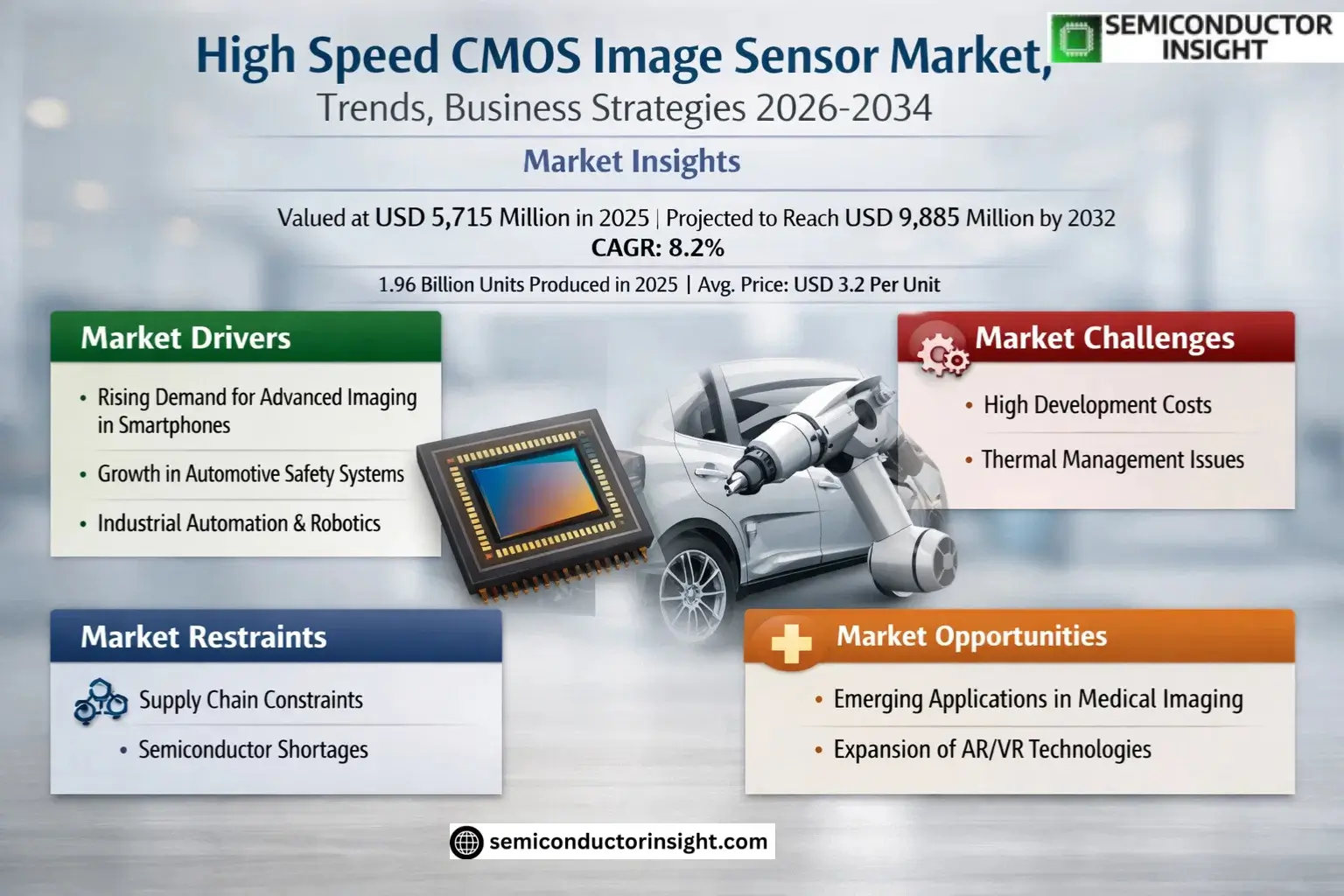
MARKET DRIVERS
Increasing Demand for Advanced Imaging in Smartphones
High Speed CMOS Image Sensor Market is experiencing significant growth due to the rising adoption of high-resolution cameras in smartphones. Manufacturers are integrating faster sensors to enable features like slow-motion video and improved low-light performance, driving market expansion.
Growth in Automotive Safety Systems
Advanced driver-assistance systems (ADAS) increasingly rely on high speed CMOS image sensors for real-time object detection and collision avoidance. The automotive sector’s push toward autonomous vehicles has accelerated demand for these high-performance imaging solutions.
Industrial automation applications, including machine vision and robotics, are further propelling market growth as manufacturers seek faster, more responsive imaging solutions.
MARKET CHALLENGES
High Development Costs
The research and development of advanced high speed CMOS image sensors requires significant investment in semiconductor technology, creating barriers for new market entrants and limiting innovation from smaller players.
Other Challenges
Thermal Management Issues
As sensor speeds increase, managing heat dissipation becomes critical to maintain image quality and sensor longevity, presenting technical hurdles for manufacturers.
MARKET RESTRAINTS
Supply Chain Constraints
High Speed CMOS Image Sensor Market faces production constraints due to global semiconductor shortages and complex manufacturing processes. These factors limit the scalability of high-performance sensor production despite growing demand.
MARKET OPPORTUNITIES
Emerging Applications in Medical Imaging
The healthcare sector presents substantial growth potential for high speed CMOS image sensors, particularly in endoscopic procedures and real-time diagnostic imaging where rapid, high-resolution capture is essential.
Expansion of AR/VR Technologies
As augmented and virtual reality systems evolve, the need for low-latency, high-speed imaging solutions creates new opportunities for CMOS sensor manufacturers to develop specialized products for this growing market segment.
High Speed CMOS Image Sensor Market Trends
Advancements in Automotive Vision Systems
High Speed CMOS Image Sensor Market is witnessing significant growth driven by the automotive sector’s increasing demand for advanced driver-assistance systems (ADAS). High Speed CIS enables critical applications like lane departure warnings and collision avoidance by capturing rapid motion with high precision. Manufacturers are developing sensors with enhanced dynamic range (120dB+) and low-light performance to meet stringent automotive safety standards.
Other Trends
Industrial Machine Vision Adoption
Industrial applications are accelerating adoption of High Speed CMOS Image Sensors for machine vision systems requiring ultra-high frame rates (1000+ fps). These sensors enable precise inspection of fast-moving production lines and robotic assembly processes. The integration of global shutter technology eliminates motion distortion, making them ideal for quality control in manufacturing.
Emerging Scientific Research Applications
Research institutions are leveraging High Speed CMOS Image Sensors for capturing transient phenomena in physics and biology experiments. Their ability to record ultra-fast events (nanosecond resolution) is enabling breakthroughs in fluid dynamics analysis and cellular imaging. Sensor manufacturers are collaborating with research labs to develop customized solutions for specific experimental requirements.
Stacked Sensor Architecture Innovations
Leading players like Sony and Samsung are pioneering 3D stacked High Speed CIS designs that separate pixel and logic layers. This architecture significantly improves processing speed while reducing power consumption. The technology is particularly beneficial for mobile devices requiring high-speed imaging in compact form factors.
Security & Surveillance Upgrades
The security industry is transitioning to High Speed CMOS Image Sensors capable of 4K resolution at 60fps for advanced surveillance systems. These sensors provide superior low-light performance and wide dynamic range for round-the-clock monitoring. AI-powered analytics integration is creating new demand for sensors that can capture high-quality footage for facial recognition and behavioral analysis.
COMPETITIVE LANDSCAPE
Key Industry Players
Global High Speed CMOS Image Sensor Market Dominated by Asian Tech Giants
Sony Semiconductor Solutions maintains market leadership with its proprietary Stacked CMOS technology, controlling over 40% of the high-speed imaging segment. The Japanese giant dominates automotive and industrial applications with its high-frame-rate sensors (up to 1,000 fps). Samsung follows closely, leveraging its vertical integration across semiconductor manufacturing, while Omnivision (acquired by Will Semiconductor) specializes in compact high-speed sensors for consumer electronics.
Emerging Chinese players like Smartsens Technology and GalaxyCore are gaining traction through competitive pricing and government-backed semiconductor initiatives. SOI specializes in radiation-hardened sensors for aerospace applications, while STMicroelectronics and ON Semiconductor lead in automotive-grade high-speed solutions. Canon and Panasonic maintain strong positions in scientific imaging with their global shutter sensors.
List of Key High Speed CMOS Image Sensor Companies Profiled
- Sony Semiconductor Solutions Corporation
- Samsung Electronics
- OmniVision Technologies
- STMicroelectronics
- ON Semiconductor
- GalaxyCore Inc.
- Panasonic Corporation
- Smartsens Technology
- Canon Inc.
- Silicon Optronics (SOI)
- SK Hynix
- Toshiba Electronic Devices
- Hamamatsu Photonics
- Teledyne Technologies
- Pixart Imaging
Segment Analysis:
| Segment Category | Sub-Segments | Key Insights |
| By Type |
|
Stacked CMOS Image Sensor dominates the high-speed segment due to:
|
| By Application |
|
Industrial Applications represent the most demanding segment because:
|
| By End User |
|
Original Equipment Manufacturers drive innovation with:
|
| By Frame Rate |
|
Ultra-high-speed segment shows strongest growth potential due to:
|
| By Pixel Size |
|
Medium Pixel sensors achieve the best balance for high-speed applications:
|
Regional Analysis: Global High Speed CMOS Image Sensor Market
Asian automakers increasingly incorporate high-speed CMOS image sensors for ADAS and autonomous driving systems, with Japanese OEMs leading in vision-based safety technologies.
Regional healthcare providers adopt high-speed medical endoscopes and surgical cameras, with South Korean firms developing ultra-compact imaging solutions for minimally invasive procedures.
Smart factories across China deploy high-frame-rate CMOS sensors for precision quality control, with growing demand from Taiwanese semiconductor equipment manufacturers.
Smartphone makers compete on high-speed video capabilities, driving sensor innovations, while action camera manufacturers in Southeast Asia require rugged high-performance imaging solutions.
North America
North America represents the second-largest market for High Speed CMOS Image Sensors, driven by defense applications, scientific research, and autonomous vehicle development. The U.S. maintains technological leadership through NASA and military contracts for space imaging and surveillance systems. Silicon Valley startups pioneer novel sensor architectures for machine vision, while Canadian research institutions develop specialized imaging for biomedical applications. Automotive OEMs and Tier 1 suppliers invest heavily in high-speed perception systems for next-generation vehicle platforms.
Europe
Europe’s High Speed CMOS Image Sensor Market benefits from strong industrial automation and automotive manufacturing sectors. German machine vision companies integrate high-performance sensors into precision manufacturing equipment. French and British research centers develop advanced sensors for scientific instrumentation. The region shows significant growth in medical imaging applications, with Swiss and Scandinavian firms leading in high-speed endoscopic technologies for minimally invasive surgery.
South America
High Speed CMOS Image Sensor Market in South America experiences moderate growth, primarily driven by industrial automation in Brazil’s manufacturing sector and security surveillance applications. Agricultural technology adoption in Argentina creates demand for high-speed crop monitoring systems. Regional electronics manufacturers increasingly source imaging components from Asian suppliers while developing local integration capabilities.
Middle East & Africa
This emerging market shows potential in security and infrastructure monitoring applications. Gulf states invest in smart city initiatives incorporating high-speed traffic monitoring and surveillance systems. South Africa develops local capabilities in industrial inspection technologies, while North African nations see growing demand for medical imaging equipment in modernizing healthcare systems.
Report Scope
This market research report provides a comprehensive analysis of the High Speed CMOS Image Sensor Market, covering the forecast period 2025–2032. It offers detailed insights into market dynamics, technological advancements, competitive landscape, and key trends shaping the industry.
Key focus areas of the report include:
- Market Overview: The report begins with an overview outlining its current market scenario, key growth indicators, and industry transformation drivers. It discusses macroeconomic factors, demand–supply balance, regulatory landscape, and the strategic role of semiconductors in powering advancements across industries such as automotive, telecommunications, consumer electronics, and industrial automation.
- Market Size & Forecast: Historical data and future projections for revenue, unit shipments, and market value across major regions and segments.
- Segmentation Analysis: Detailed breakdown by product type, technology, application, and end-user industry to identify high-growth segments and investment opportunities.
- Regional Insights: Insights into market performance across North America, Europe, Asia-Pacific, Latin America, and the Middle East & Africa, including country-level analysis where relevant.
- Competitive Landscape: Profiles of leading market participants, including their product offerings, R&D focus, manufacturing capacity, pricing strategies, and recent developments such as mergers, acquisitions, and partnerships.
- Technology Trends & Innovation: Assessment of emerging technologies, integration of AI/IoT, semiconductor design trends, fabrication techniques, and evolving industry standards.
- Market Drivers & Restraints: Evaluation of factors driving market growth along with challenges, supply chain constraints, regulatory issues, and market-entry barriers.
- Stakeholder Insights: Insights for component suppliers, OEMs, system integrators, investors, and policymakers regarding the evolving ecosystem and strategic opportunities.
Primary and secondary research methods are employed, including interviews with industry experts, data from verified sources, and real-time market intelligence to ensure the accuracy and reliability of the insights presented.
FREQUENTLY ASKED QUESTIONS:
What is the current market size of High Speed CMOS Image Sensor Market?
-> High Speed CMOS Image Sensor Market was valued at USD 5,715 million in 2025 and is projected to reach USD 9,885 million by 2032, exhibiting a CAGR of 8.2% during the forecast period.
What is the CAGR of the High Speed CMOS Image Sensor Market?
-> The market is expected to grow at a CAGR of 8.2% during the forecast period (2025-2032).
Which key companies operate in High Speed CMOS Image Sensor Market?
-> Key players include SONY, Samsung, OmniVision, STMicroelectronics, On Semi, GalaxyCore, Panasonic, Smartsens Technology, Canon, and SOI, among others.
What are the key growth drivers?
-> Key growth drivers include demand from automotive electronics (ADAS systems), industrial detection (machine vision), and security monitoring applications.
Which region dominates the market?
-> Asia is the largest consumer market, with strong presence in China, Japan and South Korea where major manufacturers are located.
Get Sample Report PDF for Exclusive Insights
Report Sample Includes
- Table of Contents
- List of Tables & Figures
- Charts, Research Methodology, and more...
 Download Sample Report PDF