
High-Refractive-Index Glass Substrate for Waveguide Market Insights
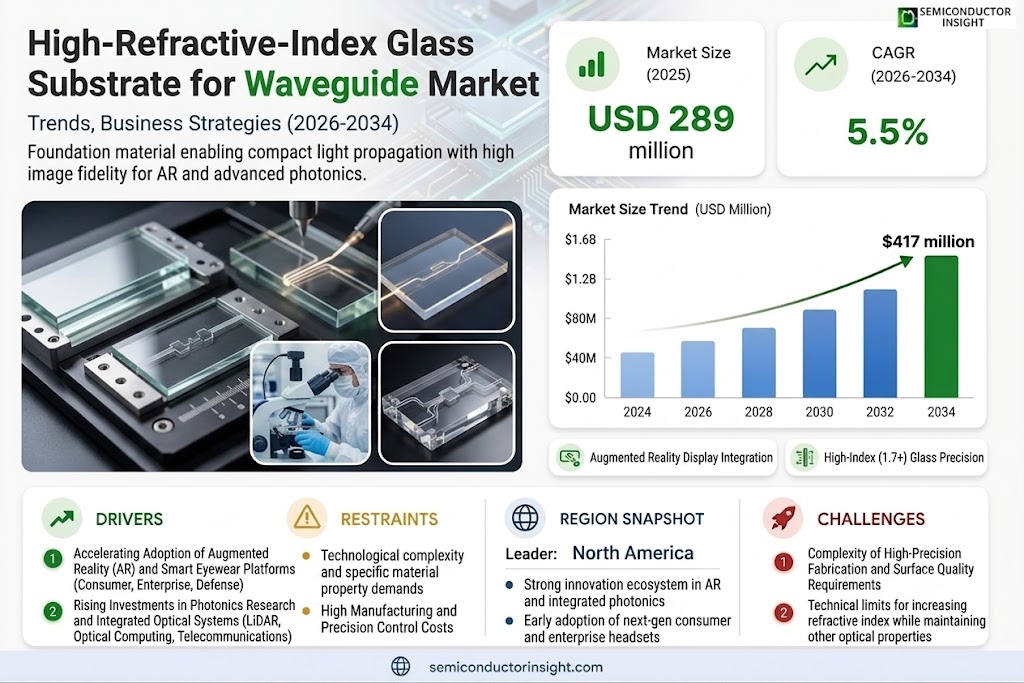
Global High-Refractive-Index Glass Substrate for Waveguide market size was valued at USD 289 million in 2025. The market is projected to grow from USD 305 million in 2026 to USD 417 million by 2034, exhibiting a CAGR of 5.5% during the forecast period.
High-Refractive-Index Glass Substrate for Waveguides is a high-precision glass material specifically engineered for augmented reality (AR) and mixed reality (MR) optical waveguide systems. The substrate features a high refractive index, high transmittance, and excellent thermal stability, serving as the core carrier for light propagation and image projection. Through micro- and nano-structured surface processing, the substrate efficiently guides and controls light, minimizing optical loss and distortion to ensure image clarity and immersion in wearable devices. Key glass types utilized in this market include Lanthanum-Based Glass, Phosphate-Based Glass, Silicate-Based Glass, and others, each offering distinct optical properties suited to specific waveguide design requirements. In 2024, production of high-refractive-index glass substrates for waveguides reached 5 million pieces, with an average unit price of USD 60 per piece, an annual capacity per production line of approximately 20,000 pieces, and an average gross margin of approximately 49%.
The market is witnessing sustained momentum driven by the rapid expansion of the AR and MR industries across applications including gaming, enterprise training, remote collaboration, and industrial design. Demand for high-refractive-index optical substrates continues to rise as device manufacturers push for greater optical performance, thinner form factors, and enhanced durability. Furthermore, ongoing innovations in nanofabrication precision and optical integration are proving essential to meeting increasingly stringent requirements for clarity and manufacturability. Companies such as SCHOTT, Hoya, DISCO, and Lapmaster are prominent upstream suppliers of high-purity optical glass materials and substrates, while downstream demand is anchored by leading AR and MR device manufacturers including Apple, Microsoft, and Magic Leap.
MARKET DRIVERS
Accelerating Adoption of Augmented Reality and Smart Eyewear Platforms
High-Refractive-Index Glass Substrate for Waveguide Market is experiencing robust momentum, primarily driven by the accelerating global adoption of augmented reality (AR) devices and next-generation smart eyewear. High-refractive-index glass substrates are a foundational material in AR waveguide optics, enabling compact light propagation with minimal optical loss and high image fidelity. As consumer electronics brands, enterprise technology providers, and defense organizations continue to scale their AR hardware pipelines, demand for precision-engineered waveguide-grade glass is intensifying. The convergence of miniaturization requirements and performance expectations has established high-refractive-index glass as a material of strategic importance across the waveguide supply chain.
Rising Investments in Photonics and Integrated Optical Systems
Significant capital flows into photonics research and integrated optical system development are reinforcing the growth trajectory of High-Refractive-Index Glass Substrate for Waveguide Market. Governments and private enterprises across North America, Europe, and Asia-Pacific are funding next-generation photonic infrastructure, including LiDAR, optical computing, and telecommunications-grade waveguide assemblies. High-refractive-index glass substrates, characterized by refractive indices typically ranging from 1.7 to above 2.0, are critically suited for these photonic integration applications due to their superior light-guiding efficiency and thermal stability. This investment wave is translating directly into expanded procurement pipelines for advanced glass substrate suppliers.
➤ The proliferation of mixed reality headsets across industrial, medical, and consumer domains is expected to sustain strong multi-year demand for high-refractive-index waveguide glass, as manufacturers seek materials capable of supporting wide field-of-view displays with reduced form factors and improved optical clarity.
The defense and aerospace sectors represent an additional, high-value driver for High-Refractive-Index Glass Substrate for Waveguide Market. Military-grade heads-up display (HUD) systems and pilot vision enhancement technologies rely on waveguide optics fabricated from high-index glass to achieve the contrast, resolution, and environmental durability required in mission-critical scenarios. Procurement programs across major defense economies are increasingly specifying advanced glass substrate materials, further broadening the commercial addressable market for waveguide-grade high-refractive-index glass.
MARKET CHALLENGES
Complexity of High-Precision Fabrication and Surface Quality Requirements
One of the principal challenges confronting participants in High-Refractive-Index Glass Substrate for Waveguide Market is the extraordinary precision demanded during substrate fabrication. Waveguide-grade high-refractive-index glass must conform to exceptionally tight surface roughness tolerances, typically in the sub-nanometer range, to ensure optical performance and minimize scattering losses. Achieving consistent surface quality at production scale requires sophisticated polishing technologies, cleanroom manufacturing environments, and rigorous metrology protocols. The complexity of this process introduces yield management challenges and elevates per-unit production costs, particularly for smaller manufacturers lacking advanced capital equipment. These fabrication barriers create friction in market scalability and restrict the pace at which supply can respond to demand growth in High-Refractive-Index Glass Substrate for Waveguide Market.
Other Challenges
Raw Material Sourcing and Compositional Sensitivity
High-refractive-index glass substrates for waveguide applications typically incorporate specialized dopants and rare oxide compounds , including lanthanum, niobium, and titanium oxides , to achieve the desired optical properties. Sourcing these materials at consistent purity levels introduces supply chain dependencies that can affect batch uniformity and production continuity. Compositional variations, even at trace levels, can alter refractive index profiles and degrade optical performance, requiring manufacturers to maintain stringent incoming material qualification processes that add both time and cost to the production cycle.
Integration Compatibility with Downstream Waveguide Processing
High-refractive-index glass substrates must interface seamlessly with downstream nanofabrication processes, including nanoimprint lithography, electron-beam patterning, and physical vapor deposition. Achieving reliable adhesion, thermal compatibility, and dimensional stability across these processing steps presents ongoing technical challenges. Mismatches in coefficient of thermal expansion between the glass substrate and deposited waveguide layers can induce stress-related defects, impacting device performance and limiting manufacturing yield in volume production environments relevant to High-Refractive-Index Glass Substrate for Waveguide Market.
MARKET RESTRAINTS
Elevated Production Costs Constraining Broad Market Penetration
The high cost of manufacturing waveguide-grade high-refractive-index glass substrates remains a significant restraint on market expansion. The combination of specialty raw material costs, low-defect melting and forming processes, precision annealing requirements, and advanced surface finishing operations results in a cost structure substantially above that of conventional optical glass. This cost premium limits the addressability of price-sensitive application segments and slows adoption in consumer-oriented AR device programs where bill-of-materials management is a critical design parameter. Until manufacturing scale and process efficiency improvements reduce per-unit substrate costs, pricing will continue to act as a moderating force on volume growth in High-Refractive-Index Glass Substrate for Waveguide Market.
Competitive Pressure from Alternative Waveguide Substrate Materials
High-Refractive-Index Glass Substrate for Waveguide Market faces increasing competitive pressure from alternative waveguide materials, including high-index polymers, silicon nitride platforms, and lithium niobate substrates. Each of these alternatives offers specific performance or cost advantages in defined application contexts, and ongoing research is narrowing the performance gap with glass-based solutions in certain waveguide configurations. The potential substitution risk from polymer-based waveguide substrates, in particular, poses a restraint for the glass substrate segment, as polymer platforms can offer lower fabrication costs and greater design flexibility in some near-eye display architectures. Market participants must continuously demonstrate the performance superiority of high-refractive-index glass to defend their position against these emerging alternatives.
MARKET OPPORTUNITIES
Expansion of AR Waveguide Applications Across Healthcare and Industrial Sectors
High-Refractive-Index Glass Substrate for Waveguide Market is positioned to benefit substantially from the broadening deployment of AR waveguide technologies across healthcare, industrial automation, and field service sectors. In healthcare, surgical navigation systems, medical imaging overlays, and clinical training platforms are increasingly integrating AR waveguide displays that require high-optical-quality glass substrates to meet regulatory and performance standards. In industrial environments, AR-assisted maintenance, quality inspection, and remote collaboration tools are being adopted at scale across manufacturing, logistics, and energy sectors. This diversification of end-use applications beyond consumer electronics provides meaningful incremental demand vectors for high-refractive-index glass substrate suppliers.
Technological Advancements Enabling Next-Generation Waveguide Architectures
Ongoing advancements in glass composition engineering and substrate processing technologies present significant opportunities for innovation-led growth in High-Refractive-Index Glass Substrate for Waveguide Market. The development of ultra-high-index glass formulations with refractive indices exceeding 2.1, combined with improvements in surface nano-texturing and anti-reflective coating integration, is enabling waveguide designs with wider fields of view, higher luminous efficiency, and reduced thickness profiles. Companies investing in proprietary glass composition platforms and precision surface engineering capabilities are well-positioned to capture design wins in next-generation AR and mixed reality programs, establishing durable competitive advantages in the evolving high-refractive-index waveguide glass landscape.
Strategic Partnerships and Regional Manufacturing Capacity Expansion
The geographic expansion of AR and photonics manufacturing ecosystems across Asia-Pacific , particularly in South Korea, Japan, Taiwan, and China , presents a compelling opportunity for High-Refractive-Index Glass Substrate for Waveguide Market participants to establish localized supply relationships with regional device manufacturers. Strategic partnerships between glass substrate producers and waveguide device integrators can accelerate co-development cycles, improve supply chain resilience, and create preferential supplier positioning within fast-growing regional AR hardware supply chains. Additionally, government-backed photonics industry programs in Europe and North America are creating incentive structures that may support domestic capacity investments, further expanding the geographic and commercial footprint of the high-refractive-index glass substrate market.
High-Refractive-Index Glass Substrate for Waveguide Market Trends
Rising Adoption in Augmented and Mixed Reality Devices Drives Market Momentum
High-Refractive-Index Glass Substrate for Waveguide Market is experiencing significant momentum, primarily driven by the accelerating adoption of augmented reality (AR) and mixed reality (MR) technologies across multiple end-use sectors. As wearable optical devices become increasingly sophisticated, the demand for precision-engineered glass substrates with superior light-guiding properties has grown substantially. These substrates serve as the core optical carrier in waveguide systems, enabling efficient image projection with minimal optical loss. Industries such as gaming, industrial design, remote collaboration, and professional training have emerged as key consumption areas, pushing manufacturers to continuously advance substrate performance in terms of transmittance, thermal stability, and refractive index consistency. Leading downstream device makers, including major players in the AR and MR space, are intensifying their procurement of high-quality optical substrates to meet growing consumer and enterprise expectations for visual clarity and immersive experience.
Other Trends
Material Innovation and Nanofabrication Precision as Competitive Differentiators
Manufacturers operating in High-Refractive-Index Glass Substrate for Waveguide Market are increasingly investing in advanced material formulations and nanofabrication techniques to differentiate their offerings. Glass types including lanthanum-based, phosphate-based, and silicate-based substrates are being refined to achieve higher refractive indices and improved optical homogeneity. Precision surface processing , encompassing micro- and nano-structured patterning, high-accuracy polishing, and multi-layer optical coating , has become a critical midstream capability that directly influences yield rates and optical performance. As production volumes scale, manufacturers are focused on maintaining consistent quality across high-throughput production lines, with annual capacity per line reported at approximately 20,000 pieces, underscoring the importance of process optimization and equipment precision in sustaining competitive margins.
Supply Chain Integration and Upstream Material Quality
The upstream segment of High-Refractive-Index Glass Substrate for Waveguide Market, encompassing high-purity optical glass manufacturers and substrate suppliers, plays a foundational role in determining the quality ceiling of finished waveguide components. Established material suppliers are under increasing pressure to deliver substrates with tighter tolerances on refractive index uniformity, surface flatness, and internal defect density. This trend is fostering closer collaboration between upstream glass producers and midstream precision processors, with integrated supply chain relationships becoming a strategic priority. Enhanced transparency in sourcing, quality inspection protocols, and co-development agreements are emerging as standard practices, reflecting the market’s shift toward vertically coordinated production models that can reliably support high-volume AR and MR device manufacturing.
Thickness and Refractive Index Segmentation Reflecting Evolving Application Requirements
Product segmentation within High-Refractive-Index Glass Substrate for Waveguide Market by refractive index and substrate thickness is increasingly reflecting the divergent optical requirements of next-generation AR and MR platforms. Substrates with refractive indices exceeding 1.9 are gaining traction for compact, high-performance waveguide architectures that demand superior light confinement and wider field-of-view capabilities. Simultaneously, thickness segmentation is being driven by the design constraints of slim-form wearable devices, where minimizing substrate weight and volume without compromising optical integrity is a primary engineering challenge. This dual-axis product differentiation is prompting manufacturers to expand their portfolio breadth, develop customized substrate solutions, and invest in optical inspection technologies capable of validating performance across a wider range of specification parameters.
COMPETITIVE LANDSCAPE
Key Industry Players
High-Refractive-Index Glass Substrate for Waveguide Market: Competitive Dynamics and Leading Manufacturer Profiles
High-Refractive-Index Glass Substrate for Waveguide Market is characterized by the strong presence of a few dominant specialty glass manufacturers with deep expertise in precision optical materials. SCHOTT AG stands out as one of the foremost leaders in this space, leveraging decades of advanced glass science to develop high-refractive-index substrates tailored for augmented reality and mixed reality waveguide applications. Hoya Corporation similarly commands a significant share of the market, offering precision optical glass substrates with superior transmittance and thermal stability that meet the stringent optical performance requirements of AR/MR device manufacturers such as Apple, Microsoft, and Magic Leap. The competitive environment is further shaped by the ability of key players to control upstream raw material quality, invest in nano-fabrication technologies, and scale production capacity , with industry-standard production lines yielding approximately 20,000 pieces annually , factors that collectively determine optical yield, gross margins (averaging around 49%), and long-term supply reliability in a market valued at USD 289 million in 2025 and projected to reach USD 417 million by 2034 at a CAGR of 5.5%.
Beyond the leading incumbents, several specialized and emerging players are carving out significant niches across lanthanum-based, phosphate-based, and silicate-based glass substrate segments. Companies such as AGC Inc. and Corning Incorporated bring formidable glass engineering capabilities and established relationships with downstream AR/MR device integrators. Precision substrate processing firms focusing on cutting, polishing, coating, and optical inspection , the midstream value chain , are increasingly becoming competitive differentiators. Suppliers like Nippon Electric Glass, Ohara Inc., and Nikon Corporation contribute advanced optical glass formulations optimized for high refractive indices exceeding n=1.9, enabling thinner and lighter waveguide designs critical for next-generation wearable devices. As demand accelerates across gaming, industrial design, remote collaboration, and training applications, competitive intensity is expected to rise, with innovation in nanofabrication precision and optical integration emerging as the primary battlegrounds for market leadership.
List of Key High-Refractive-Index Glass Substrate for Waveguide Companies Profiled
- SCHOTT AG
- Hoya Corporation
- AGC Inc.
- Corning Incorporated
- Nippon Electric Glass Co., Ltd.
- Ohara Inc.
- Nikon Corporation
- DISCO Corporation
- Lapmaster International
- Sumita Optical Glass, Inc.
- Hikari Glass Co., Ltd.
- Novatek International
- Thorlabs, Inc.
- Edmund Optics
- Sydor Optics
Segment Analysis:
| Segment Category | Sub-Segments | Key Insights |
| By Type |
|
Lanthanum-Based Glass Type holds the dominant position within the type segmentation of High-Refractive-Index Glass Substrate for Waveguide Market, attributed to its superior optical properties that make it exceptionally well-suited for advanced AR and MR waveguide systems.
|
| By Application |
|
Augmented Reality (AR) Devices represent the leading application segment, driven by rapid technological advancements and the accelerating adoption of AR headsets across both consumer and enterprise environments.
|
| By End User |
|
Consumer Electronics Manufacturers emerge as the dominant end-user segment, reflecting the outsized influence that large-scale AR and MR device producers exert on demand patterns for high-refractive-index glass substrates.
|
| By Refractive Index |
|
Refractive Index n1.7 to n1.9 constitutes the leading segment within this classification, representing the most broadly adopted range among waveguide manufacturers seeking a balanced combination of optical efficiency and processability.
|
| By Thickness |
|
Standard Thin (0.5 mm to 1.0 mm) substrates lead this segment, representing the most widely specified thickness range across the current generation of AR and MR waveguide products due to their favorable balance of structural integrity and optical performance.
|
Regional Analysis: High-Refractive-Index Glass Substrate for Waveguide Market
Asia-Pacific
Asia-Pacific’s vertically integrated manufacturing ecosystem gives it a decisive structural advantage in High-Refractive-Index Glass Substrate for Waveguide Market. The proximity of optical glass suppliers, precision processing facilities, and waveguide assemblers within regional industrial clusters reduces lead times and production costs, enabling manufacturers to respond swiftly to evolving design specifications demanded by AR and MR device developers.
Government-funded photonics and optical materials research programs across Japan, South Korea, and China are actively advancing glass substrate compositions with higher refractive indices and improved optical homogeneity. Academic-industry collaboration networks accelerate the translation of laboratory-scale innovations into commercially viable high-refractive-index glass substrate solutions for waveguide applications, sustaining the region’s technological leadership position.
The region’s globally dominant consumer electronics industry creates powerful end-market demand for waveguide-enabled wearable devices. Major OEM brands headquartered across Asia-Pacific are aggressively integrating waveguide display technologies into next-generation AR glasses and smart headsets, creating a sustained and growing procurement pipeline for high-refractive-index glass substrates from regional and international material suppliers.
Strategic national programs across China, Japan, and South Korea explicitly prioritize advanced display materials and photonics as critical technology sectors. Substantial public investment in specialty glass substrate research, manufacturing infrastructure modernization, and talent development reinforces private sector confidence, attracting further foreign direct investment into the region’s High-Refractive-Index Glass Substrate for Waveguide Market ecosystem.
North America
North America represents a highly significant market in High-Refractive-Index Glass Substrate for Waveguide Market, distinguished by its concentration of pioneering AR/MR technology companies, leading defense and aerospace contractors, and world-class optical research institutions. The United States, in particular, serves as a primary innovation hub where major technology corporations are actively developing consumer and enterprise-grade waveguide display systems, creating substantial and growing demand for precision high-refractive-index glass substrate materials. The defense sector presents a particularly compelling demand driver, as military heads-up display programs and soldier systems modernization initiatives require ruggedized, optically superior waveguide components. Furthermore, North America benefits from strong venture capital ecosystems that accelerate the commercialization of novel waveguide technologies. Collaborative frameworks between universities, national laboratories, and private companies continue to advance optical material science, ensuring the region maintains a strong position in High-Refractive-Index Glass Substrate for Waveguide Market through the forecast period.
Europe
Europe occupies a strategically important position in High-Refractive-Index Glass Substrate for Waveguide Market, anchored by Germany’s precision optics and specialty glass manufacturing heritage, alongside strong photonics research communities in France, Finland, and the United Kingdom. European optical glass manufacturers bring centuries of material science expertise to the development of high-refractive-index compositions tailored for waveguide applications, supporting both domestic waveguide device manufacturers and global supply chains. The European Union’s sustained investment in photonics as a key enabling technology through coordinated research programs reinforces regional innovation capacity. Industrial automation, automotive head-up display systems, and enterprise AR applications represent key demand segments shaping the European market landscape. Additionally, Europe’s stringent quality and environmental standards drive differentiation toward premium, precision-engineered glass substrate solutions, positioning regional manufacturers favorably in high-value waveguide supply relationships within the broader High-Refractive-Index Glass Substrate for Waveguide Market.
South America
South America currently represents an emerging and relatively nascent segment of High-Refractive-Index Glass Substrate for Waveguide Market, with market development primarily driven by growing technology adoption in Brazil and, to a lesser extent, Argentina and Colombia. The region’s waveguide market activity is largely concentrated in distribution and system integration rather than substrate manufacturing, as local industrial infrastructure for specialty optical glass production remains limited. However, increasing investments in technology modernization across industrial, healthcare, and defense sectors are gradually expanding the addressable market for waveguide-enabled display solutions. Academic and research institutions in Brazil are beginning to engage with photonics research programs that may, over time, support greater regional participation in the broader waveguide materials value chain. South America’s trajectory in High-Refractive-Index Glass Substrate for Waveguide Market is expected to be gradual, contingent on broader economic development and technology infrastructure investment.
Middle East & Africa
The Middle East and Africa region represents an early-stage market within High-Refractive-Index Glass Substrate for Waveguide Market, with demand primarily channeled through defense modernization programs, smart city technology initiatives, and growing enterprise technology investments in Gulf Cooperation Council countries. Nations such as the United Arab Emirates, Saudi Arabia, and Israel are emerging as focal points of regional technology adoption, with Israel’s advanced defense optics and photonics sector contributing meaningful participation in waveguide technology development. Africa’s contribution remains limited in the near term, constrained by infrastructure development priorities. Nevertheless, the broader Middle East’s ambitious national technology transformation agendas, combined with increasing procurement of advanced display systems for security and industrial applications, are expected to generate steady if measured growth in regional demand for high-refractive-index glass substrate materials, supporting gradual market expansion through the forecast period extending to 2034.
Report Scope
This market research report provides a comprehensive analysis of High-Refractive-Index Glass Substrate for Waveguide Market, covering the forecast period 2026–2034. It offers detailed insights into market dynamics, technological advancements, competitive landscape, and key trends shaping the industry.
Key focus areas of the report include:
- Market Overview: The report begins with an overview outlining its current market scenario, key growth indicators, and industry transformation drivers. It discusses macroeconomic factors, demand–supply balance, regulatory landscape, and the strategic role of high-refractive-index glass substrates in powering advancements across industries such as augmented reality, mixed reality, consumer electronics, and industrial wearable devices.
- Market Size & Forecast: Historical data and future projections for revenue, unit shipments, and market value across major regions and segments.
- Segmentation Analysis: Detailed breakdown by product type, refractive index, thickness, application, and end-user industry to identify high-growth segments and investment opportunities.
- Regional Insights: Insights into market performance across North America, Europe, Asia-Pacific, Latin America, and the Middle East & Africa, including country-level analysis where relevant.
- Competitive Landscape: Profiles of leading market participants, including their product offerings, R&D focus, manufacturing capacity, pricing strategies, and recent developments such as mergers, acquisitions, and partnerships.
- Technology Trends & Innovation: Assessment of emerging technologies, integration of nano-fabrication and optical integration techniques, semiconductor design trends, fabrication methods, and evolving industry standards.
- Market Drivers & Restraints: Evaluation of factors driving market growth along with challenges, supply chain constraints, regulatory issues, and market-entry barriers.
- Stakeholder Insights: Insights for component suppliers, OEMs, system integrators, investors, and policymakers regarding the evolving ecosystem and strategic opportunities.
Primary and secondary research methods are employed, including interviews with industry experts, data from verified sources, and real-time market intelligence to ensure the accuracy and reliability of the insights presented.
FREQUENTLY ASKED QUESTIONS:
What is the current market size of High-Refractive-Index Glass Substrate for Waveguide Market?
-> High-Refractive-Index Glass Substrate for Waveguide Market was valued at USD 289 million in 2025 and is expected to reach USD 417 million by 2034, growing at a CAGR of 5.5% during the forecast period.
Which key companies operate in High-Refractive-Index Glass Substrate for Waveguide Market?
-> Key players in the upstream segment include DISCO, Lapmaster, SCHOTT, and Hoya, as manufacturers of high-purity optical glass materials and substrates, while downstream application leaders include Apple, Microsoft, and Magic Leap, among others.
What are the key growth drivers?
-> Key growth drivers include the rapid expansion of the AR and MR industries, rising adoption across gaming, training, remote collaboration, and industrial design, along with continuous innovations in material quality, nanofabrication precision, and optical integration to meet stringent requirements for clarity, durability, and manufacturability.
Which region dominates the market?
-> Asia-Pacific is the fastest-growing region driven by strong manufacturing capabilities and technology adoption, while North America remains a dominant market due to the presence of leading AR/MR device companies and significant R&D investments.
What are the emerging trends?
-> Emerging trends include micro- and nano-structured surface processing for improved light guidance, advancements in Lanthanum-Based, Phosphate-Based, and Silicate-Based glass types, increasing average production volumes, and a growing focus on high transmittance and thermal stability to enhance optical performance in next-generation wearable devices.

Get Sample Report PDF for Exclusive Insights
Report Sample Includes
- Table of Contents
- List of Tables & Figures
- Charts, Research Methodology, and more...
 Download Sample Report PDF



