
MARKET INSIGHTS
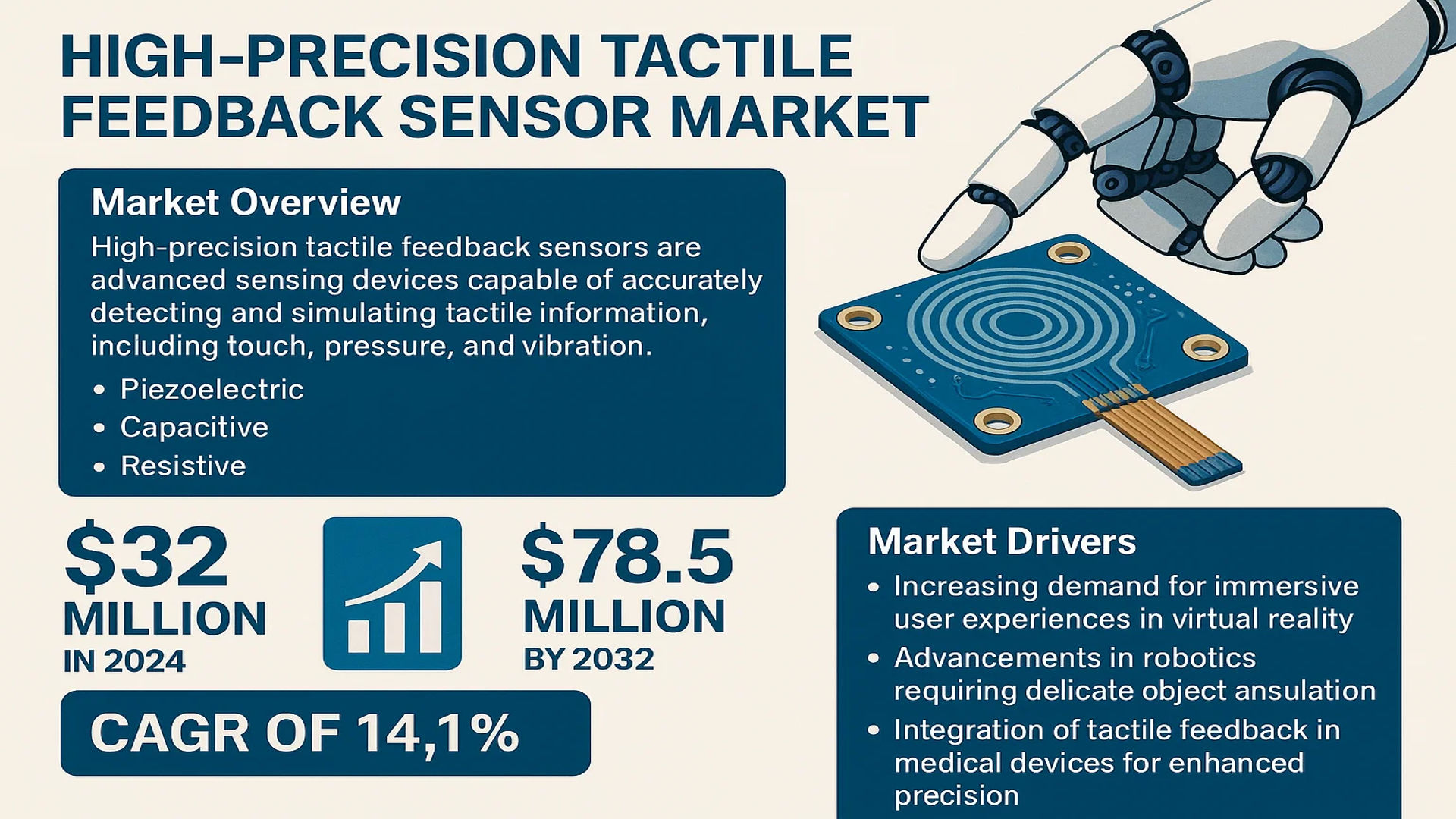
The global High-Precision Tactile Feedback Sensor Market was valued at 32 million in 2024 and is projected to reach US$ 78.5 million by 2032, at a CAGR of 14.1% during the forecast period.
High-precision tactile feedback sensors are advanced sensing devices capable of accurately detecting and simulating tactile information, including touch, pressure, and vibration. These sensors utilize highly sensitive technologies such as piezoelectric, capacitive, or resistive mechanisms to convert physical stimuli into electrical signals, enabling precise feedback in applications ranging from robotics to medical devices. Key variations include piezoelectric, capacitive, and resistive tactile sensors, each offering distinct advantages in sensitivity and durability.
The market is expanding rapidly due to increasing demand for immersive user experiences in virtual reality, advancements in robotics requiring delicate object manipulation, and the integration of tactile feedback in medical devices for enhanced precision. Additionally, the rising adoption of smart wearable technologies and Industry 4.0 automation solutions is fueling growth. Leading players such as Tekscan, Pressure Profile Systems, and SynTouch are driving innovation, with recent developments including improved sensor resolution and AI-enhanced feedback algorithms. The U.S. and China are emerging as key markets, collectively accounting for over 45% of global demand in 2024.
MARKET DYNAMICS
MARKET DRIVERS
Rapid Expansion of Robotics and Automation to Fuel Demand for Tactile Sensors
The global robotics market is experiencing exponential growth, with an increasing adoption rate of 23% annually across industrial and service sectors. High-precision tactile feedback sensors play a vital role in enabling robots to perform delicate operations with human-like dexterity. These sensors provide critical force and texture feedback essential for tasks from assembly line precision handling to surgical robotics. Leading robotics manufacturers are increasingly integrating advanced tactile sensors to improve operational accuracy, particularly in electronics manufacturing where sub-millimeter precision is required. The medical robotics sector alone accounts for nearly 18% of tactile sensor demand as they enhance surgical precision beyond human capability.
Virtual Reality and Haptic Technology Advancements Creating New Applications
The VR market is projected to maintain a 30% CAGR through 2030, with tactile feedback sensors becoming increasingly crucial for immersive experiences. Recent technological breakthroughs have enabled sensors with response times under 5 milliseconds and force detection as low as 0.1N. Gaming controllers, rehabilitation systems, and professional training simulators now incorporate these high-fidelity sensors to deliver realistic touch sensations. The consumer electronics sector represents over 35% of current tactile sensor applications, with major tech companies investing heavily in haptic research to bridge the virtual-physical experience gap.
Medical Device Innovations Driving Precision Sensor Adoption
In the medical field, tactile sensors are revolutionizing surgical tools, prosthetics, and diagnostic equipment. Advanced robotic surgical systems now incorporate arrays of up to 1,024 pressure-sensitive elements per square centimeter, providing surgeons with real-time tissue feedback. The global market for medical tactile sensors has grown by 42% since 2020, particularly in minimally invasive procedures where force sensitivity below 10 grams is critical. Recent product launches demonstrate this trend, with multiple FDA-cleared surgical robots now featuring proprietary tactile sensing technologies that improve patient outcomes.
MARKET CHALLENGES
High Development Costs and Complex Manufacturing Processes
While demand grows, developing high-precision tactile sensors remains technologically and financially challenging. Production of piezoelectric sensor arrays with nanometer-level accuracy requires cleanroom facilities and specialized equipment, with initial setup costs exceeding $15 million for medium-scale operations. The precision calibration process alone can account for 30% of manufacturing expenses. Additionally, maintaining consistent quality across production batches presents difficulties, with defect rates in some capacitive sensor models still hovering around 5-7%, creating reliability concerns for critical applications.
Integration Challenges with Existing Systems
Retrofitting tactile sensors into established industrial or medical systems often requires substantial modification to both hardware and software architectures. Compatibility issues with legacy control systems have slowed adoption in manufacturing, where only 12% of facilities report successful tactile sensor integration. The complexity increases exponentially in multi-sensor arrays, where signal processing demands can overwhelm standard industrial PCs. Major automation providers are now developing dedicated processing units to address this bottleneck, but widespread implementation remains years away.
MARKET RESTRAINTS
Material Science Limitations Impeding Performance Breakthroughs
Current tactile sensor technology faces fundamental material constraints that limit performance parameters. Piezoelectric materials struggle with hysteresis effects at extreme temperatures, while resistive sensors show significant drift after prolonged use. Research indicates that over 90% of commercial sensors experience at least 15% signal degradation within two years of continuous operation. These reliability issues severely restrict applications in harsh environments like aerospace or heavy industry. While new nanocomposite materials show promise, transitioning from lab prototypes to mass production has proven challenging.
Regulatory Hurdles in Critical Applications
Medical and automotive applications face particularly stringent certification processes that can delay product launches by 18-24 months. The FDA’s rigorous validation requirements for surgical sensors, including biocompatibility testing and EMI resistance verification, add substantial development costs. Similarly, automotive safety standards demand sensor reliability exceeding 99.999% for driver-assist systems – a benchmark few current technologies can consistently meet. These regulatory frameworks, while necessary for user safety, create significant barriers to market entry for innovative startups.
MARKET OPPORTUNITIES
Emerging Flexible Electronics Creating New Sensor Paradigms
Breakthroughs in stretchable electronics are enabling conformable tactile sensors that can wrap around complex surfaces. The flexible electronics sector dedicated to sensor development has seen investment growth of 56% annually, with applications ranging from smart prosthetics to industrial grippers. Recent prototypes demonstrate sensors that maintain functionality when stretched up to 200% of their original size, opening possibilities in wearable health monitors and adaptive robotics. Industry analysts project that flexible tactile sensors will capture over 25% of the market by 2030.
AI Integration Enhancing Sensor Capabilities
Machine learning algorithms are transforming raw sensor data into intelligent tactile perception systems. Advanced pattern recognition now enables sensors to identify materials and textures with 98% accuracy based solely on surface interaction patterns. This AI-enhanced functionality is particularly valuable in quality control applications, where automated systems can now detect microscopic surface defects imperceptible to human inspectors. Leading manufacturers report that integrating AI with tactile sensors has reduced production defects by up to 40% in pilot implementations.
HIGH-PRECISION TACTILE FEEDBACK SENSOR MARKET TRENDS
Rising Demand in Robotics and Medical Applications Accelerates Market Growth
The global high-precision tactile feedback sensor market is experiencing robust growth, driven by increasing adoption in robotics and medical applications. These sensors, capable of detecting minute pressure changes with accuracy as high as 0.1% of full-scale output, are crucial for robotic surgical systems, enabling surgeons to perform delicate procedures with enhanced precision. In 2024, the medical industry accounted for approximately 28% of the total market revenue, reflecting their widespread use in prosthetics and minimally invasive surgical tools. Meanwhile, advancements in soft robotics, which rely heavily on tactile feedback for autonomous object handling, are further propelling demand, with annual growth in robotics applications projected at 17.3% CAGR until 2032.
Other Trends
Miniaturization and IoT Integration
The trend toward miniaturization, particularly in consumer electronics, has spurred innovations in compact tactile sensors, with some ultrathin variants now measuring under 0.5 mm in thickness. Smart wearables and foldable devices increasingly incorporate these sensors for intuitive touch feedback, contributing to a 21% year-on-year growth in this segment. Additionally, the Internet of Things (IoT) ecosystem leverages tactile feedback sensors for real-time environmental monitoring, where applications like smart prosthetics and industrial safety gloves demand ultra-responsive pressure detection. This convergence of miniaturization and IoT is expected to unlock $12.4 billion in incremental revenue by 2030.
Shift Toward Piezoelectric and Capacitive Sensor Technologies
Piezoelectric tactile sensors dominate the market, holding over 42% revenue share in 2024, owing to their high sensitivity and durability under dynamic loads. However, capacitive sensors are gaining traction, particularly in consumer electronics, due to their low power consumption and ability to detect multi-touch inputs with sub-millisecond response times. Emerging hybrid models combining piezoelectric and resistive technologies are addressing niche needs, such as haptic feedback in automotive touchscreens, where demand is projected to grow at 13.8% CAGR through 2032. Such innovations highlight the industry’s focus on diversifying sensor capabilities to meet sector-specific precision requirements.
Regional Market Dynamics and Competitive Landscape
North America leads the market, contributing 38% of global revenue in 2024, with the U.S. driving innovation through R&D investments in medical and defense applications. Asia-Pacific, however, is the fastest-growing region, with China’s market expanding at 16.7% CAGR due to aggressive manufacturing automation and consumer electronics production. Key players like Tekscan and Tacterion GmbH collectively hold 23% market share, focusing on mergers and IP-driven differentiation. Recent breakthroughs, such as self-calibrating sensors with embedded AI, are reshaping competition, emphasizing the need for continuous technological evolution to sustain leadership.
COMPETITIVE LANDSCAPE
Key Industry Players
Innovation and Strategic Expansion Drive Market Leadership in Tactile Sensor Industry
The global high-precision tactile feedback sensor market features a dynamic competitive environment with both established technology leaders and emerging innovators vying for market share. Tekscan, Inc. currently holds a dominant position with its patented FlexiForce tactile sensors, which accounted for approximately 18% of the 2024 market revenue. Their success stems from decades of specialized sensor development and strong partnerships with medical device manufacturers.
Pressure Profile Systems and Sensor Products Inc. have demonstrated remarkable growth trajectories, leveraging their expertise in industrial and robotic applications. The former’s recent collaboration with a major automotive OEM for haptic feedback systems exemplifies how strategic alliances are reshaping market dynamics in this space.
While established players maintain strongholds in traditional sectors like medical devices, newer entrants like Weiss Robotics and SynTouch are gaining traction through specialized offerings. Weiss Robotics made significant inroads by developing customizable tactile solutions for collaborative robots, capturing nearly 12% of the industrial robotics sensor segment last year.
The competitive intensity is further heightened by technological convergence, with companies like Tacterion GmbH successfully integrating AI-driven tactile data processing into their sensor arrays. Their 2023 acquisition of a machine learning startup demonstrates the growing importance of software integration in hardware solutions.
List of High-Precision Tactile Feedback Sensor Market Leaders
- Tekscan, Inc. (U.S.) – Market pioneer in flexible force sensors
- Pressure Profile Systems (U.S.) – Specialized in medical and automotive applications
- Sensor Products Inc. (U.S.) – Industrial tactile sensing solutions
- Weiss Robotics (Germany) – Collaborative robot tactile systems
- SynTouch (U.S.) – BioTac biomimetic tactile sensors
- Tacterion GmbH (Germany) – Smart tactile skin solutions
- Yuansheng Intelligence (China) – Emerging leader in Asian markets
Recent technology exhibitions have highlighted the industry’s direction toward multi-modal sensing capabilities, with several key players previewing hybrid sensors that combine tactile feedback with temperature and moisture detection. This evolution suggests that future competitive advantages will likely stem from integrated sensing solutions rather than standalone tactile technologies.
Segment Analysis:
By Type
Piezoelectric Tactile Sensor Segment Leads Due to High Sensitivity and Wide Application Scope
The market is segmented based on type into:
- Piezoelectric Tactile Sensor
- Subtypes: Polymer-based, Ceramic-based, and others
- Capacitive Tactile Sensor
- Resistive Tactile Sensor
- Subtypes: Force-Sensitive Resistor (FSR), Strain Gauge, and others
- Optical Tactile Sensor
- Others
By Application
Medical Industry Segment Dominates Owing to Rising Adoption in Surgical Robotics and Prosthetics
The market is segmented based on application into:
- Medical Industry
- Consumer Electronics
- Food Industry
- Automotive
- Others
By Technology
Force Feedback Technology Gains Prominence for Enhanced User Interaction
The market is segmented based on technology into:
- Force Feedback
- Vibration Feedback
- Texture Feedback
- Temperature Feedback
By End-User
Healthcare Sector Emerges as Key Consumer for Precision Instrumentation Needs
The market is segmented based on end-user into:
- Healthcare
- Electronics
- Industrial Automation
- Research & Development
- Others
Regional Analysis: High-Precision Tactile Feedback Sensor Market
North America
North America, particularly the U.S., leads the global high-precision tactile feedback sensor market due to strong technological advancements in robotics, medical devices, and virtual reality applications. The region benefits from significant investments in R&D by key players, including established companies like Tekscan and Pressure Profile Systems. The increasing adoption of haptic technology in consumer electronics, such as wearables and gaming consoles, further propels market growth. Government support for AI and automation in industries also contributes to the demand for high-precision tactile sensors. However, stringent regulatory requirements for medical applications remain a challenge for manufacturers.
Europe
Europe is a critical market for high-precision tactile sensors, driven by advancements in robotics and healthcare applications. Countries like Germany, the U.K., and France are at the forefront due to their strong industrial automation sectors and growing demand for smart prosthetics. The presence of key market players such as Tacterion GmbH and Weiss Robotics also stimulates regional growth. Strict regulatory compliance, particularly for medical-grade sensors under EU MDR, impacts product development timelines. Nonetheless, increasing emphasis on Industry 4.0 and assistive robotics ensures sustained demand.
Asia-Pacific
Asia-Pacific is the fastest-growing region, fueled by rapid industrial automation in China, Japan, and South Korea. The consumer electronics sector, particularly in China, is a major driver due to the integration of haptic feedback in smartphones and AR/VR devices. Countries like India are emerging as key markets with rising investments in robotics and healthcare. Despite cost sensitivity, manufacturers like Yuansheng Intelligence are expanding their footprint in the region. Challenges include inconsistent quality standards and competition from low-cost alternatives in some markets.
South America
South America shows moderate growth potential, primarily driven by Brazil and Argentina’s budding robotics and healthcare industries. The adoption of tactile sensors remains limited due to economic instability and lower technological penetration compared to other regions. However, niche applications in medical rehabilitation and industrial automation are creating opportunities. Local manufacturers face hurdles such as reliance on imports for advanced components and fluctuating supply chain conditions.
Middle East & Africa
The Middle East & Africa market is in a nascent stage but exhibits long-term growth prospects. The UAE and Saudi Arabia are emerging as key markets with rising investments in smart technologies and robotics. Demand is primarily driven by healthcare applications and industrial automation. Challenges include limited local manufacturing capabilities and reliance on imported sensors. Slow regulatory adoption of advanced haptic technologies also restricts market expansion in certain countries.
Report Scope
This market research report provides a comprehensive analysis of the Global High-Precision Tactile Feedback Sensor Market, covering the forecast period 2024–2032. It offers detailed insights into market dynamics, technological advancements, competitive landscape, and key trends shaping the industry.
Key focus areas of the report include:
- Market Size & Forecast: Historical data and future projections for revenue, unit shipments, and market value across major regions and segments. The global market was valued at USD 32 million in 2024 and is projected to reach USD 78.5 million by 2032, growing at a CAGR of 14.1%.
- Segmentation Analysis: Detailed breakdown by product type (Piezoelectric, Capacitive, Resistive, Others), application (Medical, Consumer Electronics, Food Industry, Others), and end-user industries to identify high-growth segments.
- Regional Outlook: Insights into market performance across North America, Europe, Asia-Pacific, Latin America, and Middle East & Africa. The U.S. and China are key markets driving growth.
- Competitive Landscape: Profiles of leading players including Tekscan, Pressure Profile Systems, Sensor Products, Weiss Robotics, SynTouch, Tacterion GmbH, and Yuansheng Intelligence, covering market share, product portfolios, and strategic developments.
- Technology Trends & Innovation: Assessment of emerging sensor technologies, integration with AI/ML, and advancements in haptic feedback systems for VR/robotics applications.
- Market Drivers & Restraints: Evaluation of growth drivers like increasing adoption in medical robotics and VR devices, alongside challenges such as high development costs and technical complexities.
- Stakeholder Analysis: Strategic insights for sensor manufacturers, OEMs, technology providers, and investors regarding market opportunities and competitive positioning.
The research employs both primary and secondary methodologies, including interviews with industry leaders and analysis of verified market data to ensure accuracy and reliability.
FREQUENTLY ASKED QUESTIONS:
What is the current market size of Global High-Precision Tactile Feedback Sensor Market?
-> High-Precision Tactile Feedback Sensor Market was valued at 32 million in 2024 and is projected to reach US$ 78.5 million by 2032, at a CAGR of 14.1% during the forecast period.
Which key companies operate in this market?
-> Key players include Tekscan, Pressure Profile Systems, Sensor Products, Weiss Robotics, SynTouch, and Tacterion GmbH.
What are the key growth drivers?
-> Growth is driven by rising demand in medical robotics, VR/AR applications, and smart wearable devices.
Which region dominates the market?
-> North America currently leads in market share, while Asia-Pacific is expected to witness the highest growth rate.
What are the emerging trends?
-> Emerging trends include AI-integrated tactile sensors, ultra-thin flexible sensors, and multi-modal feedback systems.

Get Sample Report PDF for Exclusive Insights
Report Sample Includes
- Table of Contents
- List of Tables & Figures
- Charts, Research Methodology, and more...
 Download Sample Report PDF



