MARKET INSIGHTS
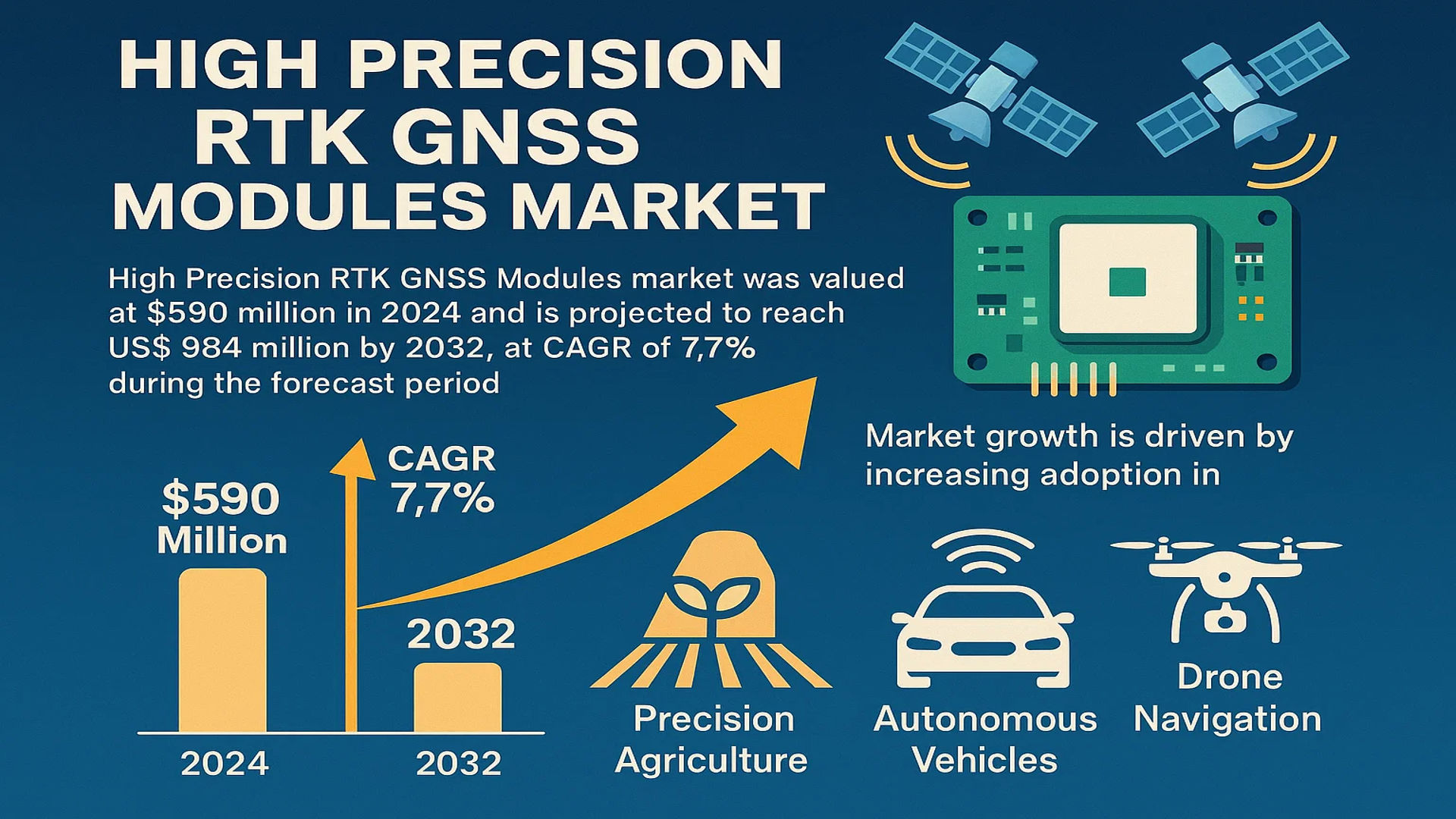
The global High Precision RTK GNSS Modules market was valued at 590 million in 2024 and is projected to reach US$ 984 million by 2032, at a CAGR of 7.7% during the forecast period.
High Precision RTK (Real-Time Kinematic) GNSS (Global Navigation Satellite System) modules are advanced positioning devices that deliver centimeter-level accuracy in real-time by leveraging signals from multiple satellite constellations, including GPS, GLONASS, Galileo, and BeiDou. These modules utilize differential correction data from reference stations to mitigate errors caused by atmospheric interference and satellite clock discrepancies, making them indispensable for applications requiring extreme positional accuracy.
The market growth is driven by increasing adoption in precision agriculture, autonomous vehicles, and drone navigation systems, where millimeter-level accuracy is critical. The rise of smart city infrastructure projects and industrial automation further fuels demand, as RTK GNSS modules enable efficient asset tracking and machine guidance. Leading players such as Trimble, U-blox, and Septentrio dominate the competitive landscape, continuously innovating to enhance module performance and integration capabilities.
MARKET DYNAMICS
MARKET DRIVERS
Expansion of Autonomous Vehicles and Drones Accelerates Demand for RTK GNSS Modules
The global autonomous vehicle market is projected to grow exponentially, driving substantial demand for high-precision positioning solutions. RTK GNSS modules provide centimeter-level accuracy, which is critical for safe navigation and precise path planning in self-driving cars and drones. The agricultural drone market alone is expected to surpass 5 million units annually by 2027, all requiring high-accuracy positioning for crop monitoring and precision spraying. Furthermore, government initiatives supporting smart transportation infrastructure development are mandating more precise positioning capabilities, creating a favorable environment for RTK adoption.
Precision Agriculture Revolution Creates Sustained Market Growth
Modern farming operations increasingly rely on RTK GNSS for automated guidance systems and variable-rate technology. The global smart agriculture market is witnessing double-digit growth as farmers seek to optimize yields while reducing input costs. Field mapping accuracy within 2-3 centimeters enables precise seed placement, fertilizer application, and yield monitoring – capabilities that can improve farm productivity by up to 20%. Governments worldwide are subsidizing precision agriculture equipment, further stimulating demand for RTK solutions.
Additionally, the integration of RTK with IoT platforms enables real-time field monitoring:
➤ Smart farming systems combining RTK positioning with soil sensors and weather stations can automatically adjust irrigation and nutrition schedules based on precise location data.
MARKET RESTRAINTS
High Initial Investment Costs Limit Widespread Adoption
While RTK GNSS technology offers superior accuracy, the total system cost—including base stations, rover units, and correction services—creates a significant barrier for price-sensitive markets. A complete RTK setup can cost 3-5 times more than standard GNSS solutions, with subscription fees for correction services adding ongoing expenses. This pricing structure makes adoption challenging for small agricultural operations and developing regions, where cost remains the primary purchasing factor.
The complexity of implementing RTK systems also contributes to higher costs:
- Requirement for permanent reference station infrastructure
- Need for specialized installation and calibration services
- Ongoing maintenance of network correction services
MARKET CHALLENGES
Signal Reliability Issues in Urban Environments Pose Operational Challenges
RTK performance degrades significantly in urban canyons and areas with obstructed satellite visibility, where multipath interference and signal blockage create positioning inaccuracies. This challenge is particularly acute for autonomous vehicle applications in dense cities, where building reflections can introduce errors exceeding 10 centimeters—well beyond the safety margins required for collision avoidance systems. The problem is compounded by the increasing electromagnetic noise pollution from 5G networks and other wireless technologies operating in adjacent frequency bands.
Other critical challenges include:
System Latency
Real-time kinematic corrections require extremely low-latency data links, with most applications needing update rates faster than 100ms. Maintaining this performance across cellular networks in remote areas remains technically challenging.
Interoperability Issues
The lack of standardization between different manufacturers’ correction formats and communication protocols creates integration hurdles, particularly for mixed-fleet operations in agriculture and construction.
MARKET OPPORTUNITIES
Emerging Satellite-Based Augmentation Systems Open New Applications
The deployment of new SBAS (Satellite-Based Augmentation System) networks and commercial PPP-RTK (Precise Point Positioning with Real-Time Kinematic) services is eliminating the need for local base stations in many applications. These innovations could reduce system costs by 40-60% while extending coverage to offshore and remote areas previously inaccessible to RTK solutions. The marine navigation sector shows particular promise, with fishing fleets and autonomous underwater vehicles increasingly adopting high-precision positioning.
Moreover, the integration of RTK with other positioning technologies creates hybrid systems:
➤ Combining RTK with inertial measurement units (IMUs) and computer vision enables seamless positioning during temporary GNSS outages – a critical capability for autonomous mining equipment operating in deep pits.
The expanding ecosystem of correction service providers, including new low-Earth orbit satellite networks, is democratizing access to centimeter-level accuracy across industries. These developments are particularly significant for emerging markets where traditional RTK infrastructure has been cost-prohibitive.
HIGH PRECISION RTK GNSS MODULES MARKET TRENDS
Increasing Demand for Centimeter-Level Positioning Accuracy in Critical Applications
The growing need for high-precision positioning across industries is significantly driving the adoption of RTK (Real-Time Kinematic) GNSS modules. These modules are achieving mainstream adoption in surveying, autonomous vehicles, and precision agriculture due to their ability to deliver centimeter-level accuracy in real-time. Recent advancements have enabled these modules to work seamlessly with multiple satellite constellations (GPS, GLONASS, Galileo, and BeiDou), improving reliability even in challenging environments. Furthermore, the integration of multi-frequency RTK capabilities has reduced signal interference errors, making them indispensable for mission-critical applications where precision is non-negotiable. The global market is projected to expand at a CAGR of 7.7%, reaching $984 million by 2032, fueled by these technological enhancements.
Other Trends
Autonomous Vehicle and Drone Navigation
The rise of autonomous vehicles and unmanned aerial vehicles (UAVs) has created substantial demand for RTK GNSS modules. These modules provide the precise geospatial data required for safe and efficient navigation, lane-keeping, and automated path planning. In drone applications, high precision is crucial for aerial surveying, agriculture spraying, and delivery logistics, where even minor positioning errors can lead to operational failures. Advances in RTK technology have enabled real-time correction capabilities, reducing dependency on post-processing and accelerating deployment in dynamic environments. The automotive and UAV sectors are expected to account for a significant share of market growth, particularly in regions with strong regulatory support for autonomous mobility.
Adoption of Precision Agriculture and Smart Farming Techniques
Precision agriculture is emerging as one of the fastest-growing segments utilizing RTK GNSS modules. Farmers and agribusinesses are increasingly adopting automated guidance systems for tractors, soil mapping, and variable-rate fertilizer application to optimize crop yields. The need to maximize land productivity while minimizing resource waste is pushing demand for high-precision GNSS solutions. Multi-band RTK modules are proving particularly beneficial in large-scale farming operations, ensuring consistent accuracy across vast fields. Regions like North America and Europe lead in adoption, with Asia-Pacific following closely as smart farming technologies gain traction in developing agricultural economies.
Technological Integration with IoT and 5G Networks
The convergence of RTK GNSS technology with IoT (Internet of Things) and 5G networks is enhancing real-time data transmission and operational efficiency. High-bandwidth 5G networks enable faster transmission of correction data, improving response times in time-sensitive applications like autonomous logistics and robotic surveying. Furthermore, integration with edge computing is allowing on-device processing of GNSS data, reducing latency and improving performance in urban environments where signal reflections often cause errors. This trend is particularly influential in smart city infrastructure, where high-accuracy positioning is essential for asset tracking and intelligent transportation systems.
COMPETITIVE LANDSCAPE
Key Industry Players
Innovation Drives Competition in High Precision RTK GNSS Market
The global high precision RTK GNSS modules market is characterized by intense competition, with established technology providers continuously enhancing their solutions to maintain leadership positions. Trimble emerges as a dominant force in the market, holding significant market share through its comprehensive product portfolio spanning single-frequency and multi-frequency modules. The company’s strong presence in surveying, construction, and agriculture applications gives it competitive advantage across North America and Europe.
U-blox and Septentrio maintain strong positions in the market by focusing on innovative, compact module designs suitable for autonomous vehicles and drone applications. Their ability to integrate multiple GNSS constellations while maintaining centimeter-level accuracy has helped these companies secure long-term contracts with automakers and UAV manufacturers.
Meanwhile, Chinese manufacturers like UniStrong and ComNav Technology are rapidly gaining traction through competitive pricing and localized support structures. These companies have particularly strengthened their position in the Asia-Pacific region, where demand for precision agriculture solutions has surged in recent years.
To maintain technological leadership, key players are investing heavily in research and development. Many have formed strategic partnerships with IoT platform providers and autonomous system developers to create more integrated positioning solutions. The focus on power efficiency and multi-constellation support remains central to most product development roadmaps as industry requirements continue to evolve.
List of Key High Precision RTK GNSS Module Manufacturers
- Trimble Inc. (U.S.)
- U-blox Holding AG (Switzerland)
- Septentrio N.V. (Belgium)
- ComNav Technology Ltd. (China)
- Unicore Communications, Inc. (China)
- Quectel Wireless Solutions (China)
- Telit Cinterion (U.K.)
- Skylab M&C Technology Co., Ltd. (China)
- UniStrong (China)
Segment Analysis:
By Type
Multi Frequency Module Segment Dominates the Market Due to Superior Performance in Challenging Environments
The market is segmented based on type into:
- Single Frequency Module
- Multi Frequency Module
- Subtypes: Dual-band, Tri-band, and others
By Application
Agriculture & Precision Farming Segment Leads Due to Increasing Adoption of Smart Farming Technologies
The market is segmented based on application into:
- Transportation & Autonomous Driving
- Agriculture & Precision Farming
- UAVs & Unmanned Systems
- Consumer Electronics
- Aerospace & Maritime
- Others
By Frequency Band
Multi-Constellation Support Gains Traction for Enhanced Coverage and Accuracy
The market is segmented based on frequency band into:
- GPS L1/L2
- GLONASS L1/L2
- Galileo E1/E5
- BeiDou B1/B2
- Multi-constellation (Hybrid)
By End User
Commercial Sector Accounts for Significant Market Share Due to Widespread Industrial Applications
The market is segmented based on end user into:
- Commercial
- Defense
- Government
- Research Institutes
Regional Analysis: High Precision RTK GNSS Modules Market
Asia-Pacific
The Asia-Pacific region dominates the High Precision RTK GNSS Modules market, driven by extensive industrial adoption and government investments in smart infrastructure. China leads the regional market, accounting for over 40% of regional revenue, fueled by its robust manufacturing sector and BeiDou satellite system integration. Japan and South Korea follow closely, with strong automotive and electronics industries leveraging RTK modules for autonomous vehicles and robotics. India’s growing agriculture and construction sectors are adopting precision positioning technologies to enhance productivity. While cost sensitivity remains a challenge for widespread adoption, technological advancements by local players like Quectel and UniStrong are making high-accuracy solutions more accessible across the region.
North America
North America represents the second-largest market for High Precision RTK GNSS Modules, with the U.S. contributing nearly 80% of regional demand. The market benefits from advanced UAV applications, precision agriculture, and autonomous vehicle development supported by tech giants and agricultural conglomerates. Stringent regulatory requirements for positioning accuracy in transportation and defense applications drive premium product demand. Canadian mining and oil/gas industries increasingly utilize RTK solutions for remote operations. However, higher product costs compared to Asia-based alternatives and intellectual property disputes occasionally restrain market growth.
Europe
Europe maintains strong demand for High Precision RTK GNSS Modules, particularly in Germany, France, and the Nordic countries. The region’s emphasis on industrial automation and smart city development creates robust opportunities. European manufacturers like U-blox and Septentrio lead in multi-frequency module innovation, catering to demanding automotive and aerospace applications. Strict EU GNSS performance standards and Galileo satellite system integration drive technology upgrades. However, fragmented regulatory frameworks across member states and competition from Asian manufacturers present ongoing challenges for regional suppliers.
South America
South America shows promising growth potential for High Precision RTK GNSS Modules, albeit from a smaller base. Brazil leads regional adoption, primarily in agriculture and mining applications. Increasing precision farming practices and infrastructure development projects fuel demand, though economic volatility limits large-scale investments. Local manufacturers face competition from Chinese imports, while government support for domestic GNSS capabilities remains inconsistent. The region’s unique topography challenges standard RTK performance, creating opportunities for customized solutions.
Middle East & Africa
The Middle East & Africa region demonstrates emerging demand for High Precision RTK GNSS Modules, led by UAE and Saudi Arabia. Infrastructure megaprojects and oil/gas operations drive initial adoption, while agricultural applications show long-term potential. Limited local manufacturing capabilities result in heavy import dependence, primarily from Europe and China. Market growth faces headwinds from geopolitical instability in certain areas and insufficient technical expertise for full system integration. However, increasing smart city initiatives and port automation projects indicate future market expansion opportunities.
Report Scope
This market research report provides a comprehensive analysis of the global High Precision RTK GNSS Modules market, covering the forecast period 2024–2032. It offers detailed insights into market dynamics, technological advancements, competitive landscape, and key trends shaping the industry.
Key focus areas of the report include:
- Market Size & Forecast: Historical data and future projections for revenue, unit shipments, and market value across major regions and segments. The global High Precision RTK GNSS Modules market was valued at USD 590 million in 2024 and is projected to reach USD 984 million by 2032, growing at a CAGR of 7.7%.
- Segmentation Analysis: Detailed breakdown by product type (Single Frequency Module, Multi Frequency Module), application (Transportation & Autonomous Driving, Agriculture & Precision Farming, UAVs & Unmanned Systems, Consumer Electronics, Aerospace & Maritime), and end-user industry to identify high-growth segments.
- Regional Outlook: Insights into market performance across North America, Europe, Asia-Pacific, Latin America, and the Middle East & Africa. The U.S. market size is estimated at USD million in 2024, while China is projected to reach USD million by 2032.
- Competitive Landscape: Profiles of leading market participants including Trimble, U-blox, Skylab, Telit Cinterion, SparkFun, Septentrio, ComNav Technology, UniStrong, ASENSING, and Quectel, covering their product portfolios, market share, and strategic initiatives.
- Technology Trends & Innovation: Assessment of emerging technologies in RTK GNSS modules, integration with AI/IoT, miniaturization trends, and multi-constellation support (GPS, GLONASS, Galileo, BeiDou).
- Market Drivers & Restraints: Evaluation of factors driving market growth such as increasing demand for precision agriculture and autonomous vehicles, along with challenges like high costs and technical complexity.
- Stakeholder Analysis: Strategic insights for component suppliers, OEMs, system integrators, and investors regarding market opportunities and competitive positioning.
The research methodology combines primary interviews with industry experts and secondary data from verified sources to ensure accuracy and reliability of market insights.
FREQUENTLY ASKED QUESTIONS:
What is the current market size of Global High Precision RTK GNSS Modules Market?
-> High Precision RTK GNSS Modules market was valued at 590 million in 2024 and is projected to reach US$ 984 million by 2032, at a CAGR of 7.7% during the forecast period.
Which key companies operate in Global High Precision RTK GNSS Modules Market?
-> Key players include Trimble, U-blox, Skylab, Telit Cinterion, SparkFun, Septentrio, ComNav Technology, UniStrong, ASENSING, and Quectel.
What are the key growth drivers?
-> Key growth drivers include rising demand for autonomous vehicles, precision agriculture applications, increasing UAV adoption, and infrastructure development projects requiring high-precision positioning.
Which region dominates the market?
-> Asia-Pacific is experiencing the fastest growth, driven by technological adoption in China and India, while North America remains a leader in innovation and deployment.
What are the emerging trends?
-> Emerging trends include miniaturization of modules, integration with AI for enhanced positioning, multi-frequency support, and increasing adoption in consumer electronics.

Get Sample Report PDF for Exclusive Insights
Report Sample Includes
- Table of Contents
- List of Tables & Figures
- Charts, Research Methodology, and more...
 Download Sample Report PDF