Key Statistics
Key Takeaways
- Multi-frequency receivers lead the technology mix because combining L1, L2, L5, E5 and other bands reduces atmospheric and multipath error and gives RTK or PPP algorithms the observations needed for centimeter- or decimeter-level positioning.
- In-vehicle systems are the dominant application, supported by ADAS, automated driving, telematics and lane-level navigation. Automotive is also the largest end-user industry in the source market structure.
- Asia Pacific represents more than 40% of GNSS chip demand, driven by BeiDou integration, automotive production, industrial automation and expanding regional chip suppliers, while North America remains a major R&D and professional-positioning market.
- High precision is moving toward mass-market economics. New all-band receivers combine RTK, PPP and public high-accuracy services, lowering the dependence on local survey-grade base infrastructure.
- Trust and resilience are becoming product requirements. Galileo OSNMA is operational and receiver makers are adding authentication, while jamming and spoofing detection increasingly influence automotive, drone, timing and critical-infrastructure designs.
High Precision GNSS Positioning Chip Market Overview
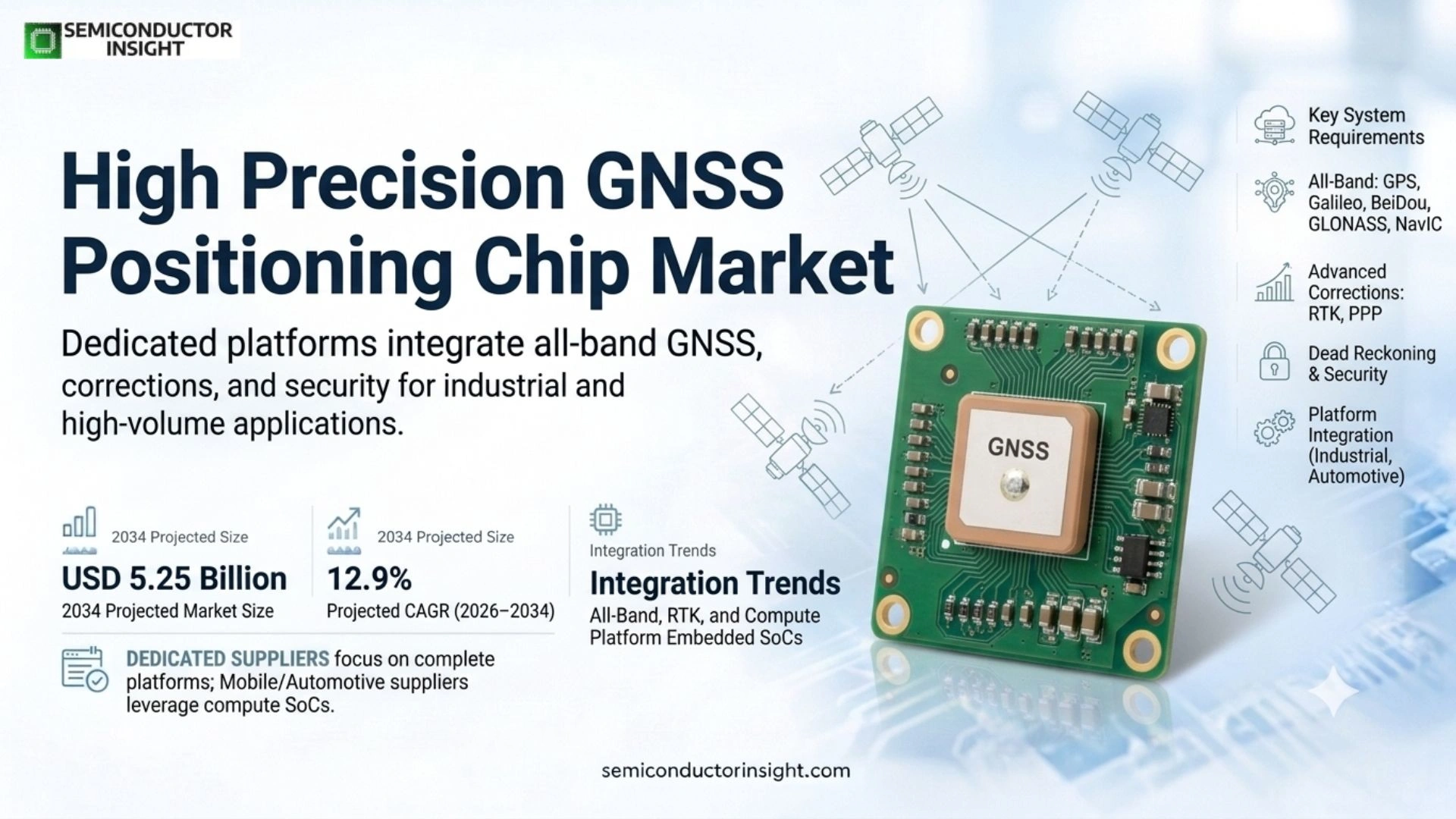
High Precision GNSS Positioning Chip market was valued at USD 1.76 billion in 2025 and is projected to reach USD 5.25 billion by 2034, representing a 12.9% CAGR during 2026–2034. The 2026 estimated market size is USD 1.99 billion. Asia Pacific represents more than 40% of global GNSS chip demand in the source market structure.
High-precision GNSS positioning chips process multiple satellite constellations, frequency bands and correction data to deliver accuracy far beyond basic navigation receivers. Multi-frequency measurements help separate ionospheric error, while RTK uses local or network corrections and PPP uses precise orbit and clock information to improve absolute positioning. The chip increasingly works with inertial sensors, wheel speed, cameras and cloud corrections because reliable field positioning requires continuity when satellite geometry or signal quality deteriorates.
The market includes single- and multi-frequency receivers used in vehicles, mobile devices, wearables, surveying and other professional systems. Automotive and industrial users care about integrity, update rate, dead reckoning and reliability in addition to static accuracy. A receiver that reaches centimeter performance in open sky but fails in an urban canyon has limited commercial value, so suppliers compete across RF sensitivity, multipath mitigation, anti-jamming, sensor fusion, correction protocols and power consumption.
Satellite-service evolution is expanding what chips can do without proprietary infrastructure. Galileo High Accuracy Service provides free correction data for decimeter-class positioning under supported conditions, while Galileo OSNMA lets compatible receivers verify that navigation messages are authentic. GPS modernization adds civilian signals such as L2C, L5 and L1C. Receiver vendors can combine these public services with private RTK or PPP networks to improve accuracy, resilience and global deployment economics.
Segment Analysis: By Type
By type, the report segments the market into Single Frequency Receiver and Multi-Frequency Receiver. Multi-frequency receivers lead because high precision benefits from observing several bands and constellations simultaneously, allowing algorithms to correct atmospheric error, resolve carrier-phase ambiguities faster and maintain better accuracy in difficult RF environments.
| Type | Technical profile | Market position |
|---|---|---|
| Single Frequency Receiver | Single-frequency high-precision designs track one primary band per constellation, such as GPS L1, Galileo E1 or BeiDou B1. They can still use differential corrections and sophisticated filtering, but they have less direct information for separating ionospheric error and resolving carrier-phase ambiguities. The architecture can offer lower cost, simpler RF design and lower power when continuous centimeter accuracy is unnecessary. | A lower-cost segment suited to selected industrial, tracking and legacy precision applications. Its share faces pressure as dual-band and multi-band front ends become more affordable, but it remains relevant where the application can tolerate slower convergence, has strong local corrections or values power and cost more than all-environment accuracy. |
| Multi-Frequency Receiver | Multi-frequency chips simultaneously process two, three or more bands across GPS, Galileo, BeiDou, GLONASS, QZSS and NavIC. This improves atmospheric-error estimation and satellite availability, while modern all-band platforms also add interference detection, high-rate raw data and sensor-fusion interfaces for mobility and automation. | Leading segment. Automotive, surveying, drones and autonomous machines need fast convergence and robust accuracy. Commercial products are moving from specialist dual-frequency designs toward wider all-band and multi-constellation architectures that can use RTK, PPP and public high-accuracy services in one hardware platform. |
Positioning technology and end-user segmentation
The report further segments the market by positioning technology and end-user industry. RTK is gaining adoption because it can deliver centimeter-level relative positioning with fast convergence when correction data are available. PPP removes the need for a nearby base station but traditionally requires longer convergence, while newer multi-band receivers and correction services are improving that trade-off. Automotive leads end-user adoption, followed by agriculture, construction, marine and aviation, each with different integrity and certification requirements.
| Axis | Segments | Commercial implication |
|---|---|---|
| By Technology | Real-Time Kinematic (RTK) · Precise Point Positioning (PPP) · Differential GPS (DGPS) · Standalone GNSS | RTK delivers fast centimeter positioning when network corrections are available; PPP offers broad coverage using precise corrections; DGPS serves lower-accuracy professional needs; standalone GNSS remains a baseline and fallback mode. Flexible platforms support several modes so one receiver can be deployed across multiple regions. |
| By End-User Industry | Automotive · Agriculture · Construction · Marine · Aviation | Automotive is the largest adoption segment, while agriculture and construction monetize centimeter precision through machine guidance and automation. Marine and aviation place greater emphasis on integrity, certification and resilience, supporting higher-value designs even at lower unit volume. |
Segment Analysis: By Application
By application, In-Vehicle Systems lead the market, followed by mobile devices, wearables, surveying and mapping equipment, and other use cases. Automotive systems combine GNSS with inertial and vehicle sensors for lane-level navigation and continuity, while surveying remains a premium application because positioning accuracy directly determines measurement quality and field productivity.
| Application | Demand characteristics |
|---|---|
| In-Vehicle Systems | The largest application includes navigation, telematics, ADAS, automated driving and commercial fleet platforms. Automotive receivers increasingly use dual- or multi-band GNSS, inertial sensors and map matching to maintain position through urban canyons, tunnels and partial signal blockage. Suppliers need high accuracy plus temperature qualification, long lifecycle, cybersecurity and deterministic software behavior, making automotive design wins more complex than consumer navigation. |
| Mobile Devices | Premium smartphones and rugged handhelds use multi-band GNSS to improve location in cities and support mapping, emergency response and augmented-reality experiences. Power and die area are critical because positioning competes with cellular, Wi-Fi, imaging and AI functions inside a constrained battery envelope. High accuracy can be enhanced through cloud corrections, but mass-market devices must balance continuous precision with energy consumption. |
| Wearable Devices | Sports, outdoor and safety wearables benefit from multi-band reception in forests, mountains and urban environments where reflections can degrade single-band fixes. Small antennas and limited batteries remain important constraints, so chip vendors use duty cycling, low-power tracking and sensor fusion. The goal is often more reliable route fidelity rather than continuous centimeter positioning. |
| Surveying & Mapping Equipment | Surveying is one of the highest-value applications because centimeter accuracy directly determines measurement quality. Professional receivers support RTK, PPP, raw carrier-phase data, high update rates and multi-constellation tracking. Customers prioritize repeatability, correction-service compatibility and field reliability over lowest chip price, allowing dedicated positioning suppliers to defend premium positions. |
| Others | Drones, robots, precision agriculture, construction machines, timing systems and critical infrastructure form a broad growth category. Autonomous devices need high-rate position and heading, while telecom and power systems value precise time. These markets increasingly require anti-jamming, spoofing awareness and sensor fusion, creating opportunities for specialized chips even when unit volume is below automotive. |
Regional Analysis
Asia Pacific dominates the High Precision GNSS Positioning Chip market with more than 40% of demand in the source analysis. China’s BeiDou ecosystem and domestic suppliers support regional scale, while Japan, South Korea and India add automotive, robotics, industrial and NavIC-driven requirements. North America remains a leading R&D and professional-positioning market, and Europe benefits from Galileo HAS and OSNMA.
How do regional high-precision GNSS requirements differ?
Regional differences reflect satellite-service ecosystems, end-use industries and supplier bases. Asia Pacific combines large electronics and automotive markets with BeiDou, QZSS and NavIC. North America has strong GPS heritage, precision agriculture and professional positioning. Europe adds Galileo high-accuracy and authentication services plus automotive demand. Emerging regions often focus on agriculture, mining, construction and fleet tracking, where precision can deliver measurable productivity gains.
| Region | Market position | Growth outlook | Demand profile | What decides supplier selection |
|---|---|---|---|---|
| Asia Pacific | >40% of demand | Very high | Automotive, electronics & BeiDou | Cost, multi-constellation support and local ecosystem |
| North America | R&D and professional leader | High | Automotive, agriculture & surveying | Accuracy, RTK/PPP, integrity and support |
| Europe | Advanced regulated market | High | Automotive & industrial | Galileo HAS/OSNMA, reliability and certification |
| South America | Professional niche | Moderate to high | Agriculture, mining & mapping | Correction coverage, cost and ruggedness |
| Middle East & Africa | Emerging | Moderate to high | Construction, logistics & mining | Coverage, resilience and local service |
Competitive Landscape
Competition spans smartphone and automotive semiconductor companies, dedicated GNSS chip vendors and professional positioning specialists. The report profiles u-blox, Qualcomm, Quectel, Broadcom, Furuno, STMicroelectronics, MediaTek, Unicore, Navika Electronics, Techtotop, Hexagon, Trimble, MENGXIN TECHNOLOGY and Chipcraft. Consumer chips emphasize integration and power, while professional products emphasize multi-band accuracy, corrections and integrity.
Dedicated positioning suppliers compete through complete platforms rather than a receiver alone. Modern all-band products combine GPS, Galileo, BeiDou, GLONASS, QZSS and NavIC, then add RTK, PPP, dead reckoning and security functions. This approach is attractive to industrial customers because they can reuse one hardware platform across regions and switch correction methods through software or service configuration.
Qualcomm, Broadcom, MediaTek and STMicroelectronics benefit from deep integration with mobile and automotive compute platforms. When GNSS is embedded inside a broader connectivity or application SoC, customers save board area and power, but professional raw-data and correction requirements can be less flexible than with a dedicated receiver. These suppliers are strongest where GNSS is one feature inside a high-volume platform.
Regional suppliers and module vendors intensify competition. Unicore and other Chinese companies benefit from BeiDou demand and local automotive, drone and surveying ecosystems, while Quectel packages high-precision receiver technology into ready-to-integrate modules. Professional solution companies such as Trimble and Hexagon add corrections and field software, showing that a chip competes inside a larger precision-positioning stack.
Competitive tier structure
| Tier | Companies | Basis of competition |
|---|---|---|
| Integrated semiconductor leaders | Qualcomm Technologies; Broadcom; MediaTek; STMicroelectronics | SoC integration, power efficiency, automotive/mobile platforms and high-volume scale |
| Dedicated GNSS specialists | u-blox; Unicore Communications; MENGXIN TECHNOLOGY; Chipcraft; Navika Electronics; Techtotop | Multi-frequency positioning engines, RTK/PPP, raw measurements, regional constellation support and specialist firmware |
| Modules & solution ecosystems | Quectel; Furuno; Hexagon; Trimble | Ready-to-integrate modules, corrections, antennas, field software and domain-specific positioning |
Key companies profiled in the report scope
- u-blox
- Qualcomm Technologies
- Quectel
- Broadcom
- Furuno
- STMicroelectronics
- MediaTek
- Unicore Communications
- Navika Electronics
- Techtotop
- Hexagon
- Trimble
- MENGXIN TECHNOLOGY
- Chipcraft
High Precision GNSSChip Production & Platform Capacity Analysis
Production capacity combines semiconductor fabrication with RF test, module assembly, firmware and correction-service infrastructure. High-precision receivers use multiple RF bands and sophisticated baseband processing, so commercial capacity depends on stable foundry supply and the ability to calibrate and test many signal paths. For module vendors, antenna guidance, filtering, shielding and software validation are often as important as underlying chip output.
Multi-frequency chips benefit from advanced CMOS processes that reduce power while integrating more RF and digital logic. Process scaling supports low-power dual-band or all-band operation, but dedicated positioning vendors must balance node cost against RF sensitivity and interference handling. The receiver still needs low noise and robust analog performance even when digital processing becomes more integrated and algorithmically complex.
Correction services are a second form of capacity. RTK requires base-station or network coverage, while PPP and PPP-RTK depend on precise orbit, clock and atmospheric corrections delivered reliably to devices. A chip supporting advanced algorithms has limited value if correction data are unavailable or poorly integrated. Vendors increasingly invest in cloud delivery, global coverage, security and device provisioning around the receiver silicon.
Market Dynamics
Growth is driven by autonomous and connected vehicles, precision agriculture, surveying, drones, robotics and public high-accuracy satellite services. Restraints include jamming and spoofing, urban multipath, power consumption, correction availability and integration complexity. Opportunities are strongest in all-band low-power silicon, authenticated positioning, global PPP, sensor fusion and mass-market machine automation.
MARKET DRIVERS
Drivers Impact Analysis*
| Factor | Forecast impact* | Geographic relevance | Impact timeline |
|---|---|---|---|
| Automotive ADAS and autonomy | High | Asia Pacific, North America, Europe | Medium to long term |
| Precision agriculture and machine control | High | Americas, Europe, Asia | Medium term |
| Galileo HAS and correction services | Medium to high | Global | Short to medium term |
| Drones, robotics and industrial autonomy | High | Global | Medium to long term |
*Directional analytical rating; it is not a measured contribution to the headline CAGR.
Automotive systems need lane-level and continuous positioning
Navigation is moving from turn-by-turn guidance toward precise localization for ADAS, automated driving and fleet intelligence. High-precision chips combine multi-band GNSS with inertial sensors and vehicle data so the system can maintain a stable pose through urban canyons or short outages. This raises semiconductor and software value per vehicle because accuracy, integrity and continuity become part of the platform architecture.
Precision agriculture converts accuracy into measurable productivity
Farm machinery can use RTK to repeat the same path across planting, spraying and harvesting with centimeter-level precision. Reduced overlap saves fuel, seed and chemicals while enabling controlled traffic and automated steering. Because the economic benefit can be measured across many hectares, agriculture remains a durable professional market for multi-frequency chips, correction services and ruggedized modules.
Public high-accuracy services lower deployment barriers
Galileo HAS provides free correction data and modern receivers can combine it with PPP or private correction services. This reduces the need to establish a dense local RTK network for every application. Vendors supporting multiple correction modes can serve global OEM platforms with one hardware design and select the most suitable service by geography.
Drones and robots create high-volume professional positioning
Commercial drones, delivery robots and autonomous machines need accurate position and heading to operate safely near obstacles or repeat planned paths. These products also demand small size, low power and high update rates, pushing vendors to integrate more functions into silicon. As autonomous machines scale beyond surveying into logistics and agriculture, the chip market gains a new volume pool.
MARKET RESTRAINTS
Restraints Impact Analysis*
| Factor | Forecast impact* | Geographic relevance | Impact timeline |
|---|---|---|---|
| Jamming and spoofing risk | High | Global critical applications | Persistent |
| Urban multipath and blockage | High | Dense cities | Persistent |
| Power consumption in multi-band modes | Medium | Wearables, drones, IoT | Persistent |
| Correction and integration complexity | Medium to high | Professional markets | Medium term |
*Directional analytical rating; it is not a measured contribution to the headline CAGR.
Satellite signals are intrinsically weak at the receiver
GNSS can be jammed by intentional or accidental RF energy and spoofed by counterfeit signals. High-precision systems are sensitive because applications may trust small positional differences. Chips need interference detection, authenticated navigation where available, multi-constellation checks and inertial fallback. Those features increase design complexity and cannot fully remove the risk of prolonged signal denial.
Urban multipath limits standalone accuracy
Buildings reflect satellite signals and can bias carrier-phase and code measurements even when the receiver tracks many satellites. Additional frequencies help reject poor measurements, but severe geometry still requires sensor fusion or map constraints. Chip vendors therefore need to support IMUs, wheel speed, vision or external corrections rather than relying on open-sky accuracy specifications alone.
High precision consumes more power and compute
Tracking several bands and constellations, running RTK or PPP filters and processing inertial data require more RF and digital activity than basic single-band navigation. Battery-powered wearables, drones and trackers cannot keep every channel active continuously. Suppliers need efficient duty cycling, low-power modes and hardware acceleration so precision does not reduce operating time below the application’s economic requirement.
Correction services add operational dependencies
RTK needs a base station or network, and PPP relies on correction streams and convergence behavior. Network coverage, data cost and service reliability therefore become part of the solution. OEMs prefer hardware that can use several correction providers and fall back gracefully, but supporting that flexibility requires more firmware, testing and commercial integration.
MARKET OPPORTUNITIES
Bring all-band positioning into cost-sensitive machines
New all-band receivers show that global centimeter precision can move from surveying into lawn equipment, construction machines, drones and warehouse systems. Vendors that reduce RF component count, simplify antenna design and integrate corrections can expand high-precision adoption beyond customers with specialist GNSS engineering teams.
Use Galileo OSNMA for trusted positioning
OSNMA gives receivers a standardized method to authenticate Galileo navigation messages. Suppliers can combine that capability with spoofing detection, multi-constellation consistency checks and inertial sensing for vehicles, drones, timing and critical infrastructure. The opportunity is to offer documented trust features that can be tested rather than proprietary claims customers cannot independently verify.
Combine PPP, RTK and PPP-RTK in one platform
Different markets have different correction infrastructure. A receiver supporting local RTK for fast convergence, PPP for broad coverage and hybrid approaches can be reused across many OEM products. The same hardware platform can then be differentiated through subscriptions or regional correction partners, increasing software and service revenue around the chip.
Expand precision timing alongside positioning
5G networks, data centers, power grids and financial systems use GNSS for timing even when they do not need location. Multi-frequency receivers with interference monitoring and precise pulse outputs can serve this market, especially when combined with holdover oscillators. Timing applications can support premium pricing because failure affects network synchronization rather than user convenience.
High Precision GNSS Positioning Chip Value Chain Analysis
Satellite-service evolution expands receiver capability
High-precision chips depend on signals and corrections created upstream by satellite operators and correction networks. GPS modernization adds new civil frequencies, Galileo HAS supplies high-accuracy corrections and OSNMA adds authentication. Receiver vendors supporting these services can improve accuracy or trust through firmware and RF capability without changing the user’s physical operating environment.
Chip architecture determines the precision-per-watt trade-off
The receiver must amplify weak satellite signals, reject interference, track many channels and process carrier phase in real time. More bands improve accuracy but increase analog complexity and power. Modern designs use advanced CMOS, hardware acceleration and shared RF paths to reduce the penalty, while algorithm quality determines multipath rejection, convergence and integrity.
Modules reduce integration risk for OEM customers
A high-precision module combines receiver silicon with oscillators, filters, power regulation, memory and validated RF layout. Vendors can add dead reckoning, antenna diagnostics and correction clients so the customer avoids developing every subsystem. This is valuable in industrial and automotive products where RF design errors can delay qualification or create difficult field failures.
Application economics determine how much precision is valuable
Surveying and machine control can monetize centimeter accuracy directly, while consumer devices may only need more reliable lane or route positioning. OEMs compare the cost of multi-band hardware and corrections with reduced labor, improved safety or automation value. Suppliers that quantify downstream benefit can defend premium solutions better than vendors selling raw accuracy specifications alone.
Recent Developments in the High Precision GNSS Positioning Chip Market
Galileo marks one year of operational OSNMA
EUSPA reported that receiver manufacturers worldwide are embedding Galileo OSNMA into commercial products one year after service declaration. The technology lets compatible receivers verify that navigation information comes from Galileo and has not been altered, increasing the commercial importance of authentication-aware receivers.
u-blox expands ZED-X20P with global PPP and Galileo HAS
u-blox launched the ZED-X20P-01B with global Precise Point Positioning, Galileo High Accuracy Service support, moving-base capability and stronger interference resilience. The product broadens high-precision deployment where local RTK infrastructure is unavailable.
Galileo OSNMA becomes available to users
EUSPA detailed the operational Open Service Navigation Message Authentication service after its 2025 declaration. The capability creates a free authentication layer that chip and module suppliers can incorporate into automotive, timing, drone and professional positioning products.
u-blox launches ZED-X20P all-band centimeter receiver
u-blox introduced an all-band GNSS receiver for global centimeter-level positioning. The launch demonstrates the market shift from specialized survey hardware toward broader industrial and mobility adoption of multi-band high-precision technology.
REPORT SCOPE & SEGMENTATION
| Attribute | Details |
|---|---|
| Study Period | 2020–2034 |
| Base Year | 2025 |
| Estimated Year | 2026 |
| Forecast Period | 2026–2034 |
| Historical Period | 2020–2025 |
| Market Size 2025 | USD 1.76 billion |
| Market Size 2034 | USD 5.25 billion |
| Growth Rate | CAGR of 12.9% from 2026–2034 |
| Unit | Value (USD Million/Billion) and chip/module unit shipments |
| Segmentation | By Type, By Application, By Technology, By End-User Industry, By Region |
| By Type | Single Frequency Receiver · Multi-Frequency Receiver |
| By Application | In-Vehicle Systems · Mobile Devices · Wearable Devices · Surveying & Mapping Equipment · Others |
| By Technology | Real-Time Kinematic (RTK) · Precise Point Positioning (PPP) · Differential GPS (DGPS) · Standalone GNSS |
| By End-User Industry | Automotive · Agriculture · Construction · Marine · Aviation |
| By Region | Each region analysed by type, application, positioning technology, end-user industry and country marketNorth AmericaUnited States, Canada, MexicoEuropeGermany, France, United Kingdom, Switzerland and other European marketsAsia PacificChina, Japan, India, South Korea, Southeast Asia and other Asian marketsSouth AmericaBrazil, Argentina, Chile and other South American marketsMiddle East & AfricaSaudi Arabia, UAE, South Africa and other MEA markets |
| Key Companies Profiled | u-blox · Qualcomm Technologies · Quectel · Broadcom · Furuno · STMicroelectronics · MediaTek · Unicore Communications · Navika Electronics · Techtotop · Hexagon · Trimble · MENGXIN TECHNOLOGY · Chipcraft |
| Customization Scope | Free report customization equivalent to up to four analyst working days with purchase. Addition or alteration to country, regional and segment scope. |
Frequently Asked Questions
What is the 2025 size of the High Precision GNSS Positioning Chip market?
The normalized market size is USD 1.76 billion in 2025 and is projected to reach USD 5.25 billion by 2034, representing a 12.9% CAGR during 2026–2034. The 2026 estimate is USD 1.99 billion. The series is derived from the published USD 1.56 billion 2024 and USD 4.12 billion 2032 market-size anchors.
Which receiver type leads the market?
Multi-frequency receivers lead because high-precision positioning benefits from simultaneous measurements on several satellite bands and constellations. Dual-, triple- and all-band designs can correct atmospheric error, resolve carrier-phase ambiguities more quickly and maintain better satellite geometry than single-frequency devices, which is critical for automotive, surveying and autonomous-machine applications.
Which application is the largest?
In-vehicle systems are the dominant application in the source report, and automotive is also the largest end-user industry. ADAS, telematics, automated driving and lane-level navigation require multi-band GNSS combined with inertial and vehicle sensors so positioning remains usable during urban multipath, tunnels or short satellite outages.
Which region leads in 2025?
Asia Pacific is the largest market and represents more than 40% of GNSS chip demand in the source analysis. China is a major driver through BeiDou integration, automotive production and domestic positioning suppliers, while Japan, India, South Korea and Southeast Asia add QZSS, NavIC, industrial, robotics and mobility demand.
What is the estimated market size in 2026?
The estimated 2026 market size is USD 1.99 billion. It is calculated using the constant annual growth factor implied by the 2024 and 2032 market-size anchors and is applied consistently across the Key Statistics, Market Overview, Report Scope and FAQ sections.
What is the difference between RTK and PPP?
RTK uses corrections from a nearby base station or network and can achieve centimeter-level positioning with fast convergence when communication and reference coverage are available. PPP uses precise satellite orbit and clock corrections over a much wider area, reducing local infrastructure needs but traditionally requiring longer convergence. Modern receivers increasingly support both approaches.
How is Galileo affecting high-precision chip design?
Galileo High Accuracy Service provides free corrections that can deliver decimeter-class positioning under supported conditions, while OSNMA lets receivers authenticate navigation messages. Supporting E5, E6 and authentication features therefore creates new commercial capabilities for chips used in vehicles, drones, timing and professional positioning.
What are the main market restraints?
The main restraints are jamming and spoofing, urban multipath, power consumption in multi-band modes, dependence on correction connectivity and complex sensor-fusion integration. High open-sky accuracy does not guarantee field performance, so OEMs require extensive testing across blocked, reflected and interfered signal environments before qualification.
What technology trend is reducing the cost of precision?
All-band and dual-band receiver platforms are integrating more RF channels and positioning algorithms while moving to advanced semiconductor processes. Modern products combine high-precision positioning with integrated RTK or PPP capabilities, allowing OEMs to deploy one receiver design across a broader set of industrial and automotive applications.
What does the report cover?
The report covers single- and multi-frequency receivers; in-vehicle, mobile, wearable, surveying and other applications; RTK, PPP, DGPS and standalone positioning technologies; automotive, agriculture, construction, marine and aviation end users; five global regions; production-capacity analysis; and the full profiled company list.
Research Sources & Evidence Base
View primary and authoritative evidence used in this overview
- u-blox. ZED-X20P all-band GNSS receiver – March 2025 official launch of an all-band receiver targeting global centimeter-level positioning.
- u-blox. ZED-X20P-01B with global PPP and Galileo HAS – April 2026 official product update adding global PPP, HAS support, moving-base capability and resilience features.
- Quectel. LC29H high-precision GNSS series – Official product information covering dual-band multi-constellation reception, RTK, dead reckoning and centimeter positioning.
- EU Agency for the Space Programme. Galileo High Accuracy Service – Official description of free Galileo corrections and decimeter-class positioning performance.
- EU Agency for the Space Programme. Galileo OSNMA – Official service description covering navigation-message authentication and protection against spoofing.
- GPS.gov. GPS Modernization and New Civil Signals – Official U.S. information on L2C, L5 and L1C signals available to modern receivers.
Get Sample Report PDF for Exclusive Insights
Report Sample Includes
- Table of Contents
- List of Tables & Figures
- Charts, Research Methodology, and more...
 Download Sample Report PDF