MARKET INSIGHTS
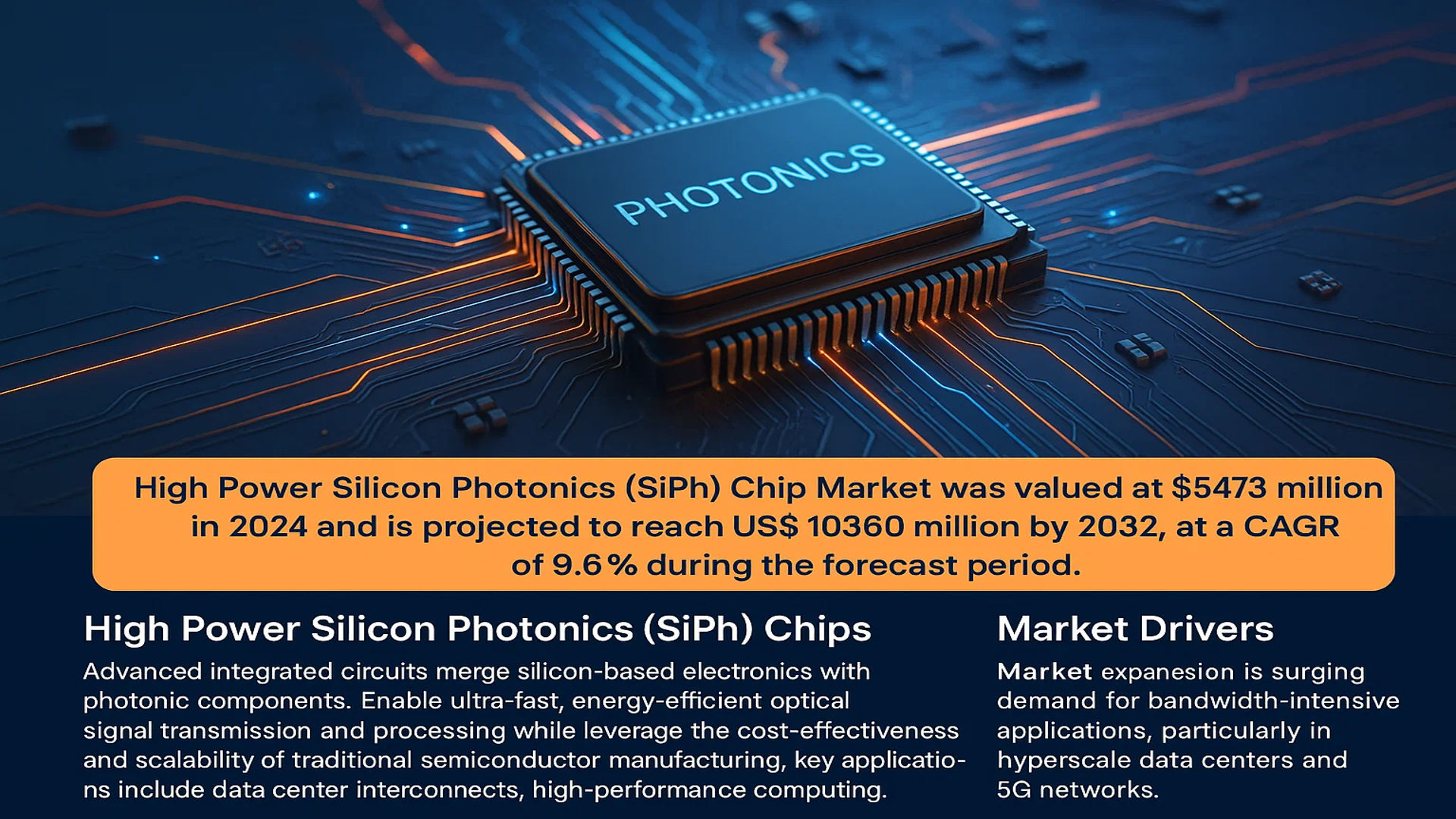
The global High Power Silicon Photonics (SiPh) Chip Market was valued at 5473 million in 2024 and is projected to reach US$ 10360 million by 2032, at a CAGR of 9.6% during the forecast period.
High Power Silicon Photonics (SiPh) Chips are advanced integrated circuits that merge silicon-based electronics with photonic components. These chips enable ultra-fast, energy-efficient optical signal transmission and processing while leveraging the cost-effectiveness and scalability of traditional semiconductor manufacturing. Key applications include data center interconnects, high-performance computing, and artificial intelligence infrastructure where low-latency, high-bandwidth communication is critical.
The market expansion is driven by surging demand for bandwidth-intensive applications, particularly in hyperscale data centers and 5G networks. Furthermore, increasing adoption of co-packaged optics and advancements in silicon photonics technology are accelerating commercialization. Major industry players like Intel, Cisco, and NVIDIA are actively investing in SiPh solutions to address the growing need for faster data transfer speeds while reducing power consumption in next-generation computing architectures.
MARKET DYNAMICS
MARKET DRIVERS
Exponential Growth in Data Center Traffic Driving Demand for High-Speed Optical Solutions
The global data center market is experiencing unprecedented growth, with hyperscale facilities requiring increasingly sophisticated optical interconnects to handle massive bandwidth demands. High Power Silicon Photonics (SiPh) Chips have emerged as a critical enabler for 800G and emerging 1.6T optical transceivers. With data center traffic projected to exceed 25 zettabytes annually by 2024, the need for energy-efficient, high-bandwidth solutions has never been greater. SiPh technology addresses this challenge by integrating optical components directly onto silicon substrates, reducing power consumption while increasing data transmission speeds to 400Gbps and beyond. Major cloud service providers are actively transitioning to silicon photonics-based interconnects, creating significant market momentum.
AI/ML Workloads Creating New Performance Requirements
Artificial Intelligence and Machine Learning applications are fundamentally changing computing architectures, with specialized accelerators requiring ultra-low latency, high-bandwidth optical interconnections between processors and memory. The AI chip market, valued at over $80 billion in 2024, increasingly relies on SiPh solutions to overcome the limitations of electrical interconnects in large-scale deployments. High Power SiPh Chips enable co-packaged optics solutions that can deliver the necessary performance while maintaining thermal efficiency – a critical factor for AI training clusters consuming megawatts of power. Recent advances in integrating photonics with advanced packaging technologies have positioned SiPh as the preferred solution for next-generation AI hardware.
Government Investments in Photonic IC Development Accelerating Innovation
National initiatives worldwide are prioritizing silicon photonics as a strategic technology, with the European Union allocating over €300 million to photonics research under Horizon Europe programs. Similarly, the U.S. CHIPS and Science Act includes provisions for advancing integrated photonics manufacturing capabilities. These investments are driving technological breakthroughs in high-power integration, with recent developments demonstrating watt-class optical power handling in silicon-based devices. Because government backing reduces R&D risks for private sector participants, we’re seeing accelerated commercialization of SiPh technologies that would otherwise require longer development cycles.
MARKET RESTRAINTS
Thermal Management Challenges Limiting Power Scaling
While silicon photonics offers significant advantages in integration density, the technology faces inherent limitations in thermal performance when scaling to higher optical power levels. Silicon’s relatively low thermal conductivity and nonlinear optical effects create barriers for applications requiring multi-watt optical outputs. These constraints become particularly apparent in long-haul telecom and high-power sensing applications, where traditional III-V compound semiconductor solutions still dominate. Manufacturers are investing heavily in thermal mitigation strategies, including innovative packaging techniques and heterogeneous integration approaches, but overcoming silicon’s fundamental thermal limitations remains an ongoing challenge.
Supply Chain Vulnerabilities Creating Manufacturing Bottlenecks
The specialized nature of silicon photonics manufacturing creates vulnerabilities in the supply chain, particularly for critical components like silicon wafers with customized dopant profiles and epitaxial layers. With less than a dozen foundries worldwide capable of volume production of photonic integrated circuits, the industry faces capacity constraints during periods of high demand. Additionally, the complex assembly and packaging processes required for high-power devices involve specialized equipment that often has long lead times. These factors contribute to extended product development cycles and can delay market adoption of new SiPh technologies.
Standardization Gaps Slowing Ecosystem Development
The lack of industry-wide standards for high-power silicon photonics interfaces and packaging creates interoperability challenges that hinder broader adoption. Unlike mature electrical interconnect standards, photonic packaging approaches vary significantly between vendors, making system integration more complex for end users. This fragmentation increases development costs and risks for equipment manufacturers seeking to implement SiPh solutions. While industry consortia are working to address these gaps, the absence of universally accepted specifications continues to slow market growth, particularly in applications requiring multi-vendor component interoperability.
MARKET OPPORTUNITIES
Co-Packaged Optics Revolutionizing Data Center Architectures
The transition to co-packaged optics (CPO) in hyperscale data centers represents a massive growth opportunity for high-power SiPh solutions. By eliminating traditional pluggable transceivers and moving optical interfaces directly onto processor packages, CPO architectures can reduce power consumption by up to 30% while increasing bandwidth density. With CPO adoption expected to grow at a compound annual rate exceeding 60% through 2030, SiPh providers are developing specialized high-power laser components optimized for integration with advanced packaging technologies. This shift is creating new revenue streams across the optical component supply chain.
Emerging Quantum Technologies Opening New Application Frontiers
Quantum computing and communications systems are driving demand for specialized photonic components capable of generating and manipulating single photons with extreme precision. Silicon photonics platforms are particularly well-suited for quantum applications because they can integrate optical components with electronic control circuits on a single chip. Recent breakthroughs in silicon-based photon pair generation and detection have demonstrated the potential for scalable quantum photonic systems. As quantum technology transitions from research labs to commercial deployment, high-performance SiPh solutions will play an increasingly critical role in enabling practical implementations.
Automotive LiDAR Creating Mass Market Potential
The automotive industry’s push toward autonomous driving is creating significant opportunities for high-power silicon photonics in LiDAR systems. Unlike traditional mechanical scanning LiDAR, solid-state solutions based on SiPh can achieve the required performance while meeting automotive reliability and cost targets. With the automotive LiDAR market projected to exceed $8 billion by 2028, silicon photonics providers are developing specialized high-power laser arrays and optical phased arrays for next-generation sensing systems. The ability to integrate these photonic components with CMOS electronics makes SiPh particularly attractive for automotive applications where size, weight, and power efficiency are critical.
MARKET CHALLENGES
High Development Costs Creating Barriers to Entry
The specialized nature of silicon photonics research and development requires substantial upfront investment, with a single fabrication run often costing millions of dollars. These high costs create significant barriers for smaller players and startups looking to enter the high-power SiPh market. Additionally, the lengthy development cycles associated with photonic IC design and testing slow time-to-market and increase financial risks. While shared fabrication facilities help mitigate some of these challenges, the capital requirements remain prohibitive for many potential market participants, potentially limiting innovation and competition.
Technical Skill Shortages Constraining Market Expansion
The specialized knowledge required to design, manufacture, and test high-performance silicon photonic devices creates workforce challenges that are slowing industry growth. Few academic institutions currently offer comprehensive programs in photonic IC design, resulting in a limited pool of qualified engineers. With the global photonics industry requiring thousands of new specialists annually, this talent gap threatens to constrain market expansion. Companies are increasingly investing in internal training programs and partnering with universities to develop pipelines of skilled workers, but bridging this gap will take years of sustained effort across the industry.
Performance Trade-offs Between Power and Integration Density
High-power operation often requires design compromises that reduce the integration density advantages of silicon photonics. Thermal isolation requirements, for example, may dictate larger spacing between components, while high optical power levels can necessitate specialized waveguide geometries that consume more chip area. These trade-offs create difficult engineering challenges when trying to simultaneously maximize both power handling and functional integration. While heterogeneous integration approaches can help address some of these issues, they often introduce additional complexity and cost, potentially limiting the competitiveness of SiPh solutions in certain applications.
HIGH POWER SILICON PHOTONICS (SiPh) CHIP MARKET TRENDS
Growing Adoption in Data Centers and AI Infrastructure to Drive Market Expansion
The global High Power Silicon Photonics (SiPh) Chip market is experiencing unprecedented growth, driven primarily by the surging demand for high-speed data transfer in hyperscale data centers and next-generation artificial intelligence (AI) applications. The market, valued at $5.47 billion in 2024, is projected to reach $10.36 billion by 2032, reflecting a CAGR of 9.6%. This exponential growth can be attributed to the increasing necessity for energy-efficient, high-bandwidth optical communication solutions. Silicon photonics enables data transmission at unparalleled speeds while significantly reducing power consumption—critical factors for AI workloads and cloud computing. The integration of co-packaged optics (CPO) in data center architectures is further accelerating SiPh adoption, with over 60% of leading cloud providers exploring photonics-based solutions for their next-gen infrastructure.
Other Trends
Advancements in Lasers and Modulators for High-Power Applications
Recent breakthroughs in high-power Electro-Absorption Modulated Laser (EML) chips and Distributed Feedback (DFB) lasers have significantly improved the performance and reliability of SiPh solutions, particularly for telecommunications and high-performance computing (HPC) applications. Manufacturers are now developing 200G and 400G coherent optical modules optimized for long-haul transmission, enabling seamless integration in 5G infrastructure. The EML chips segment, which currently holds a dominant market share, is expected to maintain its leadership due to its superior modulation efficiency and power handling capabilities. This has spurred R&D investments from key industry players, with over 30% of semiconductor firms allocating budgets to SiPh technology development to stay competitive.
Rising Competition and Vertical Integration Among Key Players
The competitive landscape of the SiPh market is rapidly evolving, with established players like Lumentum, Coherent (II-VI), and Broadcom accelerating vertical integration to streamline supply chains and reduce costs. Partnerships between semiconductor foundries and photonics specialists have become a key strategy, as demand for mass-produced, low-cost SiPh chips intensifies. Meanwhile, the Asia-Pacific region, led by China and Japan, is emerging as a major hub for SiPh manufacturing, contributing nearly 40% of global production capacity. While established markets like North America and Europe continue to dominate R&D, Asia’s cost-effective manufacturing ecosystem is positioning it as a critical player in fulfilling the growing demand for photonics-enabled solutions.
COMPETITIVE LANDSCAPE
Key Industry Players
Innovations and Strategic Expansions Drive Market Competition
The competitive landscape of the High Power Silicon Photonics (SiPh) Chip Market is highly dynamic, characterized by a mix of established technology giants and emerging specialists. Lumentum and Coherent (II-VI) dominate the market, leveraging their strong R&D capabilities and extensive customer networks in data center and telecommunications sectors. Lumentum’s recent acquisitions in laser and photonics technologies have further solidified its market position.
Mitsubishi Electric and Source Photonics also hold substantial shares, with Mitsubishi benefiting from its vertically integrated manufacturing processes and Source Photonics excelling in high-speed optical communication solutions. Both companies have reported increased investments in SiPh technology to meet rising demand from cloud infrastructure providers.
Meanwhile, semiconductor leaders like Broadcom and Sumitomo Electric are aggressively entering the market through strategic partnerships. Broadcom’s silicon photonics division, for instance, has seen a 32% revenue growth in the last fiscal year, driven by its advanced packaging technologies and collaborations with hyperscalers.
The market is witnessing intensified competition as mid-size players like Applied Optoelectronics and Macom focus on niche applications, such as AI/ML hardware accelerators and LiDAR systems. These companies are differentiating themselves through product miniaturization and power efficiency improvements.
List of Key High Power SiPh Chip Companies Profiled
- Lumentum Holdings Inc. (U.S.)
- Coherent Corp. (II-VI Incorporated) (U.S.)
- Mitsubishi Electric Corporation (Japan)
- Source Photonics (U.S./China)
- Broadcom Inc. (U.S.)
- Sumitomo Electric Industries, Ltd. (Japan)
- Applied Optoelectronics, Inc. (U.S.)
- NTT Electronics Corporation (Japan)
- Furukawa Electric Co., Ltd. (Japan)
- Macom Technology Solutions (U.S.)
Segment Analysis:
By Type
EML Chips Segment Dominates the Market Due to High Demand in Data Center Applications
The market is segmented based on type into:
- EML Chips
- Subtypes: C-band EML, L-band EML, and others
- DFB Chips
- Others
- Subtypes: VCSEL-based chips, silicon modulators, and others
By Application
Data Centers and High-speed Communications Segment Leads Due to Rising Cloud Computing Needs
The market is segmented based on application into:
- Data Centers and High-speed Communications
- High-performance Computing (HPC)
- Artificial Intelligence and Machine Learning
- Others
By Power Output
High-power Segment Gains Traction for Long-haul Optical Networks
The market is segmented based on power output into:
- Low Power (≤ 10 mW)
- Medium Power (10-50 mW)
- High Power (≥ 50 mW)
By Manufacturing Process
Hybrid Integration Segment Holds Significant Share Due to Cost-Effectiveness
The market is segmented based on manufacturing process into:
- Monolithic Integration
- Hybrid Integration
- Others
Regional Analysis: High Power Silicon Photonics (SiPh) Chip Market
North America
The North American market leads in SiPh chip adoption, driven by robust investments in hyperscale data centers and AI infrastructure. The U.S. accounts for over 60% of regional demand, with major tech hubs like Silicon Valley accelerating R&D in photonic integration. Companies like Lumentum and Broadcom dominate the supply chain, while government initiatives such as the CHIPS Act allocate $52 billion for semiconductor innovation, indirectly benefiting photonics development. Data privacy regulations are pushing encryption-enhanced optical solutions, creating opportunities for quantum-secure SiPh applications.
Asia-Pacific
Asia-Pacific exhibits the fastest growth trajectory, projected at 11.2% CAGR through 2032, fueled by China’s $150 billion semiconductor self-sufficiency push. Chinese firms like Source Photonics and Furukawa Electric are scaling production to meet 60% of domestic data center needs. Japan and South Korea focus on automotive LiDAR and 5G fronthaul applications, while India emerges as a key outsourcing hub for photonic IC design. However, geopolitical tensions over chip exports create supply chain uncertainties for Western manufacturers.
Europe
European players leverage precision manufacturing expertise, with Germany’s NTT Electronics and France’s III-V Lab leading in hybrid silicon lasers. The EU Photonics21 roadmap prioritizes energy-efficient optical interconnects, aligning with strict data center PUE regulations. While growth is steady, market fragmentation across 27 member states slows standardization. Public-private partnerships are bridging this gap, like Belgium’s imec accelerator program which has incubated 15 SiPh startups since 2020.
Middle East & Africa
This nascent market shows potential through strategic digital infrastructure projects, particularly in UAE’s Smart Dubai initiative and Saudi Arabia’s NEOM tech city. Limited local manufacturing exists, but regional data localization laws are driving imports of high-bandwidth SiPh modules from Mitsubishi Electric and Coherent. Challenges include extreme climate testing for photonic components and reliance on foreign expertise, though Israel’s quantum computing startups present niche opportunities.
South America
Brazil dominates with 45% regional market share, where telecom operators like Telefónica deploy SiPh for 5G backhaul networks. Economic volatility restricts capital-intensive photonics fabs, but design houses in Argentina and Chile increasingly participate in global supply chains. Local universities partner with Macom and Sumitomo for workforce development, though currency fluctuations keep adoption costs 20-30% above global averages.
The competitive landscape reveals consolidation trends, with Broadcom’s 2023 acquisition of a SiPh packaging specialist illustrating vertical integration strategies. While North America and Asia compete for technological leadership, Europe maintains an edge in specialty materials and testing protocols. Emerging applications in biomedical sensing and aerospace photonics are expected to unlock $2.7 billion in untapped opportunities by 2027 across all regions.
Report Scope
This market research report provides a comprehensive analysis of the Global High Power Silicon Photonics (SiPh) Chip market, covering the forecast period 2025–2032. It offers detailed insights into market dynamics, technological advancements, competitive landscape, and key trends shaping the industry.
Key focus areas of the report include:
- Market Size & Forecast: Historical data and future projections for revenue, unit shipments, and market value across major regions and segments. The Global High Power Silicon Photonics (SiPh) Chip market was valued at USD 5,473 million in 2024 and is projected to reach USD 10,360 million by 2032, growing at a CAGR of 9.6% during the forecast period.
- Segmentation Analysis: Detailed breakdown by product type (EML Chips, DFB Chips, Others) and application (Data Centers and High-speed Communications, High-performance Computing, Artificial Intelligence and Machine Learning, Others) to identify high-growth segments and investment opportunities.
- Regional Outlook: Insights into market performance across North America, Europe, Asia-Pacific, Latin America, and the Middle East & Africa, with country-level analysis for key markets like the U.S., China, Japan, and Germany.
- Competitive Landscape: Profiles of leading market participants including Lumentum, Coherent (II-VI), Mitsubishi Electric, Source Photonics, Broadcom, Sumitomo, Applied Optoelectronics, NTT Electronics, Furukawa Electric, and Macom, covering their product offerings, R&D focus, and recent developments.
- Technology Trends & Innovation: Assessment of emerging technologies in silicon photonics, integration with AI/ML systems, and advancements in high-power optical components.
- Market Drivers & Restraints: Evaluation of factors driving market growth (increasing demand for high-speed data transmission, growth in AI/ML applications) along with challenges (manufacturing complexities, supply chain constraints).
- Stakeholder Analysis: Insights for semiconductor manufacturers, system integrators, data center operators, and investors regarding market opportunities and strategic directions.
Primary and secondary research methods are employed, including interviews with industry experts, data from verified sources, and market intelligence to ensure the accuracy and reliability of the insights presented.
FREQUENTLY ASKED QUESTIONS:
What is the current market size of Global High Power Silicon Photonics (SiPh) Chip Market?
-> High Power Silicon Photonics (SiPh) Chip Market was valued at 5473 million in 2024 and is projected to reach US$ 10360 million by 2032, at a CAGR of 9.6% during the forecast period.
Which key companies operate in Global High Power Silicon Photonics (SiPh) Chip Market?
-> Key players include Lumentum, Coherent (II-VI), Mitsubishi Electric, Source Photonics, Broadcom, Sumitomo, Applied Optoelectronics, NTT Electronics, Furukawa Electric, and Macom.
What are the key growth drivers?
-> Key growth drivers include increasing demand for high-speed data transmission, growth in AI/ML applications, and expansion of data center infrastructure.
Which region dominates the market?
-> North America currently leads the market, while Asia-Pacific is expected to witness the fastest growth during the forecast period.
What are the emerging trends?
-> Emerging trends include integration of SiPh with AI accelerators, development of co-packaged optics, and advancements in power-efficient photonic designs.

Get Sample Report PDF for Exclusive Insights
Report Sample Includes
- Table of Contents
- List of Tables & Figures
- Charts, Research Methodology, and more...
 Download Sample Report PDF