MARKET INSIGHTS
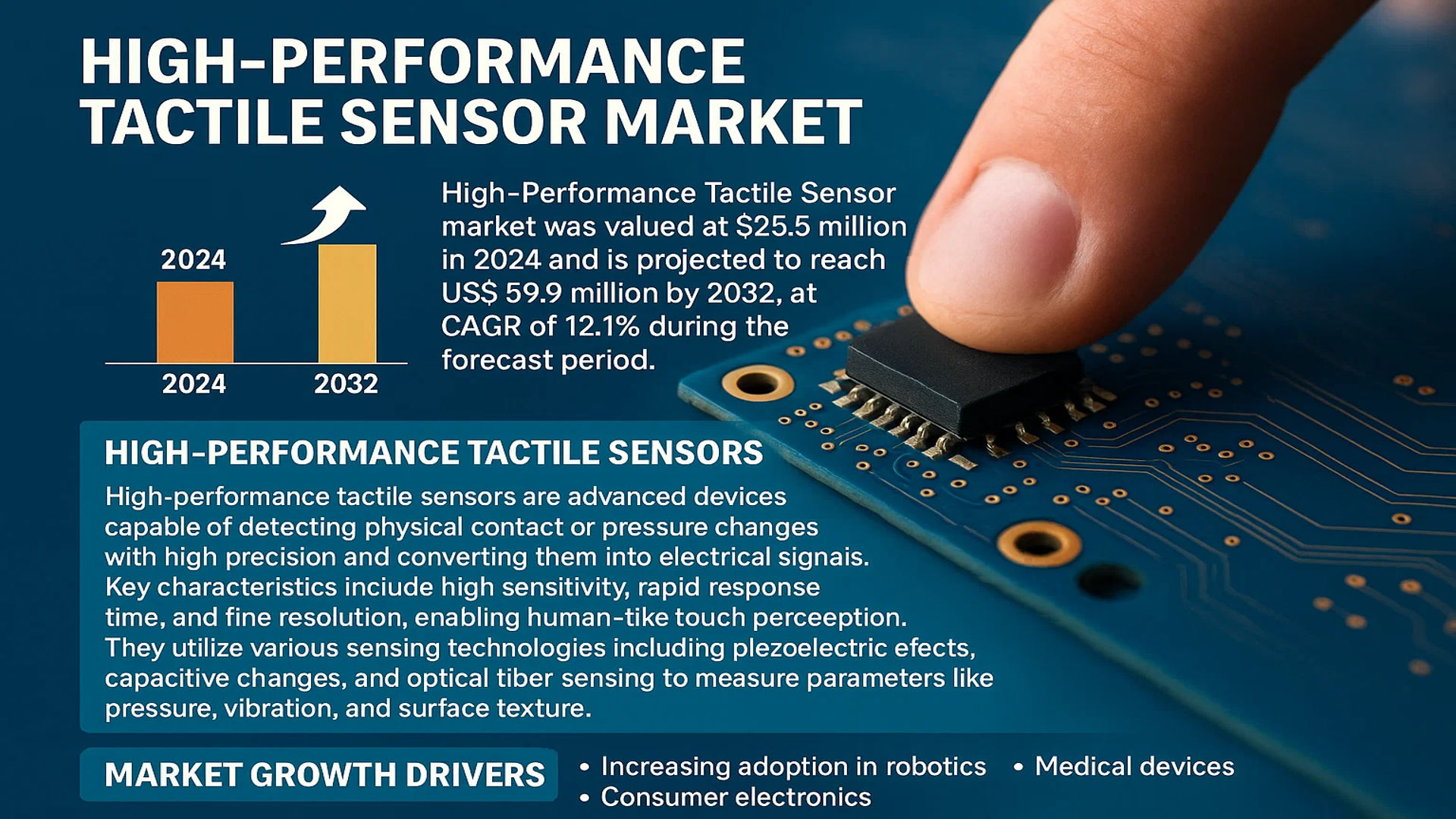
The global High-Performance Tactile Sensor market was valued at 25.5 million in 2024 and is projected to reach US$ 59.9 million by 2032, at a CAGR of 12.1% during the forecast period.
High-performance tactile sensors are advanced devices capable of detecting physical contact or pressure changes with high precision and converting them into electrical signals. These sensors exhibit key characteristics such as high sensitivity, rapid response times, and fine resolution, enabling them to replicate human-like touch perception. They utilize various sensing technologies including piezoelectric effects, capacitive changes, and optical fiber sensing to measure parameters like pressure, vibration, and surface texture.
The market growth is driven by increasing adoption in robotics, medical devices, and consumer electronics, where precise touch feedback is critical. The U.S. currently holds the largest market share, while China is emerging as the fastest-growing region. Leading players like Tekscan, Pressure Profile Systems, and SynTouch dominate the competitive landscape, collectively accounting for a significant revenue share through innovative product developments and strategic partnerships.
MARKET DYNAMICS
MARKET DRIVERS
Expansion of Robotics and Automation Industry Accelerates Demand for Tactile Sensors
The robotics industry is undergoing unprecedented growth, with industrial automation investments projected to grow at a compound annual growth rate of over 8% in coming years. High-performance tactile sensors play a critical role in enabling robots to interact safely and precisely with their environments, particularly in applications requiring delicate object handling or human-robot collaboration. These sensors provide critical feedback for force control, object recognition, and quality inspection tasks. As manufacturers increasingly adopt collaborative robots (cobots) for flexible production lines, the demand for advanced tactile sensing solutions continues to rise steadily. This trend is particularly strong in automotive manufacturing and electronics assembly sectors where precision handling is paramount.
Healthcare Sector Adoption of Tactile Sensing Technology Creates New Growth Avenues
The medical industry represents one of the fastest-growing application segments for high-performance tactile sensors. Surgical robotics, smart prosthetics, and rehabilitation devices increasingly incorporate advanced tactile feedback systems to enhance precision and patient outcomes. Robotic surgery systems alone are expected to account for a significant portion of the tactile sensor market value, driven by their ability to provide surgeons with precise force feedback during minimally invasive procedures. The prosthetics segment shows particularly strong potential, with next-generation artificial limbs incorporating tactile sensors to restore natural touch sensations for amputees. This application is gaining momentum as rehabilitation technologies become more sophisticated and patient expectations for functional restoration rise.
➤ For instance, recent advancements in neural interface technologies now allow prosthetic devices to transmit tactile feedback directly to users’ nervous systems, dramatically improving functional outcomes.
Furthermore, the integration of tactile sensors in wearable health monitoring devices presents additional growth opportunities. These applications range from pressure monitoring for wound care to gait analysis for mobility assessment, all requiring high-resolution tactile sensing capabilities.
MARKET RESTRAINTS
High Manufacturing Costs and Complex Integration Challenges Limit Market Penetration
Despite the strong market potential, high-performance tactile sensors face significant adoption barriers related to production economics and system integration. The specialized materials and precise manufacturing processes required for these sensors contribute to their relatively high unit costs compared to conventional sensing technologies. Thin-film fabrication techniques, microelectromechanical systems (MEMS) processing, and advanced packaging solutions all add to the cost structure. These economic factors make tactile sensor deployment challenging in price-sensitive applications, particularly in consumer electronics where cost per unit is a primary consideration.
Other Key Challenges
Durability and Reliability Concerns
Designing tactile sensors that maintain performance over extended operational lifetimes remains an engineering challenge. Repeated mechanical stresses, environmental exposure, and electrical wear can degrade sensor performance in demanding applications. This is particularly problematic for industrial robotics where sensors may undergo millions of operating cycles.
Standardization Gaps
The lack of standardized interfaces and performance metrics complicates system integration and cross-platform compatibility. End-user industries face challenges when attempting to incorporate tactile sensors from different manufacturers into complex automation solutions.
MARKET CHALLENGES
Sensor Calibration and Data Interpretation Complexity Creates Implementation Barriers
The advanced capabilities of high-performance tactile sensors introduce significant challenges in calibration and signal processing. Accurate force and pressure measurements require extensive calibration procedures to account for environmental factors and material properties. Many end-use applications struggle with translating raw sensor data into actionable information, particularly in dynamic environments where contact conditions change rapidly. This challenge is amplified in applications like robotic grasping, where sensors must distinguish between multiple simultaneous contact points with varying force vectors.
Additionally, the increasing resolution and channel counts of modern tactile sensors generate vast amounts of data that require sophisticated processing algorithms. The computational resources needed for real-time analysis of high-density tactile arrays can be prohibitive for embedded systems, forcing compromises between sensor performance and system responsiveness.
MARKET OPPORTUNITIES
Emerging Applications in AI and Haptic Interfaces Present Lucrative Growth Prospects
The convergence of tactile sensing with artificial intelligence and machine learning technologies opens new frontiers for market expansion. AI-driven tactile perception systems enable robots to learn complex manipulation tasks through physical interaction, dramatically improving their functional capabilities. This synergy is particularly valuable in unstructured environments where pre-programmed solutions are impractical. The market potential is significant, with AI-integrated robotic systems expected to account for a growing share of industrial automation investments.
Furthermore, advancements in haptic feedback systems create opportunities in virtual and augmented reality applications. Next-generation VR interfaces increasingly incorporate high-resolution tactile sensors to enable more immersive and intuitive user interactions. These developments are driving demand for lightweight, high-bandwidth tactile sensing solutions capable of delivering realistic touch sensations while maintaining user comfort.
The electric vehicle sector also presents promising opportunities, particularly for battery assembly and quality control applications where precise force monitoring is critical. As EV production scales globally, manufacturers are investing heavily in automation solutions that can handle delicate battery components safely and efficiently.
HIGH-PERFORMANCE TACTILE SENSOR MARKET TRENDS
Rising Demand for Robotics and Automation Fuels Tactile Sensor Adoption
The global high-performance tactile sensor market is experiencing robust growth, driven by the escalating adoption of robotics and automation across industries. Robots equipped with tactile sensors can accurately detect pressure, texture, and object proximity, enabling more precise handling in manufacturing, healthcare, and logistics. The market is projected to grow from $25.5 million in 2024 to $59.9 million by 2032, with a CAGR of 12.1%. This expansion is particularly noticeable in sectors where human-machine interaction requires enhanced sensitivity and responsiveness. Furthermore, advancements in soft robotics—where flexible tactile sensors mimic human skin—are accelerating innovation in this space.
Other Trends
Healthcare Applications Driving Market Expansion
The healthcare sector is increasingly leveraging high-performance tactile sensors for surgical robotics, prosthetics, and rehabilitation devices. In minimally invasive surgeries, for example, tactile sensors allow surgeons to “feel” tissue resistance, improving precision and reducing risks. The medical industry is expected to account for over 30% of the tactile sensor market by 2032, with smart prosthetics using these sensors to provide users with realistic tactile feedback. Additionally, wearable health monitors integrating tactile sensors for continuous pressure measurement are gaining traction in chronic disease management.
Technological Advancements in Sensor Materials
Innovations in sensor materials, including piezoelectric and capacitive technologies, are enhancing performance while reducing costs. Piezoelectric tactile sensors, expected to witness the highest growth, offer superior durability and sensitivity in dynamic pressure sensing applications. Meanwhile, capacitive sensors are gaining popularity in consumer electronics due to their high resolution and low power consumption. Leading manufacturers are investing in nanomaterials and hybrid sensor designs to improve flexibility and integration with IoT-enabled systems. For instance, graphene-based tactile sensors are emerging as a viable option for ultra-thin, high-sensitivity applications in foldable devices and robotic skins.
COMPETITIVE LANDSCAPE
Key Industry Players
Market Leaders Innovate to Capture Higher Share as Demand for Tactile Sensing Expands
The global high-performance tactile sensor market exhibits a moderately consolidated structure, with established players and emerging innovators competing across applications. Tekscan has emerged as a dominant force, commanding significant market share through its patented pressure mapping systems that serve medical robotics, automotive testing, and industrial automation sectors. Their leadership stems from decades of R&D investment and strategic acquisitions, including the purchase of Pressure Profile Systems in 2021 to expand their wearable sensor capabilities.
Sensor Products Inc. and Weiss Robotics have strengthened positions through specialized offerings – the former excels in industrial-grade tactile arrays for manufacturing quality control, while the latter focuses on human-robot interaction solutions. Both companies recorded double-digit revenue growth between 2020-2023 as Industry 4.0 adoption accelerated.
The competitive intensity is increasing as companies diversify beyond traditional strongholds. SynTouch, originally focused on biomimetic sensors for prosthetics, has successfully entered food texture analysis markets. Similarly, Tacterion GmbH expanded from automotive seating sensors to consumer electronics applications, partnering with major Asian smartphone manufacturers.
Market differentiation increasingly depends on material science breakthroughs. Players like Yuansheng Intelligence are gaining traction with flexible hybrid sensor designs that combine piezoelectric and capacitive elements, addressing the demand for thinner, more responsive sensing layers in wearable devices.
List of Key High-Performance Tactile Sensor Companies Profiled
- Tekscan, Inc. (U.S.)
- Pressure Profile Systems (U.S.)
- Sensor Products Inc. (U.S.)
- Weiss Robotics (Germany)
- SynTouch, Inc. (U.S.)
- Tacterion GmbH (Germany)
- Yuansheng Intelligence Co., Ltd. (China)
Segment Analysis:
By Type
Piezoelectric Tactile Sensor Segment Leads Due to High Accuracy and Durability in Pressure-Sensitive Applications
The market is segmented based on type into:
- Piezoelectric Tactile Sensor
- Subtypes: PVDF-based, ceramic-based, and others
- Capacitive Tactile Sensor
- Resistive Tactile Sensor
- Others
By Application
Medical Industry Segment Dominates Due to Rising Adoption in Surgical Robots and Prosthetics
The market is segmented based on application into:
- Medical Industry
- Subtypes: Surgical robotics, prosthetics, patient monitoring
- Consumer Electronics
- Food Industry
- Others
By End-User
Healthcare Sector Maintains Strong Position Due to Increased Demand for Advanced Medical Devices
The market is segmented based on end-user into:
- Healthcare
- Automotive
- Industrial Automation
- Consumer Electronics
Regional Analysis: High-Performance Tactile Sensor Market
North America
North America holds a dominant position in the global high-performance tactile sensor market, driven by robust R&D investments in robotics and medical technology. The U.S. accounts for over 60% of the regional market share, with growing applications in minimally invasive surgical devices and advanced prosthetics. Major players like Tekscan and Pressure Profile Systems are headquartered here, providing cutting-edge tactile sensing solutions. Stringent FDA regulations for medical devices and strong venture capital funding for robotics startups further accelerate innovation. However, high manufacturing costs and complex integration processes remain key challenges for widespread adoption.
Europe
Europe’s market thrives on precision engineering and Industry 4.0 adoption, with Germany and the UK leading in industrial robotics applications. The region benefits from collaborative initiatives like EU Horizon Europe, which funds haptic technology research. Piezoelectric sensors dominate demand due to their durability in automotive testing and manufacturing automation. Regulatory frameworks emphasizing workplace safety increasingly mandate tactile feedback systems in heavy machinery. While growth is steady, market expansion faces headwinds from prolonged certification processes and competition from Asian manufacturers offering cost-effective alternatives.
Asia-Pacific
China, Japan, and South Korea collectively contribute ~45% of global tactile sensor revenue, fueled by massive electronics production and government-backed robotics programs. The region’s consumer electronics sector, particularly smartphone and wearables manufacturing, extensively utilizes capacitive tactile sensors. China’s “Made in China 2025” policy actively promotes domestic sensor production, reducing reliance on imports. Despite volume growth, profit margins are thinner compared to Western markets due to intense price competition. Emerging applications in agricultural robotics and electric vehicle interfaces present untapped opportunities.
South America
The market here is in a nascent stage, with Brazil spearheading adoption in medical diagnostics and food packaging automation. Limited local manufacturing means 80% of sensors are imported, primarily from North America and Europe. Economic instability and currency fluctuations discourage large-scale investments in advanced sensing technologies. Nonetheless, increasing foreign direct investments in Argentina’s and Chile’s mining sectors are driving demand for ruggedized tactile systems in harsh environments. Growth potential exists but requires stronger supply chain development.
Middle East & Africa
This region shows pockets of high-value adoption in oil & gas and defense sectors, particularly in the UAE and Saudi Arabia. Military modernization programs incorporate tactile sensors for unmanned systems and bomb disposal robots. South Africa leads in medical applications, with several hospitals adopting sensorized surgical tools. Market expansion faces infrastructure limitations and a lack of technical expertise, though sovereign wealth fund investments in smart cities are expected to create long-term demand.
Report Scope
This market research report provides a comprehensive analysis of the Global High-Performance Tactile Sensor Market, covering the forecast period 2024–2032. It offers detailed insights into market dynamics, technological advancements, competitive landscape, and key trends shaping the industry.
Key focus areas of the report include:
- Market Size & Forecast: Historical data and future projections for revenue, unit shipments, and market value across major regions and segments. The global market was valued at USD 25.5 million in 2024 and is projected to reach USD 59.9 million by 2032, growing at a CAGR of 12.1%.
- Segmentation Analysis: Detailed breakdown by product type (Piezoelectric, Capacitive, Resistive, Others), application (Medical, Consumer Electronics, Food Industry, Others), and end-user industry to identify high-growth segments.
- Regional Outlook: Insights into market performance across North America, Europe, Asia-Pacific, Latin America, and Middle East & Africa. The U.S. and China are key markets, with Asia-Pacific exhibiting rapid growth.
- Competitive Landscape: Profiles of leading market participants including Tekscan, Pressure Profile Systems, Sensor Products, Weiss Robotics, SynTouch, Tacterion GmbH, and Yuansheng Intelligence, covering their product portfolios and strategic initiatives.
- Technology Trends & Innovation: Assessment of emerging sensor technologies, integration with robotics and AI, and advancements in material science driving market evolution.
- Market Drivers & Restraints: Evaluation of factors such as increasing automation, demand for haptic feedback in consumer electronics, and challenges related to high development costs.
- Stakeholder Analysis: Strategic insights for sensor manufacturers, OEMs, technology providers, and investors regarding market opportunities and competitive positioning.
The report employs rigorous primary and secondary research methodologies, including expert interviews and analysis of verified market data, to ensure accuracy and reliability.
FREQUENTLY ASKED QUESTIONS:
What is the current market size of Global High-Performance Tactile Sensor Market?
-> High-Performance Tactile Sensor market was valued at 25.5 million in 2024 and is projected to reach US$ 59.9 million by 2032, at a CAGR of 12.1% during the forecast period.
Which key companies operate in this market?
-> Key players include Tekscan, Pressure Profile Systems, Sensor Products, Weiss Robotics, SynTouch, Tacterion GmbH, and Yuansheng Intelligence.
What are the key growth drivers?
-> Growth is driven by rising automation, increasing demand for robotics, medical device innovations, and consumer electronics applications.
Which region dominates the market?
-> North America currently leads in market share, while Asia-Pacific is expected to exhibit the fastest growth through 2032.
What are the emerging trends?
-> Emerging trends include AI-integrated tactile sensing, flexible and stretchable sensors, and advanced haptic feedback systems.

Get Sample Report PDF for Exclusive Insights
Report Sample Includes
- Table of Contents
- List of Tables & Figures
- Charts, Research Methodology, and more...